
What No Way Jack Stand: Practical Safety and Setup Guide for 2026
Understand what no way jack stand safety risks and compare reliable mechanical support equipment for garage repairs in November 2026.
 By Christian Hazel
Updated October 10, 2026


Working under a raised vehicle demands absolute confidence in your mechanical support equipment. When vehicle owners search for what no way jack stand, they usually encounter alarming garage situations where compromised equipment, poor placement, or improvised supports led to near-misses and vehicle drops. A hydraulic floor jack alone can suffer internal seal leakage or pressure drop without warning, making dedicated mechanical jack stands an uncompromising requirement. Learning why jack stands are mandatory helps clarify why relying solely on fluid pressure is an unacceptable gamble for any underbody repair.
Understanding how stationary vehicle supports handle heavy chassis loads requires looking closely at ANSI/ASME PASE standards, pawl tooth engagement, and structural base design. Many catastrophic failures trace back to misinterpreting rated capacity per pair, failing to verify primary ratchet locking pawls, or placing narrow legs on soft asphalt surfaces. Modern designs from brands like Powerbuilt, Amazon Basics, and Jack Boss emphasize forged ductile iron bars, welded pyramid frames, and secondary safety pins to prevent accidental disengagement. Reviewing the mechanical features of these support stands ensures you select reliable hardware that keeps your chassis rock-solid throughout every maintenance session.
| Award | Product | BJL Score About BJL ScoreThe BJL Score is our own rating from 0 to 10, based on performance, design and build, ease of use, and value. It reflects independent research and is never influenced by manufacturers, retailers, or affiliate commissions. Learn more › | |
|---|---|---|---|
| Best Overall |
YELLOW JACKET 3 Ton Double-Locking Steel Jack
|
9.2/10 | Buy |
| Best Budget |
 Pencil Noise 3 Ton Double-Locking Jack Stands |
8.9/10 | Buy |
| Best Value |
 Amazon Basics 3-Ton Steel Jack Stands |
8.9/10 | Buy |
| Best Premium |
 Powerbuilt 3-Ton Unijack All-in-One Hydraulic |
8.9/10 | Buy |
 VEVOR 3-Ton Double-Locking Jack Stands (Pair) |
8.8/10 | Buy | |
 JMBHWD 3 Ton Double-Locking Jack Stands |
8.6/10 | Buy | |
 Jack Boss 2-Ton Low-Profile Ratchet Jack Stands |
8.6/10 | Buy | |
 VEVOR 6-Ton Double-Locking Jack Stands Pair |
8.6/10 | Buy | |
 ANTPOWER 3-Ton Double-Locking Jack Stands |
8.4/10 | Buy | |
 PRUTHY 3-Ton Double-Locking Jack Stands |
8.3/10 | Buy |
YELLOW JACKET 3 Ton Double-Locking Steel Jack
The YELLOW JACKET 3-ton jack stand pair provides a 6,600-pound combined capacity with ductile iron ratchet columns and secondary metal locking pins for redundant garage safety. Featuring a welded stamped steel pyramid base and a 10-7/8-inch to 16-9/16-inch height range, they offer reliable static support for compact cars, crossovers, and midsize SUVs during routine maintenance.
Pros
- Double-locking system pairs a ductile iron ratchet bar with an independent metal safety pin for added physical redundancy
- Solid one-piece forged ductile iron center column provides reliable static tooth engagement across multiple height settings
- Welded stamped steel pyramid base features wide foot pads to support vehicle stability on flat concrete shop floors
- Practical height span of 10-7/8 inches to 16-9/16 inches covers common passenger vehicle maintenance tasks like brake jobs and oil changes
Cons
- The 10-7/8-inch collapsed height may sit too high for significantly lowered sports cars or vehicles with low front splitters
- Bare metal saddle lacks rubber cushioning pads, which may mar painted subframes or bend unprotected pinch welds without aftermarket adapters
- Maximum height reach of 16-9/16 inches is limited for lifted 4x4 trucks or high-clearance off-road vehicles requiring extended droop clearance
Pencil Noise 3 Ton Double-Locking Jack Stands
The Pencil Noise 3 Ton Jack Stands provide static vehicle support with a 6,000 lb total capacity per pair, combining a forged iron ratchet bar with a secondary safety pin. Featuring an 11.4-inch to 16.9-inch height range and a pyramid base, they are a practical choice for DIY maintenance on compact cars, crossovers, and UTVs.
Pros
- Dual-action locking mechanism features both a primary ratchet pawl and a secondary locking pin for redundant mechanical security.
- Sturdy forged iron ratchet bar offers quick height adjustments across multiple indexed locking positions.
- Wide pyramid base geometry delivers solid static stability on smooth, level concrete garage slabs.
- Practical 11.4-inch to 16.9-inch working range fits common DIY garage jobs like brake service, tire rotations, and oil changes.
Cons
- Not recommended or sized for full-size pickup trucks, commercial vans, or heavy off-road SUVs.
- Minimum collapsed height of 11.4 inches may require extra lifting clearance on lowered sports cars before stands can slide underneath.
- Bare metal saddle lacks pre-installed rubber padding, which may risk marring unprotected unibody pinch welds.
Amazon Basics 3-Ton Steel Jack Stands
The Amazon Basics 3-Ton Steel Jack Stand Pair delivers 6,000 pounds of reliable vehicle support certified to ASME PASE-2014 standards for portable automotive equipment. Featuring a self-locking ratchet bar and a compact steel footprint, this set is ideal for home garage DIYers servicing passenger cars and urban SUVs.
Pros
- Rated for 3 tons (6,000 lbs) per pair and meets ASME PASE-2014 portable automotive service standards
- Self-locking ratchet bar enables rapid, secure height adjustment without fiddling with separate pins
- Compact 7.5 x 7.0-inch footprint and 12.6-lb total weight make positioning and storage simple
- Protective rustproof coating over a durable steel frame helps resist corrosion from garage fluids
Cons
- 3-ton capacity is tailored for sedans and crossover SUVs, not full-size heavy-duty pickup trucks
- Ratchet assembly does not feature a secondary mechanical cross-locking pin for redundant backup
- Must be used exclusively on flat, solid concrete slabs to prevent uneven weight distribution or base sinking
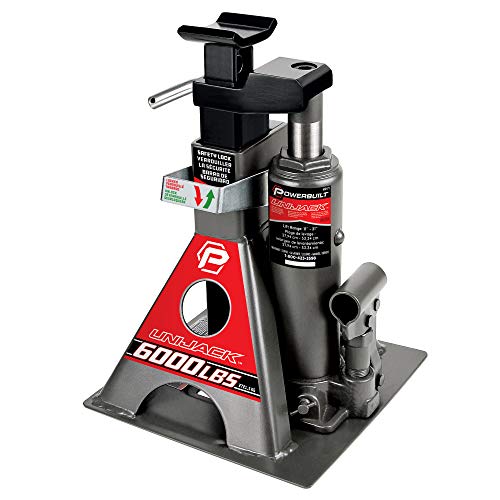
Powerbuilt 3-Ton Unijack All-in-One Hydraulic
The Powerbuilt 620471 Unijack integrates a hydraulic bottle jack and a mechanical ratcheting jack stand into a single unit, eliminating the danger of hydraulic pressure bleed-off. With a 6,000-pound capacity, an 11 to 21-inch lift range, and a wide steel base, it provides dependable single-point lifting and static holding for trucks and SUVs.
Pros
- Combines hydraulic bottle jack lifting and mechanical jack stand safety into one single-point tool
- Physical ratcheting safety lock prevents accidental vehicle drops caused by hydraulic pressure bleed-off
- Wide 9.88 x 9.75-inch base provides excellent stability on garage concrete and level paved surfaces
- Tall 21-inch maximum extension delivers ample working clearance for high-clearance trucks and SUVs
- Meets ANSI standards for portable automotive service equipment and includes a 1-year factory warranty
Cons
- Minimum collapsed height of 11 inches makes it unusable on low-clearance sedans and sports cars
- At 22.66 pounds per single unit, it is significantly heavier than standard individual mechanical jack stands
- Sold as an individual unit rather than a pair, requiring separate purchases if supporting an entire axle
VEVOR 3-Ton Double-Locking Jack Stands (Pair)
VEVOR 3-ton double-locking jack stands provide 6,000 pounds of static support per pair, combining a cast iron ratchet column with a secondary metal safety pin for added security. With a 10.8- to 16.3-inch height range and welded triangular base feet, they are well-suited for DIY oil changes, brake service, and garage maintenance.
Pros
- Double-locking mechanism pairs a positive ratchet pawl with a heavy metal safety pin for redundant mechanical security
- Welded triangular foot pads provide broader ground contact than bare stamped leg edges on garage floors
- 9 height adjustment stops allow rapid positioning between 10.8 and 16.3 inches
- Compact pyramid footprint and 11-pound total weight allow easy transport and organized garage storage
- Notched saddle profile cradles unibody seams and frame rails securely during maintenance
Cons
- A 10.8-inch minimum collapsed height may not clear aggressively lowered track cars without pre-lifting
- Notched bare metal saddle lacks rubber protective pads and may mar chassis paint or pinch welds without aftermarket adapters
- A 16.3-inch maximum extension limits utility for tall lifted 4x4 trucks or large commercial vehicles
JMBHWD 3 Ton Double-Locking Jack Stands
The JMBHWD 3-Ton Jack Stand pair provides a 6,000-pound total capacity per pair (3,000 pounds per individual stand) with a dual-action safety system pairing a serrated cast iron ratchet bar with a secondary locking pin. Featuring a 7.64-inch by 8.03-inch steel pyramid base and an 11.4-inch to 16.9-inch height envelope, this set is an accessible option for DIY mechanics maintaining sedans, crossovers, and compact passenger vehicles.
Pros
- Secondary locking pin provides redundant mechanical backup to prevent accidental release handle movement
- Stable 7.64-inch by 8.03-inch pyramid base stance helps prevent tipping when positioned on flat, solid concrete
- Cast iron serrated ratchet bar allows quick, stepped height adjustments between 11.4 and 16.9 inches
- Concave saddle profile securely cradles vehicle frame contact points and structural rails
Cons
- Manufacturer specifications clarify this model is not recommended for full-size pickup trucks, commercial vans, or large off-road SUVs
- Minimum collapsed height of 11.4 inches may prove too tall for low-slung sports cars or lowered vehicles without extended floor jack lift height
- Bare metal saddle lacks protective rubber pads, requiring careful placement or aftermarket adapters to avoid marring unibody pinch welds
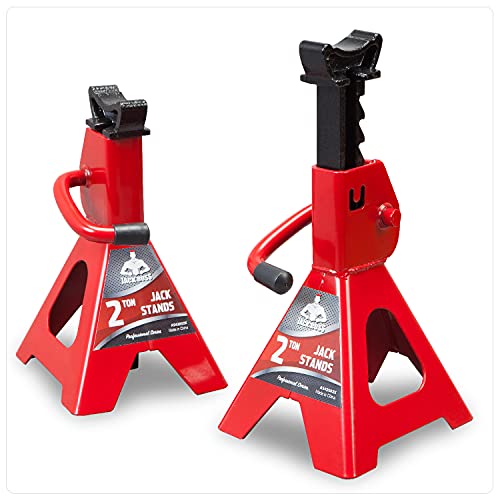
Jack Boss 2-Ton Low-Profile Ratchet Jack Stands
Designed for compact cars and small unibody vehicles, these Jack Boss low-profile jack stands combine a welded mild steel pyramid base with a ductile iron sawtooth ratchet bar spanning a 9.8-inch to 15-inch height range. They provide a lightweight, compact footprint for DIY garage maintenance, though the manufacturer explicitly advises against using them on trucks, large SUVs, or vehicles requiring over 15 inches of chassis clearance.
Pros
- Low 9.8-inch collapsed height fits easily under small passenger cars and lower unibody lift points
- Ductile iron sawtooth ratchet bar allows fast, tool-free height selection and positive pawl engagement
- Lightweight 10.5-pound overall build makes carrying, positioning, and garage storage simple
- Fully welded mild steel frame with protective powder coating guards against rust and shop grime
Cons
- Maximum 15-inch reach is too short for pickup trucks, full-size SUVs, or lifted off-road vehicles
- Single-pawl ratchet design lacks a secondary captive locking pin or redundant safety stop
- Steel concave saddle does not include rubber protection, which may mar painted unibody pinch welds without an aftermarket pad
VEVOR 6-Ton Double-Locking Jack Stands Pair
These VEVOR 6-ton (13,000-lb) double-locking jack stands pair a cast iron ratchet bar with carbon steel pyramid bases and secondary metal safety pins. Built for DIY mechanics, they provide dependable static support with notched saddles and triangular foot pads for trucks, SUVs, and passenger cars.
Pros
- Double-locking safety system incorporates a primary ratchet pawl and a physical metal safety pin
- Generous 6-ton (13,000 lbs) combined load rating provides adequate safety margins for passenger cars, SUVs, and half-ton pickups
- Welded triangular foot pads increase floor contact surface area and improve overall pyramid base stability
- Cast iron ratchet bar with protective rust-proof coating resists workshop corrosion
Cons
- Bare metal notched saddle can crush or bend bare unibody pinch welds without an aftermarket rubber adapter
- Stepped ratchet teeth offer incremental height settings rather than infinite micro-adjustability
- Requires auxiliary structural steel spreader plates if used on warm asphalt driveways to prevent indentation
ANTPOWER 3-Ton Double-Locking Jack Stands
The ANTPOWER 3-ton double-locking jack stands provide reliable static support for garage maintenance, pairing a ductile iron sawtooth ratchet column with a secondary steel side-locking pin. With an 11.2 to 16.8-inch height range and a fully welded pyramid steel base, they offer solid safety for compact cars, sedans, and light crossovers.
Pros
- Secondary side-pin lock adds physical redundancy alongside the primary ratchet pawl
- High-strength ductile iron ratchet bar provides positive sawtooth height adjustments
- Fully welded mild steel pyramid base delivers stable static support on level concrete slabs
- Protective powder-coated finish helps resist common garage moisture and chemical rust
- Manageable 14.3-pound total weight makes repositioning easy during four-corner vehicle setups
Cons
- Maximum 16.8-inch reach is insufficient for lifted 4x4s, full-size trucks, or vehicles with frame heights over 16 inches
- Bare steel saddle lacks a rubber pad, which may mar painted unibody pinch welds without an aftermarket adapter
- Conflicting product listing text notes both 6,000 lbs per pair and 6,600 lbs per stand, requiring conservative 3-ton pair load planning
PRUTHY 3-Ton Double-Locking Jack Stands
The PRUTHY 3-Ton Jack Stand Pair provides static vehicle support rated up to 6,600 pounds across the pair, combining a ductile iron ratchet bar with an added metal safety pin for dual-locking peace of mind. Featuring an 11.4-inch to 16.9-inch height range and a wide stamped-steel pyramid base, they offer reliable stability for routine garage maintenance on sedans, crossovers, and small SUVs.
Pros
- Secondary metal safety pin adds a positive mechanical backup to the primary ratchet pawl mechanism
- Welded stamped-steel pyramid base provides solid footing and even weight distribution on level concrete floors
- Clear 11.4-inch to 16.9-inch elevation range works well for passenger cars, crossovers, and compact utility trailers
- Forged one-piece ductile iron ratchet column resists fracturing under static load
Cons
- Minimum collapsed height of 11.4 inches may be too tall for lowered sports cars without pre-lifting
- Maximum extension of 16.9 inches will not provide adequate clearance for lifted 4x4 trucks on oversized tires
- Metal saddle lacks included rubber protective pads to shield delicate pinch welds from cosmetic scratches
Mechanical Integrity and Vehicle Support: What Makes a Jack Stand Truly Safe
The sudden gasp of disbelief that sparks a search for what no way jack stand usually happens when someone spots a vehicle precariously balanced on stacked timber, unstable cinder blocks, or a lone hydraulic floor jack. Mechanical security under a raised automobile is not a matter of luck or casual improvisation. When you position your body beneath thousands of pounds of suspended metal, stationary steel stands represent the primary physical barrier separating a routine repair from a fatal crushing accident. Understanding what makes a support stand dependable requires looking closely at structural load paths, metal casting integrity, and positive mechanical locking.
A dependable vehicle support system operates through predictable physical principles rather than temporary fluid pressure. Hydraulic floor jacks excel at lifting mass upward, but their internal bypass valves and rubber seals degrade over time, leading to gradual fluid bypass and unexpected height loss. Mechanical jack stands eliminate that hydraulic failure risk by transferring chassis weight directly through ductile iron columns and welded steel base plates into solid ground. Analyzing the engineering differences between precarious lifting setups and certified mechanical stands clarifies why proper equipment is essential for every home mechanic.
Deciphering Support Hazards: Why Precarious Setups Fail
Dangerous garage setups often trigger an immediate visceral reaction because experienced observers instinctively spot severe stability flaws. Structural collapses rarely happen without an identifiable mechanical root cause, such as severe overloading, lateral base tilt, or degraded locking pawls. When an amateur mechanic uses makeshift wooden blocks or hollow masonry cinder blocks to gain extra working height, concentrated contact pressure rapidly splits the wood along its natural grain or shatters brittle concrete. A vehicle resting on improvised risers can shift sideways with minimal physical force, causing an instant, catastrophic fall.
Mechanical failure can also occur when using low-quality or damaged steel stands that lack proper manufacturing oversight. In previous industry safety investigations, certain ratchet-style stands suffered unexpected disengagement because shallow pawl teeth slipped under normal vehicle movement. When a technician applies substantial torque to break loose a stubborn suspension bolt or rusted axle nut, lateral chassis vibrations can cause poorly cast ratchet teeth to jump out of alignment. Equipment built without strict quality controls or precise tooth profiles justifies every ounce of user skepticism.
Ground conditions play an equally decisive role in sudden vehicle support collapse. Placing narrow, stamped-steel pyramid legs directly onto soft dirt, loose gravel, or sun-softened asphalt concentrates immense point pressure onto an unstable substrate. As the vehicle sits, one leg can punch through the asphalt crust, instantly pitching the center of gravity and causing the remaining stands to lever out of position. True workshop safety demands stable equipment operating on level, reinforced concrete slabs that can withstand concentrated downward pressure without yielding.
Understanding Load Ratings: ASME PASE Standards and Capacity Per Pair
Confusion surrounding load capacity ratings remains one of the most widespread hazards in home garages. Under standard ANSI/ASME PASE guidelines for portable automotive service equipment, vehicle jack stands are officially rated and sold by their total capacity per pair rather than as individual units. A pair of stands marked with a 3-ton rating is engineered to support a combined total of 6,000 pounds across both stands, meaning each individual stand carries a nominal working load limit of 3,000 pounds. Misinterpreting this rating can lead a vehicle owner to mistakenly overload a single corner with excessive mass.
Reputable manufacturers design their equipment around these explicit engineering standards to prevent catastrophic structural overload. Units like the Amazon Basics Steel Jack Auto Stands explicitly reference the ASME PASE-2014 standard, assuring users that the welded steel frame and self-locking ratchet have met rigorous structural load criteria. Similarly, stands from brands like ANTPOWER emphasize ASME certified load saddles and ductile iron sawtooth ratchets rated for 6,600 pounds per pair. Always cross-referencing your vehicle curb weight and front-to-rear axle weight splits against these pair ratings ensures you never push support hardware past its safe mechanical capacity.
Axle weight distribution is particularly critical when lifting pickup trucks, front-heavy SUVs, or work vans. Modern diesel trucks and full-size work vans often carry over 60 percent of their total gross vehicle weight directly over the front steering axle. If a vehicle weighs 6,500 pounds in total, the front axle alone could exert near 4,000 pounds of downward force onto the front pair of stands. Choosing support units rated at 6 tons, such as the heavy-duty VEVOR 6-ton stands, provides a comfortable safety envelope that prevents hardware fatigue during complex engine or suspension overhauls.
Locking Mechanisms Compared: Ratchet Bars, Through-Pins, and Redundant Locks
The locking mechanism represents the primary physical barrier preventing a raised jack stand from collapsing under load. Ratchet-bar designs utilize a central ductile iron post with a series of angled sawtooth teeth that engage a pivoting counterweighted pawl inside the base collar. As you lift the center column, the internal pawl clicks over each tooth and drops securely into the valley, holding the load through mechanical interference. While ratchet stands offer rapid one-handed height adjustments, their security depends entirely on full pawl tooth engagement and crisp casting edges.
To eliminate lingering fears of pawl slippage or accidental handle bumping, many modern manufacturers now incorporate secondary physical locks. Exploring secondary locking mechanisms on jack stands highlights how redundant hardware stops unexpected mechanical failure before it starts. Models like the YELLOW JACKET 3 Ton, VEVOR 3 Ton, Pencil Noise, and PRUTHY jack stands utilize a dual-locking architecture featuring both a primary ratcheting handle and an independent steel safety pin. Inserting this solid cross-pin through the post collar physically blocks the ratchet bar from dropping, even if someone accidentally bumps the release lever.
Traditional pin-type stands take a different engineering approach by replacing the ratcheting sawtooth mechanism entirely with a solid steel through-pin. In these designs, a heavy steel post slides inside a tubular base, and a heat-treated steel cross-pin passes completely through matching holes on both components. Although adjusting pin-style stands requires slightly more time and manual alignment, they provide absolute mechanical peace of mind because shear strength governs the assembly. Mechanics working under high-torque conditions often favor through-pins or double-locking pawls because neither configuration relies solely on a single moving casting.
Novel hybrid systems also exist to bridge the gap between lifting capability and stationary support. The Powerbuilt 3 Ton Unijack combines a hydraulic bottle jack and a ratcheting mechanical stand into a single integrated unit. By incorporating a mechanical locking safety bar directly onto the lifting column, this design lifts the vehicle hydraulically and then locks mechanically in place between 11 and 21 inches of height. This hybrid setup eliminates the traditional challenge of finding separate hydraulic jacking and stationary stand points on cramped chassis sections.
Chassis Contact Points: Pinch Welds, Boxed Frames, and Saddle Compatibility
Positioning a jack stand saddle against an improper underbody surface can crush sheet metal, puncture fuel lines, or trigger sudden lateral slippage. Modern passenger sedans and compact crossovers utilize unibody construction, where the outer perimeter lacks a heavy steel frame and instead relies on reinforced rocker pinch welds. Lowering a bare, curved cast-iron saddle directly onto a thin factory pinch weld can easily bend or flatten the metal seam. Learning proper jack stand placement locations prevents expensive structural damage and ensures the vehicle rests squarely on factory-designated reinforced lift pads.
Saddle geometry must match the chassis interface you intend to support. Stands from Jack Boss, ANTPOWER, and JMBHWD feature wide, concave saddles designed to cradle rounded suspension links, solid axle tubes, or perimeter frame rails securely. A concave saddle prevents cylindrical axle tubes from rolling or sliding sideways when you apply heavy torque to suspension nuts. Conversely, flat chassis rails require broad, stable support surfaces that spread downward force evenly across the heavy-gauge metal without concentrating load along a sharp edge.
For unibody vehicles with delicate pinch welds, mechanics should use slotted vulcanized rubber saddle pads or purpose-built pinch-weld adapters. These adapters cradle the vertical seam while allowing the horizontal rocker reinforcement to bear the true vehicle weight, protecting factory rust-preventative coatings from gouging. Under no circumstances should anyone place scrap 2×4 lumber, plywood cutouts, or loose bricks between a bare steel saddle and the vehicle chassis. Unrated wooden spacers can split along grain lines without warning under heavy point loads, instantly destabilizing the raised vehicle.
Body-on-frame trucks and large sport utility vehicles offer much simpler placement options along continuous boxed frame rails. When positioning stands beneath heavy truck frames, place the saddles beneath flat, straight sections of the rail as close to the working area as safety permits. Avoid placing stands on curved transitions, angled suspension brackets, or thin steering crossmembers that could slide or deform under load. Ensuring complete, flush contact between the frame flange and the stand saddle guarantees that the vehicle remains immobile while elevated.
Lift Envelopes and Base Stability: Collapsed Height Versus Extended Reach
Matching a jack stand’s dimensional range to your vehicle clearance is just as important as matching its tonnage rating. Low-profile passenger cars and sports coupes require a compact collapsed height so the stand can slide underneath the chassis after modest hydraulic lifting. The Jack Boss Low Profile 2 Ton stands feature a minimum height of 9.8 inches, making them well suited for low-slung passenger vehicles. Attempting to force a tall truck stand under a lowered sedan usually ends in frustration, as the floor jack might lack the hydraulic travel needed to clear the stand’s minimum collar height.
Lifted trucks, full-size SUVs, and commercial vans present the exact opposite challenge, requiring substantial maximum extension to reach frame rails once the suspension drops. When you raise a solid-axle 4×4 by its frame, the suspension droop can extend several inches before the tires leave the ground, requiring stands with extended reach. Units like the Powerbuilt 3 Ton Unijack provide a massive lift range spanning from 11 inches up to 21 inches, while heavy-duty options like VEVOR 6-ton stands provide the necessary column height and broad stance to manage taller chassis envelopes safely.
Base footprint dimensions dictate how effectively a jack stand resists lateral tipping when subjected to heavy side loads. Stands with narrow leg spreads are inherently more prone to tipping if a vehicle shifts during intense mechanical work. Stamped steel stands with wide pyramid bases, such as the JMBHWD 3 Ton model with its 7.64-inch by 8.03-inch base, distribute downward force across a wider surface area. Furthermore, welded perimeter foot pads at each corner prevent the legs from digging into asphalt or catching on minor concrete irregularities, creating a rock-solid foundation.
Step-by-Step Garage Setup: Safe Placement, Load Transfer, and the Shake Test
Establishing a completely safe working environment begins before the hydraulic floor jack ever touches the vehicle chassis. Always park the vehicle on a level, solid concrete slab, shift the transmission into park or reverse, and fully engage the mechanical parking brake. Place heavy-duty wheel chocks snugly against both the front and back of the tires remaining firmly on the ground. Chocking both directions on the grounded axle eliminates rolling motion while the opposite axle is lifted into the air.
Raise the vehicle using a reliable hydraulic floor jack placed squarely beneath an approved factory jacking point. Once you have reached the required service height, slide your mechanical jack stands into position directly under the designated chassis support locations. Adjust the stand height by lifting the ratchet bar or aligning the pin collar, making sure both stands on the axle are set to the identical height increment. Double-check that the saddle is perfectly centered beneath the frame rail or reinforced pinch-weld notch before initiating load transfer.
Lower the hydraulic floor jack with extreme care, opening the release valve slowly to transfer vehicle mass gradually onto the stationary stands. Once the vehicle contacts the saddles, confirm that the ratchet pawls are fully seated in their tooth valleys or that through-pins are completely engaged with their safety cotters. Insert secondary safety pins if your stands feature a dual-locking mechanism. Lower the hydraulic jack completely until the full vehicle weight rests on the stands, but leave the unloaded jack tucked just beneath a central chassis crossmember as an extra redundant fail-safe.
Before crawling underneath the chassis with tools, perform a mandatory physical stability check known across garages as the shake test. Stand beside the vehicle and push vigorously against the fender, quarter panel, or bumper with substantial lateral body force. If the vehicle rocks, wobbles, or exhibits any movement on the stand saddles, stop immediately and raise the car back up to re-align the stands. The vehicle should feel as solid and immobile as if it were resting directly on the ground before you ever position your body beneath it.
Routine Maintenance, Casting Inspection, and Equipment Retirement Criteria
Jack stands are enduring pieces of garage equipment, but they are not indestructible and require regular structural inspection. Before every lifting session, wipe away accumulated road grime, grease, and dust from the center post and collar ratchet track. Visually inspect the sawtooth teeth along ductile iron ratchet bars to ensure each tooth maintains a sharp, crisp profile without rounded edges or chipped corners. If a ratchet tooth displays rounding, deformation, or casting cracks, the stand has reached the end of its safe operational life and must be retired immediately.
Check the welded steel pyramid base for signs of metal fatigue, stress fractures, or bent legs. Inspect the weld seams along the collar and corner gussets to confirm there is no weld cracking or separation under structural load. Ensure the center column slides smoothly within the outer housing without excessive lateral play or binding. For double-locking models, verify that the secondary safety pin slides freely through the collar holes and that retention chains or lanyards remain undamaged so components cannot be lost.
Never attempt to repair, straighten, or re-weld a bent or damaged jack stand in a home workshop. Structural steel and ductile iron castings undergo precise factory thermal treatments and quality checks that cannot be duplicated with hobbyist garage welders. If a stand has suffered an overload event, dropped load shock, or severe base distortion, cut the center post in half with an angle grinder and scrap the metal to ensure nobody accidentally uses it again. Investing in dependable, certified support hardware is the ultimate guarantee of long-term garage safety.
About the author
Christian Hazel is an automotive journalist with extensive experience covering four-wheel-drive vehicles, mechanical upgrades, and off-road equipment. His background includes technical reviews, installation features, and project-vehicle coverage, bringing useful context to equipment choices for trucks, Jeeps, and off-road enthusiasts.