
Where Do You Place Jack Stands on a Car: Safe Placement and Setup Guide for 2026
Learn where do you place jack stands on a car safely with proper pinch weld and frame rail support points in this November 2026 garage setup guide.
 By Larry Carley
Updated October 10, 2026


Working beneath a raised vehicle demands absolute mechanical confidence because hydraulic jacks can lose pressure without warning. Knowing where do you place jack stands on a car prevents catastrophic chassis drops and shields fragile floor pans from crushing. Factory service manuals designate reinforced structural locations like unibody pinch welds and boxed subframe rails specifically to bear concentrated loads. Positioning stands at these reinforced junctions keeps the chassis level and resists tipping while you break loose stubborn suspension bolts.
Surface preparation and redundant mechanical locking mechanisms also dictate vehicle stability before you ever slide underneath. Setting up on level poured concrete prevents the narrow feet of stamped steel stands from digging into softened asphalt or tilting off balance. While some home mechanics explore permanent overhead lifting options after reviewing garage ceiling clearance needs, a dependable pair of mechanical stands remains the most accessible garage safeguard. Verifying full ratchet tooth engagement and locking pin insertion guarantees that your vehicle stays firmly anchored throughout your entire repair project.
| Award | Product | BJL Score About BJL ScoreThe BJL Score is our own rating from 0 to 10, based on performance, design and build, ease of use, and value. It reflects independent research and is never influenced by manufacturers, retailers, or affiliate commissions. Learn more › | |
|---|---|---|---|
| Best Overall |
YELLOW JACKET 3 Ton Double-Locking Steel Jack
|
9.2/10 | Buy |
| Best Value |
 Amazon Basics 3-Ton Steel Jack Stands |
8.9/10 | Buy |
| Best Premium |
 Powerbuilt 3-Ton Unijack All-in-One Hydraulic |
8.9/10 | Buy |
| Best Budget |
 Jack Boss 2-Ton Low-Profile Ratchet Jack Stands |
8.6/10 | Buy |
 ANTPOWER 3-Ton Double-Locking Jack Stands |
8.4/10 | Buy | |
 JKWQFBOYAN 3-Ton Double-Locking Jack Stands |
7.8/10 | Buy |
YELLOW JACKET 3 Ton Double-Locking Steel Jack
The YELLOW JACKET 3-ton jack stand pair provides a 6,600-pound combined capacity with ductile iron ratchet columns and secondary metal locking pins for redundant garage safety. Featuring a welded stamped steel pyramid base and a 10-7/8-inch to 16-9/16-inch height range, they offer reliable static support for compact cars, crossovers, and midsize SUVs during routine maintenance.
Pros
- Double-locking system pairs a ductile iron ratchet bar with an independent metal safety pin for added physical redundancy
- Solid one-piece forged ductile iron center column provides reliable static tooth engagement across multiple height settings
- Welded stamped steel pyramid base features wide foot pads to support vehicle stability on flat concrete shop floors
- Practical height span of 10-7/8 inches to 16-9/16 inches covers common passenger vehicle maintenance tasks like brake jobs and oil changes
Cons
- The 10-7/8-inch collapsed height may sit too high for significantly lowered sports cars or vehicles with low front splitters
- Bare metal saddle lacks rubber cushioning pads, which may mar painted subframes or bend unprotected pinch welds without aftermarket adapters
- Maximum height reach of 16-9/16 inches is limited for lifted 4x4 trucks or high-clearance off-road vehicles requiring extended droop clearance
Amazon Basics 3-Ton Steel Jack Stands
The Amazon Basics 3-Ton Steel Jack Stand Pair delivers 6,000 pounds of reliable vehicle support certified to ASME PASE-2014 standards for portable automotive equipment. Featuring a self-locking ratchet bar and a compact steel footprint, this set is ideal for home garage DIYers servicing passenger cars and urban SUVs.
Pros
- Rated for 3 tons (6,000 lbs) per pair and meets ASME PASE-2014 portable automotive service standards
- Self-locking ratchet bar enables rapid, secure height adjustment without fiddling with separate pins
- Compact 7.5 x 7.0-inch footprint and 12.6-lb total weight make positioning and storage simple
- Protective rustproof coating over a durable steel frame helps resist corrosion from garage fluids
Cons
- 3-ton capacity is tailored for sedans and crossover SUVs, not full-size heavy-duty pickup trucks
- Ratchet assembly does not feature a secondary mechanical cross-locking pin for redundant backup
- Must be used exclusively on flat, solid concrete slabs to prevent uneven weight distribution or base sinking
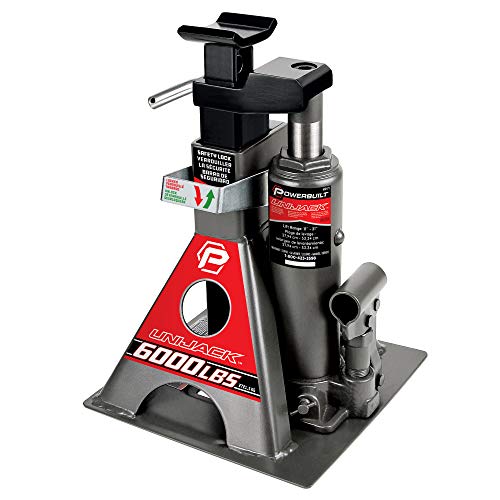
Powerbuilt 3-Ton Unijack All-in-One Hydraulic
The Powerbuilt 620471 Unijack integrates a hydraulic bottle jack and a mechanical ratcheting jack stand into a single unit, eliminating the danger of hydraulic pressure bleed-off. With a 6,000-pound capacity, an 11 to 21-inch lift range, and a wide steel base, it provides dependable single-point lifting and static holding for trucks and SUVs.
Pros
- Combines hydraulic bottle jack lifting and mechanical jack stand safety into one single-point tool
- Physical ratcheting safety lock prevents accidental vehicle drops caused by hydraulic pressure bleed-off
- Wide 9.88 x 9.75-inch base provides excellent stability on garage concrete and level paved surfaces
- Tall 21-inch maximum extension delivers ample working clearance for high-clearance trucks and SUVs
- Meets ANSI standards for portable automotive service equipment and includes a 1-year factory warranty
Cons
- Minimum collapsed height of 11 inches makes it unusable on low-clearance sedans and sports cars
- At 22.66 pounds per single unit, it is significantly heavier than standard individual mechanical jack stands
- Sold as an individual unit rather than a pair, requiring separate purchases if supporting an entire axle
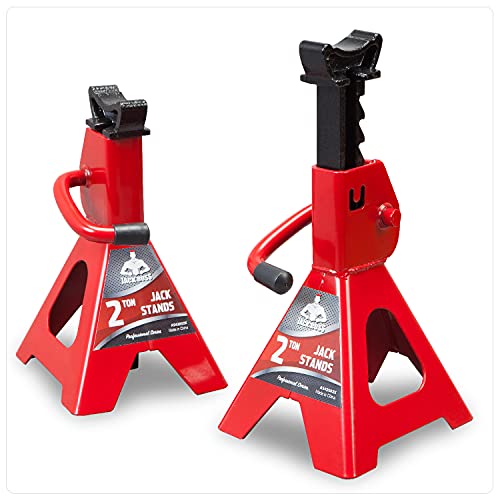
Jack Boss 2-Ton Low-Profile Ratchet Jack Stands
Designed for compact cars and small unibody vehicles, these Jack Boss low-profile jack stands combine a welded mild steel pyramid base with a ductile iron sawtooth ratchet bar spanning a 9.8-inch to 15-inch height range. They provide a lightweight, compact footprint for DIY garage maintenance, though the manufacturer explicitly advises against using them on trucks, large SUVs, or vehicles requiring over 15 inches of chassis clearance.
Pros
- Low 9.8-inch collapsed height fits easily under small passenger cars and lower unibody lift points
- Ductile iron sawtooth ratchet bar allows fast, tool-free height selection and positive pawl engagement
- Lightweight 10.5-pound overall build makes carrying, positioning, and garage storage simple
- Fully welded mild steel frame with protective powder coating guards against rust and shop grime
Cons
- Maximum 15-inch reach is too short for pickup trucks, full-size SUVs, or lifted off-road vehicles
- Single-pawl ratchet design lacks a secondary captive locking pin or redundant safety stop
- Steel concave saddle does not include rubber protection, which may mar painted unibody pinch welds without an aftermarket pad
ANTPOWER 3-Ton Double-Locking Jack Stands
The ANTPOWER 3-ton double-locking jack stands provide reliable static support for garage maintenance, pairing a ductile iron sawtooth ratchet column with a secondary steel side-locking pin. With an 11.2 to 16.8-inch height range and a fully welded pyramid steel base, they offer solid safety for compact cars, sedans, and light crossovers.
Pros
- Secondary side-pin lock adds physical redundancy alongside the primary ratchet pawl
- High-strength ductile iron ratchet bar provides positive sawtooth height adjustments
- Fully welded mild steel pyramid base delivers stable static support on level concrete slabs
- Protective powder-coated finish helps resist common garage moisture and chemical rust
- Manageable 14.3-pound total weight makes repositioning easy during four-corner vehicle setups
Cons
- Maximum 16.8-inch reach is insufficient for lifted 4x4s, full-size trucks, or vehicles with frame heights over 16 inches
- Bare steel saddle lacks a rubber pad, which may mar painted unibody pinch welds without an aftermarket adapter
- Conflicting product listing text notes both 6,000 lbs per pair and 6,600 lbs per stand, requiring conservative 3-ton pair load planning
JKWQFBOYAN 3-Ton Double-Locking Jack Stands
These JKWQFBOYAN 3-ton ratchet jack stands feature a dual-locking setup with a cast iron ratchet bar and secondary metal safety pin supported by a wide carbon steel pyramid base. Designed for DIY maintenance on passenger cars, small trucks, and SUVs, they offer an accessible static support option for budget-conscious home mechanics.
Pros
- Double-locking design combines a ratchet handle mechanism with a metal safety pin for secondary security
- Wide pyramid base features triangular foot pads to distribute static chassis weight across level concrete
- Notched saddle profile helps locate vehicle edges and factory lift points
- Relatively lightweight at under 11 pounds for easy garage positioning and compact shelf storage
Cons
- Minimum collapsed and maximum extended height dimensions are not explicitly specified in the manufacturer data
- Listing notes CE conformity rather than the ASME PASE certification standards typical for U.S. commercial shops
- Notched metal saddle lacks rubber pads, which may require aftermarket pinch-weld protectors to prevent underbody marring
Locating Approved Structural Support Points on Modern Chassis
Locating the proper load-bearing points under a vehicle is the foundation of any safe garage maintenance procedure. Modern automobiles distribute their weight through specific structural channels designed to support the vehicle during assembly and maintenance. Placing support equipment beneath unreinforced sheet metal or steering linkages invites immediate mechanical failure and dangerous chassis shifts. Understanding how different chassis architectures manage concentrated vertical loads ensures your vehicle remains stable from initial lift to final bolt torquing.
Unibody Pinch Welds and Reinforced Rocker Seam Placement
Passenger cars, crossovers, and compact sports coupes utilize unibody construction where the frame and body form a single unified steel structure. Automotive manufacturers reinforce the lower pinch-weld seams directly behind the front wheel openings and just ahead of the rear wheels. Small notches, stamped dimples, or molded arrows along the lower rocker panel identify these reinforced factory jacking pockets. The vertical steel flange inside these designated cutouts features layered, high-strength sheet metal designed to accept vertical vehicle weight without buckling.
Positioning standard curved saddles beneath a bare pinch weld requires deliberate alignment to prevent rolling or crushing the metal seam. Deep concave saddles or notched tops, such as those found on ANTPOWER Car Jack Stands 3 Ton (6,600 lbs), cradle the reinforced flange to distribute vehicle weight across the saddle bed. Slotted vulcanized rubber pucks or grooved urethane pads create a protective barrier between the hard steel saddle and the vehicle paint. This protective layer prevents protective underbody coatings from chipping, which stops premature corrosion along the structural rocker panels.
Boxed Ladder Frame Rails and Subframe Mounting Points
Full-size pickup trucks, body-on-frame SUVs, and classic automobiles feature heavy-gauge boxed or C-channel perimeter frame rails. These longitudinal steel beams provide exceptional structural rigidity and serve as the ideal support location for heavier vehicles. Stands should be positioned beneath flat, straight sections of the frame rail rather than angled bends or tapered crossmember junctions. Centering the frame rail directly into the saddle cradle prevents lateral slippage when you apply mechanical leverage to suspension components.
Unibody vehicles lacking full-length perimeter frames often incorporate heavy stamped subframes that cradle the engine, transmission, and front suspension. The reinforced structural mounting points where these subframes bolt directly into the vehicle floor pan make excellent alternative support locations. The Jack Boss Jack Stands Low Profile 2 Ton(4000 LBs) feature a compact minimum height of 9.8 inches, allowing easy placement under low-clearance front subframe pads. Always ensure the saddle rests against solid structural subframe steel rather than thin floor pan sheet metal or hollow engine cradles.
Solid Axle Tube Placement for Rear Suspension and Drivetrain Work
Rear-wheel-drive trucks, solid-axle SUVs, and off-road vehicles frequently require support directly under the rear axle assembly during brake or differential service. The cylindrical steel tubes extending from the central differential housing offer substantial load-bearing strength when properly cradled. Jack stand saddles must feature a pronounced V-notch or concave profile to capture the round contour of the axle housing securely. Placing the stands as close to the rear leaf-spring perches or lower control arm mounts as possible maximizes lateral chassis stability.
Certain mechanical tasks require the suspension to hang freely, making axle tube support inappropriate for shock or spring replacements. Supporting the vehicle by the forward frame rails allows the solid axle to droop naturally, providing the necessary clearance to extract coil springs or swap suspension links. The Powerbuilt 3 Ton, Bottle Jack and Jack Stands all-in-one unit provides a generous lift range of 11 to 21 inches, making it well-suited for holding elevated truck frames above drooped axles. Never rest a jack stand saddle against flexible brake hard lines, ABS sensor wiring, or emergency brake cables routed along the axle tubes.
Vulnerable Underbody Components You Must Never Support
Severe structural damage and catastrophic personal injury can occur if you place support stands beneath non-load-bearing vehicle components. Floor pans consist of thin stamped sheet metal that will puncture instantly under concentrated vehicle weight, compromising the passenger cabin. Steering linkages, tie rods, and front sway bars cannot hold vertical vehicle loads and will bend immediately, causing severe alignment failures. Aluminum oil pans, transmission casings, and differential covers must never contact a stand saddle, as cast aluminum cracks easily under localized pressure.
Hollow exhaust tubing and catalytic converter heat shields represent another common hazard for careless stand placement. Resting a vehicle on exhaust piping crushes the exhaust flow path and bends exhaust hangers, leading to expensive manifold leaks. Fuel lines, brake lines, and high-voltage hybrid cables frequently route along the inner rocker channels, requiring visual clearance before raising any support column. Taking an extra moment to sweep an inspection light along the underside guarantees that your stand contacts only structural frame steel or designated pinch welds.
Step-by-Step Hydraulic Jack Transition and Weight Transfer Protocol
Transferring vehicle weight from a hydraulic lifting device to stationary mechanical stands requires a methodical sequence of actions. Park the vehicle on a level poured concrete surface, shift into park or reverse gear, and firmly set the emergency parking brake. Place heavy-duty wheel chocks snugly against both the front and rear tread faces of the tires remaining on the ground. Use your hydraulic floor jack on an approved central jacking point to raise the vehicle to the height necessary for your specific project.
Slide your jack stands directly beneath the designated factory support locations, adjusting the center column so the saddle sits just below the chassis. Amazon Basics Steel Jack Auto Stands utilize a multi-position ductile iron ratchet bar that enables quick height adjustments to match the elevated vehicle. Slowly turn the release valve on your hydraulic floor jack to ease the chassis downward onto the mechanical stand saddles. Maintain visual contact with the saddle interfaces as the weight transfers to verify that the vehicle settles square and true without sliding laterally.
Leave the hydraulic jack directly under the central lift point with the pressure released just enough so the stands carry the full vehicle load. Raising the jack pad back up until it lightly touches the chassis without lifting weight creates an extra safety buffer. Professional mechanics working around commercial grade vehicle lift systems rely on rigid mechanical safety locks, and your garage setup requires that same level of discipline. Never rely on the hydraulic jack alone to sustain vehicle weight while performing underbody repairs.
Verifying Positive Mechanical Lock Engagement and Secondary Pin Redundancy
Mechanical locking mechanisms prevent the central support column of a jack stand from slipping downward while supporting thousands of pounds. Traditional ratchet-bar stands rely on an internal cast pawl that drops into angled teeth along the ductile iron column. Visually inspecting the handle position confirms that the pawl has dropped fully into the tooth valley and is not balanced precariously on a tooth peak. Audible clicking during extension signals normal pawl movement, but physical inspection remains essential before you commit vehicle weight.
Secondary safety mechanisms provide an extra layer of mechanical defense against accidental release or pawl disengagement. Models like the YELLOW JACKET Car Jack Stands 3 Ton with Double feature a secondary steel safety pin that slides horizontally through the outer collar and the center column. The Car Jack Stands, Jack Stands 3Ton (6000lb) model similarly incorporates double pin locking systems to secure the ratchet assembly during rigorous repair tasks. Inserting this cross-pin physically blocks the ratchet bar from dropping, even if the primary release handle experiences an accidental bump from a dropped tool.
Ground Substrate Integrity and Base Footprint Stability
The surface beneath your jack stands plays a role in vehicle stability that is just as critical as the chassis contact point above. Smooth, poured concrete slabs provide the compressive strength necessary to support narrow steel pyramid feet without deflecting. Asphalt driveways, by contrast, soften significantly during warm weather and can deform under the intense point loads generated by a raised vehicle. Narrow steel legs can punch through softened asphalt or loose exterior soil, causing the vehicle to tilt violently off level.
Wide pyramid base footprints distribute concentrated weight over a broader surface area, reducing ground pressure significantly. ANTPOWER Car Jack Stands 3 Ton (6,600 lbs) incorporate a broad stamped steel pyramid base designed to maximize floor contact. Welded perimeter foot pads on each corner prevent the stand edges from cutting into garage floor coatings or sinking into outdoor surfaces. Never use makeshift height extenders such as wooden boards, concrete pavers, or cinder blocks beneath stand feet, as these materials can split or crumble instantly under heavy loads.
Saddle Profiles, Slotted Adapters, and Preventing Sheet Metal Damage
Matching the saddle contour to your vehicle chassis interface prevents localized metal deformation and slipping hazards. Deep concave saddles cradling round axle tubes offer superior contact area compared to narrow, shallow saddles that touch only a fraction of the tube radius. Flat-top jack stands provide an even resting surface for wide frame rails, preventing the focused pressure points that can dent hollow tubular chassis sections. The Jack Boss Jack Stands Low Profile 2 Ton(4000 LBs) feature a large concave top saddle engineered to relieve pressure along rounded structural components.
Unibody vehicles frequently suffer crushed rocker seams when placed directly on bare steel saddle cradles. Using aftermarket slotted rubber saddle adapters preserves factory pinch-weld integrity by supporting the vehicle on the reinforced floor section rather than bending the vertical seam. These thick vulcanized rubber pads slot into standard concave saddles and prevent metal-on-metal sliding while torquing high-resistance fasteners. Inspect your saddle surfaces periodically to remove metal shavings, oil residue, or road grit that could reduce friction between the stand and the vehicle chassis.
Matching ANSI PASE Rated Load Capacities to Vehicle Curb Weight
Understanding automotive equipment rating conventions prevents dangerous overloading situations during major maintenance projects. Standards established under ANSI/ASME PASE define portable automotive service equipment capacity based on the combined rating of a matched pair of stands. A pair of stands marked with a 3-ton rating supports up to 6,000 pounds across both units, which translates to 3,000 pounds of capacity per individual stand. Home mechanics must cross-reference their vehicle curb weight and axle weight distribution against this per-pair rating before lifting.
Passenger cars and midsize crossovers typically place roughly sixty percent of their curb weight over the front drive axle. Lifting the front end of a 4,000-pound sedan places roughly 2,400 pounds onto your front support stands, well within the safety parameters of a 3-ton pair. Full-size pickup trucks and large SUVs, however, require stepping up to heavier 6-ton or 12-ton support stands to gain both structural safety margins and necessary vertical reach. Amazon Basics Steel Jack Auto Stands clearly display ASME PASE compliance markings on their steel frames, providing verified adherence to rigorous load standards.
The Mandatory Physical Push Test Before Working Underneath
Performing a vigorous lateral push test is the final mandatory safety protocol before placing any portion of your body beneath a raised vehicle. With the vehicle resting fully on the stands and the hydraulic jack lowered to safety contact, step to the side of the chassis. Place both hands firmly on the vehicle fender or bumper and push forcefully from side to side and front to back. The vehicle should exhibit zero rocking, slipping, or shifting on the jack stand saddles during this test.
Any movement or creaking at the saddle interface indicates that the stands are not sitting square or the ground surface has shifted. If the vehicle wobbles, raise the hydraulic jack immediately, reposition the stands onto level ground points, and repeat the lowering procedure from the beginning. Never compromise on lateral stability when preparing to apply heavy torque with breaker bars on stubborn suspension bolts or axle nuts. A vehicle that passes an aggressive physical shake test will remain stable and secure throughout your entire maintenance procedure.
Proper vehicle support relies on matching the right equipment specifications to your vehicle factory lifting geography. By identifying reinforced unibody pinch welds or boxed frame rails, verifying secondary mechanical lock pins, and testing lateral stability on flat concrete, you eliminate the risks associated with underbody automotive maintenance. Taking the time to execute each procedural step methodically protects your vehicle chassis from costly cosmetic damage and guarantees a completely secure working environment in your home garage.
About the author
Larry Carley is an experienced automotive technical writer and editor with more than four decades of work covering vehicle diagnostics, repair procedures, and automotive technology. His extensive technical writing helps readers understand mechanical systems, maintenance decisions, and the importance of accurate information when working on vehicles.