
Where to Place Jack Stands on Truck: Safe Placement and Setup Guide for 2026
Learn where to place jack stands on truck frames and axles safely. Here is your garage guide to lift points and stability for November 2026.
 By Larry Carley
Updated October 10, 2026


Working beneath a full-size pickup or heavy sport utility vehicle demands absolute confidence in your mechanical support equipment. Hydraulic floor jacks are designed strictly to lift vehicles into the air, but they depend entirely on pressurized fluid that can leak past internal seals without warning. Learning where to place jack stands on truck chassis points ensures that structural steel carries the static load rather than vulnerable hydraulic circuits. Before positioning your hardware, reviewing our guide on understanding jack stand weight ratings can help you confirm whether your equipment provides an adequate safety margin for your vehicle curb weight.
Truck platforms feature heavy ladder frames, solid live axles, and complex independent front suspensions that interact differently with support saddles. Choosing an incorrect contact point risks crushing delicate brake hardlines, denting floor pans, or causing the vehicle to slide off the stand head when breaking loose stubborn suspension bolts. Proper setup also requires an unyielding, level foundation to prevent the stand feet from biting into the floor or tilting off balance. Following proper ground support and stability guidelines ensures your working surface maintains structural integrity while supporting heavy axle loads.
| Award | Product | BJL Score About BJL ScoreThe BJL Score is our own rating from 0 to 10, based on performance, design and build, ease of use, and value. It reflects independent research and is never influenced by manufacturers, retailers, or affiliate commissions. Learn more › | |
|---|---|---|---|
| Best Overall |
YELLOW JACKET 3 Ton Double-Locking Steel Jack
|
9.2/10 | Buy |
| Best Premium |
 Powerbuilt 3-Ton All-in-One Bottle Jack |
9.2/10 | Buy |
| Best Value |
 JACK BOSS 3 Ton Aluminum Jack Stands |
9.1/10 | Buy |
| Best Budget |
 KOERZORE 3-Ton Jack Stands (Pair) |
8.9/10 | Buy |
 SENKEYFE 3-Ton Jack Stands (6,600 lbs Per Pair) |
8.9/10 | Buy | |
 USYATO 6-Ton Heavy Duty Jack Stands with Double |
8.9/10 | Buy | |
 Powerbuilt 3-Ton Unijack All-in-One Hydraulic |
8.9/10 | Buy | |
 Jack Boss 2-Ton Low-Profile Ratchet Jack Stands |
8.6/10 | Buy | |
 TONDA 3-Ton Extra Tall Jack Stands |
8.4/10 | Buy | |
 CAT 240342 4-Ton All-in-One Truck Jack |
8.3/10 | Buy |
YELLOW JACKET 3 Ton Double-Locking Steel Jack
The YELLOW JACKET 3-ton jack stand pair provides a 6,600-pound combined capacity with ductile iron ratchet columns and secondary metal locking pins for redundant garage safety. Featuring a welded stamped steel pyramid base and a 10-7/8-inch to 16-9/16-inch height range, they offer reliable static support for compact cars, crossovers, and midsize SUVs during routine maintenance.
Pros
- Double-locking system pairs a ductile iron ratchet bar with an independent metal safety pin for added physical redundancy
- Solid one-piece forged ductile iron center column provides reliable static tooth engagement across multiple height settings
- Welded stamped steel pyramid base features wide foot pads to support vehicle stability on flat concrete shop floors
- Practical height span of 10-7/8 inches to 16-9/16 inches covers common passenger vehicle maintenance tasks like brake jobs and oil changes
Cons
- The 10-7/8-inch collapsed height may sit too high for significantly lowered sports cars or vehicles with low front splitters
- Bare metal saddle lacks rubber cushioning pads, which may mar painted subframes or bend unprotected pinch welds without aftermarket adapters
- Maximum height reach of 16-9/16 inches is limited for lifted 4x4 trucks or high-clearance off-road vehicles requiring extended droop clearance
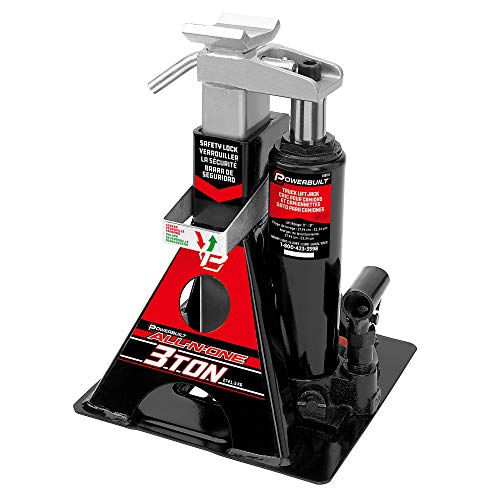
Powerbuilt 3-Ton All-in-One Bottle Jack
This hybrid tool merges a hydraulic bottle jack with an integrated mechanical jackstand to lift and lock vehicles in one step. Its wide, sink-resistant base makes it particularly practical for stabilizing trailers, RVs, and off-road vehicles on soft ground.
Pros
- Dual-function design removes need for separate jackstands
- Mechanical ratcheting bar locks firmly under load
- Wide base provides excellent stability on soft ground
- Meets or exceeds ANSI safety standards
Cons
- Relatively heavy at 22.45 pounds
- Bulky footprint takes up notable storage space
- Covered by only a one-year warranty
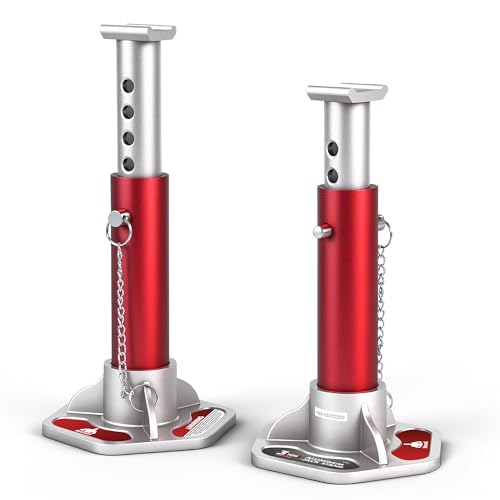
JACK BOSS 3 Ton Aluminum Jack Stands
The JACK BOSS 3-Ton Aluminum Jack Stands provide a combined 6,000-lb static load capacity per pair, utilizing positive-locking support pins for secure vehicle support. Weighing roughly 10.3 pounds for the pair, these lightweight aluminum stands are well suited for DIY garage mechanics and track hobbyists who prioritize easy portability.
Pros
- Lightweight aluminum build weighs approximately 10.3 lbs per pair, making them far easier to carry than standard stamped-steel stands
- Captive locking pin mechanism provides positive, visual mechanical engagement through the center column
- Broad base profile offers a stable platform when placed squarely on level concrete garage floors
- Dual-tone red and silver finish resists garage moisture and workshop fluid exposure
Cons
- Combined 6,000-lb rating applies per pair, meaning each individual stand has a 3,000-lb limit and cannot support heavy commercial or full-size trucks
- Pin-style adjustment requires manual hole alignment, which takes slightly longer to set than quick-ratcheting ductile iron bars
- Bare aluminum saddle contact surfaces may mark or bend thin unibody pinch welds if used without protective rubber adapters
KOERZORE 3-Ton Jack Stands (Pair)
Built for garage maintenance and oil changes, these KOERZORE jack stands feature a dual-locking mechanism and a wide pyramid base to support sedans and midsize SUVs safely.
Pros
- Dual-locking mechanism provides added fail-safe protection
- Wide pyramid base enhances stability on hard surfaces
- Concave saddle securely cradles vehicle frame points
- Lightweight 10.7-pound build allows easy garage portability
Cons
- Maximum 16.75-inch height restricts clearance on lifted trucks
- 3-ton capacity is insufficient for heavy-duty commercial vehicles
SENKEYFE 3-Ton Jack Stands (6,600 lbs Per Pair)
These SENKEYFE 3-ton jack stands deliver a 6,600-pound rated capacity per pair, combining an alloy steel frame with a secondary double-pin locking mechanism and protective rubber saddle covers. Designed for home garage maintainers working on sedans, crossovers, and light SUVs, they offer dependable static support and wide footpads for routine maintenance on level concrete.
Pros
- Secondary double-pin locking system provides mechanical redundancy beyond standard single-locking gravity pawls
- Includes protective rubber saddle covers to safeguard unibody contact points and painted frame surfaces
- Oversized footpads enhance base stability and distribute load weight across level concrete surfaces
- Lightweight design at approximately 11 pounds makes repositioning and garage storage easy
Cons
- Rated static capacity of 3 tons per pair is not suitable for heavy commercial vans or full-size three-quarter-ton pickups
- Maximum extension height of 17 inches may be limited for lifted 4x4 trucks on oversized off-road tires
- Requires smooth, level concrete; soft asphalt or unpaved driveways require heavy-gauge steel load-spreader plates
USYATO 6-Ton Heavy Duty Jack Stands with Double
These USYATO 6-ton jack stands pair cast-iron ratchet bars with removable steel safety pins for dual-lock static support. Featuring a broad pyramid base and protective rubber pads, they provide a 17.25-inch to 23.87-inch height range well suited for truck, SUV, and home garage maintenance.
Pros
- Dual-locking protection combining cast-iron ratchet pawls with manual secondary safety pins.
- Generous maximum extension height of 23.87 inches creates ample working clearance under trucks and SUVs.
- Included protective rubber saddle pads prevent chassis gouging and metal-on-metal slippage.
- Broad 10.6-inch by 9.2-inch pyramid base offers a steady footprint on level concrete slabs.
Cons
- Tall 17.25-inch minimum collapsed height will not fit under lowered sports cars or low-clearance sedans without lifting the chassis exceptionally high.
- Coarse ratchet increments provide fixed step levels rather than continuous micro-height adjustments.
- Base legs can dig into soft outdoor asphalt during warm weather without rigid load-spreader plates underneath.
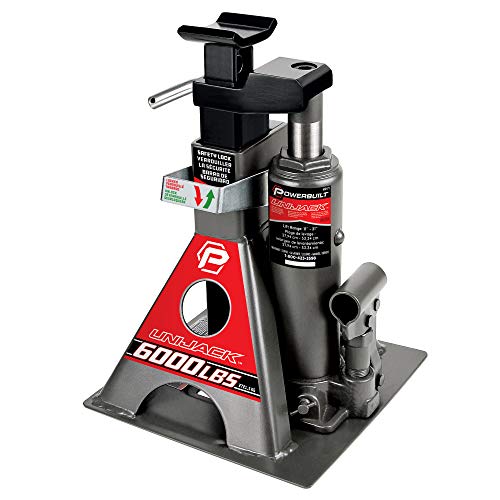
Powerbuilt 3-Ton Unijack All-in-One Hydraulic
The Powerbuilt 620471 Unijack integrates a hydraulic bottle jack and a mechanical ratcheting jack stand into a single unit, eliminating the danger of hydraulic pressure bleed-off. With a 6,000-pound capacity, an 11 to 21-inch lift range, and a wide steel base, it provides dependable single-point lifting and static holding for trucks and SUVs.
Pros
- Combines hydraulic bottle jack lifting and mechanical jack stand safety into one single-point tool
- Physical ratcheting safety lock prevents accidental vehicle drops caused by hydraulic pressure bleed-off
- Wide 9.88 x 9.75-inch base provides excellent stability on garage concrete and level paved surfaces
- Tall 21-inch maximum extension delivers ample working clearance for high-clearance trucks and SUVs
- Meets ANSI standards for portable automotive service equipment and includes a 1-year factory warranty
Cons
- Minimum collapsed height of 11 inches makes it unusable on low-clearance sedans and sports cars
- At 22.66 pounds per single unit, it is significantly heavier than standard individual mechanical jack stands
- Sold as an individual unit rather than a pair, requiring separate purchases if supporting an entire axle
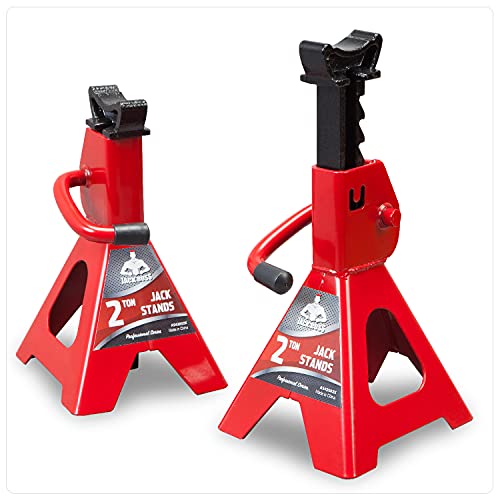
Jack Boss 2-Ton Low-Profile Ratchet Jack Stands
Designed for compact cars and small unibody vehicles, these Jack Boss low-profile jack stands combine a welded mild steel pyramid base with a ductile iron sawtooth ratchet bar spanning a 9.8-inch to 15-inch height range. They provide a lightweight, compact footprint for DIY garage maintenance, though the manufacturer explicitly advises against using them on trucks, large SUVs, or vehicles requiring over 15 inches of chassis clearance.
Pros
- Low 9.8-inch collapsed height fits easily under small passenger cars and lower unibody lift points
- Ductile iron sawtooth ratchet bar allows fast, tool-free height selection and positive pawl engagement
- Lightweight 10.5-pound overall build makes carrying, positioning, and garage storage simple
- Fully welded mild steel frame with protective powder coating guards against rust and shop grime
Cons
- Maximum 15-inch reach is too short for pickup trucks, full-size SUVs, or lifted off-road vehicles
- Single-pawl ratchet design lacks a secondary captive locking pin or redundant safety stop
- Steel concave saddle does not include rubber protection, which may mar painted unibody pinch welds without an aftermarket pad
TONDA 3-Ton Extra Tall Jack Stands
Built with an extended 13.39 to 21.06-inch lift range, these TONDA 3-ton jack stands deliver generous clearance for taller vehicles. The welded carbon steel frame and self-locking cast-iron ratchet bar provide stable, dependable support for regular garage maintenance.
Pros
- Supports up to 6,000 pounds per pair
- Extended 21.06-inch maximum height suits taller vehicles
- Durable welded carbon steel construction
- Wide pyramid base provides a stable footprint
- Self-locking ratchet bar engages automatically when raised
Cons
- High 13.39-inch minimum height limits low-clearance vehicles
- Combined weight of 17 pounds reduces portability
CAT 240342 4-Ton All-in-One Truck Jack
Combining a hydraulic bottle jack with an integrated mechanical stand, this unit allows truck and SUV owners to safely raise and hold high-clearance vehicles without juggling separate jack stands. Its automatic safety lock and 8,000-pound capacity make undercarriage service and tire changes much more streamlined.
Pros
- Integrated stand eliminates need for secondary supports
- Strong 4-ton lifting and holding capacity
- Mechanical safety lock maintains height without hydraulic drift
- Versatile design supports both unibody and frame vehicles
Cons
- High minimum clearance not designed for low cars
- Relatively heavy at 22.6 pounds for mobile use
Structural Lift Points and Support Locations for Trucks
Locating the correct mechanical support points on a truck requires understanding how body-on-frame architecture distributes high vehicle weight across rigid steel members. Unlike unibody passenger cars that rely on thin sheet-metal pinch welds, trucks utilize heavy boxed rails, open C-channels, and thick tubular axles designed to handle intense chassis stress. Setting your stands beneath these designated load paths guarantees that your vehicle remains completely immobile during heavy maintenance operations.
Identifying Boxed Frame Rails and Main Chassis Pick Points
Full-size pickups and traditional sport utility vehicles rely on rigid perimeter frame rails running the entire length of the chassis. When supporting the front or center section of a truck, the primary support location is along the flat, straight sections of the boxed frame rails directly behind the front wheel wells. This boxed section possesses high torsional rigidity and easily bears the concentrated downward force of the vehicle engine and transmission. Technicians should always visually verify that the stand saddle cradles the center of the frame rail flange rather than catching only the outer edge.
Rear frame rail placement requires finding flat sections forward of the rear leaf spring mounting brackets. Avoid placing stand saddles directly beneath angled transition zones where the frame rail arches over the rear axle, as these curved profiles encourage slippage. Inspect the inner and outer frame rail faces before setting the saddle to avoid pinching factory wiring harnesses, brake hardlines, or rubber fuel vapor lines clipped along the steel. Clean away road grime or loose undercoating from the contact point so the metal saddle engages clean, structural frame steel directly.
Positioning Jack Stands Under Solid Live Rear Axles
Solid rear axle assemblies provide an exceptionally stable and convenient contact location for routine maintenance tasks such as brake jobs, tire rotations, and wheel bearing replacements. When supporting a truck by its live axle, position the jack stands directly underneath the thick round axle tubes outboard as close to the leaf spring perches or lower shock brackets as possible. This wide stance maximizes lateral stability and mirrors the vehicle normal track width. Placing the stands wide prevents the vehicle chassis from rocking side to side while you apply high torque to wheel lug nuts.
The cast iron differential housing in the center of the axle assembly should never serve as a stationary support point for jack stands. Differential housings have rounded, asymmetrical geometries that can cause stand saddles to shift laterally under load. Furthermore, supporting a truck by its axle tubes keeps the rear suspension compressed under the vehicle static curb weight. If your planned repair involves replacing leaf springs, servicing rear shock absorbers, or dropping the axle assembly, support the truck by its rear frame rails instead to allow the suspension to droop freely.
Independent Front Suspension Support Strategies
Modern light trucks frequently utilize independent front suspension setups that lack a continuous solid axle beam. When servicing the front end of an IFS truck, the primary support point remains the main boxed frame rails directly behind the front wheels. If you need front suspension droop to service struts, upper control arms, or ball joints, placing the stands on the frame rails allows the suspension components to hang freely. Always ensure the stand saddle profile clears the body cab mounts and transmission crossmember attachment points.
For repairs where suspension compression is acceptable, such as front brake pad replacements or hub bearing work, heavy-duty lower control arm pockets can sometimes serve as stable contact points. Look for broad, flat reinforced spring pockets or thick stamped steel lower control arm surfaces located close to the lower ball joint. Never position jack stands beneath steering tie rods, front stabilizer sway bars, CV axle half-shafts, or aluminum steering knuckles. Reviewing detailed guidelines on front vehicle jack stand placement can help clarify structural component differences across various truck and SUV front-end designs.
Step-by-Step Lifting and Mechanical Load Transfer
Preparing the vehicle properly before operating your hydraulic floor jack is essential for preventing dangerous rolling incidents. Park the truck on a smooth, perfectly level concrete floor, shift the transmission firmly into park, and fully engage the emergency parking brake. Place heavy-duty rubber wheel chocks snugly in front of and behind the tires on the axle that will remain in contact with the ground. These mechanical wheel chocks prevent the truck from pivoting or rolling backward as the hydraulic jack raises the opposite axle off the pavement.
Position your hydraulic floor jack beneath a factory-approved central lifting point, such as a heavy front frame crossmember or the reinforced rear axle pumpkin. Pump the jack handle smoothly until the tires lift several inches higher than your planned working height, providing ample clearance to slide your jack stands into position. Adjust the center columns of both stands to identical heights so the truck rests on a level plane. Position each stand saddle directly beneath the designated frame rail or axle tube location, ensuring the load will bear squarely onto the center of each saddle cradle.
Lowering the vehicle onto the stands requires slow, deliberate control of the hydraulic release valve. Turn the release knob slowly counterclockwise to allow the chassis to descend gently until the vehicle weight settles fully into the stand saddles. Once the truck is resting entirely on the stands, verify that the locking ratchet pawls or solid steel pins are completely engaged in their mechanical detents. Never remove the hydraulic floor jack completely; instead, leave it raised just a fraction of an inch below the lifting point to serve as an unloaded emergency safety backup.
Understanding Rated Load Capacity and ANSI/ASME PASE Standards
Vehicle support equipment is certified under rigorous ANSI/ASME PASE standards, which define how rated capacities are calculated and labeled. Under these standard rules, jack stands are traditionally rated by the pair rather than as individual units. A pair of stands rated for three tons (6,000 pounds) is engineered to hold a maximum of 3,000 pounds per individual stand when used together on a level surface. Confusing a per-pair rating with an individual capacity rating can lead to catastrophic overloading when supporting a heavy commercial truck or diesel crew-cab pickup.
Trucks feature uneven front-to-rear weight distribution due to the substantial mass of large displacement engines, heavy cast iron transmissions, and transfer cases. In a typical empty half-ton pickup, up to sixty percent of the total vehicle curb weight rests over the front axle. A truck with a 6,000-pound curb weight may place 3,600 pounds across the front support points, which exceeds the working limit of lightweight passenger car stands. Opting for heavy-duty six-ton pairs provides superior structural margin and generous height extension that easily clears tall light-truck tires.
Locking Mechanism Security: Ratchet Bars, Through-Pins, and All-in-One Jacks
Standard automotive jack stands employ cast ductile iron ratchet bars that slide vertically through a stamped steel base collar. A counterweighted locking pawl pivots into deep sawtooth teeth along the bar, locking the column mechanically as soon as downward load is applied. High-quality double-locking models, such as the USYATO six-ton and YELLOW JACKET three-ton units, incorporate a secondary steel safety pin that slides directly through the base collar above the pawl handle. This redundant steel pin physically prevents the release handle from lifting, eliminating any potential for accidental pawl disengagement during aggressive underbody work.
Pin-type jack stands, exemplified by the lightweight aluminum models from JACK BOSS, utilize a completely different mechanical locking architecture. Instead of cast teeth and pawls, these stands feature a solid center tube with drilled horizontal through-holes that accept a heavy-gauge forged steel shear pin. The through-pin passes entirely through the outer collar and center post, secured by a steel retaining cotter pin on a flexible lanyard. This design offers absolute mechanical shear resistance and zero possibility of slipping, making pin stands highly favored for prolonged vehicle storage and trackside repairs.
All-in-one vehicle lifts, like the Powerbuilt Unijack and CAT 4 Ton truck jack, combine a hydraulic bottle jack and a mechanical jack stand into a single integrated unit. These innovative units solve the common problem of limited space on truck frame rails where fitting both a floor jack cup and a separate stand saddle proves difficult. The hydraulic cylinder raises the truck to the desired height, while an integrated ratcheting safety bar or locking riser pin locks the column mechanically in place. This allows home mechanics to lift and securely hold high-clearance trucks without juggling separate tools.
Ground Surface Integrity and Base Footprint Stability
The stability of any vehicle support setup depends directly on the compressive strength of the ground beneath the stand feet. Smooth, level poured concrete slabs offer the only truly reliable foundation for supporting heavy trucks on jack stands. Narrow steel pyramid legs concentrate thousands of pounds of downward force onto small surface contact points. On asphalt driveways softened by summer heat or direct sunlight, these narrow steel feet can easily puncture the blacktop, causing the stands to lean and tipping the raised truck sideways.
Never place jack stands on uncompacted dirt, loose gravel, or sloped driveway surfaces. If emergency roadside maintenance forces you to work on an asphalt surface, place thick, flat steel load-distributing plates directly beneath the stand base to disperse the concentrated point load across a broader footprint. Mechanics must strictly avoid using makeshift wooden blocks, paving bricks, or hollow cinder blocks beneath jack stand feet or saddles to gain extra lift height. Exploring what may be used in place of jack stands highlights why purpose-built mechanical support equipment remains the only safe solution for vehicle underbody work.
Matching Saddle Profile to Truck Frame and Axle Geometry
Saddle profile design determines how securely a jack stand mechanically locks against the chassis of your truck. Standard curved or shallow cradle saddles are optimized for resting against the flat lower flanges of perimeter frame rails. These broad saddles distribute weight evenly and feature raised outer ears that prevent the frame rail from sliding sideways off the stand column. Stamped steel saddles with broad surface areas also help prevent deep gouges in the factory rust-inhibiting coating applied to the chassis frame.
When supporting round rear axle tubes, a deep contoured V-notch saddle provides vastly superior security compared to a flat-top stand. The curved radius cradles the tubular steel axle housing, preventing rotational or lateral displacement while you work. Some modern stands, such as the USYATO heavy-duty units, include dense vulcanized rubber saddle pads that provide extra friction against the metal axle while protecting finished chassis coatings. Ensuring that your saddle profile matches the physical geometry of your truck contact points is essential for preventing sudden chassis slippage under heavy wrenching loads.
The Essential Lateral Push Test Before Crawling Underneath
Before placing any part of your body underneath a raised truck, performing a physical stability test is an absolute non-negotiable safety rule. Stand beside the front fender or rear bumper of the raised truck and grip the vehicle body firmly with both hands. Deliver several aggressive, deliberate two-handed lateral shoves against the truck chassis to simulate the heavy forces encountered when breaking loose rusted suspension bolts. If the vehicle wobbles, shifts on the saddles, or causes any stand foot to lift off the ground, the setup is unsafe and must be lowered and repositioned immediately.
A properly positioned truck resting on commercial-grade jack stands will feel completely rigid and rock-solid during the push test. Walk around the perimeter of the vehicle to inspect all four feet of each stand, confirming that every foot maintains firm, flat contact with the concrete floor. Verify that center columns are plumb and vertical without any visible tilt or mechanical distortion in the base welding. Taking this final thirty seconds to confirm absolute mechanical stability provides total peace of mind while you work beneath your truck.
About the author
Larry Carley is an experienced automotive technical writer and editor with more than four decades of work covering vehicle diagnostics, repair procedures, and automotive technology. His extensive technical writing helps readers understand mechanical systems, maintenance decisions, and the importance of accurate information when working on vehicles.