
How Many Locking Systems Does This Jack Stand Have: Practical Guide for 2026
Learn How Many Locking Systems Does This Jack Stand Have in November 2026 to ensure dual mechanical locks protect you during garage vehicle service.
 By Christian Hazel
Updated October 10, 2026


Crawling beneath several thousand pounds of elevated steel demands complete confidence in your mechanical support equipment. When preparing your vehicle for underbody service, knowing how many locking systems does this jack stand have directly determines your margin of safety during heavy wrenching. Standard garage models traditionally rely on a single cast ductile iron ratchet pawl, but modern workshops increasingly prioritize double-locking designs that add a dedicated secondary safety pin. Whether you are changing engine oil or replacing suspension components, understanding these mechanical fail-safes protects against catastrophic drop risks if a release handle gets bumped.
While some home mechanics manage projects in standard bays after reviewing a garage ceiling height guide for vehicle lifts, most DIYers depend on reliable jack stands resting firmly on level concrete. Modern dual-security models from manufacturers like BIG RED, TOWKING, and TUZAOUA integrate two distinct mechanical barriers to keep the load supported. By pairing a serrated ratchet column with an independent steel cross-pin, these stands eliminate single-point failure hazards. Taking time to inspect each locking mechanism before lowering your chassis ensures that both physical locks engage fully into their designated slots.
| Award | Product | BJL Score About BJL ScoreThe BJL Score is our own rating from 0 to 10, based on performance, design and build, ease of use, and value. It reflects independent research and is never influenced by manufacturers, retailers, or affiliate commissions. Learn more › | |
|---|---|---|---|
| Best Budget |
TUZAOUA 3-Ton Double Locking Jack Stands
|
8.4/10 | Buy |
| Best Overall |
 TOWKING 3-Ton Double Locking Jack Stands |
9.2/10 | Buy |
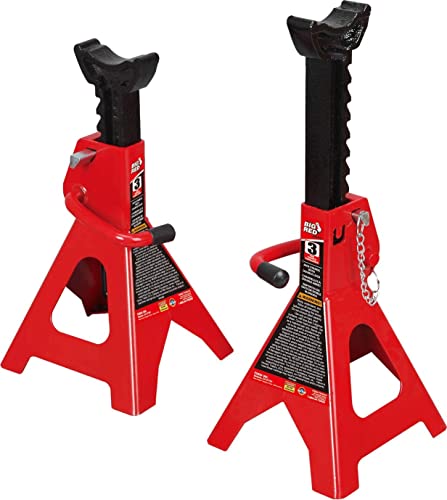 BIG RED TAM43002A Torin 3 Ton Steel Jack Stands |
8.6/10 | Buy |
TUZAOUA 3-Ton Double Locking Jack Stands
The TUZAOUA 3-Ton Double Locking Jack Stands offer a dependable 6,000-lb combined static capacity per pair, backed by a dual-stage ratchet bar and tethered steel safety pin. Built with a broad pyramid base and curved top saddle, they are well suited for DIY driveway mechanics servicing sedans, crossovers, and mid-size SUVs on level concrete.
Pros
- Dual-locking mechanism provides secondary mechanical redundancy via a captive steel safety pin
- Clear 3-ton (6,000 lbs) combined capacity per pair suitable for sedans, crossovers, and mid-size SUVs
- Wide triangular pyramid base enhances static stability on smooth, level concrete garage slabs
- Multi-groove serrated column allows rapid, tool-free height adjustment from 295 mm to 425 mm
- Protective anti-corrosion finish resists surface rust from everyday shop fluid exposure
Cons
- Minimum collapsed height of 295 mm (11.6 inches) may be too tall for lowered chassis or sports cars without high jacking clearance
- Bare metal curved saddle lacks protective rubber pads, which may mark unibody pinch welds without aftermarket adapters
- Stamped steel leg feet can sink into soft outdoor surfaces or warm asphalt driveways without load-spreader plates
TOWKING 3-Ton Double Locking Jack Stands
These TOWKING 3-ton ratchet jack stands deliver a rated capacity of 6,600 lbs per pair, pairing an auto-locking pawl with a secondary steel safety pin for added peace of mind. Featuring an 8.0 by 7.6-inch steel base with welded anti-sink feet and protective rubber caps, they offer solid static support for driveway maintenance on sedans, coupes, and compact crossovers.
Pros
- Secondary steel safety pin adds mechanical redundancy beyond standard gravity ratchet pawls
- Removable soft rubber saddle caps protect unibody pinch welds and chassis coating from bare metal contact
- Four welded anti-sink foot pads provide better ground load distribution than bare stamped legs
- Clear 6,600 lbs pair rating suitable for routine driveway servicing on passenger cars and crossovers
Cons
- Maximum extended height of 16.6 inches is not tall enough for lifted 4x4 trucks or large solid-axle SUVs
- Minimum collapsed height of 11.4 inches may require significant floor jack lift clearance under lowered sports cars
- Ratchet adjustments occur in fixed stepped increments rather than continuous micro-adjustments
BIG RED TAM43002A Torin 3 Ton Steel Jack Stands
The BIG RED TAM43002A Torin 3 Ton Jack Stand pair provides up to 6,000 lbs of static support with a multi-position forged iron ratchet bar and secondary steel locking pin. Featuring an 11-1/4-inch to 16-3/4-inch height range, a 7.5-inch by 6.7-inch pyramid base, and a 3.35-inch saddle, this pair is well suited for DIYers maintaining compact cars, sedans, and light crossovers.
Pros
- Double-locking mechanism pairs a sawtooth ratchet bar with a removable steel safety pin to prevent accidental handle release
- Stable 7.5-inch by 6.7-inch pyramid base footprint distributes static vehicle weight across level concrete floors
- Wide 3.35-inch saddle diameter provides solid contact area beneath designated automotive lift locations
- Lightweight 13.7-pound pair weight offers hassle-free positioning and easy garage storage
Cons
- Manufacturer explicitly notes these stands are not recommended for full-size pickups, commercial vans, or large off-road SUVs
- Maximum extended height of 16-3/4 inches limits clearance under lifted trucks or high-clearance 4x4s
- Bare steel saddle lacks protective rubber pads, which may cause cosmetic marring on delicate pinch welds without aftermarket adapters
Understanding Mechanical Locking Systems on Modern Jack Stands
A vehicle support stand typically features either one or two independent locking systems depending on its mechanical design. Standard ratchet-style units operate with a single locking system that relies entirely on an internal pawl engaging a serrated column. Contemporary dual-security models, such as the pairs offered by TOWKING, BIG RED, and TUZAOUA, incorporate two distinct locking systems by combining an auto-locking ratchet pawl with a heavy-duty steel safety pin. Knowing exactly which configuration sits beneath your vehicle determines how you inspect, position, and secure the chassis before initiating any repair work.
Single-Lock Versus Double-Lock Jack Stand Architecture
Single-locking ratchet stands have served automotive enthusiasts for decades by providing rapid height adjustment through a cast iron or ductile steel center post. In these traditional units, lifting the center column allows the internal pawl to slide over angled teeth before settling into a deep notch under load. While this mechanism offers swift operation, it relies on a single mechanical contact point to bear the vehicle weight. If the pawl fails to seat completely or the release handle suffers an accidental upward strike, the column can drop without warning.
Double-locking jack stands solve this single-point vulnerability by adding an entirely separate mechanical barrier across the support column. Once the primary ratchet pawl drops into place, the user inserts a solid steel cross-pin directly through predrilled alignment holes in the outer collar. This secondary pin passes beneath the ratchet teeth or through a dedicated slot in the central post, physically preventing downward movement. Even if an external force dislodges the primary release handle, the vehicle cannot descend past the inserted pin.
The Primary Ratchet Pawl: Materials and Tooth Engagement
The foundation of any ratchet-style support stand is its cast ductile iron center bar and counterweighted internal pawl. The center column features a vertical track of angled, sawtooth teeth engineered to accept the downward thrust of vehicle weight. When you pull upward on the support saddle, the angled profile of each tooth pushes the pawl back against its pivot pin until the next valley clears. Gravity or an internal counterweight then snaps the weighted pawl forward into the tooth recess, creating an immediate mechanical lock.
Ductile iron serves as the material of choice for ratchet bars due to its balanced combination of compressive strength and impact resistance. Unlike brittle gray iron, ductile iron tolerates substantial dynamic shock loads without developing structural micro-fractures. The geometry of the pawl tooth interface is specifically angled so that downward pressure from the vehicle forces the pawl deeper into its locking groove. This wedging action ensures that the primary lock becomes tighter as more vehicle weight transfers onto the saddle.
The Secondary Safety Pin: Positive Mechanical Stops
The secondary locking system on a double-locking stand functions as a manual mechanical interceptor that operates independently of the primary ratchet pawl. This component typically takes the form of a solid forged steel pin attached to the base frame via a braided wire or ball-chain retention lanyard. Once you raise the center column to your desired working height, you insert this pin horizontally through precision-punched holes in the outer collar. The pin spans the entire width of the frame, resting directly below the ratchet bar teeth or sliding through a transverse channel.
Because the secondary pin is manufactured from high-tensile solid steel, its shear strength easily matches the overall structural rating of the stand. When fully seated, the pin bridges the gap between the inner post and outer collar walls, creating an unyielding positive stop. If the primary pawl mechanism were to crack, slip, or disengage, the falling ratchet bar would strike this steel pin within a fraction of an inch. That instantaneous mechanical block arrests downward motion before the chassis can drop and cause severe injury.
Alternative Support Styles: Pin-Type and Threaded Columns
Not all vehicle support equipment relies on serrated ratchet bars to hold elevated loads. Pin-type jack stands represent an alternative design that utilizes a single, ultra-heavy-duty locking mechanism without any ratcheting components. These stands feature a smooth tubular center post drilled with cross-holes at fixed height increments. Height adjustment requires manually lifting the inner tube and sliding a massive steel through-pin entirely across both outer collar holes, securing it with an external hitch pin.
Many professional shops and commercial fleet technicians favor pin-type stands because they eliminate moving mechanical pawls entirely. The load path travels straight from the saddle down the center pipe and directly into the shear strength of the solid cross-pin. Threaded screw-style stands take another route by utilizing an acme-threaded steel post paired with a rotating collar for micro-level adjustment. While threaded screw stands are less common for quick residential tire changes, both alternative styles highlight the broad variety of mechanical locking systems used in vehicle service.
Mechanical Failure Modes and Handle Disengagement Risks
Understanding why double-locking systems exist requires examining how single-lock ratchet stands historically failed in home workshops. The primary vulnerability in budget ratchet designs stemmed from shallow pawl tooth engagement caused by casting inconsistencies. If the ductile iron tooth profiles were cast with rounded crowns or insufficient pocket depth, the pawl could sit on the edge of the tooth rather than settling deeply into the valley. Under heavy dynamic shifting, this precarious contact could slip, allowing the center column to drop through the collar.
Another prevalent hazard involves accidental physical contact with the external release handle while working beneath the car. Rolling on a mechanics creeper, pulling air hoses, or sliding heavy floor jacks can accidentally bump the handle upward. On a single-lock stand without load, or under a momentary chassis shift that unloads one corner, lifting the handle instantly releases the pawl. A secondary safety pin completely negates this hazard because the pin physically locks the column in place regardless of handle position.
Proper Engagement Verification and the Lateral Push Test
Operating a double-locking jack stand correctly requires a methodical procedure to ensure both safety systems function as intended. After raising your vehicle with a reliable hydraulic floor jack, position the stand saddle directly beneath the factory-designated lift point. Pull upward on the support saddle to bring it into close proximity with the chassis contact point. Listen carefully for the distinct clicking sounds as the ratchet pawl travels over the teeth, and visually confirm that the pawl settles into the lowest possible tooth recess.
Once the ratchet bar is positioned, take the attached steel safety pin and insert it smoothly through the outer collar opening. The pin should slide completely through both sides of the stand frame without requiring excessive force or hammering. If the pin encounters resistance, adjust the center bar upward or downward slightly until the alignment holes match up perfectly. Never attempt to force a pin at an angle or operate the stand with the pin only partially inserted through one side.
With both mechanical locks positioned, slowly release the hydraulic pressure valve on your floor jack to transfer vehicle weight onto the stands. Once the full weight rests on the mechanical supports, grasp the vehicle bumper or fender firmly and deliver a vigorous lateral push test. If the stands shift, rock, or exhibit wobble, raise the vehicle immediately, reposition the stands on level ground, and recheck all mechanical locks before beginning any service.
ANSI/ASME PASE Capacity Ratings: Per Pair Versus Per Stand
A frequent source of dangerous confusion among home mechanics is how manufacturers calculate and display load capacity ratings. Under the standards established by the American National Standards Institute and the American Society of Mechanical Engineers for Portable Automotive Service Equipment, commonly known as ANSI/ASME PASE, jack stands are rated by the pair. A set labeled as a 3-ton capacity model holds up to 6,000 pounds across two synchronized units, meaning each individual stand carries a rated working limit of 3,000 pounds.
Confusing a per-pair rating with an individual stand capacity can lead to severe overloading hazards, especially when supporting heavy pickup trucks or large SUVs. When evaluating your vehicle curb weight, remember that a typical passenger car concentrates roughly sixty percent of its mass over the front drive axle. A 3-ton pair easily manages routine front-end brake service on sedans, coupes, and compact crossovers whose total curb weight falls well below the 6,000-pound threshold. For full-size trucks or heavy utility vehicles, stepping up to higher capacity support equipment is essential to maintain a healthy safety factor.
Base Footprint Stability and Ground Surface Dynamics
A secure locking mechanism is only as effective as the foundation supporting it against the ground. High-quality double-locking jack stands utilize a wide pyramid base constructed from heavy-gauge stamped steel to resist tipping under lateral loads. For example, units measuring roughly eight inches by seven inches across the base spread vehicle weight across a broad contact area. This wide stance counteracts the rotational forces generated when you lean on a long breaker bar to loosen stubborn axle nuts or suspension bolts.
The design of the base feet plays a critical role in maintaining garage floor stability and preventing substrate damage. Quality models feature fully welded perimeter foot pads that close off the bottom of each pyramid leg. These broad steel pads prevent the stand legs from biting into asphalt driveways during hot summer days, which could cause sudden unlevel settling. If you must work outside a dedicated concrete bay or are considering dedicated automotive lift options for your property, always place heavy steel load-spreader plates beneath stand feet when working on softer ground.
Saddle Contours and Unibody Pinch-Weld Protection
The interface between the jack stand saddle and your vehicle chassis is another crucial factor in maintaining rock-solid stability. Most automotive stands feature a curved, contoured saddle designed to cradle solid axle tubes or box-section frame rails securely. While this curved profile works wonderfully on traditional ladder-frame trucks and rear drive axles, bare steel saddles can crush thin sheet metal pinch welds on modern unibody passenger cars. Bending a factory pinch weld can damage rocker panels, compromise lift points, and crack protective rustproofing coatings.
To prevent chassis damage, many modern stands include vulcanized rubber saddle pads or slotted unibody adapters. The TOWKING 3Ton stands, for instance, supply protective rubber caps that slip directly over the cast iron saddle. These rubber protectors feature a recessed channel that allows the thin pinch weld seam to sit harmlessly inside while the vehicle weight rests on the reinforced floor pan flange. Protecting these factory lift points prevents metal-on-metal slippage, avoiding hazardous makeshift wood blocks or bricks that can split under load.
Routine Inspection and Stand Retirement Guidelines
Maintaining long-term underbody safety requires conducting periodic visual inspections of every locking component on your jack stands. Before each use, examine the center ratchet column for any signs of rounded tooth profiles, metal flaking, or hairline cracks in the ductile iron casting. Check the internal counterweighted pawl to verify that it pivots freely on its pin and springs back into full engagement without binding. Clean away any accumulated road grime, grease, or dirt from the ratchet track so the pawl seats cleanly into every tooth valley.
Inspect the secondary safety pin, its retention chain, and the collar alignment holes with equal diligence. Verify that the pin remains perfectly straight, free from bends, gouges, or severe rust that could impair its shear strength. If a stand ever experiences an accidental impact, severe overload, bent base leg, or cracked weld seam, retire the unit from automotive service immediately. Investing in dependable, double-locking vehicle support equipment and confirming every mechanical lock before crawling underneath gives you the peace of mind required to tackle any DIY automotive project safely.
About the author
Christian Hazel is an automotive journalist with extensive experience covering four-wheel-drive vehicles, mechanical upgrades, and off-road equipment. His background includes technical reviews, installation features, and project-vehicle coverage, bringing useful context to equipment choices for trucks, Jeeps, and off-road enthusiasts.