
Where Should Jack Stands Be Placed: Safe Placement Guide for 2026
Learn where should jack stands be placed safely on unibody seams and truck frames in this November 2026 vehicle support and garage maintenance guide.
 By Emily Markham
Updated October 10, 2026

Setting up a vehicle for undercarriage maintenance requires absolute mechanical certainty before anyone slides underneath the chassis. Whether you are tackling a routine oil change, replacing brake rotors, or dropping an exhaust assembly, knowing where should jack stands be placed separates a secure home workshop from a catastrophic accident. Relying strictly on a hydraulic floor jack invites disaster because internal hydraulic seals can bypass without warning. Proper support equipment mechanical locks ensure the vehicle weight transfers onto solid structural steel rather than temporary hydraulic pressure.
Chassis designs vary considerably between modern unibody passenger cars and traditional body-on-frame trucks or sport utility vehicles. Finding the reinforced structural points prevents costly body damage such as crumpled rocker panels or punctured floorboards. For homeowners planning broader garage upgrades, reviewing a garage ceiling clearance requirements resource helps benchmark vertical working space alongside portable equipment. Mastering the exact positioning of your stands on reinforced pinch welds, boxed frame rails, or solid axle tubes keeps your project safe from start to finish.
| Award | Product | BJL Score About BJL ScoreThe BJL Score is our own rating from 0 to 10, based on performance, design and build, ease of use, and value. It reflects independent research and is never influenced by manufacturers, retailers, or affiliate commissions. Learn more › | |
|---|---|---|---|
| Best Overall |
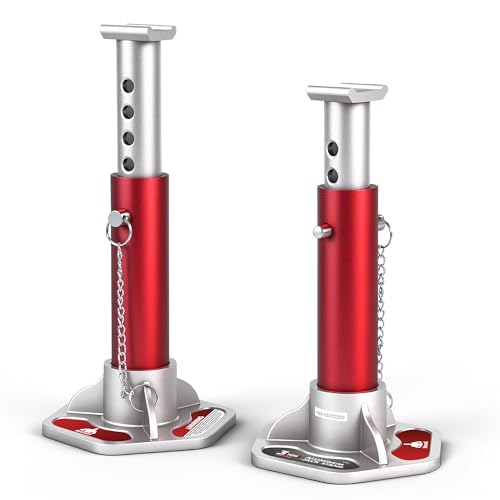
JACK BOSS 3 Ton Aluminum Jack Stands
|
9.1/10 | Buy |
| Best Value |
 SENKEYFE 3-Ton Jack Stands (6,600 lbs Per Pair) |
8.9/10 | Buy |
 Amazon Basics 3-Ton Steel Jack Stands |
8.9/10 | Buy | |
| Best Premium |
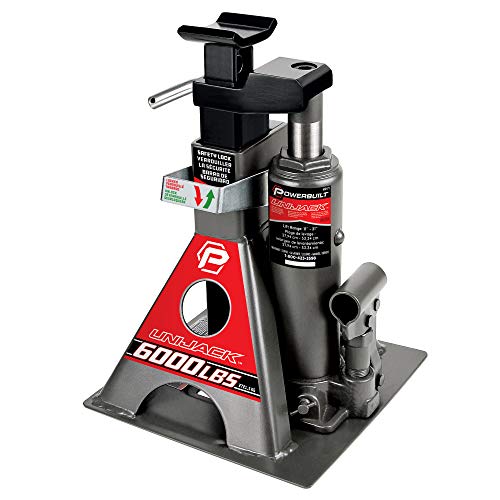 Powerbuilt 3-Ton Unijack All-in-One Hydraulic |
8.9/10 | Buy |
| Best Budget |
 JMBHWD 3 Ton Double-Locking Jack Stands |
8.6/10 | Buy |
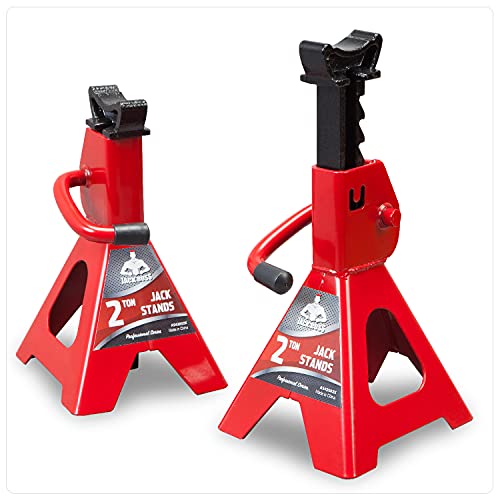 Jack Boss 2-Ton Low-Profile Ratchet Jack Stands |
8.6/10 | Buy | |
 TONDA 3-Ton Extra Tall Jack Stands |
8.4/10 | Buy | |
 ESCO 3 Ton Performance Shorty Low Profile Jack |
8.4/10 | Buy | |
 JKWQFBOYAN 3-Ton Double-Locking Jack Stands |
7.8/10 | Buy |
JACK BOSS 3 Ton Aluminum Jack Stands
The JACK BOSS 3-Ton Aluminum Jack Stands provide a combined 6,000-lb static load capacity per pair, utilizing positive-locking support pins for secure vehicle support. Weighing roughly 10.3 pounds for the pair, these lightweight aluminum stands are well suited for DIY garage mechanics and track hobbyists who prioritize easy portability.
Pros
- Lightweight aluminum build weighs approximately 10.3 lbs per pair, making them far easier to carry than standard stamped-steel stands
- Captive locking pin mechanism provides positive, visual mechanical engagement through the center column
- Broad base profile offers a stable platform when placed squarely on level concrete garage floors
- Dual-tone red and silver finish resists garage moisture and workshop fluid exposure
Cons
- Combined 6,000-lb rating applies per pair, meaning each individual stand has a 3,000-lb limit and cannot support heavy commercial or full-size trucks
- Pin-style adjustment requires manual hole alignment, which takes slightly longer to set than quick-ratcheting ductile iron bars
- Bare aluminum saddle contact surfaces may mark or bend thin unibody pinch welds if used without protective rubber adapters
SENKEYFE 3-Ton Jack Stands (6,600 lbs Per Pair)
These SENKEYFE 3-ton jack stands deliver a 6,600-pound rated capacity per pair, combining an alloy steel frame with a secondary double-pin locking mechanism and protective rubber saddle covers. Designed for home garage maintainers working on sedans, crossovers, and light SUVs, they offer dependable static support and wide footpads for routine maintenance on level concrete.
Pros
- Secondary double-pin locking system provides mechanical redundancy beyond standard single-locking gravity pawls
- Includes protective rubber saddle covers to safeguard unibody contact points and painted frame surfaces
- Oversized footpads enhance base stability and distribute load weight across level concrete surfaces
- Lightweight design at approximately 11 pounds makes repositioning and garage storage easy
Cons
- Rated static capacity of 3 tons per pair is not suitable for heavy commercial vans or full-size three-quarter-ton pickups
- Maximum extension height of 17 inches may be limited for lifted 4x4 trucks on oversized off-road tires
- Requires smooth, level concrete; soft asphalt or unpaved driveways require heavy-gauge steel load-spreader plates
Amazon Basics 3-Ton Steel Jack Stands
The Amazon Basics 3-Ton Steel Jack Stand Pair delivers 6,000 pounds of reliable vehicle support certified to ASME PASE-2014 standards for portable automotive equipment. Featuring a self-locking ratchet bar and a compact steel footprint, this set is ideal for home garage DIYers servicing passenger cars and urban SUVs.
Pros
- Rated for 3 tons (6,000 lbs) per pair and meets ASME PASE-2014 portable automotive service standards
- Self-locking ratchet bar enables rapid, secure height adjustment without fiddling with separate pins
- Compact 7.5 x 7.0-inch footprint and 12.6-lb total weight make positioning and storage simple
- Protective rustproof coating over a durable steel frame helps resist corrosion from garage fluids
Cons
- 3-ton capacity is tailored for sedans and crossover SUVs, not full-size heavy-duty pickup trucks
- Ratchet assembly does not feature a secondary mechanical cross-locking pin for redundant backup
- Must be used exclusively on flat, solid concrete slabs to prevent uneven weight distribution or base sinking
Powerbuilt 3-Ton Unijack All-in-One Hydraulic
The Powerbuilt 620471 Unijack integrates a hydraulic bottle jack and a mechanical ratcheting jack stand into a single unit, eliminating the danger of hydraulic pressure bleed-off. With a 6,000-pound capacity, an 11 to 21-inch lift range, and a wide steel base, it provides dependable single-point lifting and static holding for trucks and SUVs.
Pros
- Combines hydraulic bottle jack lifting and mechanical jack stand safety into one single-point tool
- Physical ratcheting safety lock prevents accidental vehicle drops caused by hydraulic pressure bleed-off
- Wide 9.88 x 9.75-inch base provides excellent stability on garage concrete and level paved surfaces
- Tall 21-inch maximum extension delivers ample working clearance for high-clearance trucks and SUVs
- Meets ANSI standards for portable automotive service equipment and includes a 1-year factory warranty
Cons
- Minimum collapsed height of 11 inches makes it unusable on low-clearance sedans and sports cars
- At 22.66 pounds per single unit, it is significantly heavier than standard individual mechanical jack stands
- Sold as an individual unit rather than a pair, requiring separate purchases if supporting an entire axle
JMBHWD 3 Ton Double-Locking Jack Stands
The JMBHWD 3-Ton Jack Stand pair provides a 6,000-pound total capacity per pair (3,000 pounds per individual stand) with a dual-action safety system pairing a serrated cast iron ratchet bar with a secondary locking pin. Featuring a 7.64-inch by 8.03-inch steel pyramid base and an 11.4-inch to 16.9-inch height envelope, this set is an accessible option for DIY mechanics maintaining sedans, crossovers, and compact passenger vehicles.
Pros
- Secondary locking pin provides redundant mechanical backup to prevent accidental release handle movement
- Stable 7.64-inch by 8.03-inch pyramid base stance helps prevent tipping when positioned on flat, solid concrete
- Cast iron serrated ratchet bar allows quick, stepped height adjustments between 11.4 and 16.9 inches
- Concave saddle profile securely cradles vehicle frame contact points and structural rails
Cons
- Manufacturer specifications clarify this model is not recommended for full-size pickup trucks, commercial vans, or large off-road SUVs
- Minimum collapsed height of 11.4 inches may prove too tall for low-slung sports cars or lowered vehicles without extended floor jack lift height
- Bare metal saddle lacks protective rubber pads, requiring careful placement or aftermarket adapters to avoid marring unibody pinch welds
Jack Boss 2-Ton Low-Profile Ratchet Jack Stands
Designed for compact cars and small unibody vehicles, these Jack Boss low-profile jack stands combine a welded mild steel pyramid base with a ductile iron sawtooth ratchet bar spanning a 9.8-inch to 15-inch height range. They provide a lightweight, compact footprint for DIY garage maintenance, though the manufacturer explicitly advises against using them on trucks, large SUVs, or vehicles requiring over 15 inches of chassis clearance.
Pros
- Low 9.8-inch collapsed height fits easily under small passenger cars and lower unibody lift points
- Ductile iron sawtooth ratchet bar allows fast, tool-free height selection and positive pawl engagement
- Lightweight 10.5-pound overall build makes carrying, positioning, and garage storage simple
- Fully welded mild steel frame with protective powder coating guards against rust and shop grime
Cons
- Maximum 15-inch reach is too short for pickup trucks, full-size SUVs, or lifted off-road vehicles
- Single-pawl ratchet design lacks a secondary captive locking pin or redundant safety stop
- Steel concave saddle does not include rubber protection, which may mar painted unibody pinch welds without an aftermarket pad
TONDA 3-Ton Extra Tall Jack Stands
Built with an extended 13.39 to 21.06-inch lift range, these TONDA 3-ton jack stands deliver generous clearance for taller vehicles. The welded carbon steel frame and self-locking cast-iron ratchet bar provide stable, dependable support for regular garage maintenance.
Pros
- Supports up to 6,000 pounds per pair
- Extended 21.06-inch maximum height suits taller vehicles
- Durable welded carbon steel construction
- Wide pyramid base provides a stable footprint
- Self-locking ratchet bar engages automatically when raised
Cons
- High 13.39-inch minimum height limits low-clearance vehicles
- Combined weight of 17 pounds reduces portability
ESCO 3 Ton Performance Shorty Low Profile Jack
The ESCO 3 Ton Performance Shorty Low Profile Jack Stands come as a pair, offering a 6,000-lb capacity per stand with an 11 to 17-inch height range. reviewed to ASME standards by an A2LA certified facility, they provide a stable 9.5 x 9.5-inch base footprint for DIY mechanics working on lower clearance vehicles.
Pros
- reviewed to ASME standards by an A2LA Certified evaluation Facility for verified load compliance
- Low 11-inch collapsed height simplifies placement under lower vehicle chassis
- Anodized post and powder-coated base offer strong resistance against garage moisture and fluids
- Broad 9.5 x 9.5-inch square base stance provides dependable footprint stability
- Seven selectable height settings offer flexible elevation up to 17 inches
Cons
- 17-inch maximum height may not provide enough reach for tall solid-axle 4x4 trucks
- 11-inch minimum height may still require a high-lift floor jack on heavily lowered track cars
- Manual height adjustments require aligning the post across the 7 fixed position settings
JKWQFBOYAN 3-Ton Double-Locking Jack Stands
These JKWQFBOYAN 3-ton ratchet jack stands feature a dual-locking setup with a cast iron ratchet bar and secondary metal safety pin supported by a wide carbon steel pyramid base. Designed for DIY maintenance on passenger cars, small trucks, and SUVs, they offer an accessible static support option for budget-conscious home mechanics.
Pros
- Double-locking design combines a ratchet handle mechanism with a metal safety pin for secondary security
- Wide pyramid base features triangular foot pads to distribute static chassis weight across level concrete
- Notched saddle profile helps locate vehicle edges and factory lift points
- Relatively lightweight at under 11 pounds for easy garage positioning and compact shelf storage
Cons
- Minimum collapsed and maximum extended height dimensions are not explicitly specified in the manufacturer data
- Listing notes CE conformity rather than the ASME PASE certification standards typical for U.S. commercial shops
- Notched metal saddle lacks rubber pads, which may require aftermarket pinch-weld protectors to prevent underbody marring
Safe Vehicle Support: Structural Contact Points, Load Transfer, and Stability
Securing a car or truck in the air demands a clear understanding of structural vehicle engineering. Placing mechanical supports beneath non-load-bearing sheet metal can crush floor pans, rupture brake lines, or cause the chassis to slip catastrophically. The primary objective is to align the saddle of each stand directly against an engineered structural point specified by the vehicle manufacturer. Taking time to inspect your vehicle underbody before turning a single bolt ensures that every maintenance task remains secure.
Identifying Factory Lifting Points on Unibody Vehicles
Most modern sedans, hatchbacks, and compact crossovers utilize unibody construction where the frame and body form a single unified steel structure. Vehicle manufacturers designate specific support locations along the reinforced pinch welds located just behind the front wheels and just ahead of the rear wheels. These pinch-weld seams are doubled or tripled in sheet-metal thickness to handle concentrated vertical loads without deforming. You can typically locate these areas by spotting small triangular notches, stamped indentations, or reinforced cutouts molded into the plastic rocker covers.
Placing a standard bare metal saddle directly against a thin pinch weld can sometimes fold the seam over or chip away protective corrosion-inhibiting coatings. Using stands equipped with protective rubber saddle covers cushions the contact point and spreads the vertical force evenly across the seam. Alternatively, slotted rubber puck adapters allow the metal seam to sit securely inside a deep groove while the broader pad bears against the reinforced unibody floor seam. Never position support stands inside the floor pan floorboards, as thin passenger compartment sheet metal will buckle under vehicle weight.
Positioning Stands on Body-on-Frame Trucks and SUVs
Full-size pickup trucks, large sport utility vehicles, and traditional commercial vans utilize a heavy boxed steel or open-channel ladder frame beneath the body panels. The primary placement location for jack stands on these vehicles is along the flat, straight sections of the longitudinal frame rails. Positioning stands as close to the suspension mounting points as practical helps reduce chassis flex and maintains natural weight distribution. Always ensure that the stand saddle sits squarely under the center of the frame rail rather than catching an edge or riding on an adjacent fuel line bracket.
Working on tall, heavy-duty vehicles often requires extra reach to accommodate long-travel suspension droop and taller ground clearance. Extra-tall steel stands provide the vertical reach necessary to contact elevated truck frame rails without stacking unstable materials. When positioning stands beneath tall frames, make sure the base footprint remains completely flat against the ground without tilt. Technicians evaluating workshop upgrades often contrast portable high-reach stands with dedicated automotive shop equipment to determine what vertical clearance suits their space best.
Solid Axle Tube Placement for Suspension and Differential Work
Rear-wheel-drive vehicles, heavy-duty trucks, and off-road rigs often feature solid drive axles that house the differential and axle shafts. Supporting a vehicle by its solid axle tubes is standard practice when performing brake jobs, hub servicing, or fluid changes where suspension droop is not required. The saddle of the jack stand should be placed outward on the axle tube, directly beneath the coil spring or leaf spring perches. This placement mimics the vehicle natural weight-bearing geometry and keeps the suspension loaded in its normal operating orientation.
Care must be taken to ensure the concave cradle of the stand saddle captures the round curvature of the axle tube cleanly. Never place a stand under the center differential housing, steering tie rods, or trailing control arms because these components are not designed for direct vertical point loading. Make sure the stand sits far enough away from brake backing plates, speed sensors, and hydraulic lines to avoid crushing critical hardware. If you are replacing rear leaf springs or shocks, you must support the vehicle by the forward frame rails instead so the rear axle can hang freely.
Front Subframe and Suspension Cradle Contact Points
On front-wheel-drive and all-wheel-drive unibody cars, the engine and front suspension bolt directly into a heavy-gauge steel or cast aluminum subframe cradle. When factory pinch-weld points are occupied by a hydraulic floor jack, these sturdy subframe mounting locations offer an approved alternative support area. Look for the large, structural subframe bolts that secure the cradle to the main unibody chassis horns. The broad, thick metal surrounding these reinforced mounting points can reliably support the localized weight of the front drivetrain.
Before positioning your stands, inspect the subframe to verify it is completely free from structural rust, road debris, or suspension fluid leaks. Position the center saddle of the stand directly beneath the heavy boxed section or bolt head, avoiding stamped control arm bushings or steering rack housings. Suspension control arms and sway bars pivot dynamically and can slide off the stand saddle if force is applied. If your vehicle uses an aluminum subframe, verify that the saddle has a broad, flat contact area to prevent gouging or indenting the structural casting.
Dangerous Locations to Avoid Under the Chassis
Improper stand placement represents one of the most common causes of undercarriage damage and mechanical instability in home garages. Never position stands under stamped steel floor pans, as they are engineered merely to isolate the cabin rather than bear vehicle tonnage. Placing a stand against thin floor pans will immediately puncture or cave in the metal, potentially damaging interior wiring harnesses, sound deadening, or carpeting. Similarly, avoiding fuel tanks, plastic aero underbody shields, and exhaust pipes is vital to preventing expensive shop repairs.
Steering linkages, tie-rod sleeves, drive shafts, and transmission pans must also never be used as support foundations. These components will bend instantly under slight chassis weight, rendering the vehicle undriveable and creating severe safety risks. Additionally, do not position stands on thin sheet-metal pinch welds that show significant corrosion or rust bubbling. When rocker panels are weakened by rust, you must trace the load path inward to solid unibody frame rails or structural suspension pickup points before committing vehicle weight.
Surface Preparation and Garage Floor Dynamics
The ground beneath your vehicle supports the entire concentrated load transferred through the four small feet of each jack stand. Always perform vehicle lifting on a flat, level concrete slab that possesses sufficient compressive strength to resist point-load indentation. Never position jack stands on dirt, soft turf, gravel, or sloped surfaces where the center of gravity can shift laterally. Even a slight slope can exert side-loading forces on the stand columns, causing the base legs to tip or slide unexpectedly.
Asphalt driveways present a hidden hazard during warm summer weather because petroleum-based blacktop softens significantly under ambient heat. The narrow steel feet of a loaded stand can punch directly through softened asphalt, causing the vehicle to tilt violently while you work underneath. If you must support a vehicle on asphalt, place wide, thick solid steel distribution plates beneath each stand base to distribute the pressure over a larger surface area. Never use thin plywood, particle board, or brittle masonry pavers, as wood can split along grain lines and cinder blocks can crumble instantaneously under load.
Step-by-Step Lifting and Mechanical Load Transfer Procedure
Executing a safe lift requires a methodical sequence to ensure the chassis remains balanced throughout the entire transition. Park the vehicle on your level concrete floor, engage the mechanical emergency brake firmly, and shift the transmission into park or reverse gear. Place heavy-duty rubber wheel chocks snugly against both the front and rear of the tires remaining on the ground to prevent rolling. Position your hydraulic floor jack under the factory central lifting point, then slowly raise the vehicle until the chassis reaches the required service height.
Slide your jack stands directly into position beneath the reinforced structural contact points and raise the central posts to meet the chassis. Double-check that both stands are adjusted to the exact same ratchet notch or pin height setting to keep the car completely level. Slowly turn the release valve on your hydraulic floor jack, lowering the chassis with gradual control until the structural contact points rest firmly in the stand saddles. Once the full vehicle weight rests on the stands, leave the hydraulic jack raised just below the central crossmember with minimal clearance to serve as a redundant physical barrier.
Understanding ANSI/ASME PASE Capacity Ratings and Safety Factors
Understanding how load ratings are calculated prevents dangerous overloading scenarios in home workshops and commercial bays. Under the standard portable automotive service equipment criteria, known as ANSI/ASME PASE, jack stands are rated based on their capacity per pair rather than individually. For example, a set of three-ton jack stands is engineered to support a total of six thousand pounds across two matched units working in tandem. This means each individual stand carries an operational limit of three thousand pounds when the load is distributed evenly between them.
Always compare the Gross Vehicle Weight Rating found on your vehicle driver-side door jamb against the rated capacity of your stand pair. Because modern vehicles have an uneven weight split, with front-engine layouts placing up to sixty percent of total mass over the front axle, maintaining a generous safety cushion is crucial. Choosing three-ton or even six-ton capacity pairs for compact SUVs and half-ton pickups provides substantial margin against mechanical stress. Many technicians planning commercial facilities explore permanent vehicle lift systems when higher continuous load capacity and complete underbody access become daily operational requirements.
Locking Mechanism Security: Ratchet Pawls vs. Solid Pin Designs
Vehicle support equipment relies on distinct mechanical locking designs to maintain elevated height under heavy chassis loads. Ratchet-bar designs utilize a ductile iron center post with angled sawteeth that automatically engage an internal counterweighted cast pawl as you raise the column. Many modern ratchet models now incorporate a secondary steel safety pin that slides directly through the outer collar beneath the teeth to prevent accidental pawl release. This double-locking configuration combines the rapid height adjustment of a ratchet mechanism with positive mechanical backup.
Pin-type jack stands take a different approach by utilizing a solid steel cross-pin that passes completely through matching holes in the tubular post and base collar. Lightweight aluminum models often use high-strength locking pins secured with retention cables to deliver robust load bearing in a portable package. Pin-style units provide exceptional shear strength, though they offer fewer incremental height settings compared to fine-pitch ratchet bars. Whatever mechanism you choose, always visually verify that the locking pin or ratchet pawl is fully seated in the bottom of its pocket before lowering vehicle weight.
The Critical Stability Push Test and Final Safety Verifications
Before ever placing your head or torso beneath an elevated vehicle, you must execute a vigorous physical stability check. Stand beside the vehicle, grasp the fender or quarter panel with both hands, and push firmly side-to-side and back-and-forth. If the stands rock, creak, or exhibit any base lift during this aggressive shove, the chassis is not secure and must be reset immediately. Performing this test while the vehicle is entirely supported by the stands ensures that any potential slippage occurs before you are in harm way.
Once the vehicle passes the shake test with zero movement, perform a final visual sweep around all four corners. Verify that all base feet sit flat against the concrete floor without riding on floor expansion joints or debris. Check that the locking pawls or safety pins remain fully engaged and that your wheel chocks are tight against the grounded tires. Only after confirming every physical checkpoint should you place tools and yourself beneath the vehicle to begin your maintenance work.
Properly supporting an automobile on mechanical stands requires respect for physics, mechanical load paths, and disciplined garage procedures. Knowing precisely where to interface the saddles with reinforced pinch welds, boxed frames, or solid axles transforms potentially dangerous maintenance into a controlled, safe workshop routine. Inspect your equipment before every use, verify complete load transfer off your lifting jack, and never rush the setup process. Taking these deliberate steps guarantees that your vehicle remains rock-solid while you work safely and efficiently.
About the author
Emily Markham is an automotive aftermarket editor who has covered professional tools, workshop equipment, and the businesses that support vehicle repair since 2019. Her editorial background gives her a practical understanding of how technicians and shop owners evaluate equipment, product value, and long-term support.