
Can You Put Jack Stands on Pinch Welds: Safe Placement and Setup Guide for 2026
Wondering can you put jack stands on pinch welds without damaging your unibody chassis? Explore safe support points, slotted rubber adapters, and stability rules for November 2026.
 By Mike Bumbeck
Updated October 20, 2026


Lowering a modern unibody vehicle onto garage support equipment often causes hesitation when bare steel saddles meet thin sheet metal seams. Drivers frequently ask can you put jack stands on pinch welds without crushing the vertical seam or chipping protective factory e-coatings. While factory pinch welds represent the primary emergency lifting points designated by automotive manufacturers, resting bare curved jack stand saddles directly beneath them can easily deform the sheet metal. Understanding how unibody load paths distribute vehicle weight helps prevent expensive rocker panel damage and keeps your workspace stable during suspension or brake overhauls.
Direct metal contact concentrates hundreds of pounds of downward pressure onto a thin metal flange, creating sharp point loads that standard saddles cannot support evenly. Implementing slotted rubber adapters cushions the vehicle flange while directing chassis weight onto reinforced floor sections adjacent to the weld. Practicing proper vehicle support procedures ensures the vehicle stays locked in place while you torque suspension hardware. With the right saddle protection and deliberate positioning, home mechanics can safely support unibody cars right at their reinforced factory lift notches.
| Award | Product | BJL Score About BJL ScoreThe BJL Score is our own rating from 0 to 10, based on performance, design and build, ease of use, and value. It reflects independent research and is never influenced by manufacturers, retailers, or affiliate commissions. Learn more › | |
|---|---|---|---|
| Best Overall |
Seven Sparta 4-Pack Rubber Jack Stand Pads
|
9.1/10 | Buy |
| Best Value |
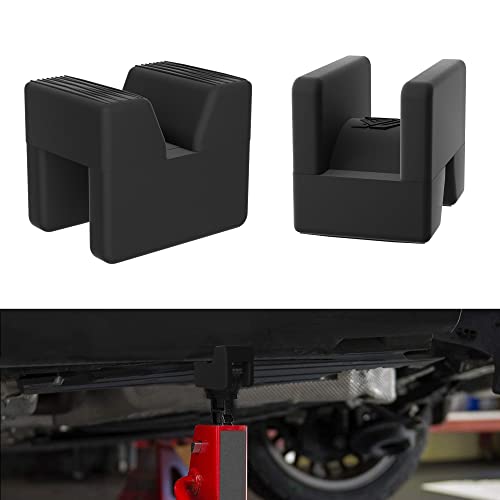 Seven Sparta 2-Piece Rubber Jack Stand Pads |
8.9/10 | Buy |
 FEAOXYO 4-Pack Rubber Jack Stand Pads |
8.9/10 | Buy | |
| Best Premium |
 HXXF 4-Piece Rubber Jack Stand Pad and Floor Jack |
8.8/10 | Buy |
 Amylove 8-Piece Rubber Jack Pad Adapter Set |
8.8/10 | Buy | |
| Best Budget |
 TONDA Rubber Jack Stand Pads 2-Pack |
8.6/10 | Buy |
 Amylove 4-Piece Universal Rubber Jack Stand Pads |
8.4/10 | Buy | |
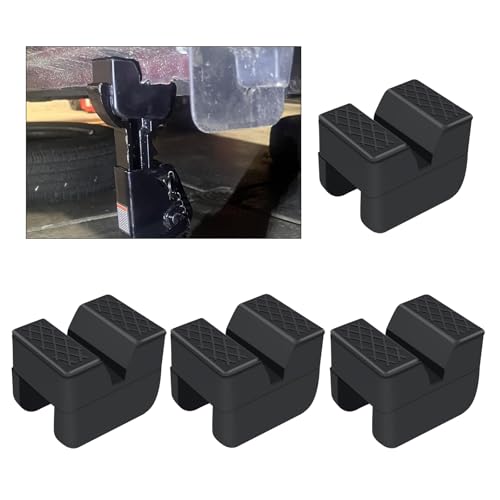 VKQTS 4-Pack Rubber Pinch Weld Jack Pads |
8.1/10 | Buy | |
 TONDA 4.92-Inch Rubber Floor Jack Pad |
8.1/10 | Buy | |
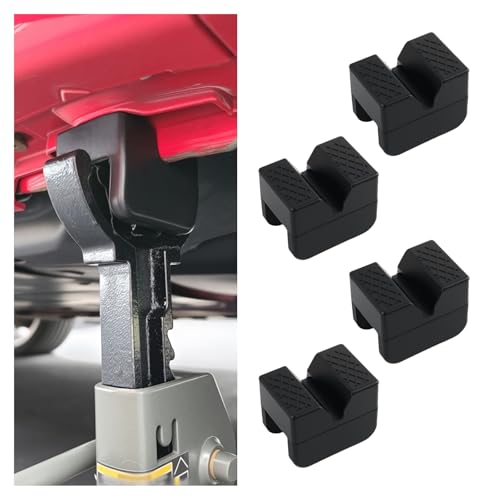 Aokdom 4-Pack Rubber Pinch Weld Jack Stand Pads |
8.0/10 | Buy |
Seven Sparta 4-Pack Rubber Jack Stand Pads
The Seven Sparta 4-Piece Rubber Jack Stand Pad set protects unibody pinch welds and frame rails from bending under static vehicle loads up to a suggested 3-ton capacity. Designed specifically for stands such as the Torin Big Red T43002, this grooved cube-style adapter set provides a dependable rubber cushion for DIY driveway maintenance.
Pros
- Durable heavy-duty rubber construction with a listed 3-ton suggested load rating
- Deep center groove protects thin unibody pinch welds from crushing or mushrooming
- Prevents metal-on-metal gouging on factory undercoating and pinch weld seam sealers
- Supplied as a 4-pack to equip a full matching set of garage jack stands
- Direct fitment on popular Torin Big Red T43002 jack stand saddle heads
Cons
- Incompatible with Torin Big Red T42002 jack stand saddles due to dimensional differences
- Dense rubber can show cosmetic gouging or compression marks over time under sharp sheet metal seams
- Universal fit claims may require checking non-Torin saddle dimensions to verify proper seat stability
Seven Sparta 2-Piece Rubber Jack Stand Pads
These Seven Sparta rubber jack stand pads provide slotted pinch weld and chassis protection with a suggested 3-ton load capacity. Specifically contoured for models like the Torin Big Red T43002, they are an essential accessory for DIY mechanics servicing unibody vehicles without crushing factory seams.
Pros
- Durable heavy-duty rubber construction provides reliable cushioning under static vehicle loads
- Center groove effectively prevents unibody pinch welds and frame rails from bending or gouging
- Tailored fitment for popular stands such as the Torin Big Red T43002
- Lightweight and compact design makes them easy to store and position on stand saddles
Cons
- Not universally compatible with all jack stand saddles; explicitly does not fit Torin Big Red T42002 stands
- Rubber pads can experience wear, compression, or tearing over time when subjected to sharp or damaged pinch welds
- Suggested 3-ton rating represents an accessory load guideline, requiring users to rely on the underlying stand's certified capacity
FEAOXYO 4-Pack Rubber Jack Stand Pads
The FEAOXYO 4-Piece Jack Stand Pad Set provides heavy-duty rubber cushioning with slotted channels designed to protect unibody pinch welds on vehicles up to 2-3 tons. Ideal for DIY garage mechanics and driveway maintainers, these textured adapters help prevent sheet metal crushing and lateral slipping during static support.
Pros
- Slotted channel helps safeguard fragile unibody pinch welds from crushing or folding under vehicle weight
- Textured diamond surface pattern adds friction to help resist lateral and longitudinal slip
- Heavy-duty rubber composition offers a practical balance of compressive firmness and chassis paint protection
- Four-pack bundle provides enough adapters for a full four-point vehicle stand setup
Cons
- Compact groove width and overall dimensions will not fit large boxed truck frame rails or deep proprietary lift pockets
- Rubber material is susceptible to gouging or splitting over time when exposed to sharp, damaged pinch welds
- Listed 2-3 ton rating makes them unsuitable for heavy 3/4-ton pickups, commercial service vans, or heavy machinery
HXXF 4-Piece Rubber Jack Stand Pad and Floor Jack
The HXXF 4-piece rubber jack pad adapter set provides essential protection for unibody pinch welds and frame rails under static vehicle loads up to 3 tons. Designed to fit standard floor jack saddles and specific stands like the Torin Big Red T43002, this set is ideal for DIY mechanics servicing passenger cars and crossovers.
Pros
- Includes both circular floor jack pucks and rectangular V-groove jack stand pads in a single four-piece kit
- Deep slotted channels (15mm and 17mm) provide ample clearance for tall factory pinch-weld seams
- Rated for up to 3 tons of load bearing to match standard consumer floor jacks and light-duty garage stands
- Helps prevent costly cosmetic and structural rocker panel damage on unibody passenger vehicles
Cons
- Explicitly incompatible with certain models like the Torin T42002 jack stand saddle
- Rubber material can compress or show surface wear over time under repeated heavy static loads
- Requires careful pre-purchase measurement of vehicle pinch weld thickness and jack stand saddle widths
Amylove 8-Piece Rubber Jack Pad Adapter Set
This Amylove eight-piece rubber adapter set provides cushioned pinch-weld and frame rail protection across four round floor jack pucks and four V-groove stand pads. Designed to buffer metal-on-metal contact during maintenance, it suits DIY mechanics lifting unibody cars on standard garage equipment.
Pros
- Includes eight total rubber adapters in two functional shapes for floor jacks and jack stand saddles
- Slotted design helps prevent delicate sheet-metal unibody pinch welds from flattening under vehicle weight
- Dense rubber compound cushions metal surfaces and increases friction grip against bare steel
- Provides sufficient pads to equip four jack stands and hydraulic floor jacks simultaneously
Cons
- Sharp or thin unibody pinch welds can cut or split the rubber material under heavy vehicle loads over time
- V-groove pads may fit loosely on oversized, extra-wide, or deep commercial truck jack stand saddles
- Strong initial rubber odor out of the packaging that requires airing out in a ventilated garage
TONDA Rubber Jack Stand Pads 2-Pack
The TONDA Jack Stand Pads are molded rubber pinch weld adapters designed to cushion contact points on compatible 2-3 ton jack stands. They provide a slotted center channel and waffle-textured grip, making them a practical add-on for DIYers servicing unibody vehicles.
Pros
- Dedicated center slot helps position and cushion vulnerable vehicle pinch welds
- Waffle-textured contact face provides added friction against smooth chassis contact points
- Durable rubber construction helps reduce scratching, gouging, and direct metal-to-metal contact
- Compact dimensions (2.45 x 1.96 x 1.73 inches) designed to fit compatible 2-3 ton jack stand saddles
Cons
- Sized specifically for compatible 2-3 ton stands and will not fit larger 6-ton or commercial truck stand saddles
- Deep or tall pinch weld seams on certain vehicles may bottom out if they exceed the slot depth
- Rubber material naturally compresses and may show wear over time with frequent, heavy vehicle use
Amylove 4-Piece Universal Rubber Jack Stand Pads
This four-piece rubber adapter set provides circular pucks and V-groove blocks designed to buffer unibody pinch welds and painted chassis rails against metal jack saddles. It is an affordable accessory for DIY garage mechanics seeking to prevent rocker seam bending and paint damage during routine maintenance.
Pros
- Two distinct shapes (round and V-groove) provide versatility across floor jacks and jack stands
- Effectively shields unibody pinch welds and painted rocker flanges from metal-on-metal crushing
- Durable rubber composition increases surface grip to minimize chassis slipping on slick metal saddles
- Four-piece bundle provides enough adapters to equip multiple lifting or static support points
Cons
- High-density rubber can gradually compress, gouge, or split under thin, sharp unibody seams under heavy vehicle weight
- No manufacturer-specified working load limit (WLL) or tonnage rating; relies on underlying stand capacity
- Round pucks may not seat flush in oversized commercial jack saddles or exceptionally shallow floor jack dishes
VKQTS 4-Pack Rubber Pinch Weld Jack Pads
The VKQTS 4-piece pinch weld pad set delivers durable rubber cushioning and a dedicated slotted channel to help protect unibody rocker seams on compatible 2-ton vehicle jacks and stands. Featuring a non-slip diamond texture, these compact adapters help prevent metal-on-metal marring during home garage maintenance.
Pros
- Resilient rubber body cushions delicate vehicle chassis seams against hard metal jack saddles
- Grooved slot helps prevent pinch weld rolling and protects factory paint from rust-causing scrapes
- Diamond tread texture adds surface friction to help keep the pad seated against the chassis lift point
- Four-piece bundle provides enough adapters to outfit multiple stands or trolley jacks in a home garage
Cons
- Narrow 0.31-inch groove width will not accommodate wide, reinforced, or double-folded pinch welds found on heavier vehicles
- Listed 2-ton load capacity restricts practical use to light passenger cars rather than full-size trucks or heavy SUVs
- Rubber material is susceptible to eventual tearing or gouging if exposed to sharp damaged metal edges or dynamic chassis shifts
TONDA 4.92-Inch Rubber Floor Jack Pad
The TONDA 4.92-Inch Rubber Floor Jack Pad provides a slotted, waffle-textured cushion designed for 2-3 ton lifting applications on unibody pinch welds. It is an ideal garage accessory for DIY mechanics wanting to prevent bent rocker seams and metal-to-metal gouging during floor jack lifting.
Pros
- Deep cross-slotted grooves seat vehicle pinch welds securely to prevent metal crushing
- Textured waffle pattern enhances contact grip between lifting point and jack saddle
- Heavy-duty rubber composition cushions up to 2-3 ton vehicle lifting applications
- Substantial 4.92-inch diameter spreads contact load across compatible floor jack saddles
Cons
- Pack includes only one pad, requiring an extra purchase if lifting both sides simultaneously
- Wide 4.92-inch diameter may not fit smaller or deeply recessed floor jack saddle cups
- Dense rubber can show compression marks or cosmetic wear under heavy concentrated point loads over time
Aokdom 4-Pack Rubber Pinch Weld Jack Stand Pads
The Aokdom 4-pack rubber pinch weld jack pads provide a cushioned, slotted barrier between metal jack stand saddles or 2-ton floor jacks and unibody lift seams. Designed with a tapered groove and diamond-textured surface, they help DIY mechanics prevent rocker panel marring and crushed pinch welds during routine maintenance.
Pros
- Tapered slot design cushions unibody pinch welds without placing direct static load on the bottom seam edge
- Molded flexible rubber helps prevent scratches, indentations, and protective e-coat flaking at factory jack points
- Diamond-textured top face improves contact grip against smooth painted underbodies
- Four-piece bundle provides enough adapters to stage an entire vehicle on jack stands
Cons
- Listed compatibility is targeted toward smaller 2-ton jacks rather than heavy commercial or truck equipment
- Fixed groove width of 0.86 inches at the top will not fit extra-thick or heavily reinforced frame flanges
- Soft rubber construction can experience wear or compression indentations over repeated heavy lifting cycles
Complete Guide to Placing Jack Stands on Pinch Welds Safely
You can safely support a unibody vehicle on its pinch welds, but doing so directly on bare metal jack stand saddles invites structural deformation. Modern passenger cars and compact crossovers utilize unibody construction where vertical sheet metal seams along the rocker panels provide structural rigidity. The primary mechanical functions of jack stands require a stable mating interface that distributes weight across reinforced metal rather than crushing a thin seam. When bare steel saddles meet unprotected pinch welds, the concentrated point load folds the vertical seam over and strips away protective anti-corrosion sealants.
Anatomy of Unibody Pinch Welds and Factory Lift Points
A unibody pinch weld consists of multiple stamped sheet metal panels joined by spot welds along the bottom edge of the rocker panel. These layered panels combine the outer rocker sheet, internal reinforcements, and floor pan edges into an upright vertical flange. Automotive manufacturers designate specific sections along this flange as emergency lifting points, typically marked by small notches or reinforced doubling plates. While these designated sections feature thicker metal than the rest of the seam, they remain vulnerable to crushing when loaded with bare curved saddles. Placing weight outside these reinforced notches risks buckling the outer rocker panel and damaging door alignment.
Factory scissor jacks work in these locations because they feature a recessed channel that straddles the vertical flange while lifting the reinforced sill behind it. In contrast, standard garage jack stands feature curved cast-iron saddles designed to cradle round truck axle tubes or wide frame rails. Placing a curved cradle under a straight sheet metal seam creates severe point loading at two tiny contact spots. Without an adapter to distribute this load, vehicle weight bends the pinch weld flat against the floor pan. A crushed seam also prevents roadside emergency jacks from seating correctly during flat tire repairs.
Bare Steel Saddles Compared to Slotted Rubber Adapters
Slotted rubber jack stand adapters bridge the geometric mismatch between curved metal saddles and narrow vertical pinch welds. Heavy-duty rubber pads sit directly over the stand saddle, providing a deep central channel that accepts the vertical seam without bottoming out. Flat shoulders on either side transfer vehicle weight directly into reinforced horizontal sill plates adjacent to the seam. This arrangement mimics the load distribution of factory lift equipment while maintaining stationary stand security. High-density rubber cushions the contact area, preventing metal gouging and preserving factory undercoating against moisture.
Bare metal contact also introduces slip risks, especially if the vehicle shifts while breaking loose high-torque suspension bolts. Steel sliding against painted steel offers low friction, which can allow a raised chassis to slip off a narrow saddle crown. Vulcanized rubber adapters feature textured upper surfaces, such as diamond patterns or waffle grooves, that increase contact grip against the underbody. Brands like TONDA and FEAOXYO incorporate raised surface textures that resist lateral chassis movement when applying mechanical force underneath. Slotted adapters protect both vehicle finishes and structural alignment by cushioning the contact zone and increasing friction.
Dimensional Matching for V-Groove and Round Jack Stand Pads
Selecting the correct pad geometry requires measuring your vehicle pinch weld depth and your jack stand saddle dimensions. V-groove rectangular adapters from brands like Seven Sparta, Amylove, and HXXF typically measure around 2.45 to 2.5 inches long, 1.97 inches wide, and 1.73 to 1.78 inches high. These blocks fit directly over the contoured saddle heads of common 2-ton and 3-ton ratchet jack stands. For instance, models from Seven Sparta and HXXF match Torin Big Red T43002 ratchet heads, though manufacturers note they do not fit T42002 units. Checking saddle width prevents the rubber pad from wobbling or shifting out of position under load.
Slot dimensions dictate whether the vertical seam touches the bottom of the groove before the surrounding shoulders contact the chassis floor. Common groove depths range from 0.59 inches (15mm) up to 0.71 inches (18mm), with slot widths tapering from 0.86 inches at the top to 0.31 inches at the base. If a vehicle pinch weld measures taller than the slot depth, corner weight concentrates on the sharp bottom edge of the seam, splitting the rubber block. Round pad adapters measuring 2.95 inches (75mm) to 4.92 inches (125mm) in diameter provide broader contact footprints suitable for flat floor jack plates or large flat-top jack stands. Matching groove depth and saddle pocket dimensions ensures complete mechanical contact without seam damage.
Understanding Load Capacity and Rubber Compound Durability
Jack stand pads typically carry load ratings between 2 tons and 3 tons per pad or pair, matching common residential jack stands. Rubber adapters rely on specialized elastomeric compounds engineered to resist permanent deformation under compressive stress. The material must remain rigid enough to support chassis mass while flexing slightly to cushion surface contours. Brittle plastics can crack abruptly under sudden shock loads, whereas dense vulcanized rubber flexes elastically. Understanding the mechanical holding principles of vehicle stands clarifies that rubber adapters act solely as an interface cushion, while the underlying steel stand carries the structural load.
Home mechanics must evaluate their vehicle curb weight against both the stands and the rubber adapters before lifting. A standard midsize passenger car weighing 3,500 pounds places approximately 900 to 1,000 pounds of force onto each front support point due to engine weight distribution. Adapters rated for 2 to 3 tons provide ample safety margins for compact sedans, hatchbacks, and light crossovers. However, heavy electric vehicles with floor-mounted battery packs demand extreme caution regarding lift point positioning. Placing stands on pinch welds near high-voltage battery enclosures without verified factory clearance can cause catastrophic battery casing puncture.
Step-by-Step Lifting and Placement Protocol
Executing a safe lift begins with surface preparation and wheel security before any lifting equipment touches the vehicle. Park the vehicle on a level concrete slab, engage the parking brake firmly, and shift the transmission into gear or park. Place heavy-duty wheel chocks snugly against both front and rear faces of tires remaining on the ground to prevent rolling. Locate the primary central lifting point specified in your vehicle service manual, such as a front crossmember or rear differential, to raise the axle end simultaneously. Raising centrally leaves both rocker pinch weld notches completely open for immediate jack stand placement.
Slide your jack stands underneath the reinforced pinch weld notches, ensuring each stand sits plumb and flat against the floor. Seat the slotted rubber adapter securely into the saddle pocket, aligning the groove parallel with the length of the vehicle rocker panel. Raise the ratchet bar or insert the through-pin so the rubber slot aligns directly beneath the designated factory seam notch. Slowly lower the hydraulic floor jack release valve to settle the vehicle chassis gradually onto the rubber pads. Watch the contact area closely as the weight transfers to verify the seam enters the groove without binding or tilting the stand base.
Never rely on a hydraulic jack to hold vehicle weight while working underneath, as hydraulic seals can fail without warning. Once the full chassis weight rests securely on the jack stands, lower the hydraulic jack arm slightly until it no longer bears load, leaving it beneath a central frame point as an unloaded safety buffer. Inspect the ratchet bar pawls or locking pins to confirm complete mechanical engagement within the stand collar. The vehicle should rest completely level across both stands, with equal load distribution visible across the base foot pads.
The Essential Stability Push Test and Visual Verification
Before placing any part of your body beneath a raised vehicle, you must conduct a physical stability verification known as the push test. Grip the vehicle bumper or fender firmly with both hands and deliver vigorous lateral and longitudinal pushes to simulate working forces. The car should feel completely rigid on its support points, moving only with the slight compliance of the tires on the grounded axle. If the vehicle rocks, shifts, or lifts a stand foot off the pavement, stop immediately. Raise the vehicle with the hydraulic jack, inspect saddle alignment, and reposition the stands to establish a flat four-point foundation.
Visual inspection under load provides another layer of confirmation that the pinch weld has seated correctly. Look directly into the adapter channel to confirm that the vertical seam has not bottomed out hard against the rubber floor while leaving the sill shoulders floating. The horizontal unibody floor sill must firmly compress the top shoulder pads, proving that the structural load path bypasses the delicate edge of the seam. Check that all four feet of each stamped steel pyramid stand maintain firm, gap-free contact with the concrete floor. Any gap beneath a foot indicates an uneven floor or a twisted chassis placement that can cause stand walk under vibration.
Ground Surface Mechanics and Base Stability Rules
The ground surface beneath your jack stands dictates overall stability just as much as the saddle interface at the pinch weld. Jack stands should always be deployed on a flat, level concrete garage slab capable of handling intense compressive point loads. Residential asphalt driveways soften in warm weather, allowing narrow stamped steel feet to punch directly through the surface. When a stand sinks into soft asphalt, the vehicle tilts sideways, generating lateral shear forces that can dislodge the pinch weld from the adapter groove. If working on asphalt is unavoidable, place heavy-gauge steel distribution plates beneath each stand base to spread the concentrated footprint weight.
Never use makeshift risers like wooden blocks, bricks, paving stones, or hollow cinder blocks to increase stand height. Concentrated loads from jack stand feet will easily shear wood along its natural grain lines and crush brittle masonry into dust without warning. If your jack stands lack sufficient height to reach the pinch welds, invest in taller stands rated for extended lift travel rather than improvising spacers. Furthermore, avoid placing stands on sloped driveways where gravity introduces continuous lateral slip angles across the rubber saddle interface. Maintaining level, non-yielding ground contact prevents tipping hazards and keeps the chassis firmly anchored to the stands.
Adapter Wear, Maintenance, and Equipment Retirement
Rubber pinch weld adapters experience tremendous compressive stresses and require regular physical inspection before every garage project. Over repeated lifting cycles, sharp sheet metal edges can gradually cut into the bottom of the adapter channel. Inspect the rubber core for deep split lines, missing chunks, or tears radiating outward from internal slot corners. If an adapter exhibits deep cracking along its central seam, discard it immediately, as a split pad can eject under load and drop the chassis onto bare steel. Keeping pads clean of motor oil, brake fluid, and road grime also extends rubber life by preventing chemical softening.
Inspect the mechanical components of your jack stands with equal diligence alongside the rubber pads. Check ratchet bar teeth for rounding, chipping, or burrs that could prevent the ductile iron pawl from seating deeply into the column. Examine base perimeter welds for hairline cracks, flaking paint indicating metal fatigue, or bent pyramid legs resulting from off-center loading. For pin-type stands, ensure the solid steel through-pin remains perfectly straight and the retention cotter pin fits snugly. Retiring worn pads and damaged stands protects your vehicle chassis from catastrophic drops and keeps your workshop operating safely.
Taking the extra time to install slotted rubber adapters transforms factory unibody pinch welds into secure, damage-free support locations. Matching adapter slot dimensions to your vehicle seam height ensures load transfers into structural floor sills rather than folding delicate flanges. Combined with a level concrete workspace, proper wheel chocks, and thorough stability push tests, you can execute underbody maintenance with total mechanical confidence. Always prioritize verified OEM lift point guidance and never cut corners on vehicle support safety.
About the author
Mike Bumbeck is an automotive journalist and hands-on product evaluator with a long-standing interest in classic vehicles, motorcycles, and practical garage equipment. His work brings a grounded perspective to automotive tools, maintenance products, and the details that matter when choosing gear for real-world use.