
Why Must Jack Stands Be Used: Practical Safety and Placement Guide for 2026
Understanding why must jack stands be used prevents fatal accidents. Explore mechanical holding power and vehicle support safety rules for November 2026.
 By Emily Markham
Updated October 10, 2026


Crawling beneath a motor vehicle that weighs several thousand pounds represents one of the most hazardous tasks in home mechanical repair. A hydraulic floor jack relies entirely on fluid pressure transmitted through synthetic rubber O-rings, internal check valves, and machined metal pistons. Because these internal hydraulic components are engineered strictly to raise mass rather than support it over time, seal blowouts, reservoir leaks, or thermal contraction can cause unannounced mechanical drops.
Understanding why must jack stands be used during every maintenance session protects DIY enthusiasts from catastrophic chassis collapses. Stationary mechanical stands utilize solid steel bodies, ductile iron ratchet bars, or hardened cross-pins that physically lock the vehicle height in place without relying on pressurized fluid. When paired with proper vehicle staging and a reliable vertical garage ceiling clearance guide, certified support stands provide the rigid foundation necessary to execute suspension overhauls, brake repairs, and oil services with complete peace of mind.
| Award | Product | BJL Score About BJL ScoreThe BJL Score is our own rating from 0 to 10, based on performance, design and build, ease of use, and value. It reflects independent research and is never influenced by manufacturers, retailers, or affiliate commissions. Learn more › | |
|---|---|---|---|
| Best Overall |
YELLOW JACKET 3 Ton Double-Locking Steel Jack
|
9.2/10 | Buy |
| Best Value |
 Amazon Basics 3-Ton Steel Jack Stands |
8.9/10 | Buy |
| Best Premium |
 Powerbuilt 3-Ton Unijack All-in-One Hydraulic |
8.9/10 | Buy |
| Best Budget |
 Jack Boss 2-Ton Low-Profile Ratchet Jack Stands |
8.6/10 | Buy |
 VEVOR 6-Ton Double-Locking Jack Stands Pair |
8.6/10 | Buy | |
 ANTPOWER 3-Ton Double-Locking Jack Stands |
8.4/10 | Buy | |
 JKWQFBOYAN 3-Ton Double-Locking Jack Stands |
7.8/10 | Buy |
YELLOW JACKET 3 Ton Double-Locking Steel Jack
The YELLOW JACKET 3-ton jack stand pair provides a 6,600-pound combined capacity with ductile iron ratchet columns and secondary metal locking pins for redundant garage safety. Featuring a welded stamped steel pyramid base and a 10-7/8-inch to 16-9/16-inch height range, they offer reliable static support for compact cars, crossovers, and midsize SUVs during routine maintenance.
Pros
- Double-locking system pairs a ductile iron ratchet bar with an independent metal safety pin for added physical redundancy
- Solid one-piece forged ductile iron center column provides reliable static tooth engagement across multiple height settings
- Welded stamped steel pyramid base features wide foot pads to support vehicle stability on flat concrete shop floors
- Practical height span of 10-7/8 inches to 16-9/16 inches covers common passenger vehicle maintenance tasks like brake jobs and oil changes
Cons
- The 10-7/8-inch collapsed height may sit too high for significantly lowered sports cars or vehicles with low front splitters
- Bare metal saddle lacks rubber cushioning pads, which may mar painted subframes or bend unprotected pinch welds without aftermarket adapters
- Maximum height reach of 16-9/16 inches is limited for lifted 4x4 trucks or high-clearance off-road vehicles requiring extended droop clearance
Amazon Basics 3-Ton Steel Jack Stands
The Amazon Basics 3-Ton Steel Jack Stand Pair delivers 6,000 pounds of reliable vehicle support certified to ASME PASE-2014 standards for portable automotive equipment. Featuring a self-locking ratchet bar and a compact steel footprint, this set is ideal for home garage DIYers servicing passenger cars and urban SUVs.
Pros
- Rated for 3 tons (6,000 lbs) per pair and meets ASME PASE-2014 portable automotive service standards
- Self-locking ratchet bar enables rapid, secure height adjustment without fiddling with separate pins
- Compact 7.5 x 7.0-inch footprint and 12.6-lb total weight make positioning and storage simple
- Protective rustproof coating over a durable steel frame helps resist corrosion from garage fluids
Cons
- 3-ton capacity is tailored for sedans and crossover SUVs, not full-size heavy-duty pickup trucks
- Ratchet assembly does not feature a secondary mechanical cross-locking pin for redundant backup
- Must be used exclusively on flat, solid concrete slabs to prevent uneven weight distribution or base sinking
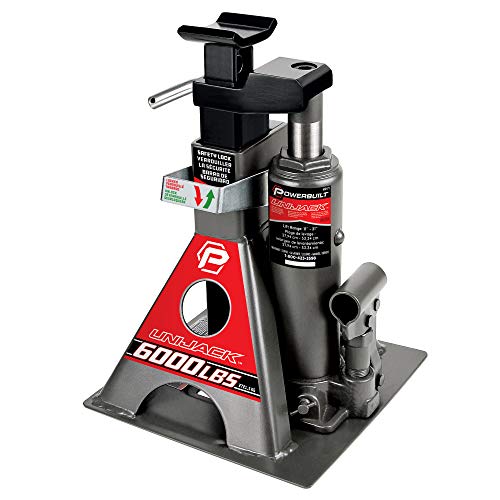
Powerbuilt 3-Ton Unijack All-in-One Hydraulic
The Powerbuilt 620471 Unijack integrates a hydraulic bottle jack and a mechanical ratcheting jack stand into a single unit, eliminating the danger of hydraulic pressure bleed-off. With a 6,000-pound capacity, an 11 to 21-inch lift range, and a wide steel base, it provides dependable single-point lifting and static holding for trucks and SUVs.
Pros
- Combines hydraulic bottle jack lifting and mechanical jack stand safety into one single-point tool
- Physical ratcheting safety lock prevents accidental vehicle drops caused by hydraulic pressure bleed-off
- Wide 9.88 x 9.75-inch base provides excellent stability on garage concrete and level paved surfaces
- Tall 21-inch maximum extension delivers ample working clearance for high-clearance trucks and SUVs
- Meets ANSI standards for portable automotive service equipment and includes a 1-year factory warranty
Cons
- Minimum collapsed height of 11 inches makes it unusable on low-clearance sedans and sports cars
- At 22.66 pounds per single unit, it is significantly heavier than standard individual mechanical jack stands
- Sold as an individual unit rather than a pair, requiring separate purchases if supporting an entire axle
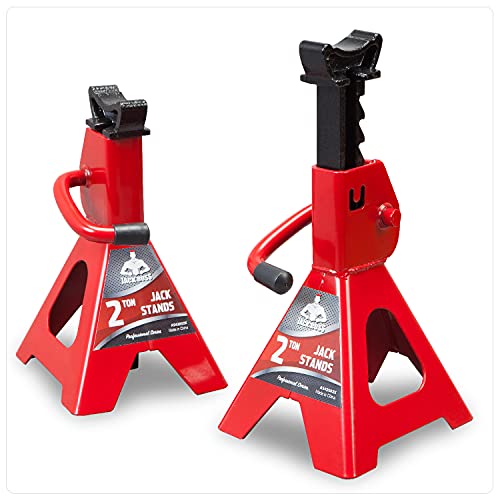
Jack Boss 2-Ton Low-Profile Ratchet Jack Stands
Designed for compact cars and small unibody vehicles, these Jack Boss low-profile jack stands combine a welded mild steel pyramid base with a ductile iron sawtooth ratchet bar spanning a 9.8-inch to 15-inch height range. They provide a lightweight, compact footprint for DIY garage maintenance, though the manufacturer explicitly advises against using them on trucks, large SUVs, or vehicles requiring over 15 inches of chassis clearance.
Pros
- Low 9.8-inch collapsed height fits easily under small passenger cars and lower unibody lift points
- Ductile iron sawtooth ratchet bar allows fast, tool-free height selection and positive pawl engagement
- Lightweight 10.5-pound overall build makes carrying, positioning, and garage storage simple
- Fully welded mild steel frame with protective powder coating guards against rust and shop grime
Cons
- Maximum 15-inch reach is too short for pickup trucks, full-size SUVs, or lifted off-road vehicles
- Single-pawl ratchet design lacks a secondary captive locking pin or redundant safety stop
- Steel concave saddle does not include rubber protection, which may mar painted unibody pinch welds without an aftermarket pad
VEVOR 6-Ton Double-Locking Jack Stands Pair
These VEVOR 6-ton (13,000-lb) double-locking jack stands pair a cast iron ratchet bar with carbon steel pyramid bases and secondary metal safety pins. Built for DIY mechanics, they provide dependable static support with notched saddles and triangular foot pads for trucks, SUVs, and passenger cars.
Pros
- Double-locking safety system incorporates a primary ratchet pawl and a physical metal safety pin
- Generous 6-ton (13,000 lbs) combined load rating provides adequate safety margins for passenger cars, SUVs, and half-ton pickups
- Welded triangular foot pads increase floor contact surface area and improve overall pyramid base stability
- Cast iron ratchet bar with protective rust-proof coating resists workshop corrosion
Cons
- Bare metal notched saddle can crush or bend bare unibody pinch welds without an aftermarket rubber adapter
- Stepped ratchet teeth offer incremental height settings rather than infinite micro-adjustability
- Requires auxiliary structural steel spreader plates if used on warm asphalt driveways to prevent indentation
ANTPOWER 3-Ton Double-Locking Jack Stands
The ANTPOWER 3-ton double-locking jack stands provide reliable static support for garage maintenance, pairing a ductile iron sawtooth ratchet column with a secondary steel side-locking pin. With an 11.2 to 16.8-inch height range and a fully welded pyramid steel base, they offer solid safety for compact cars, sedans, and light crossovers.
Pros
- Secondary side-pin lock adds physical redundancy alongside the primary ratchet pawl
- High-strength ductile iron ratchet bar provides positive sawtooth height adjustments
- Fully welded mild steel pyramid base delivers stable static support on level concrete slabs
- Protective powder-coated finish helps resist common garage moisture and chemical rust
- Manageable 14.3-pound total weight makes repositioning easy during four-corner vehicle setups
Cons
- Maximum 16.8-inch reach is insufficient for lifted 4x4s, full-size trucks, or vehicles with frame heights over 16 inches
- Bare steel saddle lacks a rubber pad, which may mar painted unibody pinch welds without an aftermarket adapter
- Conflicting product listing text notes both 6,000 lbs per pair and 6,600 lbs per stand, requiring conservative 3-ton pair load planning
JKWQFBOYAN 3-Ton Double-Locking Jack Stands
These JKWQFBOYAN 3-ton ratchet jack stands feature a dual-locking setup with a cast iron ratchet bar and secondary metal safety pin supported by a wide carbon steel pyramid base. Designed for DIY maintenance on passenger cars, small trucks, and SUVs, they offer an accessible static support option for budget-conscious home mechanics.
Pros
- Double-locking design combines a ratchet handle mechanism with a metal safety pin for secondary security
- Wide pyramid base features triangular foot pads to distribute static chassis weight across level concrete
- Notched saddle profile helps locate vehicle edges and factory lift points
- Relatively lightweight at under 11 pounds for easy garage positioning and compact shelf storage
Cons
- Minimum collapsed and maximum extended height dimensions are not explicitly specified in the manufacturer data
- Listing notes CE conformity rather than the ASME PASE certification standards typical for U.S. commercial shops
- Notched metal saddle lacks rubber pads, which may require aftermarket pinch-weld protectors to prevent underbody marring
The Mechanical Science and Safety Imperatives of Jack Stands
Vehicle maintenance demands an uncompromising approach to static load holding and chassis stabilization. While lifting a car off the pavement takes only a few strokes of a hydraulic pump handle, securing that elevated chassis for underbody service requires dedicated mechanical locking devices. Examining the structural physics, hydraulic limitations, and load distribution mechanics explains why mechanical stands remain an absolute necessity in every workshop environment.
The Fundamental Physics: Dynamic Hydraulic Jacks vs. Static Mechanical Supports
Hydraulic floor jacks and mechanical jack stands serve entirely different mechanical functions in automotive maintenance. A hydraulic jack is an active lifting mechanism designed to convert manual pumping force into concentrated fluid pressure, which forces a hydraulic piston outward against gravity. Once the pumping action stops, that pressurized column of hydraulic oil must constantly hold the full gravitational mass of the vehicle chassis. Even without a visible external fluid leak, microscopic fluid migration past internal relief valves or check balls gradually diminishes hydraulic pressure over extended working periods.
Mechanical jack stands function as passive, unyielding support structures that require zero fluid retention to maintain elevation. Once lowered onto a rigid stand, the gravitational weight of the vehicle transfers directly through forged ductile iron or heavy stamped steel down to the shop floor. This direct physical load path eliminates fluid pressure variables, bypass valves, and seal degradation from the vehicle support equation entirely. While floor jacks excel at moving weight through vertical space, only mechanical stands possess the structural rigidity required for prolonged stationary holding. For hobbyists transitioning toward larger workshop setups, comparing standard stands against commercial automotive service lifts illustrates how mechanical lockouts remain standard across all professional maintenance equipment.
Failure Modes of Hydraulic Floor Jacks Under Continuous Load
Relying solely on a hydraulic jack to hold a raised vehicle creates an invisible and unpredictable danger zone. Internal hydraulic cylinders depend on precision rubber O-rings and backup seals that degrade over time due to friction, contamination, and temperature fluctuations. If an O-ring ruptures or microscopic metal debris lodges within the internal ball-check valve, hydraulic fluid rapidly bypasses the high-pressure chamber. This loss of internal pressure results in sudden cylinder retraction, dropping the vehicle chassis without warning in a fraction of a second.
External mechanical factors can also cause a hydraulic floor jack to fail catastrophically beneath a vehicle. Floor jacks roll on small steel casters designed to track inward as the lifting arm travels upward through its arc. If a caster hangs up on an expansion joint, a pebble, or an uneven concrete seam, the saddle can slip from the vehicle lift point as the chassis angle changes. Furthermore, inadvertent contact with the jack handle or an accidental twist of the release valve immediately drops the vehicle. Mechanical stands eliminate these failure points by establishing a wide, stationary perimeter that cannot depressurize or roll across the floor.
Decoding Rated Load Capacity: Why ANSI/ASME PASE Measures in Pairs
Selecting vehicle support equipment requires an exact understanding of industrial safety rating conventions. Under the ANSI/ASME PASE standards governing portable automotive service equipment, jack stand capacity ratings are explicitly evaluated per pair rather than per individual unit. A pair of stands marked with a three-ton rating provides a total combined working load limit of six thousand pounds across both units. Misinterpreting this rating as three tons per individual stand can result in dangerous overloading when supporting heavy trucks or commercial vans.
To establish a safe working margin, mechanics must cross-reference vehicle gross weight ratings against axle weight distribution. A typical passenger vehicle distributes approximately sixty percent of its curb weight over the front axle due to the engine and transmission assembly. When lifting the front end of a four-thousand-pound crossover, the support equipment must safely manage twenty-four hundred pounds of dynamic load. Selecting stands that exceed axle load requirements guarantees that structural components operate well beneath their ultimate elastic yield limits. Sturdy support designs provide structural peace of mind when wrenching on stubborn bolts.
Locking Mechanism Engineering: Ratchet Pawls vs. Secondary Safety Pins
Modern vehicle support stands utilize distinct mechanical locking mechanisms to prevent column collapse under load. Ratchet-bar stands employ a cast ductile iron center post equipped with deep saw-tooth notches that engage a pivoting steel pawl. As the post rises, gravity and weighted counterbalances force the pawl into the tooth valley, creating a directional mechanical wedge. Ductile iron offers superior impact resistance compared to standard gray cast iron, resisting tooth fracture under extreme downward compressive stress during sudden vehicle weight transfers.
Many premium designs now integrate a secondary safety pin that passes horizontally through the collar and ratchet bar. This double-locking configuration provides redundant mechanical retention in the unlikely event that the primary pawl shifts or dislodges from the ratchet teeth. Alternatively, pin-type stands replace the ratchet entirely with a solid steel cross-pin inserted through precision-machined holes in a telescoping round tube. While pin-type designs require manual alignment during height adjustments, they offer unequivocal visual verification of positive mechanical engagement that cannot slip out of position.
Chassis Interface Dynamics: Pinch Welds, Frame Rails, and Saddle Geometry
Securing a raised vehicle requires careful matching between the stand saddle profile and the vehicle chassis architecture. Unibody passenger cars utilize reinforced vertical pinch welds along the rocker panels that direct vertical loads into structural pillars. Placing a deep concave steel saddle directly against a thin unibody pinch weld can bend or crush the factory seam, damaging body panels and compromising structural integrity. Specialized slotted rubber pads or flat-top saddles distribute downward force evenly across the reinforced flange without gouging protective paint layers or bending sheet metal.
Body-on-frame trucks and SUVs present entirely different interface requirements than unibody passenger vehicles. Boxed steel frame rails and round solid axle tubes require deep concave or notched saddles that cradle the structural steel securely. A broad saddle perimeter prevents the frame rail from sliding laterally when technicians apply heavy torque to stubborn suspension bolts or axle nuts. Proper alignment ensures that the center of the vehicle chassis contact point aligns precisely with the vertical centerline of the support stand post, preventing uneven side-loading.
Ground Pressure Distribution: Why Base Footprints and Concrete Slabs Matter
The structural stability of any vehicle support setup depends heavily on the compressive strength of the ground surface. A four-leg pyramid base distributes concentrated chassis loads across its perimeter foot pads, generating high ground pressure. While cured concrete slabs withstand several thousand pounds per square inch of compressive force, asphalt driveways soften significantly under direct sunlight and high ambient temperatures. Narrow stamped steel feet can easily punch through hot asphalt, causing the stand to tilt and dropping the vehicle unexpectedly.
When working outside a garage or on questionable surfaces, technicians must place heavy-gauge steel distribution plates beneath each stand base. Improvised thin plywood or plastic mats often deflect, crack, or fracture under concentrated point loads, failing to maintain vertical plumb. For those planning extensive workshop expansions or considering dedicated garage lift installations, verifying floor slab thickness and compressive concrete strength remains just as critical as stand selection. Maintaining a level, unyielding floor surface ensures that the center of gravity remains directly over the stand pyramid footprint at all times.
The Dangers of Makeshift Spacers and Improvised Height Boosters
Attempting to gain extra working height by stacking foreign objects beneath or on top of jack stands creates catastrophic instability. Wooden blocks, dimensional lumber, and landscaping pavers exhibit low compressive strength and irregular shear planes. Under the concentrated downward pressure of a sharp vehicle pinch weld or narrow stand foot, wood blocks frequently split along their natural grain lines without warning. Cinder blocks and hollow bricks are even more dangerous, as their brittle composition shatters violently under sudden point loading.
Height adjustments must always be achieved through the engineered mechanical extension of the stand center post. If a lifted truck or high-clearance off-road vehicle requires greater ground clearance, operators must utilize heavy-duty high-lift stands rather than stacking spacers. Manufacturers design stand bases with specific height-to-width ratios that resist lateral tip-over within their rated extension ranges. Introducing loose spacers elevates the center of gravity beyond engineered parameters and introduces friction slip surfaces that can slide apart when applying torque to chassis components.
The Five-Point Vehicle Support Protocol and the Mandatory Push Test
Executing a safe vehicle lift requires strict adherence to a systematic staging and transfer sequence. First, the vehicle must be parked on a level concrete surface with the transmission locked in park and the emergency brake fully engaged. Second, heavy rubber wheel chocks must be wedged tightly against both the front and rear of the tires remaining on the ground to prevent rolling. Third, the hydraulic floor jack raises the chassis from an approved factory lift point until the target working height is achieved.
Once the stands are positioned under designated chassis support points, the operator slowly opens the hydraulic jack release valve to lower the vehicle onto the saddles. The operator must verify that all four feet of each stand make firm, flat contact with the concrete floor and that the ratchet pawls are fully seated. Finally, before placing any part of the body beneath the vehicle, the operator must conduct an aggressive lateral push test. Grabbing the vehicle bumper or fender and shaking the chassis firmly confirms that the vehicle is mechanically locked and will not shift when wrenching on stubborn bolts.
Stand Inspection, Weld Integrity, and Equipment Retirement Criteria
Regular equipment inspection ensures that mechanical stands maintain their structural safety margins over years of garage use. Technicians should routinely inspect perimeter welds along the base legs and collar tube for hairline fissures, rust pitting, or weld separation. Ratchet bars must be examined for rounded teeth, chipped edges, or casting voids that could allow the pawl to slip under downward load. If a stand post shows any signs of bending, distortion, or excessive collar wobble, the unit must be retired from service immediately.
Storage conditions also influence the long-term reliability and safety of vehicle support gear. Storing stands in damp or unheated sheds can cause internal oxidation along the ratchet track, binding the counterweighted pawl mechanism. Applying a light dry-film lubricant prevents corrosion while avoiding the sticky oil residue that attracts abrasive dirt and metal shavings. Any stand that has experienced a shock load, vehicle drop, or structural collision should be permanently decommissioned to guarantee workshop safety over the long haul.
Adhering to strict vehicle support protocols transforms hazardous underbody mechanical work into a predictable, controlled process. By understanding the mechanical limitations of dynamic hydraulic jacks and respecting the static strength of certified support stands, home mechanics eliminate the risks of unexpected chassis drops. Verifying equipment ratings, inspecting locking pawls, and maintaining proper chassis placement ensures that every maintenance project concludes safely and securely.
About the author
Emily Markham is an automotive aftermarket editor who has covered professional tools, workshop equipment, and the businesses that support vehicle repair since 2019. Her editorial background gives her a practical understanding of how technicians and shop owners evaluate equipment, product value, and long-term support.