
How Much Can a 3 Ton Jack Stand Hold: Weight Limits and Safety for 2026
Learn how much can a 3 ton jack stand hold safely with rated weight limits, axle splits, and garage setup advice for November 2026.
 By Mike Bumbeck
Updated October 10, 2026


Setting up vehicle support equipment requires an exact understanding of weight capacities before anyone crawls underneath an elevated chassis. Many home mechanics ask %how much can a 3 ton jack stand hold% when preparing to lift passenger sedans, crossover SUVs, or light pickup trucks for weekend maintenance. Understanding the real mechanical capacity prevents catastrophic equipment failure, frame damage, and severe garage injuries. Taking time to review safe garage vehicle support protocols ensures that every lifting session begins with proven mechanical stability rather than dangerous guesswork.
Vehicle weight ratings can create serious confusion because automotive support tools often express their capacity limits under specific industry conventions. Knowing whether a rating applies to an individual stand or across a pair determines whether you can safely support an entire axle. Whether you are supporting a car for an oil change or tackling extensive suspension overhauls, matching the structural capability of your stands to your vehicle curb weight is non-negotiable. Quality vehicle stands provide stationary mechanical security, replacing the hydraulic pressure of a floor jack with rigid steel components that do not suffer from internal fluid bypass.
| Award | Product | BJL Score About BJL ScoreThe BJL Score is our own rating from 0 to 10, based on performance, design and build, ease of use, and value. It reflects independent research and is never influenced by manufacturers, retailers, or affiliate commissions. Learn more › | |
|---|---|---|---|
| Best Overall |
YELLOW JACKET 3 Ton Double-Locking Steel Jack
|
9.2/10 | Buy |
| Best Premium |
 VEVOR 3-Ton Hydraulic Bottle Jack and Jack Stand |
9.2/10 | Buy |
 Powerbuilt 3-Ton All-in-One Bottle Jack |
9.2/10 | Buy | |
| Best Budget |
 KOERZORE 3-Ton Jack Stands (Pair) |
8.9/10 | Buy |
| Best Value |
 Amazon Basics 3-Ton Steel Jack Stands |
8.9/10 | Buy |
 VEVOR 3-Ton Double-Locking Jack Stands (Pair) |
8.8/10 | Buy | |
 JMBHWD 3 Ton Double-Locking Jack Stands |
8.6/10 | Buy | |
 ANTPOWER 3-Ton Double-Locking Jack Stands |
8.4/10 | Buy | |
 TONDA 3-Ton Extra Tall Jack Stands |
8.4/10 | Buy | |
 PRUTHY 3-Ton Double-Locking Jack Stands |
8.3/10 | Buy |
YELLOW JACKET 3 Ton Double-Locking Steel Jack
The YELLOW JACKET 3-ton jack stand pair provides a 6,600-pound combined capacity with ductile iron ratchet columns and secondary metal locking pins for redundant garage safety. Featuring a welded stamped steel pyramid base and a 10-7/8-inch to 16-9/16-inch height range, they offer reliable static support for compact cars, crossovers, and midsize SUVs during routine maintenance.
Pros
- Double-locking system pairs a ductile iron ratchet bar with an independent metal safety pin for added physical redundancy
- Solid one-piece forged ductile iron center column provides reliable static tooth engagement across multiple height settings
- Welded stamped steel pyramid base features wide foot pads to support vehicle stability on flat concrete shop floors
- Practical height span of 10-7/8 inches to 16-9/16 inches covers common passenger vehicle maintenance tasks like brake jobs and oil changes
Cons
- The 10-7/8-inch collapsed height may sit too high for significantly lowered sports cars or vehicles with low front splitters
- Bare metal saddle lacks rubber cushioning pads, which may mar painted subframes or bend unprotected pinch welds without aftermarket adapters
- Maximum height reach of 16-9/16 inches is limited for lifted 4x4 trucks or high-clearance off-road vehicles requiring extended droop clearance
VEVOR 3-Ton Hydraulic Bottle Jack and Jack Stand
The VEVOR 3-Ton Hydraulic Bottle Jack and Jack Stand in One combines lifting action and static support into a single 19.62-pound unit rated for 6,613.9 pounds. With a leak-resistant welded cylinder, internal overload valve, and widened base, it provides a compact option for DIY garage vehicle maintenance.
Pros
- Integrated all-in-one hydraulic jack and stand design eliminates the need for separate floor jack positioning.
- Heavy-duty 3-ton (6,613.9 lb) rated capacity suitable for various unibody vehicles, crossovers, and light pickups.
- Welded hydraulic cylinder construction reduces leak potential compared to standard modular screw-together bottle designs.
- Widened base structure provides stable ground distribution on level concrete shop slabs.
- Compact 19.62-pound form factor fits easily in vehicle trunks, toolboxes, or garage shelving.
Cons
- Single-unit configuration requires a second stand if you plan to support an entire axle evenly across two points.
- Upright bottle jack stance requires strictly level, solid concrete to prevent off-center side loading.
- Textured bare-metal saddle lacks a rubber protector pad to cushion painted unibody pinch welds.
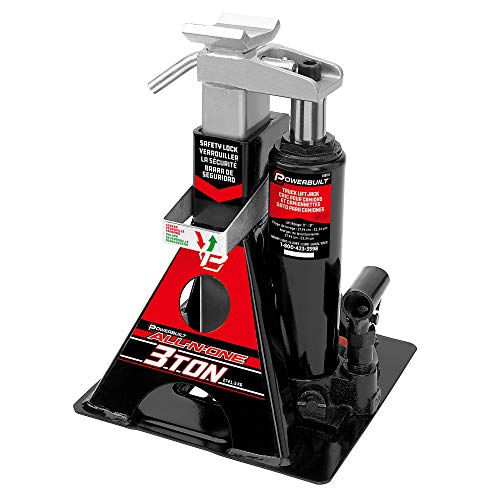
Powerbuilt 3-Ton All-in-One Bottle Jack
This hybrid tool merges a hydraulic bottle jack with an integrated mechanical jackstand to lift and lock vehicles in one step. Its wide, sink-resistant base makes it particularly practical for stabilizing trailers, RVs, and off-road vehicles on soft ground.
Pros
- Dual-function design removes need for separate jackstands
- Mechanical ratcheting bar locks firmly under load
- Wide base provides excellent stability on soft ground
- Meets or exceeds ANSI safety standards
Cons
- Relatively heavy at 22.45 pounds
- Bulky footprint takes up notable storage space
- Covered by only a one-year warranty
KOERZORE 3-Ton Jack Stands (Pair)
Built for garage maintenance and oil changes, these KOERZORE jack stands feature a dual-locking mechanism and a wide pyramid base to support sedans and midsize SUVs safely.
Pros
- Dual-locking mechanism provides added fail-safe protection
- Wide pyramid base enhances stability on hard surfaces
- Concave saddle securely cradles vehicle frame points
- Lightweight 10.7-pound build allows easy garage portability
Cons
- Maximum 16.75-inch height restricts clearance on lifted trucks
- 3-ton capacity is insufficient for heavy-duty commercial vehicles
Amazon Basics 3-Ton Steel Jack Stands
The Amazon Basics 3-Ton Steel Jack Stand Pair delivers 6,000 pounds of reliable vehicle support certified to ASME PASE-2014 standards for portable automotive equipment. Featuring a self-locking ratchet bar and a compact steel footprint, this set is ideal for home garage DIYers servicing passenger cars and urban SUVs.
Pros
- Rated for 3 tons (6,000 lbs) per pair and meets ASME PASE-2014 portable automotive service standards
- Self-locking ratchet bar enables rapid, secure height adjustment without fiddling with separate pins
- Compact 7.5 x 7.0-inch footprint and 12.6-lb total weight make positioning and storage simple
- Protective rustproof coating over a durable steel frame helps resist corrosion from garage fluids
Cons
- 3-ton capacity is tailored for sedans and crossover SUVs, not full-size heavy-duty pickup trucks
- Ratchet assembly does not feature a secondary mechanical cross-locking pin for redundant backup
- Must be used exclusively on flat, solid concrete slabs to prevent uneven weight distribution or base sinking
VEVOR 3-Ton Double-Locking Jack Stands (Pair)
VEVOR 3-ton double-locking jack stands provide 6,000 pounds of static support per pair, combining a cast iron ratchet column with a secondary metal safety pin for added security. With a 10.8- to 16.3-inch height range and welded triangular base feet, they are well-suited for DIY oil changes, brake service, and garage maintenance.
Pros
- Double-locking mechanism pairs a positive ratchet pawl with a heavy metal safety pin for redundant mechanical security
- Welded triangular foot pads provide broader ground contact than bare stamped leg edges on garage floors
- 9 height adjustment stops allow rapid positioning between 10.8 and 16.3 inches
- Compact pyramid footprint and 11-pound total weight allow easy transport and organized garage storage
- Notched saddle profile cradles unibody seams and frame rails securely during maintenance
Cons
- A 10.8-inch minimum collapsed height may not clear aggressively lowered track cars without pre-lifting
- Notched bare metal saddle lacks rubber protective pads and may mar chassis paint or pinch welds without aftermarket adapters
- A 16.3-inch maximum extension limits utility for tall lifted 4x4 trucks or large commercial vehicles
JMBHWD 3 Ton Double-Locking Jack Stands
The JMBHWD 3-Ton Jack Stand pair provides a 6,000-pound total capacity per pair (3,000 pounds per individual stand) with a dual-action safety system pairing a serrated cast iron ratchet bar with a secondary locking pin. Featuring a 7.64-inch by 8.03-inch steel pyramid base and an 11.4-inch to 16.9-inch height envelope, this set is an accessible option for DIY mechanics maintaining sedans, crossovers, and compact passenger vehicles.
Pros
- Secondary locking pin provides redundant mechanical backup to prevent accidental release handle movement
- Stable 7.64-inch by 8.03-inch pyramid base stance helps prevent tipping when positioned on flat, solid concrete
- Cast iron serrated ratchet bar allows quick, stepped height adjustments between 11.4 and 16.9 inches
- Concave saddle profile securely cradles vehicle frame contact points and structural rails
Cons
- Manufacturer specifications clarify this model is not recommended for full-size pickup trucks, commercial vans, or large off-road SUVs
- Minimum collapsed height of 11.4 inches may prove too tall for low-slung sports cars or lowered vehicles without extended floor jack lift height
- Bare metal saddle lacks protective rubber pads, requiring careful placement or aftermarket adapters to avoid marring unibody pinch welds
ANTPOWER 3-Ton Double-Locking Jack Stands
The ANTPOWER 3-ton double-locking jack stands provide reliable static support for garage maintenance, pairing a ductile iron sawtooth ratchet column with a secondary steel side-locking pin. With an 11.2 to 16.8-inch height range and a fully welded pyramid steel base, they offer solid safety for compact cars, sedans, and light crossovers.
Pros
- Secondary side-pin lock adds physical redundancy alongside the primary ratchet pawl
- High-strength ductile iron ratchet bar provides positive sawtooth height adjustments
- Fully welded mild steel pyramid base delivers stable static support on level concrete slabs
- Protective powder-coated finish helps resist common garage moisture and chemical rust
- Manageable 14.3-pound total weight makes repositioning easy during four-corner vehicle setups
Cons
- Maximum 16.8-inch reach is insufficient for lifted 4x4s, full-size trucks, or vehicles with frame heights over 16 inches
- Bare steel saddle lacks a rubber pad, which may mar painted unibody pinch welds without an aftermarket adapter
- Conflicting product listing text notes both 6,000 lbs per pair and 6,600 lbs per stand, requiring conservative 3-ton pair load planning
TONDA 3-Ton Extra Tall Jack Stands
Built with an extended 13.39 to 21.06-inch lift range, these TONDA 3-ton jack stands deliver generous clearance for taller vehicles. The welded carbon steel frame and self-locking cast-iron ratchet bar provide stable, dependable support for regular garage maintenance.
Pros
- Supports up to 6,000 pounds per pair
- Extended 21.06-inch maximum height suits taller vehicles
- Durable welded carbon steel construction
- Wide pyramid base provides a stable footprint
- Self-locking ratchet bar engages automatically when raised
Cons
- High 13.39-inch minimum height limits low-clearance vehicles
- Combined weight of 17 pounds reduces portability
PRUTHY 3-Ton Double-Locking Jack Stands
The PRUTHY 3-Ton Jack Stand Pair provides static vehicle support rated up to 6,600 pounds across the pair, combining a ductile iron ratchet bar with an added metal safety pin for dual-locking peace of mind. Featuring an 11.4-inch to 16.9-inch height range and a wide stamped-steel pyramid base, they offer reliable stability for routine garage maintenance on sedans, crossovers, and small SUVs.
Pros
- Secondary metal safety pin adds a positive mechanical backup to the primary ratchet pawl mechanism
- Welded stamped-steel pyramid base provides solid footing and even weight distribution on level concrete floors
- Clear 11.4-inch to 16.9-inch elevation range works well for passenger cars, crossovers, and compact utility trailers
- Forged one-piece ductile iron ratchet column resists fracturing under static load
Cons
- Minimum collapsed height of 11.4 inches may be too tall for lowered sports cars without pre-lifting
- Maximum extension of 16.9 inches will not provide adequate clearance for lifted 4x4 trucks on oversized tires
- Metal saddle lacks included rubber protective pads to shield delicate pinch welds from cosmetic scratches
Structural Limits, Real Capacity, and Vehicle Weight Matching for 3-Ton Jack Stands
A three-ton rating sounds immense on paper, yet understanding the physical mechanics behind that number makes all the difference between garage safety and disastrous structural failure. In standard automotive terminology, three tons equals six thousand pounds of static holding strength, but how that rating is applied across garage equipment dictates how much weight you can safely support. Misinterpreting this rating leads many home mechanics to either underestimate their safety margin or accidentally overload their support points. Exploring the engineering standards, vehicle weight distribution, and real garage forces reveals exactly what a three-ton setup can handle.
Decoding Industry Standards for Jack Stand Weight Ratings
Under standards established by the American Society of Mechanical Engineers, specifically the ASME PASE portable automotive service equipment code, jack stand ratings apply to the pair when sold together. This means a pair of jack stands labeled as three tons has a combined capacity of 6,000 pounds. Each individual stand in that pair is engineered and rated to carry 3,000 pounds, or 1.5 tons of static weight. Assuming that each individual stand holds three full tons on its own is one of the most dangerous misconceptions in automotive DIY maintenance.
Global manufacturing standards introduce a slight variation between imperial tons and metric tons that buyers should recognize. Standard American short tons equal 2,000 pounds each, while metric tons weigh roughly 2,204.6 pounds. Consequently, several modern three-ton stands specify a total capacity of 6,600 pounds or approximately 6,614 pounds per pair. The fundamental rule remains that the advertised capacity represents the combined strength of both stands working together across a single vehicle axle.
Manufacturer labeling and certified compliance plates provide the definitive record of how a stand was tested. Reputable support stands carry permanently attached data plates or stamped steel markings outlining their rated load per pair. These specifications indicate the maximum static load the units can bear when placed on a hard, flat, level concrete surface. Exceeding that figure by assuming the rating applies per post strips away the structural safety margin designed into the steel frame.
Calculating Vehicle Curb Weight and Axle Load Splits
Evaluating whether a three-ton pair can support your vehicle requires looking at actual vehicle curb weight rather than gross vehicle weight ratings. Curb weight represents the actual weight of the vehicle with all fluids and equipment installed, but without passengers or cargo. A typical compact sedan weighs between 2,800 and 3,200 pounds, a midsize crossover weighs between 3,800 and 4,400 pounds, and a half-ton pickup truck often scales between 4,800 and 5,600 pounds. These figures demonstrate that a 6,000-pound rated pair easily possesses enough gross capacity to support the vast majority of consumer passenger vehicles.
Vehicles never distribute their total mass equally across all four wheels. Front-engine vehicles typically carry a weight distribution of roughly 60 percent on the front axle and 40 percent on the rear axle. When you elevate the front end of a 4,000-pound crossover to perform brake work, the rear tires remain on the ground carrying approximately 1,600 pounds of the chassis. The jack stands supporting the front axle are therefore carrying roughly 2,400 pounds total, which breaks down to about 1,200 pounds per stand, sitting comfortably below their 3,000-pound individual limit.
Problems arise when mechanics attempt to use three-ton equipment on heavy-duty commercial vans, three-quarter-ton diesel trucks, or heavily laden utility vehicles. A heavy diesel truck can easily place over 4,000 pounds of weight exclusively onto its front axle due to the massive cast-iron engine block. In that scenario, a three-ton pair rated for 6,000 pounds would operate near its upper threshold with very little room for dynamic shifting. Stepping up to larger capacity ratings becomes essential whenever working on heavy commercial platforms or vehicles with substantial axle weights.
Static Weight Versus Dynamic Garage Forces
The weight ratings stamped on automotive support stands represent static load capacities, which assume the supported mass remains completely motionless. In an active garage setting, real-world work introduces sudden dynamic forces that temporarily spike the stress placed on individual support columns. Loosening stubborn suspension bolts, removing rusted axle nuts with long breaker bars, or using pry bars to pop ball joints transfers substantial torque through the chassis. These mechanical actions can briefly concentrate hundreds of additional pounds onto a single stand while momentarily unloading the opposite side.
Suspension components also store energy during lifting that can release suddenly during disassembly. When a seized strut or torsion bar breaks free, the chassis can shift abruptly, producing an impact shock rather than a smooth, stationary load. Steel stands possess high tensile and compressive strength, but sudden lateral shock loads test the mechanical limits of ratchet pawls and collar welds. Operating well below the maximum rated capacity ensures the equipment absorbs these sudden garage forces without catastrophic distortion.
A practical working rule among experienced home mechanics is to maintain at least a twenty to thirty percent capacity buffer between vehicle axle weight and the stand rating. If your elevated front axle exerts 2,500 pounds, a three-ton pair rated for 6,000 pounds provides more than a two-to-one safety ratio. This generous margin guarantees that normal wrenching, hammering, and chassis movement will never push the support hardware close to mechanical yield points.
Mechanical Locking Designs and Structural Integrity
The internal locking mechanism directly determines how a jack stand carries its rated three-ton load over time. The most prevalent design in residential garages is the ratchet-bar system, which utilizes a central ductile cast-iron post equipped with angled teeth. A weighted pawl inside the collar pivots beneath each tooth as the post rises, dropping into the tooth pocket to hold the weight. Ductile iron offers excellent compressive strength and shock absorption, making it capable of handling heavy static weight as long as the pawl teeth fully engage.
Double-locking mechanisms have become the modern safety standard to eliminate the hazard of accidental pawl disengagement. These systems pair the conventional ductile iron ratchet bar with a heavy-duty steel safety pin that slides directly through the main housing collar. The steel pin physically locks the vertical ratchet column in position, preventing the release handle from pivoting even if accidentally kicked or bumped. This redundant mechanical lock ensures that the stand cannot release downward until the safety pin is deliberately removed by hand.
Hybrid hydraulic units offer an alternative mechanical approach by integrating a hydraulic bottle jack directly inside a ratcheting steel stand. In these all-in-one systems, hydraulic pressure raises the vehicle to the desired height, while an integrated mechanical locking collar or ratcheting bar engages beneath the load. Once the mechanical bar locks into position, the physical steel column carries the static load rather than the internal hydraulic fluid. This configuration prevents vehicle descent from hydraulic seal leak-down while maintaining the convenient lifting action of a bottle jack.
Height Extension and Base Geometry Under Heavy Load
A jack stand exhibits its highest structural stability and rigidity when resting at its lowest collapsed height. As you extend the ratchet column upward toward its maximum reach, the center of gravity rises and the mechanical leverage exerted by any lateral movement increases. Most three-ton automotive stands feature an adjustment range between approximately 11 inches at full collapse and 16 to 17 inches at maximum extension. While the stand remains certified to hold its rated weight across its entire height spectrum, user stability is noticeably greater when working within the lower and middle height notches.
The footprint of the base plays a monumental role in keeping the supported load vertical and stable. Quality three-ton models feature a wide pyramid design constructed from stamped, heavy-gauge welded carbon steel. A broad base measuring roughly seven to eight inches on each side resists the tipping forces generated when heavy mechanical torque is applied to the vehicle. Narrow-base designs may save storage space, but they dramatically reduce lateral stability when an elevated vehicle experiences side loads.
Welded perimeter foot pads on each corner of the pyramid base prevent the steel legs from digging into surfaces or rocking unevenly. These triangular or rectangular steel pads spread the concentrated downward point loads over a broader surface area. Without broad foot pads, narrow stamped steel leg edges concentrate immense pressure onto the flooring material, increasing the risk of structural slippage. High-quality base welds and symmetrical leg angles ensure that all four corners share the vehicle load equally.
Surface Substrates and Ground Sinking Hazards
A three-ton jack stand can only support its rated capacity when resting upon a completely solid, level substrate. Poured concrete garage floors represent the ideal foundation because cured concrete possesses exceptional compressive strength capable of handling thousands of pounds per square inch. When placed on smooth, level concrete, the broad steel feet remain stationary without flexing, indenting, or shifting beneath the vehicle weight. Working on unlevel floors or across expansion joints can cause three-legged contact, severely reducing stand stability.
Asphalt driveways present a severe hidden danger for elevated vehicles, especially during warm summer weather. Asphalt is a flexible aggregate that softens significantly under direct sunlight and high ambient temperatures. The concentrated downward pressure exerted by the base feet of a loaded jack stand can easily punch deep depressions into soft asphalt. As one leg sinks deeper than the others, the stand tilts out of vertical plumb, creating severe side-loading forces that can cause catastrophic collapse.
To prevent base sinking on non-concrete surfaces, heavy-gauge steel load-distribution plates should be positioned directly beneath each stand foot. Never use makeshift risers like wooden 2×4 blocks, particle board, paving bricks, or hollow cinder blocks to spread the weight or gain extra lifting height. Wood splits unpredictably along natural grain lines when subjected to high point loads, while bricks and concrete blocks crush instantaneously without warning. The stand base must always rest either directly on solid slab concrete or on certified, flat steel distribution plates.
Chassis Contact Points and Saddle Interface
Holding several thousand pounds safely requires positioning the jack stand saddle against factory-engineered structural contact points. Modern passenger cars and crossovers utilize unibody construction, which relies on reinforced pinch-weld seams along the lower rocker panels to bear concentrated lifting loads. Body-on-frame vehicles, such as traditional pickup trucks and large SUVs, utilize rigid steel frame rails that provide sturdy landing pads for stand saddles. Placing stands beneath unreinforced floor pans, thin sheet metal, or suspension control arms will crush body panels and destabilize the vehicle.
Consulting manufacturer guidelines for locating factory jack stand points protects both the vehicle structure and the mechanic working underneath. Automotive service manuals outline the precise reinforced locations along pinch welds, subframe mounting brackets, or solid axle tubes intended for stationary support. Saddles must seat dead center beneath these reinforced zones to prevent off-center loading. An off-center load concentrates massive shear forces along one side of the ratchet post collar, increasing the potential for mechanical slippage.
The profile of the saddle must match the shape of the vehicle lifting location to prevent accidental movement. Deep concave saddles naturally cradle round solid axle tubes and prevent rear drive axles from rolling forward or backward. Flat or shallow-notched saddles interface cleanly with broad frame rails, but they can bend or distort thin unibody pinch welds if used bare. Equipping the stand saddle with slotted vulcanized rubber pads protects delicate factory paint coatings and pinch-weld seams from crushing under the vehicle weight.
Step-by-Step Lowering, Weight Transfer, and Stability Checks
Achieving safe, reliable support requires a disciplined mechanical procedure during every lift. Always park the vehicle on level ground, shift the transmission into park or reverse, engage the emergency brake, and place heavy-duty wheel chocks snugly against both sides of the grounded tires. Use a hydraulic floor jack to raise the chassis smoothly until you achieve sufficient working clearance for your maintenance project. Position your three-ton jack stands directly beneath the designated structural lift points and raise the ratchet columns until the saddles sit just below the chassis.
Gradually lower the hydraulic floor jack release valve to transfer the vehicle mass slowly onto the mechanical stands. When holding a car on stands long term, the full weight of the vehicle must rest entirely upon the stationary steel stands rather than on the hydraulic lift. Once the weight transfers completely, inspect the ratchet pawls to verify they sit fully engaged in their tooth pockets, then insert and lock any secondary safety pins. Leave the hydraulic jack raised just shy of the chassis contact point as a redundant fail-safe without carrying active load.
Before ever crawling beneath an elevated vehicle, perform an aggressive physical stability check from outside the chassis. Place both hands firmly on the vehicle fender or bumper and push forcefully from side to side and forward to backward. If the jack stand feet shift, rock, or lift off the floor during this push test, the setup is unsafe and must be repositioned immediately. A correctly configured three-ton stand setup will feel rock-solid, absorbing vigorous chassis movement without any perceptible flex, collar wobble, or foot lift.
Equipment Inspection and Retirement Criteria
Regular visual inspection of your vehicle support stands is mandatory to guarantee they retain their certified load capacity over years of garage use. Examine the four corner welds joining the base legs to the central collar, looking for hairline cracks, rust scaling, or metal fatigue. Inspect the vertical ratchet column and individual sawtooth notches, verifying that the tooth edges remain sharp, crisp, and square. If dirt, oil, or debris accumulates inside the collar track, clean it thoroughly so the counterweighted pawl drops freely into position.
Any jack stand that displays physical damage or mechanical deformation must be decommissioned and discarded immediately. Rounded pawl teeth, bent release handles, wallowed pin holes, or distorted base legs destroy the calibrated load distribution of the stand. Never attempt to weld, bend, or repair a damaged automotive support stand in a home workshop, as heat from welding weakens the heat-treated metal structure. Replacing compromised support hardware is a modest investment that ensures your garage maintenance always remains completely safe and secure.
Knowing exactly how much weight a three-ton stand can hold empowers you to tackle DIY vehicle maintenance with absolute confidence. By remembering that three tons equates to 6,000 pounds per pair, matching your vehicle axle split to that capacity, and verifying solid mechanical engagement on level concrete, you ensure reliable protection for every garage project.
About the author
Mike Bumbeck is an automotive journalist and hands-on product evaluator with a long-standing interest in classic vehicles, motorcycles, and practical garage equipment. His work brings a grounded perspective to automotive tools, maintenance products, and the details that matter when choosing gear for real-world use.