
How Tall Garage for Car Lift: Garage Ceiling Height Guide for 2026
Planning how tall garage for car lift clearance must be in October 2026 requires measuring vehicle height, lock travel, and overhead doors.
 By Mike Bumbeck
Updated October 9, 2026

Measuring vertical clearances inside a residential workshop is the single most critical step before ordering any lifting equipment. Many homeowners wonder exactly how tall garage for car lift installations require when trying to move away from floor jacks or double their parking space. If ceiling drywall, exposed trusses, or horizontal garage door tracks sit too low, even a compact frame-engaging unit can damage a vehicle roof during elevation. Exploring proven residential car lift options helps clarify which designs fit tighter spaces without sacrificing daily vehicle utility.
Ceiling height requirements depend heavily on whether you choose a two-post frame-contact hoist, a four-post parking stacker, or a low-profile mid-rise scissor platform. Full-height commercial hoists typically demand between eleven and fourteen feet of overhead clearance, while lower scissor and portable units can operate safely under standard eight-foot or nine-foot ceilings. Modern hydraulic car lifts also require several inches of extra headroom beyond maximum lifting height so mechanical safety locks can disengage cleanly. Taking exact physical measurements of your vehicles, garage door opener rails, and slab thickness ensures you select equipment that operates securely without structural interference.
| Award | Product | BJL Score About BJL ScoreThe BJL Score is our own rating from 0 to 10, based on performance, design and build, ease of use, and value. It reflects independent research and is never influenced by manufacturers, retailers, or affiliate commissions. Learn more › | |
|---|---|---|---|
| Best Overall |
LGYORWAY Portable Single Post Mobile Car Lift
|
9.2/10 | Buy |
| Best Value |
 KATOOL 7000 lb Portable Mid-Rise Scissor Lift |
9.1/10 | Buy |
| Best Premium |
 DigMaster 8000 LBS Portable Two Post Car Lift |
9.1/10 | Buy |
 WEIZE 11,000 lb Two-Post Car Lift with 220V 3HP |
9.1/10 | Buy | |
| Best Budget |
 Albott 7000 LBS Portable Scissor Car Lift |
8.6/10 | Buy |
 Albott 7000 lb Portable Car Lift with Extension |
8.1/10 | Buy | |
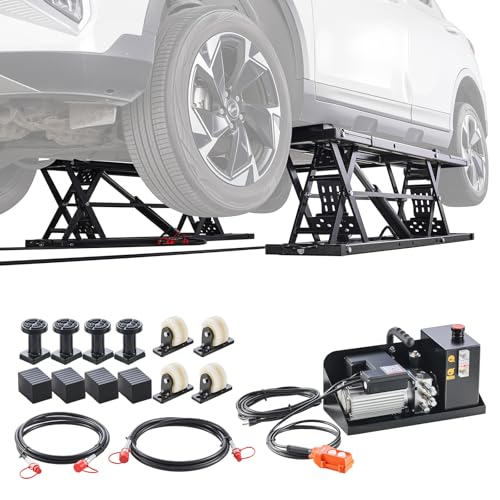 VEVOR Portable Scissor Car Lift |
8.1/10 | Buy | |
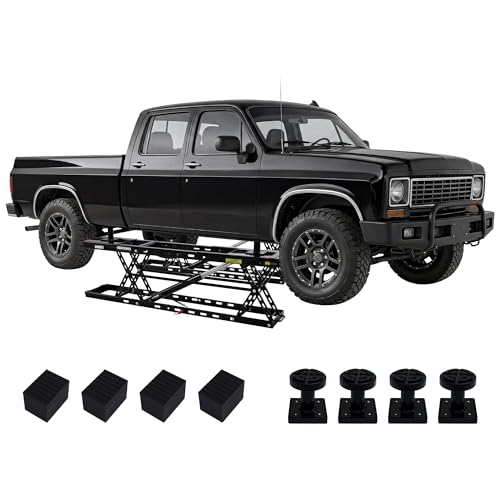 Albott 8000 LBS Portable Car Lift |
7.8/10 | Buy |
LGYORWAY Portable Single Post Mobile Car Lift
The LGYORWAY Portable Single Post Car Lift is a non-hydraulic, mobile tire-engaging lifting station rated for up to 8,800 lbs per wheel with a 33.5-inch maximum lift height. Requiring no electrical wiring, hydraulic fluid, or concrete floor anchors, it is an ideal choice for home garage DIYers and mobile mechanics seeking safe wheel-end access without pinching rocker panels.
Pros
- Mechanical drive requires no 110V or 220V electrical circuits and zero hydraulic fluid sourcing
- Tire-engaging forks eliminate contact with vulnerable vehicle pinch welds, floorboards, and rocker panels
- Compact 31.9 x 30.7 x 49.2-inch footprint rolls easily across standard residential garage slabs on 4 casters
- Substantial 33.5-inch rise height provides far superior working clearance compared to conventional 20-inch floor jacks
- Includes a heavy cargo plate to double as an industrial shop dolly and material handling station
Cons
- Lifts only one wheel or vehicle corner at a time rather than elevating the entire chassis simultaneously
- Carries European CE and TUV marks rather than American Automotive Lift Institute (ALI) gold label certification
- Requires a smooth, solid, and level hard surface to safely support and roll under substantial loads
KATOOL 7000 lb Portable Mid-Rise Scissor Lift
The KATOOL 7,000 lb mid-rise scissor lift delivers 39 inches of lifting clearance with an ultra-low 4.3-inch collapsed profile powered by standard 110V electricity. It is an ideal solution for DIY mechanics, sports car enthusiasts, and low-ceiling garage owners who require dependable vehicle lifting without drilling permanent floor anchors.
Pros
- Substantial 7,000 lb capacity handles a wide variety of passenger cars, lowered sports cars, and light utility vehicles
- Ultra-low 4.3-inch drive-over profile eliminates clearance issues on low-slung performance vehicles
- Runs on a standard 110V household electrical supply for effortless residential garage integration
- Compact 39-inch vertical rise is perfectly matched to standard 8-to-10-foot residential ceiling heights
- Freestanding design avoids the concrete anchor drilling and slab modifications required by two-post lifts
Cons
- LTL freight delivery requires an on-site forklift for offloading or customer pickup at a regional freight terminal
- A 39-inch maximum lift height requires creeper or rolling stool use rather than full upright standing clearance
- Hydraulic oil is not pre-filled and must be sourced separately prior to system priming and operation
DigMaster 8000 LBS Portable Two Post Car Lift
Engineered for home workshops with limited overhead space, the DigMaster portable two-post lift delivers an 8,000-pound capacity, 51.3-inch maximum lifting height, and 220V electric-lock operation. It offers DIY mechanics wheel-free service capability without the permanent footprint of a full-height commercial two-post hoist.
Pros
- 8,000-lb capacity handles passenger vehicles, light trucks, and SUVs without taking up permanent bay space
- Low column height of roughly 72 inches fits comfortably beneath standard 8-foot or 9-foot residential ceilings
- Mid-rise 51.3-inch elevation provides comfortable creeper or rolling seat clearance for underside vehicle maintenance
- Electric lock release system simplifies carriage engagement compared to complex manual dual-point release cables
Cons
- Maximum 51.3-inch lift height does not provide full stand-up undercarriage headroom for taller mechanics
- Requires a 220V electrical power connection, which may necessitate running dedicated garage wiring
- Substantial 1,223-lb shipping weight requires planned freight handling, equipment assistance, or extra hands for unloading
WEIZE 11,000 lb Two-Post Car Lift with 220V 3HP
The WEIZE 11,000-lb two-post automotive lift combines a high-output 220V 3HP hydraulic power unit with an open-floor layout for home garage mechanics and light commercial service bays. Requiring a dedicated 220V circuit, structural concrete slab, and dual-point lock disengagement, it offers substantial lifting capacity for sedans, SUVs, and work trucks.
Pros
- High 11,000-lb capacity easily handles heavier half-ton and three-quarter-ton trucks
- Wide 110.23-inch drive-through clearance makes vehicle positioning simple and stress-free
- Rugged 220V 3 HP hydraulic motor delivers dependable lifting muscle
- Clear-floor layout leaves garage floor completely open for transmission jacks and fluid drains
Cons
- Dual-point safety release requires walking to both columns to disengage locks before lowering
- Requires a dedicated 220V single-phase electrical hookup and an appropriate concrete foundation
- Heavy 1,426-lb shipping package requires a forklift, trailer ramp, or helpers for freight delivery offloading
Albott 7000 LBS Portable Scissor Car Lift
The Albott 7000 LBS Portable Car Lift delivers reliable frame-engaging lifting power with a 28-inch maximum rise height, making it an excellent unanchored solution for low-ceiling residential garages. Built from high-strength Q235B steel, it suits DIY mechanics and car enthusiasts tackling brake jobs, tire rotations, and chassis maintenance on level concrete.
Pros
- Substantial 7,000-lb capacity easily handles most domestic sedans, sports cars, and midsize SUVs
- Mobile four-wheel design eliminates permanent concrete drilling and fits well under standard 8-to-10-foot residential ceilings
- Includes extension panels and multi-height adapter blocks to reach factory frame contact points across different wheelbases
- Multiple mechanical locking positions allow safe, stable under-vehicle working heights off hydraulic pressure
Cons
- Maximum 28-inch rise height does not provide full standing headroom underneath the vehicle
- Weighs 401 pounds, which requires moderate physical effort to reposition or wheel across uneven garage thresholds
- Requires a minimum load of approximately 220 pounds on the frames to compress the return springs and initiate descent
Albott 7000 lb Portable Car Lift with Extension
The Albott 7000 lb Portable Car Lift provides residential mechanics with reliable mid-rise lifting capacity without requiring permanent concrete anchors. Built from high-strength Q355B steel with dual mechanical locking pins, it delivers up to 20 inches of working height for brake jobs, tire rotations, and underbody maintenance.
Pros
- 7,000-pound lifting capacity accommodates a wide variety of passenger vehicles and half-ton trucks.
- Modular extension plates increase maximum jacking spread up to 70.7 inches for longer chassis.
- Dual mechanical safety locks ensure the raised vehicle is mechanically supported during undercar service.
- Compact folding frame design with integrated wall-mount handles preserves valuable garage floor space.
Cons
- Individual lifting frames weigh roughly 120 pounds each, requiring physical effort to position beneath vehicles.
- Maximum rise height of 20 inches provides practical clearance for wheel and suspension service, but does not allow full standing headroom.
- Hydraulic fluid is not included and requires sourcing ISO grade No. 46 hydraulic oil prior to first operation.
VEVOR Portable Scissor Car Lift
The VEVOR 9,000 lb portable electric-hydraulic vehicle lift delivers up to 28 inches of working height on a standard 120V residential circuit without requiring permanent floor anchoring. It is an ideal mid-rise lifting solution for home garage DIYers, truck and SUV owners, and shops with standard 8-to-10-foot ceilings.
Pros
- Substantial 9,000 lb rating safely handles heavier modern trucks, crossovers, and electric vehicles
- Plugs into standard 120V household outlets for straightforward residential garage installation
- Reaches up to 28 inches of working height, ideal for low 8-to-10-foot residential garage ceilings
- Includes four non-slip rubber pads and four taller frame-contact extension columns in the box
Cons
- Total crated package weight of over 450 lbs requires multiple sets of hands or equipment to unload
- Requires sourcing ISO 46 hydraulic oil separately and bleeding the system before initial operation
- The 6.1-inch collapsed profile may require drive-on helper boards for aggressively lowered sports cars
Albott 8000 LBS Portable Car Lift
The Albott 8000 LBS Portable Car Lift provides an 8,000-pound capacity frame-engaging scissor system constructed from high-tensile Q355B steel for low-ceiling residential garages. Featuring mechanical safety locks, dual locking pins, and extension plates reaching up to 75 inches, it suits DIYers and truck owners seeking serious lifting capability without permanent concrete anchoring.
Pros
- Substantial 8,000-lb gross capacity handles heavier consumer trucks and SUVs that exceed smaller portable units.
- Requires no permanent concrete slab anchor bolts, allowing free floor repositioning and low-ceiling garage clearance.
- Included extension plates lengthen frame support reach up to 75 inches to engage separated factory jacking points.
- Constructed from high-grade Q355B structural steel with dual locking pins for reliable mechanical safety.
Cons
- Individual frames weigh roughly 130 pounds each, requiring physical effort to slide and align beneath vehicles.
- Requires sourcing ISO No. 46 hydraulic fluid separately before initial setup and cylinder bleeding.
- Maximum lift height of 27.4 inches is restricted to creeper work and does not offer full standing undercarriage access.
Essential Garage Height Calculations and Clearance Planning for Vehicle Lifts
Determining whether a vehicle lift fits in your garage requires more than comparing column height to the distance between your concrete floor and finished drywall. A garage must provide adequate clearance for the total physical height of the raised vehicle, mechanical lock over-travel, and overhead obstacles like door tracks and rafters. Understanding these vertical dimensions prevents expensive installation delays, structural damage, and unsafe operating conditions.
The Core Vertical Clearance Calculation
Calculating the required ceiling height for vehicle maintenance begins with a straightforward mathematical formula. You must add the total height of your tallest vehicle to the maximum lifting height of the hoist, plus a mechanical buffer. Most automotive hoists require between four and six inches of additional lift beyond the lock position so internal safety pawls can disengage during descent. For example, lifting a sixty-inch sedan on a lift that raises seventy inches requires at least one hundred thirty-four inches, or roughly eleven feet two inches of clear ceiling space.
Vehicle stacking scenarios on four-post parking lifts demand a different calculation. For storage stacking, calculate the height of the lower parked vehicle, the height of the upper stored vehicle, the thickness of the steel runways, and the mandatory lock clearance buffer. Runways typically add four to five inches of vertical profile between the two vehicles. Stacking a fifty-inch sports car over a seventy-inch sport utility vehicle requires fifty inches plus seventy inches plus five inches of runway thickness plus six inches of safety buffer, totaling one hundred thirty-one inches of ceiling clearance.
Failing to account for mechanical lock disengagement is one of the most common mistakes DIY installers make. Hydraulic cylinders push the lift carriage slightly upward above the mechanical safety ladder so the locking dogs can pivot outward before lowering begins. If a vehicle roof is already touching ceiling joists or lighting fixtures while sitting on a lock, the lift cannot raise that extra two to three inches to release the safety pawls. That situation can trap the vehicle on the lift or force the operator to lower the vehicle manually under hazardous conditions.
Ceiling Demands Across Different Lift Architectures
Two-post surface-mounted lifts divide into clear-floor models with overhead crossbeams and baseplate models with hydraulic hoses routed along the floor. Clear-floor designs feature an overhead shutoff bar that prevents tall vehicles from colliding with the top crossbeam. The WEIZE 11000lbs Two Post Car Lift illustrates this architecture with an overall height of one hundred nine inches and a maximum lifting height of 70.87 inches. While its column height stands just over nine feet, servicing taller trucks on its 11,000-pound capacity frame requires at least eleven to twelve feet of ceiling clearance to avoid roof contact.
Baseplate two-post lifts position hydraulic equalization cables and hydraulic lines underneath a floor-mounted cover plate between the columns. This layout keeps the top of the columns open, which allows the posts to fit under lower ceilings between nine and ten feet tall. However, vehicle height still limits how far you can raise a car before its roof approaches the ceiling. The Portable Two Post Car Lift 8000 LBS Capacity bridges these categories with a movable two-post design offering a maximum lifting height of 51.3 inches, making it a viable alternative for garages that cannot accommodate fixed overhead towers.
Mid-rise scissor lifts provide an effective solution for bays where vertical space is strictly constrained. The KATOOL Portable Car Lift Mid Rise Scissor Lift delivers an ultra-low collapsed profile of 4.3 inches and a maximum lifting height of 39 inches while handling up to 7,000 pounds. Under a standard eight-foot residential ceiling, a thirty-nine-inch lift stroke leaves plenty of room above average passenger cars while elevating the chassis high enough for tire rotations, brake overhauls, and body panel maintenance.
Low-Profile Solutions for Standard Eight-Foot and Nine-Foot Bays
Standard residential garages constructed with eight-foot ceilings present unique challenges for traditional full-rise car hoists. In an eight-foot bay, lifting a vehicle sixty inches off the floor would require a building height of at least ten feet once the vehicle roof is factored into the layout. Portable frame-engaging lifts and low-profile scissor platforms resolve this constraint by lifting vehicles between twenty and thirty inches, which positions the vehicle at a comfortable working height for seated creeper tasks without contacting the ceiling.
Units like the Albott 7000 LBS Portable Car Lift with Extension and the VEVOR Portable Car Lift, 9000 lbs Capacity provide maximum lifting heights of up to 28 inches using portable dual-frame ramps. The Albott 7000 lb Portable Car Lift with Extension and the Albott 8000 LBS Portable Car Lift for Home Garage offer working heights ranging between twenty and twenty-seven inches. These heights provide substantial space under the oil pan, transmission, and exhaust system while easily clearing an eight-foot ceiling even when lifting light trucks or full-size sport utility vehicles.
Single-post mobile options offer an alternative approach for specialized wheel-end maintenance in low-clearance spaces. The LGYORWAY Portable Car Lift lifts vehicles up to 8,800 pounds by a single tire up to 33.5 inches without drawing electric or hydraulic shop power. Because only one corner or axle rises at a time, the opposite tires remain planted, keeping the overall roof profile well below typical residential ceiling limits while providing lateral access for brake, suspension, and rocker panel work.
Garage Door Tracks, Openers, and Overhead Obstructions
Measuring from the concrete floor to the ceiling drywall tells only half the story when evaluating garage suitability. Overhead sectional garage doors retract horizontally directly above the service bay, frequently stealing twelve to twenty-four inches of critical vertical working space. Standard ceiling-mounted garage door openers with center pull tracks hang down even further, creating a severe obstruction hazard right above where the vehicle hood or roof needs to rise. Addressing these interference points is a central part of thorough auto lift buying considerations before finalizing your bay layout.
Converting existing garage door tracks to a high-lift track configuration is the most effective way to recover lost ceiling height. A high-lift door track conversion extends the vertical tracks closer to the ceiling before curving into the horizontal run, keeping the door panel flush against the ceiling drywall when open. Alternatively, installing a full-vertical track system allows the door to slide straight up a tall wall if your building features cathedral ceilings or high shop trusses.
Replacing a traditional center-mounted trolley opener with a wall-mounted jackshaft opener completes the overhead clearance upgrade. Jackshaft openers attach directly to the garage door torsion bar on the front wall beside the door opening, eliminating the suspended ceiling motor and drive rail entirely. This modification creates an open, unobstructed vertical corridor from the concrete floor to the ceiling joists, allowing vehicles to reach maximum elevation without striking garage door hardware.
Concrete Slab Foundations and Structural Anchor Integrity
Adequate ceiling height is useless if your concrete floor cannot support the intense mechanical forces generated by a vehicle hoist. Surface-mounted two-post lifts exert tremendous tensile pull-out forces on baseplate anchor bolts, especially when supporting heavy diesel pickup trucks. Standard manufacturer specifications require a minimum concrete slab thickness of four inches with a compressive strength of at least 3,000 PSI cured for a minimum of twenty-eight days. Drilling a test core or checking foundation drawings is critical to verify that your floor meets these structural parameters.
Anchor bolt placement requires strict adherence to manufacturer setback rules to prevent edge blowout or concrete spalling. Wedge anchors must maintain at least six inches of edge distance from any slab perimeter, control joints, relief cuts, or stress cracks. Setting anchors too close to an expansion seam significantly reduces pull-out resistance, creating a severe tipping hazard when heavy vehicles are raised. When tightening anchor bolts, always use a calibrated torque wrench to achieve the exact foot-pound rating specified in the hoist manual.
Post-tension concrete slabs present an extreme safety hazard that requires specialized precautions before drilling any holes. Post-tension slabs contain high-strength steel tendons under severe tension embedded within the concrete. Striking a live post-tension cable with a rotary hammer drill can cause catastrophic structural failure, cracked foundations, and severe personal injury. Garages built on post-tension foundations require professional ground-penetrating radar scanning to map cable locations before any surface anchors are drilled.
Power Unit Voltage, Circuit Breakers, and Hydraulic Demands
Planning lift placement also involves assessing your electrical service panel to ensure it can support hydraulic pump motors. High-capacity hoists, such as the WEIZE two-post clear-floor model, utilize powerful 220V 3-horsepower electric motors that require dedicated single-phase circuits with appropriate thirty-amp circuit breakers. Running a dedicated 220V drop to the primary column provides the necessary power for swift lifting cycles and protects other garage tools from voltage drops.
Lighter mid-rise and portable lifts frequently operate on standard household currents, making them easier to integrate into detached residential garages. The KATOOL mid-rise scissor lift uses a 110V power supply, while the VEVOR 9,000-pound portable unit incorporates a 120V electric-hydraulic power unit with a remote push-button controller. These standard-voltage power systems eliminate the immediate need for extensive electrical rewiring, although they still perform best when connected to a dedicated twenty-amp branch circuit free from high-draw air compressors.
Hydraulic fluid specification is another vital consideration for smooth pump performance and long cylinder seal life. Most automotive lift manufacturers specify ISO VG 32 or ISO VG 46 anti-wear hydraulic oil to maintain proper viscosity across varying seasonal temperatures. The Albott portable lift models explicitly call for Number 46 hydraulic fluid to ensure smooth pressure delivery and controlled descent speeds. Keeping hydraulic reservoirs properly filled and bleeding trapped air from dual-cylinder circuits prevents spongy carriage travel and uneven lifting.
Bay Layout, Drive-Through Spacing, and Delivery Logistics
Evaluating your bay footprint involves measuring horizontal drive-through clearance as well as vertical rafter spacing. A lift like the WEIZE 11,000-pound unit provides a drive-through width of 110.23 inches and an overall width of one hundred thirty-seven inches. Ensuring sufficient lateral clearance between column baseplates and side garage walls allows vehicle doors to open comfortably so technicians can exit the vehicle after positioning it on the lift pads.
Managing the physical delivery of commercial-grade steel columns is another critical planning phase that requires advance preparation. Understanding heavy-duty car lift logistics helps prepare garage owners for LTL freight shipments arriving on full-size tractor-trailers. Large steel columns and crossbeams cannot be offloaded using standard residential liftgates, often requiring terminal pickup or local flatbed tow truck assistance to transport the crated equipment into a residential driveway.
Floor levelness also plays a significant role in safe carriage travel and column stability. Automotive lift columns must stand perfectly plumb, but typical residential garage slabs slope outward toward the vehicle doors for drainage. Manufacturers allow steel horseshoe shims beneath column baseplates to correct minor floor grade variations. However, slopes exceeding four degrees require concrete re-leveling or dedicated structural footing pads before attempting to mount any rigid column system.
Operational Verification and Safety Lock Engagement
Completing a lift installation safely requires a series of physical verification checks before lifting any vehicle to full height. Perform initial lift cycles with an empty carriage to confirm that equalization cables maintain equal tension across both columns. You should hear both mechanical safety locks click simultaneously into their respective ladder slots at every elevation interval. If one carriage clicks noticeably before the other, adjust the steel equalization cables until both sides move in perfect mechanical synchronization.
Never rely on hydraulic pressure alone to support an elevated vehicle while performing maintenance underneath the chassis. Always raise the vehicle past the desired working lock, release the hydraulic control valve to settle the mechanical carriage firmly onto the safety dogs, and inspect the locking pawls visually. This mechanical transfer eliminates hydraulic line pressure, prevents seal stress, and guarantees that the vehicle remains securely supported even in the unlikely event of a hose failure.
Carefully mapping your vertical clearances, foundation integrity, and overhead door hardware turns your garage into an efficient, safe automotive workshop. By combining vehicle height measurements with mechanical lock buffers and verifying slab specifications, you ensure your chosen lift operates reliably for years to come. Taking the time to calculate these dimensions accurately protects your vehicle, your building, and your personal safety every time you hit the lift switch.
About the author
Mike Bumbeck is an automotive journalist and hands-on product evaluator with a long-standing interest in classic vehicles, motorcycles, and practical garage equipment. His work brings a grounded perspective to automotive tools, maintenance products, and the details that matter when choosing gear for real-world use.