
What May Be Used in Lieu of Jack Stands: Practical Answers for 2026
Wondering what may be used in lieu of jack stands? Learn about safe vehicle support, cribbing blocks, and garage safety for November 2026.
 By Larry Carley
Updated October 10, 2026


Working under several thousand pounds of raised automotive steel requires dependable mechanical load-bearing capacity that never relies on hydraulic pressure alone. Home mechanics frequently face situations where dedicated shop equipment is temporarily unavailable, prompting urgent questions about what may be used in lieu of jack stands during emergency repairs or weekend fluid changes. A catastrophic failure under a vehicle leaves zero room for error, which makes understanding load paths, structural chassis interfaces, and certified equipment non-negotiable. Placing unrated materials beneath a chassis creates lethal hazards that many casual DIYers fail to recognize until severe structural shifting occurs.
While commercial vehicle support equipment remains the benchmark for home garage safety, certain engineered tools and structured support methods can provide stationary stability for specific underbody maintenance tasks. Heavy-duty drive-on ramps and certified multi-stage lifting units can help bridge the gap, provided the vehicle wheels remain on the ground and weight ratings are strictly respected. Before raising any chassis, understanding proper ceiling height requirements for lifting equipment helps ensure you maintain adequate overhead clearance while staging your workspace. Examining certified equipment options like hybrid locking bottle stands and low-profile welded supports helps protect your vehicle unibody while preserving life safety.
| Award | Product | BJL Score About BJL ScoreThe BJL Score is our own rating from 0 to 10, based on performance, design and build, ease of use, and value. It reflects independent research and is never influenced by manufacturers, retailers, or affiliate commissions. Learn more › | |
|---|---|---|---|
| Best Overall |
VEVOR 3-Ton Hydraulic Bottle Jack and Jack Stand
|
9.2/10 | Buy |
| Best Value |
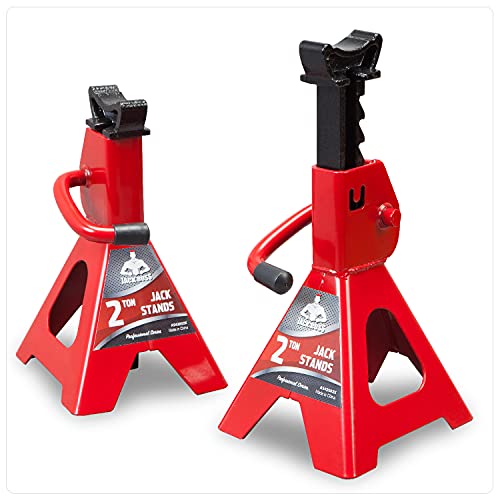 Jack Boss 2-Ton Low-Profile Ratchet Jack Stands |
8.6/10 | Buy |
VEVOR 3-Ton Hydraulic Bottle Jack and Jack Stand
The VEVOR 3-Ton Hydraulic Bottle Jack and Jack Stand in One combines lifting action and static support into a single 19.62-pound unit rated for 6,613.9 pounds. With a leak-resistant welded cylinder, internal overload valve, and widened base, it provides a compact option for DIY garage vehicle maintenance.
Pros
- Integrated all-in-one hydraulic jack and stand design eliminates the need for separate floor jack positioning.
- Heavy-duty 3-ton (6,613.9 lb) rated capacity suitable for various unibody vehicles, crossovers, and light pickups.
- Welded hydraulic cylinder construction reduces leak potential compared to standard modular screw-together bottle designs.
- Widened base structure provides stable ground distribution on level concrete shop slabs.
- Compact 19.62-pound form factor fits easily in vehicle trunks, toolboxes, or garage shelving.
Cons
- Single-unit configuration requires a second stand if you plan to support an entire axle evenly across two points.
- Upright bottle jack stance requires strictly level, solid concrete to prevent off-center side loading.
- Textured bare-metal saddle lacks a rubber protector pad to cushion painted unibody pinch welds.
Jack Boss 2-Ton Low-Profile Ratchet Jack Stands
Designed for compact cars and small unibody vehicles, these Jack Boss low-profile jack stands combine a welded mild steel pyramid base with a ductile iron sawtooth ratchet bar spanning a 9.8-inch to 15-inch height range. They provide a lightweight, compact footprint for DIY garage maintenance, though the manufacturer explicitly advises against using them on trucks, large SUVs, or vehicles requiring over 15 inches of chassis clearance.
Pros
- Low 9.8-inch collapsed height fits easily under small passenger cars and lower unibody lift points
- Ductile iron sawtooth ratchet bar allows fast, tool-free height selection and positive pawl engagement
- Lightweight 10.5-pound overall build makes carrying, positioning, and garage storage simple
- Fully welded mild steel frame with protective powder coating guards against rust and shop grime
Cons
- Maximum 15-inch reach is too short for pickup trucks, full-size SUVs, or lifted off-road vehicles
- Single-pawl ratchet design lacks a secondary captive locking pin or redundant safety stop
- Steel concave saddle does not include rubber protection, which may mar painted unibody pinch welds without an aftermarket pad
Safe Alternatives and Critical Support Rules for Working Under a Vehicle
Finding safe, stable ways to support a chassis becomes essential whenever traditional mechanical stands are missing or ill-suited for a specific task. Many home garage enthusiasts seek answers regarding what may be used in lieu of jack stands when planning routine oil drains, exhaust repairs, or suspension overhauls. True safety depends on recognizing the difference between active hydraulic lifting forces and passive, mechanically locked structural supports. Selecting an appropriate alternative requires strict adherence to rated weight capacities, level surface placement, and designated vehicle lift points.
Why Dedicated Mechanical Support Is Non-Negotiable Under a Raised Chassis
Hydraulic jacks are designed strictly to raise a load off the ground, not to hold it stationary while someone works underneath. Every hydraulic cylinder relies on rubber O-rings, fluid bypass valves, and sealed hydraulic chambers that can fail without warning. When an internal seal blows or a release valve slips, a raised vehicle drops instantly to the garage floor. Relying on a standalone trolley jack, bottle jack, or factory scissor jack to support vehicle weight creates an imminent risk of crushing. Mechanical holding devices eliminate this hazard by transferring the static load into rigid steel columns, forged pins, or interlocking solid structures.
Chassis stability also involves resisting lateral forces that occur when loosening stubborn suspension bolts, lug nuts, or rusted exhaust hangers. Hydraulic jacks roll on steel casters and sit on narrow lifting pads that provide almost no lateral shear resistance. Applying high torque with a breaker bar under an improperly supported chassis easily pulls the vehicle off the jack saddle. Mechanical vehicle supports use wide pyramid bases or broad contact footprints specifically engineered to distribute static weight evenly across a flat surface. Understanding this mechanical reality explains why improvised substitutes so often fail disastrously under real workshop conditions.
Engineered Drive-On Wheel Ramps for Underbody Access
Solid commercial wheel ramps represent one of the few universally recognized, engineered alternatives to stationary support stands when working on a vehicle. Ramps are designed for maintenance procedures that do not require removing the vehicle wheels, such as oil changes, fluid flushes, differential servicing, and exhaust inspections. Quality drive-on ramps feature molded structural honeycomb designs or heavy-gauge welded steel channels rated for substantial vehicle curb weights. Because the vehicle tires remain resting on a solid, cradled platform, the vehicle retains its natural suspension stance without stressing delicate unibody pinch welds.
Using drive-on ramps requires strict adherence to operational safety guidelines to prevent roll-offs or ramp shifting. The vehicle must always be driven onto the ramps on a completely flat, level concrete surface with the steering wheel centered. Once the tires rest inside the curved ramp cradles, the transmission must be placed in park or reverse gear, and the mechanical parking brake must be firmly engaged. Heavy-duty wheel chocks must be positioned tightly against the front and rear of the grounded tires on the opposite axle. Ramps cannot be used for brake inspections, wheel bearing replacements, or suspension arm swaps because the wheels must stay attached and loaded.
Box Cribbing Principles Borrowed from Heavy Rescue Operations
Box cribbing offers a proven, exceptionally rigid method for holding vehicle weight by adapting techniques long utilized in structural firefighting and industrial rigging. This technique involves stacking dimensional hardwood timbers, such as solid oak or ash four-by-four beams, in perpendicular pairs to form a stable square tower. Weight is transferred directly through the solid overlapping corners of the wood, which can support thousands of pounds without bowing or deflecting. Box cribbing is commonly built directly beneath the vehicle tires, providing a broad, unyielding platform that will not tip or buckle sideways under wrenching torque.
Building safe cribbing requires strict structural discipline and high-grade materials rather than random construction debris. Only solid, defect-free hardwood or engineered composite cribbing blocks should be utilized, as soft pine lumber can compress and crack unpredictably along natural grain lines. Each tier must sit perfectly square, level, and flat on a clean concrete slab, with each upper timber overlapping the lower joint by at least several inches. Box cribbing should never be used as a tall, skinny stack directly against thin frame rails or unibody seams without a dedicated load-spreading header plate. When built correctly beneath tires, a box crib provides immense load-bearing stability for extended storage or heavy underbody wrenching.
Hybrid Lifting Solutions: Bottle Jack and Stand Combinations
All-in-one lifting tools combine the effortless raising power of a hydraulic bottle jack with the locked security of a mechanical support stand. Devices such as the VEVOR Hydraulic Bottle Jack and Jack Stand in One solve the classic dilemma of where to position a separate stand when the floor jack occupies the factory lift point. These hybrid units incorporate a welded hydraulic cylinder surrounded by a heavy steel collar and a mechanical locking bar. Once the internal hydraulic ram raises the vehicle to the desired height, a physical locking mechanism drops into place to mechanically secure the load.
The primary advantage of a hybrid unit is that it eliminates the dangerous transfer step between lifting equipment and stationary holding tools. The manufacturer specifications for this style of equipment highlight integrated features like overload relief valves, leak-resistant welded cylinders, and wide structural base plates. Once the mechanical pawl or pin engages, the hydraulic pressure can be relieved, leaving the chassis resting safely on rigid steel rather than pressurized fluid. This setup is particularly advantageous for trucks, sport utility vehicles, and trailers where chassis clearance permits positioning a taller, all-in-one base directly beneath a solid axle tube or frame horn.
Low-Profile Dedicated Stands as the Practical Compact Baseline
When vehicle ground clearance is minimal, compact mechanical stands remain the simplest and most dependable equipment choice for residential garages. Units like the Jack Boss Jack Stands Low Profile 2 Ton(4000 LBs) provide an entry height as low as 9.8 inches, sliding easily beneath lowered sedans and compact cars. The ductile iron sawtooth ratchet bar allows quick, incremental height adjustment up to a 15-inch maximum lift limit. Constructed with a fully welded mild steel frame and a pyramid foot base, this style of equipment delivers dependable structural support without requiring excessive garage storage space.
Low-profile stands feature large concave saddles that cradle frame rails or suspension pickup points while relieving pressure from the vehicle tires. The multi-position ratchet bar utilizes a positive self-locking mechanism that seats deeply into cast iron teeth under the downward force of the vehicle. While these compact units are not recommended for tall four-wheel-drive trucks with chassis rails exceeding 15 inches, they excel on passenger vehicles with tight underbody clearances. Keeping a matched pair of low-profile stands in your shop ensures you never have to resort to improvised, dangerous lifting compromises when performing brake overhauls or tire rotations.
Permanent and Semi-Permanent Vehicle Lift Systems
Home mechanics who frequently perform major restoration projects, transmission replacements, or engine pulls often upgrade to dedicated mechanical vehicle lifts. Two-post lifts, four-post storage lifts, and mid-rise scissor lifts represent the ultimate alternative to mobile jack stands, providing complete walk-under working access. These systems utilize heavy structural steel columns, electro-hydraulic power units, and continuous mechanical locking ladders that automatically catch every few inches of ascent. If you are exploring permanent lifting options, researching dedicated automotive shop lifts can help you evaluate overhead clearance, post anchoring, and power requirements.
Installing a permanent vehicle lift requires verifying that your garage floor concrete meets strict compressive strength and thickness standards. Most light-duty automotive lifts require a minimum of four inches of reinforced slab concrete rated at 3,000 pounds per square inch to support heavy anchor bolts. Mid-rise portable scissor lifts offer a flexible alternative for standard home garages, lifting a vehicle several feet off the floor while resting on large steel base plates that distribute ground pressure. Regardless of the lift design, mechanical safety locks must always be fully engaged before walking beneath the vehicle, ensuring that hydraulic cylinders never bear stationary loads unattended.
Lethal Makeshift Substitutes You Must Strictly Prohibit
Every year, severe garage accidents occur because DIYers place unrated household materials beneath raised chassis in place of certified support equipment. Hollow concrete cinder blocks and decorative paving stones are among the most hazardous makeshift items ever used under an automobile. Cinder blocks are engineered solely to handle distributed compressive loads across their flat outer faces in architectural masonry walls. When placed beneath a narrow steel frame rail or axle tube, the vehicle weight generates intense, concentrated point-load pressure that shatters the brittle concrete without warning. A crumbling cinder block causes instantaneous chassis collapse with zero structural warning.
Loose stacks of scrap lumber, firewood logs, or unrated plastic containers present equally severe risks under a raised automobile. Construction-grade two-by-four lumber splits easily along longitudinal grain lines when subjected to angular weight or shifting suspension loads. Stacking loose wooden boards creates multiple slippery interface points that can kick out sideways the moment a wheel is tugged or an axle bolt is wrenched loose. Leaving a car balanced entirely on an unrated hydraulic jack or emergency roadside scissor jack is another fatal mistake that invites catastrophic seal blowouts. No home maintenance job is worth risking your life over improvised, uncertified cribbing materials.
Vehicle Chassis Interfaces: Pinch Welds, Frame Rails, and Axle Tubes
Correctly interfacing your chosen support device with the vehicle chassis is just as critical as selecting the support equipment itself. Modern unibody passenger cars feature specific reinforced lift points along the rocker panel pinch welds where two stamped sheet metal seams meet. Placing a broad, bare steel saddle directly on a delicate pinch weld without a slotted rubber protector can fold the sheet metal, crush floor pans, and damage factory rust-proofing coatings. Full-frame pickup trucks and older rear-wheel-drive vehicles offer heavier structural boxed frame rails that accommodate curved cradles and flat support surfaces far more easily.
Solid live rear axle tubes on trucks and rear-drive sport utility vehicles provide excellent support points when overhauling suspension or rear braking components. The support saddle must feature a deep concave recess or contoured notch that securely hugs the round axle casing, preventing side-to-side slippage during mechanical work. You should never place support equipment beneath thin stamped suspension control arms, steering tie rods, oil pans, or drive shafts, as these components lack the structural strength to hold vehicle curb weight. Always consult your vehicle owner manual or factory service documentation to locate the precise structural lift points recommended by the automotive manufacturer.
Mechanical Weight Transfer and the Mandatory Lateral Push Test
The physical process of transferring a vehicle weight from your lifting mechanism onto stationary supports must follow a meticulous, controlled sequence. Before lifting begins, the vehicle must be parked on flat, smooth poured concrete, the transmission set in park or low gear, and heavy chocks placed against opposing tires. Once the vehicle is lifted to the desired working height, position your mechanical supports squarely beneath the designated factory lifting points. Lower the hydraulic jack extremely slowly, watching closely to ensure the support saddles contact the chassis dead center without catching body panels or tilting on their bases.
After the full weight of the vehicle rests entirely on the mechanical supports, lower the hydraulic jack slightly so it remains just beneath the frame as an unloaded safety backstop. Before crawling underneath the car or removing any wheels, you must conduct a firm, two-handed lateral push test against the vehicle bumper or fender. Push the chassis firmly from the side and front to verify that the vehicle will not shift, rock, or slip off its supports under aggressive wrenching forces. If the vehicle moves, creaks excessively, or one foot of a support lifts off the concrete floor, raise the vehicle immediately and readjust your support positioning.
Practical Summary on Alternative Vehicle Support Equipment
Working under a raised automobile safely requires respecting the physics of static load distribution and mechanical failure modes. While commercial drive-on ramps and well-constructed hardwood box cribbing can serve as dependable substitutes for wheel-on maintenance, jobs requiring wheel removal demand certified mechanical holding devices. Hybrid bottle jack stands and low-profile ratchet stands provide affordable, space-efficient security that completely removes hydraulic failure risks from your garage. Never allow convenience or haste to justify placing brittle concrete pavers, scrap wood, or unsupported hydraulic jacks beneath your vehicle. Taking the time to stage certified equipment, verify chassis contact points, and perform a rigorous shake test ensures that every garage project finishes safely.
About the author
Larry Carley is an experienced automotive technical writer and editor with more than four decades of work covering vehicle diagnostics, repair procedures, and automotive technology. His extensive technical writing helps readers understand mechanical systems, maintenance decisions, and the importance of accurate information when working on vehicles.