
How Strong Are Jack Stands: Practical Ratings and Load Guide for 2026
Learn how strong are jack stands in this November 2026 vehicle support guide covering rated weight capacities, ANSI standards, and underbody chassis stability.
 By Christian Hazel
Updated October 10, 2026


Crawling beneath a multi-ton vehicle requires absolute confidence in your mechanical support equipment. When tackling brake jobs, fluid flushes, or suspension overhauls on a home garage floor, home mechanics frequently ask how strong are jack stands before trusting their physical safety to stamped steel or cast iron pillars. Jack stands serve as the stationary foundation that prevents catastrophic mechanical drops when hydraulic pressure inevitably bleeds off from a floor jack. Understanding rated load capacities, weld integrity, and the physical engineering behind secondary safety pins ensures that your chassis stays firmly elevated without sudden slippage.
Load ratings often generate confusion because equipment standards specify weight thresholds differently than consumer expectations anticipate. Deciding between a standard three-ton unit and a heavy-duty six-ton support post requires calculating gross vehicle weight distribution and checking factory pick points. Proper preparation also extends beyond the stands themselves, much like consulting a garage ceiling height planning guide before configuring taller overhead shop setups. Choosing equipment verified under recognized safety protocols gives you the peace of mind required to turn high-torque wrenching into a safe, routine task.
| Award | Product | BJL Score About BJL ScoreThe BJL Score is our own rating from 0 to 10, based on performance, design and build, ease of use, and value. It reflects independent research and is never influenced by manufacturers, retailers, or affiliate commissions. Learn more › | |
|---|---|---|---|
| Best Overall |
YELLOW JACKET 3 Ton Double-Locking Steel Jack
|
9.2/10 | Buy |
| Best Value |
 Amazon Basics 3-Ton Steel Jack Stands |
8.9/10 | Buy |
| Best Premium |
 Powerbuilt 3-Ton Unijack All-in-One Hydraulic |
8.9/10 | Buy |
| Best Budget |
 Jack Boss 2-Ton Low-Profile Ratchet Jack Stands |
8.6/10 | Buy |
 VEVOR 6-Ton Double-Locking Jack Stands Pair |
8.6/10 | Buy | |
 ANTPOWER 3-Ton Double-Locking Jack Stands |
8.4/10 | Buy | |
 TONDA 3-Ton Extra Tall Jack Stands |
8.4/10 | Buy | |
 PRUTHY 3-Ton Double-Locking Jack Stands |
8.3/10 | Buy | |
 Pro-Lift T-6906D 6-Ton Double Locking Jack Stands |
8.0/10 | Buy | |
 JKWQFBOYAN 3-Ton Double-Locking Jack Stands |
7.8/10 | Buy |
YELLOW JACKET 3 Ton Double-Locking Steel Jack
The YELLOW JACKET 3-ton jack stand pair provides a 6,600-pound combined capacity with ductile iron ratchet columns and secondary metal locking pins for redundant garage safety. Featuring a welded stamped steel pyramid base and a 10-7/8-inch to 16-9/16-inch height range, they offer reliable static support for compact cars, crossovers, and midsize SUVs during routine maintenance.
Pros
- Double-locking system pairs a ductile iron ratchet bar with an independent metal safety pin for added physical redundancy
- Solid one-piece forged ductile iron center column provides reliable static tooth engagement across multiple height settings
- Welded stamped steel pyramid base features wide foot pads to support vehicle stability on flat concrete shop floors
- Practical height span of 10-7/8 inches to 16-9/16 inches covers common passenger vehicle maintenance tasks like brake jobs and oil changes
Cons
- The 10-7/8-inch collapsed height may sit too high for significantly lowered sports cars or vehicles with low front splitters
- Bare metal saddle lacks rubber cushioning pads, which may mar painted subframes or bend unprotected pinch welds without aftermarket adapters
- Maximum height reach of 16-9/16 inches is limited for lifted 4x4 trucks or high-clearance off-road vehicles requiring extended droop clearance
Amazon Basics 3-Ton Steel Jack Stands
The Amazon Basics 3-Ton Steel Jack Stand Pair delivers 6,000 pounds of reliable vehicle support certified to ASME PASE-2014 standards for portable automotive equipment. Featuring a self-locking ratchet bar and a compact steel footprint, this set is ideal for home garage DIYers servicing passenger cars and urban SUVs.
Pros
- Rated for 3 tons (6,000 lbs) per pair and meets ASME PASE-2014 portable automotive service standards
- Self-locking ratchet bar enables rapid, secure height adjustment without fiddling with separate pins
- Compact 7.5 x 7.0-inch footprint and 12.6-lb total weight make positioning and storage simple
- Protective rustproof coating over a durable steel frame helps resist corrosion from garage fluids
Cons
- 3-ton capacity is tailored for sedans and crossover SUVs, not full-size heavy-duty pickup trucks
- Ratchet assembly does not feature a secondary mechanical cross-locking pin for redundant backup
- Must be used exclusively on flat, solid concrete slabs to prevent uneven weight distribution or base sinking
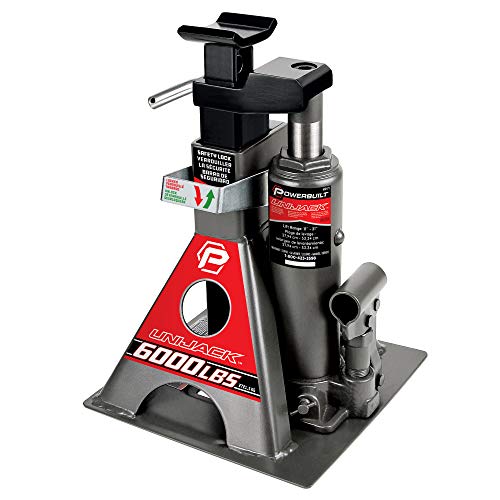
Powerbuilt 3-Ton Unijack All-in-One Hydraulic
The Powerbuilt 620471 Unijack integrates a hydraulic bottle jack and a mechanical ratcheting jack stand into a single unit, eliminating the danger of hydraulic pressure bleed-off. With a 6,000-pound capacity, an 11 to 21-inch lift range, and a wide steel base, it provides dependable single-point lifting and static holding for trucks and SUVs.
Pros
- Combines hydraulic bottle jack lifting and mechanical jack stand safety into one single-point tool
- Physical ratcheting safety lock prevents accidental vehicle drops caused by hydraulic pressure bleed-off
- Wide 9.88 x 9.75-inch base provides excellent stability on garage concrete and level paved surfaces
- Tall 21-inch maximum extension delivers ample working clearance for high-clearance trucks and SUVs
- Meets ANSI standards for portable automotive service equipment and includes a 1-year factory warranty
Cons
- Minimum collapsed height of 11 inches makes it unusable on low-clearance sedans and sports cars
- At 22.66 pounds per single unit, it is significantly heavier than standard individual mechanical jack stands
- Sold as an individual unit rather than a pair, requiring separate purchases if supporting an entire axle
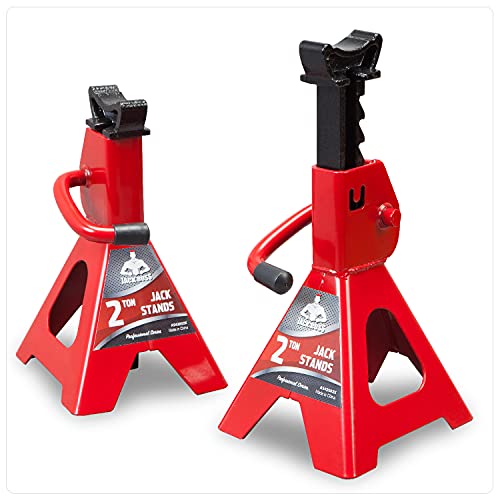
Jack Boss 2-Ton Low-Profile Ratchet Jack Stands
Designed for compact cars and small unibody vehicles, these Jack Boss low-profile jack stands combine a welded mild steel pyramid base with a ductile iron sawtooth ratchet bar spanning a 9.8-inch to 15-inch height range. They provide a lightweight, compact footprint for DIY garage maintenance, though the manufacturer explicitly advises against using them on trucks, large SUVs, or vehicles requiring over 15 inches of chassis clearance.
Pros
- Low 9.8-inch collapsed height fits easily under small passenger cars and lower unibody lift points
- Ductile iron sawtooth ratchet bar allows fast, tool-free height selection and positive pawl engagement
- Lightweight 10.5-pound overall build makes carrying, positioning, and garage storage simple
- Fully welded mild steel frame with protective powder coating guards against rust and shop grime
Cons
- Maximum 15-inch reach is too short for pickup trucks, full-size SUVs, or lifted off-road vehicles
- Single-pawl ratchet design lacks a secondary captive locking pin or redundant safety stop
- Steel concave saddle does not include rubber protection, which may mar painted unibody pinch welds without an aftermarket pad
VEVOR 6-Ton Double-Locking Jack Stands Pair
These VEVOR 6-ton (13,000-lb) double-locking jack stands pair a cast iron ratchet bar with carbon steel pyramid bases and secondary metal safety pins. Built for DIY mechanics, they provide dependable static support with notched saddles and triangular foot pads for trucks, SUVs, and passenger cars.
Pros
- Double-locking safety system incorporates a primary ratchet pawl and a physical metal safety pin
- Generous 6-ton (13,000 lbs) combined load rating provides adequate safety margins for passenger cars, SUVs, and half-ton pickups
- Welded triangular foot pads increase floor contact surface area and improve overall pyramid base stability
- Cast iron ratchet bar with protective rust-proof coating resists workshop corrosion
Cons
- Bare metal notched saddle can crush or bend bare unibody pinch welds without an aftermarket rubber adapter
- Stepped ratchet teeth offer incremental height settings rather than infinite micro-adjustability
- Requires auxiliary structural steel spreader plates if used on warm asphalt driveways to prevent indentation
ANTPOWER 3-Ton Double-Locking Jack Stands
The ANTPOWER 3-ton double-locking jack stands provide reliable static support for garage maintenance, pairing a ductile iron sawtooth ratchet column with a secondary steel side-locking pin. With an 11.2 to 16.8-inch height range and a fully welded pyramid steel base, they offer solid safety for compact cars, sedans, and light crossovers.
Pros
- Secondary side-pin lock adds physical redundancy alongside the primary ratchet pawl
- High-strength ductile iron ratchet bar provides positive sawtooth height adjustments
- Fully welded mild steel pyramid base delivers stable static support on level concrete slabs
- Protective powder-coated finish helps resist common garage moisture and chemical rust
- Manageable 14.3-pound total weight makes repositioning easy during four-corner vehicle setups
Cons
- Maximum 16.8-inch reach is insufficient for lifted 4x4s, full-size trucks, or vehicles with frame heights over 16 inches
- Bare steel saddle lacks a rubber pad, which may mar painted unibody pinch welds without an aftermarket adapter
- Conflicting product listing text notes both 6,000 lbs per pair and 6,600 lbs per stand, requiring conservative 3-ton pair load planning
TONDA 3-Ton Extra Tall Jack Stands
Built with an extended 13.39 to 21.06-inch lift range, these TONDA 3-ton jack stands deliver generous clearance for taller vehicles. The welded carbon steel frame and self-locking cast-iron ratchet bar provide stable, dependable support for regular garage maintenance.
Pros
- Supports up to 6,000 pounds per pair
- Extended 21.06-inch maximum height suits taller vehicles
- Durable welded carbon steel construction
- Wide pyramid base provides a stable footprint
- Self-locking ratchet bar engages automatically when raised
Cons
- High 13.39-inch minimum height limits low-clearance vehicles
- Combined weight of 17 pounds reduces portability
PRUTHY 3-Ton Double-Locking Jack Stands
The PRUTHY 3-Ton Jack Stand Pair provides static vehicle support rated up to 6,600 pounds across the pair, combining a ductile iron ratchet bar with an added metal safety pin for dual-locking peace of mind. Featuring an 11.4-inch to 16.9-inch height range and a wide stamped-steel pyramid base, they offer reliable stability for routine garage maintenance on sedans, crossovers, and small SUVs.
Pros
- Secondary metal safety pin adds a positive mechanical backup to the primary ratchet pawl mechanism
- Welded stamped-steel pyramid base provides solid footing and even weight distribution on level concrete floors
- Clear 11.4-inch to 16.9-inch elevation range works well for passenger cars, crossovers, and compact utility trailers
- Forged one-piece ductile iron ratchet column resists fracturing under static load
Cons
- Minimum collapsed height of 11.4 inches may be too tall for lowered sports cars without pre-lifting
- Maximum extension of 16.9 inches will not provide adequate clearance for lifted 4x4 trucks on oversized tires
- Metal saddle lacks included rubber protective pads to shield delicate pinch welds from cosmetic scratches
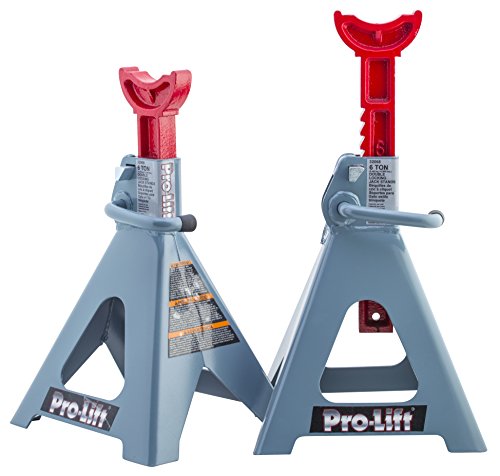
Pro-Lift T-6906D 6-Ton Double Locking Jack Stands
The Pro-Lift T-6906D 6-ton jack stand pair features heavy stamped steel bases, cast ductile iron ratchet bars, and secondary mobility pins for redundant garage safety. Offering a tall 16-inch to 23.5-inch working range, this ANSI/PALD-compliant set suits truck, SUV, and farm equipment owners requiring solid static undercarriage support.
Pros
- Secondary mobility pin creates a physical mechanical stop that locks the ratchet column against accidental handle release
- Tall 23.5-inch maximum lift extension provides generous under-vehicle clearance for truck frame rails and suspension servicing
- Sturdy stamped steel pyramid base and cast ductile iron ratchet bar meet ANSI/PALD safety standards
- Tethered safety pin lanyard keeps critical hardware right on the stand so it cannot be misplaced
Cons
- Tall 16-inch minimum collapsed height will not fit lowered cars, sports cars, or standard unibody sedans
- Bare metal saddle teeth can indent unibody pinch welds or scrape painted axle tubes without aftermarket rubber pads
- Substantial 26.4-pound paired weight and tall footprint make storage and mobile paddock transport less convenient than compact aluminum stands
JKWQFBOYAN 3-Ton Double-Locking Jack Stands
These JKWQFBOYAN 3-ton ratchet jack stands feature a dual-locking setup with a cast iron ratchet bar and secondary metal safety pin supported by a wide carbon steel pyramid base. Designed for DIY maintenance on passenger cars, small trucks, and SUVs, they offer an accessible static support option for budget-conscious home mechanics.
Pros
- Double-locking design combines a ratchet handle mechanism with a metal safety pin for secondary security
- Wide pyramid base features triangular foot pads to distribute static chassis weight across level concrete
- Notched saddle profile helps locate vehicle edges and factory lift points
- Relatively lightweight at under 11 pounds for easy garage positioning and compact shelf storage
Cons
- Minimum collapsed and maximum extended height dimensions are not explicitly specified in the manufacturer data
- Listing notes CE conformity rather than the ASME PASE certification standards typical for U.S. commercial shops
- Notched metal saddle lacks rubber pads, which may require aftermarket pinch-weld protectors to prevent underbody marring
Evaluating Mechanical Strength, Capacity Ratings, and Structural Load Limits
A pair of quality support stands can withstand thousands of pounds of downward mechanical force without structural yield. Most automotive jack stands designed for consumer garages hold between 4,000 and 13,000 pounds when deployed in matched pairs on level ground. That holding strength relies on precise metallurgy, rigid geometric base designs, and secure mechanical pawl locks rather than hydraulic pressure. Learning how these components interact helps home mechanics match their equipment to vehicle gross weights while avoiding dangerous structural failure points.
Understanding ANSI/ASME PASE Standards and Per-Pair Capacity Ratings
Standardized safety ratings define how automotive lifting equipment must perform under sustained mechanical load. The American Society of Mechanical Engineers establishes criteria under the ASME PASE standard for portable automotive service equipment. This standard mandates that capacity ratings for standard support stands apply to a matched pair rather than an individual unit. When a stand set features a label stating three tons, the equipment is designed to hold 6,000 pounds distributed across both stands.
Confusion surrounding rating definitions remains one of the primary causes of workshop overloading. Placing 6,000 pounds of vehicle weight onto a single three-ton rated post cuts the built-in engineering safety factor in half. Certified manufacturers subject their designs to proof load tests exceeding nominal capacity to verify that components resist deformation. Trusting unrated imports that lack clear ASME or ANSI documentation creates unnecessary risks during heavy chassis work.
Consumer models also exhibit minor rating variations that buyers must read carefully. Certain units, such as the YELLOW JACKET and ANTPOWER three-ton models, carry a specific 6,600-pound pair rating based on metric conversion thresholds. Other units, like the Amazon Basics steel stands, list an even 6,000-pound threshold matching standard US short tons. Always confirm the exact poundage marked on the manufacturer data plate before planning your maintenance setup.
Material Metallurgy: Ductile Cast Iron versus Stamped Welded Steel
The structural strength of a jack stand depends directly on the metal alloys selected for each component. Outer upright columns and base legs almost universally employ stamped sheet steel or formed carbon steel plate. High-grade mild steel offers excellent tensile strength and bends slightly under extreme yield stress rather than snapping catastrophically. Fully welded perimeter seams join the four legs into a rigid pyramid that resists torsional twist.
The center ratchet column demands a completely different metallurgical approach to handle direct downward compressive force. Quality manufacturers forge or cast this notched bar from ductile iron rather than standard grey cast iron. Ductile cast iron incorporates nodular graphite within its microscopic crystalline structure, granting the metal superior shock resistance and fracture toughness. This property prevents the sawtooth teeth from shearing off when supporting thousands of pounds of steel chassis weight.
Weld quality along the base frame also plays a crucial role in overall holding capability. Inspecting the leg joints should reveal continuous, uniform weld beads without visible slag inclusions, gaps, or porosity. Incomplete weld penetration creates localized stress risers that can tear when subjected to uneven chassis loading. Heavy-duty units utilize formed steel collars welded directly to the top of the pyramid body to guide the center post securely.
Mechanical Locking Physics: Pawl Engagement and Double-Pin Security
Ratcheting support stands rely on a simple yet robust mechanical interface to sustain vertical loads. The center column features angled sawtooth notches that mate with a pivoted ductile iron pawl inside the collar. As the column rises, a weighted pawl drops into the corresponding tooth pocket under the force of gravity. Downward vehicle weight drives the tooth deeper into the collar pocket, effectively wedging the mechanism into a locked state.
Accidental disengagement remains a constant worry for mechanics working in tight residential spaces. Bumping an unlocked release handle with a foot or creeper wheel could theoretically lift the pawl if the chassis shifts. To counter this hazard, double-locking models incorporate a heavy-gauge steel pin that slides directly through the main body and ratchet column. Units like the Pro-Lift double-pin stand and VEVOR six-ton supports use this secondary pin to physically block the column from dropping.
Pin-type stands forgo ratcheting teeth entirely in favor of direct shear pin engagement. These designs pass a solid forged steel crossbar straight through precision-drilled holes in both the inner post and outer collar. While adjusting pin stands takes slightly longer than pulling up a ratcheting bar, solid cross-pins eliminate tooth wear variables. Both locking styles offer immense strength provided the locking elements seat completely before taking the load.
Structural Load Paths: Saddle Profiles and Chassis Interfaces
Vertical holding capacity means very little if the top contact point fails to stabilize the vehicle. The top saddle acts as the direct mechanical bridge between the stand post and the vehicle frame. Standard curved saddles feature a concave pocket designed to cradle round solid axle tubes and tubular suspension arms. This curved geometry prevents smooth steel axle housings from sliding sideways during heavy mechanical work.
Modern passenger cars and crossover vehicles present unique support challenges due to unibody architectures. These vehicles require support along reinforced pinch-weld seams located beneath the rocker panels. Resting a thin metal seam directly across a bare steel concave saddle can crush the seam and damage protective coatings. Utilizing slotted vulcanized rubber saddle pads helps distribute downward force evenly across reinforced factory lift points without distorting sheet metal.
Makeshift spacers must never be inserted between the jack stand saddle and the vehicle chassis. Stacking wooden blocks, bricks, or scrap lumber creates an immediate collapse hazard under load. Wood grain splits unpredictably under high concentrated contact pressure, allowing the vehicle to drop several inches instantly. Always maintain direct, unyielding metal-to-metal or rubber-isolated contact on structural steel lifting pads.
Ground Surface Dynamics and Pyramid Base Footprint Stability
A jack stand can only support its rated capacity when positioned on a solid, unyielding surface. Commercial repair shops rely on reinforced poured concrete slabs capable of sustaining thousands of pounds of concentrated point pressure. Narrow steel pyramid feet exert extreme pressure per square inch where they touch the floor. Poured concrete resists this downward force without settling, ensuring that the four legs remain perfectly level.
Asphalt driveways behave very differently under heavy chassis weight, particularly during hot summer afternoons. Warm asphalt softens, allowing narrow stamped steel feet to sink unevenly into the pavement. As one leg sinks, the center post tilts, introducing dangerous lateral side-loading forces that jack stands are not built to withstand. Home mechanics working on asphalt should place thick steel load-distributing plates beneath each stand base to spread the contact footprint.
Base dimensions also dictate how resistant a stand is to accidental tipping during aggressive wrenching. Units with wide pyramid footprints, such as the 7.2 by 8.86 inch base on TONDA stands, provide superior stability against lateral chassis sway. Exploring permanent automotive lift equipment options provides an alternative for technicians who want clear garage floors without managing multiple pyramid footprints. Welded foot pads on the corner feet also prevent the sharp steel edges from gouging epoxy garage coatings.
Working Height Clearances: Collapsed Stance versus Extension Reach
Matching stand height specifications to your vehicle stance is essential for safe mechanical operation. Low-profile passenger cars and sports coupes demand stands with low minimum collapsed heights to slide beneath jacked frames. Compact units like the Jack Boss two-ton model feature a collapsed height under ten inches, fitting comfortably under compact vehicle rockers. Forcing a tall stand under a partially lifted vehicle risks off-center saddle contact that can slip.
Lifted four-wheel-drive trucks, full-size vans, and commercial SUVs require significant extension reach to clear long suspension travel. High-lift units like the Pro-Lift six-ton model extend up to 23.5 inches to support tall truck frame rails. Extending any center post to its uppermost setting increases mechanical leverage against the collar assembly. Selecting a larger capacity stand allows you to reach required heights using the lower or middle notches of the column.
Specialty all-in-one equipment offers another way to manage vehicle lifting height in tight residential settings. The Powerbuilt Unijack combines a hydraulic bottle jack with a ratcheting mechanical lock within a single compact base. This design lifts and mechanically locks the chassis across an eleven to twenty-one inch envelope without swapping tools. Regardless of stand style, never place loose blocks underneath stand bases to gain artificial lifting reach.
Calculating Real Safety Margins: Vehicle Curb Weight and Axle Loads
Selecting the proper stand capacity begins with checking the vehicle federal safety certification label on the driver door jamb. That label specifies the Gross Vehicle Weight Rating alongside individual Gross Axle Weight Ratings for front and rear axles. Front-engine passenger vehicles rarely distribute weight fifty-fifty across both axles. Most front-wheel-drive sedans carry roughly sixty percent of their curb weight over the front wheels due to the engine and transaxle assembly.
Because weight distribution remains uneven, mechanics should calculate equipment safety buffers conservatively. A three-ton pair of stands rated for 6,000 pounds easily supports the front axle of a 4,000-pound sedan with substantial safety margin. Supporting a full-size half-ton pickup requires stepping up to six-ton stands to handle heavy boxed frames safely. Higher capacity ratings provide greater steel thickness, wider pyramid bases, and deeper tooth engagement pockets.
Extensive project builds involving engine pulls or complete suspension teardowns can challenge standard floor stand stability. In high-demand restoration environments, hobbyists often compare mobile support stands against dedicated vehicle service lifts to secure long-term elevation. Jack stands excel for routine brake flushes and oil changes, but high-torque tasks demand careful attention to rated capacity. Adding a fifty percent buffer above your working axle weight prevents pushing mechanical stands near their limits.
Step-by-Step Weight Transfer and The Mandatory Push Test
Transitioning vehicle weight from a hydraulic floor jack to stationary mechanical stands requires methodical execution. Always park the vehicle on level concrete, set the emergency brake firmly, and place wheel chocks against tires remaining on the ground. Lift the vehicle from the manufacturer-designated central hydraulic jacking point until tires clear the floor with adequate room. Position both jack stands beneath factory reinforced structural frame points or axle tubes at identical heights.
Lower the hydraulic floor jack release valve slowly, allowing the chassis to settle gently into the center of each saddle. Rapid drops can shock-load the ductile iron pawls and cause the pyramid base to shift on the floor. Once the vehicle weight rests fully on the stands, leave the hydraulic jack raised just below the lift point as an unloaded fail-safe backup. Inspect the locking handles and verify that redundant safety pins are inserted completely through the retention holes.
Before crawling beneath any raised vehicle, performing a vigorous physical push test is non-negotiable. Grip the vehicle bumper or fender with both hands and shove the chassis firmly from side to side and front to back. If the stands rock, shift, or lift off the floor, stop immediately and reposition your support equipment. Taking ten seconds to shake the vehicle above ground ensures the stands hold securely before you position your body beneath the steel frame.
Automotive jack stands offer immense holding strength when mechanics respect rating guidelines, material limitations, and placement physics. Ensuring that capacity ratings apply to pairs, verifying ductile iron pawl engagement, and supporting frames on level concrete guarantees reliable performance. High-quality support equipment transforms intimidating underbody maintenance into a controlled, secure garage routine.
About the author
Christian Hazel is an automotive journalist with extensive experience covering four-wheel-drive vehicles, mechanical upgrades, and off-road equipment. His background includes technical reviews, installation features, and project-vehicle coverage, bringing useful context to equipment choices for trucks, Jeeps, and off-road enthusiasts.