
Where Should I Place Jack Stands: Safe Placement Guide for 2026
Learn where should i place jack stands safely using factory pinch welds, frame rails, and stable garage practices in November 2026.
 By Christian Hazel
Updated October 10, 2026


Safely supporting a vehicle during underbody maintenance begins with identifying reinforced structural points rather than guessing under the chassis. Knowing exactly where should i place jack stands prevents devastating chassis distortion, crushed rocker panels, and catastrophic slip hazards while you work. Whether you are performing routine brake maintenance, rotating tires, or changing transmission fluid, mechanical support equipment must bear the vehicle load on rigid factory contact zones. Understanding the structural differences between unibody pinch welds and truck ladder frames ensures that your support setup remains immovable under heavy mechanical torque.
Before raising any vehicle, verifying your working environment and overhead clearance remains just as critical as locating structural contact points. Consulting a garage ceiling height clearance guide helps ensure your bay accommodates raised equipment safely without obstruction. In this updated 2026 overview, we examine structural chassis points, proper weight distribution, and durable mechanical support options from trusted manufacturers like Powerbuilt, Amazon Basics, and Jack Boss to keep your garage workspace completely secure.
| Award | Product | BJL Score About BJL ScoreThe BJL Score is our own rating from 0 to 10, based on performance, design and build, ease of use, and value. It reflects independent research and is never influenced by manufacturers, retailers, or affiliate commissions. Learn more › | |
|---|---|---|---|
| Best Overall |
YELLOW JACKET 3 Ton Double-Locking Steel Jack
|
9.2/10 | Buy |
| Best Value |
 Amazon Basics 3-Ton Steel Jack Stands |
8.9/10 | Buy |
| Best Premium |
 Powerbuilt 3-Ton Unijack All-in-One Hydraulic |
8.9/10 | Buy |
| Best Budget |
 JMBHWD 3 Ton Double-Locking Jack Stands |
8.6/10 | Buy |
 Jack Boss 2-Ton Low-Profile Ratchet Jack Stands |
8.6/10 | Buy | |
 TONDA 3-Ton Extra Tall Jack Stands |
8.4/10 | Buy | |
 JKWQFBOYAN 3-Ton Double-Locking Jack Stands |
7.8/10 | Buy |
YELLOW JACKET 3 Ton Double-Locking Steel Jack
The YELLOW JACKET 3-ton jack stand pair provides a 6,600-pound combined capacity with ductile iron ratchet columns and secondary metal locking pins for redundant garage safety. Featuring a welded stamped steel pyramid base and a 10-7/8-inch to 16-9/16-inch height range, they offer reliable static support for compact cars, crossovers, and midsize SUVs during routine maintenance.
Pros
- Double-locking system pairs a ductile iron ratchet bar with an independent metal safety pin for added physical redundancy
- Solid one-piece forged ductile iron center column provides reliable static tooth engagement across multiple height settings
- Welded stamped steel pyramid base features wide foot pads to support vehicle stability on flat concrete shop floors
- Practical height span of 10-7/8 inches to 16-9/16 inches covers common passenger vehicle maintenance tasks like brake jobs and oil changes
Cons
- The 10-7/8-inch collapsed height may sit too high for significantly lowered sports cars or vehicles with low front splitters
- Bare metal saddle lacks rubber cushioning pads, which may mar painted subframes or bend unprotected pinch welds without aftermarket adapters
- Maximum height reach of 16-9/16 inches is limited for lifted 4x4 trucks or high-clearance off-road vehicles requiring extended droop clearance
Amazon Basics 3-Ton Steel Jack Stands
The Amazon Basics 3-Ton Steel Jack Stand Pair delivers 6,000 pounds of reliable vehicle support certified to ASME PASE-2014 standards for portable automotive equipment. Featuring a self-locking ratchet bar and a compact steel footprint, this set is ideal for home garage DIYers servicing passenger cars and urban SUVs.
Pros
- Rated for 3 tons (6,000 lbs) per pair and meets ASME PASE-2014 portable automotive service standards
- Self-locking ratchet bar enables rapid, secure height adjustment without fiddling with separate pins
- Compact 7.5 x 7.0-inch footprint and 12.6-lb total weight make positioning and storage simple
- Protective rustproof coating over a durable steel frame helps resist corrosion from garage fluids
Cons
- 3-ton capacity is tailored for sedans and crossover SUVs, not full-size heavy-duty pickup trucks
- Ratchet assembly does not feature a secondary mechanical cross-locking pin for redundant backup
- Must be used exclusively on flat, solid concrete slabs to prevent uneven weight distribution or base sinking
Powerbuilt 3-Ton Unijack All-in-One Hydraulic
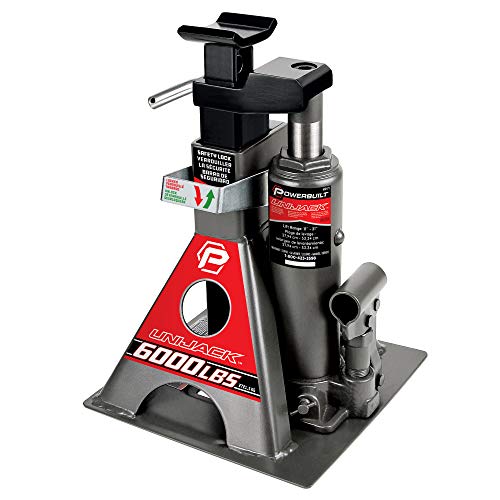
The Powerbuilt 620471 Unijack integrates a hydraulic bottle jack and a mechanical ratcheting jack stand into a single unit, eliminating the danger of hydraulic pressure bleed-off. With a 6,000-pound capacity, an 11 to 21-inch lift range, and a wide steel base, it provides dependable single-point lifting and static holding for trucks and SUVs.
Pros
- Combines hydraulic bottle jack lifting and mechanical jack stand safety into one single-point tool
- Physical ratcheting safety lock prevents accidental vehicle drops caused by hydraulic pressure bleed-off
- Wide 9.88 x 9.75-inch base provides excellent stability on garage concrete and level paved surfaces
- Tall 21-inch maximum extension delivers ample working clearance for high-clearance trucks and SUVs
- Meets ANSI standards for portable automotive service equipment and includes a 1-year factory warranty
Cons
- Minimum collapsed height of 11 inches makes it unusable on low-clearance sedans and sports cars
- At 22.66 pounds per single unit, it is significantly heavier than standard individual mechanical jack stands
- Sold as an individual unit rather than a pair, requiring separate purchases if supporting an entire axle
JMBHWD 3 Ton Double-Locking Jack Stands
The JMBHWD 3-Ton Jack Stand pair provides a 6,000-pound total capacity per pair (3,000 pounds per individual stand) with a dual-action safety system pairing a serrated cast iron ratchet bar with a secondary locking pin. Featuring a 7.64-inch by 8.03-inch steel pyramid base and an 11.4-inch to 16.9-inch height envelope, this set is an accessible option for DIY mechanics maintaining sedans, crossovers, and compact passenger vehicles.
Pros
- Secondary locking pin provides redundant mechanical backup to prevent accidental release handle movement
- Stable 7.64-inch by 8.03-inch pyramid base stance helps prevent tipping when positioned on flat, solid concrete
- Cast iron serrated ratchet bar allows quick, stepped height adjustments between 11.4 and 16.9 inches
- Concave saddle profile securely cradles vehicle frame contact points and structural rails
Cons
- Manufacturer specifications clarify this model is not recommended for full-size pickup trucks, commercial vans, or large off-road SUVs
- Minimum collapsed height of 11.4 inches may prove too tall for low-slung sports cars or lowered vehicles without extended floor jack lift height
- Bare metal saddle lacks protective rubber pads, requiring careful placement or aftermarket adapters to avoid marring unibody pinch welds
Jack Boss 2-Ton Low-Profile Ratchet Jack Stands
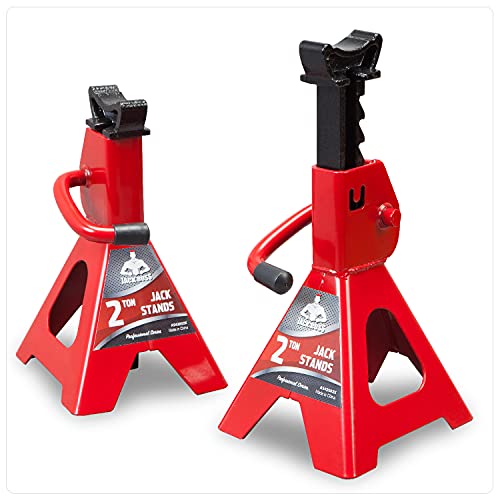
Designed for compact cars and small unibody vehicles, these Jack Boss low-profile jack stands combine a welded mild steel pyramid base with a ductile iron sawtooth ratchet bar spanning a 9.8-inch to 15-inch height range. They provide a lightweight, compact footprint for DIY garage maintenance, though the manufacturer explicitly advises against using them on trucks, large SUVs, or vehicles requiring over 15 inches of chassis clearance.
Pros
- Low 9.8-inch collapsed height fits easily under small passenger cars and lower unibody lift points
- Ductile iron sawtooth ratchet bar allows fast, tool-free height selection and positive pawl engagement
- Lightweight 10.5-pound overall build makes carrying, positioning, and garage storage simple
- Fully welded mild steel frame with protective powder coating guards against rust and shop grime
Cons
- Maximum 15-inch reach is too short for pickup trucks, full-size SUVs, or lifted off-road vehicles
- Single-pawl ratchet design lacks a secondary captive locking pin or redundant safety stop
- Steel concave saddle does not include rubber protection, which may mar painted unibody pinch welds without an aftermarket pad
TONDA 3-Ton Extra Tall Jack Stands
Built with an extended 13.39 to 21.06-inch lift range, these TONDA 3-ton jack stands deliver generous clearance for taller vehicles. The welded carbon steel frame and self-locking cast-iron ratchet bar provide stable, dependable support for regular garage maintenance.
Pros
- Supports up to 6,000 pounds per pair
- Extended 21.06-inch maximum height suits taller vehicles
- Durable welded carbon steel construction
- Wide pyramid base provides a stable footprint
- Self-locking ratchet bar engages automatically when raised
Cons
- High 13.39-inch minimum height limits low-clearance vehicles
- Combined weight of 17 pounds reduces portability
JKWQFBOYAN 3-Ton Double-Locking Jack Stands
These JKWQFBOYAN 3-ton ratchet jack stands feature a dual-locking setup with a cast iron ratchet bar and secondary metal safety pin supported by a wide carbon steel pyramid base. Designed for DIY maintenance on passenger cars, small trucks, and SUVs, they offer an accessible static support option for budget-conscious home mechanics.
Pros
- Double-locking design combines a ratchet handle mechanism with a metal safety pin for secondary security
- Wide pyramid base features triangular foot pads to distribute static chassis weight across level concrete
- Notched saddle profile helps locate vehicle edges and factory lift points
- Relatively lightweight at under 11 pounds for easy garage positioning and compact shelf storage
Cons
- Minimum collapsed and maximum extended height dimensions are not explicitly specified in the manufacturer data
- Listing notes CE conformity rather than the ASME PASE certification standards typical for U.S. commercial shops
- Notched metal saddle lacks rubber pads, which may require aftermarket pinch-weld protectors to prevent underbody marring
Essential Guidelines on Where to Place Jack Stands for Secure Vehicle Support
Determining where should i place jack stands requires identifying the structural lift points engineered directly into your vehicle chassis. For most passenger cars and crossover vehicles, these load-bearing zones sit along reinforced rocker panel pinch welds, while body-on-frame trucks rely on solid boxed frame rails or heavy axle housings. Never position stationary stands under flat sheet metal floor pans, steering linkages, or suspension control arms that can buckle under concentrated chassis weight. Establishing firm contact on certified structural points prevents sudden vehicle shifts and preserves body panel integrity throughout your service session.
Locating Factory-Designated Lift Points and Pinch Welds on Unibody Vehicles
Modern passenger cars and compact crossovers utilize unibody construction, where the floor pan, frame rails, and body panels form a unified structural shell. Because thin floor sheet metal cannot support thousands of pounds, automakers reinforce specific sections along the bottom seam of the rocker panels known as pinch welds. These designated support points are typically located just behind the front wheel openings and just ahead of the rear wheel housings. Many manufacturers indicate these zones with small triangular stamped notches, embossed arrows, or molded indents in the plastic side skirts.
Placing a bare curved steel jack stand saddle directly against a thin unibody pinch weld requires careful attention to alignment. If the center column saddle possesses a deep concave curve without adequate flat support, the thin steel seam can fold over horizontally under load. Using slotted vulcanized rubber pinch weld pads cushions the joint while allowing the reinforced vertical metal lip to sit securely in the groove. Models like the Jack Boss Low Profile 2 Ton provide a wide concave saddle designed to balance contact, though adding an aftermarket rubber protector helps preserve factory rust coatings on low-clearance vehicles.
Always verify the exact jacking locations in your vehicle owner manual before raising the chassis. Certain European unibody models feature rectangular reinforced plastic jack blocks recessed into the rocker panels rather than exposed metal pinch seams. Placing a standard saddle carelessly beside these factory blocks can crush thin floor pans and puncture sensitive wiring harnesses running along the interior threshold. Taking a few moments to inspect the factory lift tabs ensures that your support equipment interfaces directly with high-strength structural steel.
Positioning Stands on Body-on-Frame Trucks and Boxed Chassis Rails
Full-size pickup trucks, commercial vans, and traditional sport utility vehicles utilize a heavy steel ladder frame running beneath the body shell. These boxed or C-channel steel frame rails offer exceptional strength, making them ideal landing surfaces for heavy-duty jack stands. When supporting the front of a truck, locate a flat, horizontal section of the frame rail directly behind the front suspension mounts. Positioning stands along the straight chassis rails avoids angled transition zones where the frame bends upward toward the bumper.
Working on elevated truck platforms often demands significant vertical extension to bridge the gap between garage floor and frame. Stands like the TONDA 3 Ton Extra Tall provide an adjustable height span ranging from 13.39 to 21.06 inches, allowing mechanics to reach high truck chassis without awkward staging. Center the saddle squarely under the bottom surface of the frame rail so the vertical load passes straight down through the center column. Angling the stand or placing it partially on a frame flange risks lateral slippage when you loosen high-torque suspension bolts.
Clever all-in-one lifting tools also solve the common problem of limited underbody positioning space on trucks. The Powerbuilt Unijack 3 Ton combines a hydraulic bottle jack and a ratcheting jack stand into a single unit with a lift range of 11 to 21 inches. This configuration lets you lift and mechanically lock the chassis at the exact same frame rail location without juggling separate floor jacks and support columns. Regardless of the equipment used, always position stands symmetrically on both side rails to maintain uniform weight distribution across the chassis.
Supporting Solid Drive Axles and Heavy Suspension Housings
Solid rear drive axles found on rear-wheel-drive cars, trucks, and solid-axle off-road vehicles provide another robust location for mechanical stand placement. Placing stands under the axle tubes allows you to service brakes, rotate wheels, and inspect driveline components while keeping the rear suspension under normal ride-height compression. Position each stand saddle under the round steel axle tube as close to the wheel hub assembly as practical. Keeping the stands spaced widely apart maximizes lateral stability and prevents the vehicle from rocking side to side.
A concave saddle profile is especially advantageous when supporting solid round axle tubes. The curved cradle cups the tubular housing, preventing the axle from sliding laterally off the post. Never rest jack stand saddles directly under the center differential pumpkin or thin stamped differential cover plate. Stamping covers can bend easily under concentrated load, causing catastrophic gear oil leaks and damaging delicate internal ring gear assemblies.
Do not confuse solid axle housings with independent rear suspension (IRS) components found on modern sports cars and crossovers. Thin stamped steel or cast aluminum lower control arms on IRS setups are engineered to absorb suspension movement, not bear the full static weight of the chassis on a narrow stand. Placing stands under aluminum control arms or CV axle half-shafts can bend suspension links, crush ball joints, and crack expensive aluminum castings. Solid axle placement should remain strictly confined to continuous cast iron or heavy steel axle tubes.
Hazardous Contact Zones That Must Never Bear Chassis Weight
Understanding where to avoid placing stands is just as vital as knowing correct factory positions. One of the most disastrous garage mistakes involves resting support stands under flat passenger floor pans. The sheet metal composing vehicle floor pans is remarkably thin, designed only to form the cabin floor and deaden road noise. Placing mechanical stands under floor pans causes the post to punch straight through the floor, destroying interior carpeting, sound insulation, and interior electronics.
Steering linkages, front sway bars, and tie rod assemblies must also remain completely clear of mechanical support saddles. These precision suspension components cannot tolerate vertical vehicle weight and will bend instantly if subjected to lifting forces. A bent tie rod ruins vehicle wheel alignment and can snap during operation, creating an extreme safety hazard on the road. Similarly, never position stands along thin metal rocker panels outside the reinforced pinch weld notches, as external body panels will crush under load.
Drivetrain components including engine oil pans, transmission bellhousings, and transfer cases should never serve as stationary support points. Even heavy cast iron transmission casings are not designed to balance the shifting weight of a motor vehicle. Concentrated point load on an oil pan will crack the casting or dent the metal pan against the internal oil pickup tube, starving the engine of oil upon restart. Always confirm that your stand saddle contacts structural frame rails, subframe mounting brackets, or factory pinch welds before releasing hydraulic pressure.
Surface Dynamics: Preventing Driveway Sinking and Base Instability
The ground surface beneath your jack stands dictates overall vehicle stability just as much as chassis contact points. Flat, level poured concrete slabs offer the safest working foundation because concrete possesses high compressive strength that resists deformation under concentrated loads. Asphalt driveways present a hidden hazard, particularly during warm summer months when petroleum binders soften under heat. Narrow steel stand feet can punch directly into softened blacktop, causing the vehicle to tilt unpredictably while you work underneath.
Jack stand base geometry plays a decisive role in distributing ground pressure evenly across your floor. Models like the YELLOW JACKET 3 Ton and the JKWQFBOYAN 3 Ton feature wide pyramid foot bases equipped with welded steel perimeter foot pads. These broadened foot pads dramatically reduce ground pressure per square inch compared to open-ended tube legs, resisting sinking on slightly softer garage surfaces. If working on asphalt is unavoidable, placing thick structural steel plates under the stand feet distributes weight across a much broader surface area.
Under no circumstances should you ever use makeshift wood blocks, cinder blocks, or paving bricks to gain extra lifting height under your jack stands. Wood grain splits unpredictably under concentrated shear force, and hollow cinder blocks can shatter without warning under static vehicle weight. Using unrated spacers between the stand saddle and the vehicle chassis creates an unstable pivot point that invites sudden slip. If your vehicle requires extra ground clearance, choose purpose-built high-lift stands with certified vertical adjustment rather than stacking loose materials.
Calculating Rated Load Capacity Under ANSI and ASME PASE Standards
Selecting appropriate vehicle support requires a thorough understanding of capacity ratings governed by the ANSI and ASME PASE standards. Under these safety guidelines, portable automotive service equipment ratings generally apply to a pair of stands rather than an individual unit. A pair of stands rated for 3 tons (6,000 pounds), such as the Amazon Basics Steel Jack Auto Stands, is engineered to hold 6,000 pounds distributed across both units. Misinterpreting this rating as 6,000 pounds per single stand can lead to dangerous overloading on heavy pickup trucks.
When calculating required support capacity, compare the stand rating against your vehicle gross weight distribution rather than average curb weight. Front-engine vehicles typically place roughly sixty percent of their total mass over the front axle, concentrating substantial weight on the front support pair. A four-thousand-pound crossover might carry twenty-four hundred pounds over the front subframe during an engine or transmission repair. Choosing a pair of 3-ton stands provides a generous safety margin that easily accommodates heavy front-end weight biases.
Compact cars and lightweight sports coupes can utilize low-profile support systems tailored for smaller vehicle footprints. The Jack Boss Low Profile 2 Ton pair provides a 4,000-pound load rating with a collapsed height of just 9.8 inches, making it easy to slide under lowered unibody pinch welds. For larger sport utility vehicles and half-ton pickups, stepping up to heavy-duty 3-ton pairs ensures the center column retains robust structural strength at full extension. Matching rated load capacity to vehicle axle splits eliminates structural flex and guarantees reliable chassis support.
Mechanical Locking Reliability: Ratchet Bars and Redundant Locking Pins
Jack stands rely on mechanical locking systems to hold raised vehicles securely without depending on hydraulic pressure. The most common design incorporates a cast ductile iron ratchet bar featuring deep sawtooth notches along its spine. As you lift the center column, a counterweighted pawl drops into the tooth valleys, mechanically preventing the post from sliding downward under load. The ductile iron ratchet bar on models like the Amazon Basics 3 Ton delivers rapid height adjustments that engage automatically as the saddle is raised.
Many modern designs incorporate redundant secondary locking mechanisms to prevent accidental pawl disengagement during active wrenching sessions. Double-locking models, including the JMBHWD 3 Ton and the YELLOW JACKET 3 Ton, pair the primary ratchet bar with a heavy steel safety pin inserted through the collar. This solid metal pin physically blocks the release handle from rotating upward, ensuring the pawl cannot back out of the sawtooth notch if bumped by a tool or creeper. Double-locking protection delivers invaluable peace of mind when performing high-torque suspension or exhaust jobs.
For mechanics seeking alternatives to stationary floor stands, exploring dedicated automotive lifting equipment offers insights into hydraulic column hoists and permanent bay setups. Regardless of the locking mechanism chosen, always inspect the cast teeth and locking pawl for dirt, grease buildup, or wear before placing the stand under load. Clean, sharp tooth engagement ensures that the full weight of the vehicle is supported by solid metal-to-metal mechanical interlocks.
Step-by-Step Procedure: Raising, Aligning, and Lowering onto Saddles
Executing a safe vehicle support transition requires methodical preparation before ever touching a hydraulic jack handle. Begin by parking the vehicle on a flat, level concrete surface, engaging the parking brake, and shifting the transmission into park or reverse. Place solid rubber wheel chocks firmly against both sides of the tires remaining on the ground to prevent any rolling motion. Position your hydraulic floor jack under the primary front or rear central jacking point designated in the vehicle factory service manual.
Pump the hydraulic floor jack smoothly until the vehicle tires rise roughly two inches higher than your target working height. Slide your jack stands directly beneath the reinforced factory support locations on both sides of the vehicle chassis. Adjust the center ratchet post so each saddle sits just below the chassis contact surface, ensuring that the locking pawls seat completely into identical tooth notches. Double-check that the center post is oriented vertically with all four base feet resting flat on the concrete floor.
Slowly turn the hydraulic release valve on your floor jack counterclockwise to lower the chassis gradually onto the stand saddles. Monitor both contact points closely as the vehicle settles to confirm that the pinch welds or frame rails seat dead center within the saddle cradles. Once the stands bear one hundred percent of the chassis weight, lower the floor jack until its saddle barely touches the frame, leaving it in place as a redundant secondary safety catch. Insert any secondary safety locking pins completely through the stand collars before proceeding.
Verifying Lateral Stability with the Physical Push Test
Before crawling beneath any raised vehicle, performing a vigorous physical stability check is a non-negotiable garage safety rule. Stand beside the raised vehicle and grip the bumper, fender, or wheel arch firmly with both hands. Apply deliberate, moderate body weight pushing laterally and rocking slightly to verify that the chassis does not shift or wobble atop the stands. If the stands are positioned correctly on flat structural points, the vehicle should feel completely rigid and integrated with the ground.
If you observe any shifting, base tilting, or uneven leg contact during the push test, raise the hydraulic jack immediately to re-level the chassis. A stand that rocks on three legs indicates that the floor is uneven or that one stand post is adjusted one tooth higher than the other. Never attempt to correct stand alignment by kicking or tapping the base legs while vehicle weight rests on the post. Re-engaging the hydraulic jack takes only a minute and completely eliminates the risk of an unseated saddle slipping during high-torque wrenching.
Taking the time to locate factory pinch welds, align boxed frame rails, and inspect mechanical locking pawls ensures your underbody maintenance remains completely safe. By choosing certified equipment that matches your vehicle curb weight and adhering to strict placement protocols, you can tackle brake jobs, fluid changes, and suspension rebuilds with total confidence. Treat every lift as a methodical procedure, confirm your contact points before crawling underneath, and let mechanical steel provide the unyielding support your garage projects demand.
About the author
Christian Hazel is an automotive journalist with extensive experience covering four-wheel-drive vehicles, mechanical upgrades, and off-road equipment. His background includes technical reviews, installation features, and project-vehicle coverage, bringing useful context to equipment choices for trucks, Jeeps, and off-road enthusiasts.