
What Ton Jack Stands for F150: Practical Guide for 2026
Determine what ton jack stands for f150 maintenance in November 2026, comparing 3-ton and 6-ton ratings, lift height, and frame rail stability.
 By Hank O'Hop
Updated October 10, 2026


Supporting a full-size half-ton pickup requires careful attention to rated weight capacity, vehicle curb weight distribution, and working height reach. Many truck owners wondering what ton jack stands for f150 maintenance assume that standard passenger car gear is adequate, but half-ton pickups present unique support challenges. A modern Ford F-150 features high ground clearance, long suspension travel, and heavy boxed ladder frame rails that demand substantial lift height beyond what typical automotive equipment delivers. Relying on an undersized stand can lead to unstable work conditions, dangerous overextension, or severe frame slipping while servicing brakes and suspension assemblies.
Under ANSI/ASME PASE safety standards, jack stand load capacities are rated per pair, meaning a 3-ton pair provides 6,000 pounds of total capacity while a 6-ton set supports 12,000 pounds. While a standard 3-ton setup might seem sufficient on paper for supporting one axle of a 4,500-to-5,500-pound truck, working height and footprint stability frequently shift the recommendation toward heavier support gear. When setting up a home workspace or planning overhead garage clearance for serious truck maintenance, choosing the correct tonnage ensures your frame stays secure. Using the proper capacity rating keeps the vehicle stable even when applying heavy breaker-bar torque to stubborn chassis hardware.
| Award | Product | BJL Score About BJL ScoreThe BJL Score is our own rating from 0 to 10, based on performance, design and build, ease of use, and value. It reflects independent research and is never influenced by manufacturers, retailers, or affiliate commissions. Learn more › | |
|---|---|---|---|
| Best Overall |
YELLOW JACKET 3 Ton Double-Locking Steel Jack
|
9.2/10 | Buy |
| Best Value |
 Amazon Basics 3-Ton Steel Jack Stands |
8.9/10 | Buy |
| Best Premium |
 Powerbuilt 3-Ton Unijack All-in-One Hydraulic |
8.9/10 | Buy |
| Best Budget |
 VEVOR 3-Ton Double-Locking Jack Stands (Pair) |
8.8/10 | Buy |
 Jack Boss 2-Ton Low-Profile Ratchet Jack Stands |
8.6/10 | Buy | |
 VEVOR 6-Ton Double-Locking Jack Stands Pair |
8.6/10 | Buy | |
 ANTPOWER 3-Ton Double-Locking Jack Stands |
8.4/10 | Buy | |
 TONDA 3-Ton Extra Tall Jack Stands |
8.4/10 | Buy | |
 PRUTHY 3-Ton Double-Locking Jack Stands |
8.3/10 | Buy | |
 SALIFTFE 6-Ton Heavy Duty Jack Stands with Double |
8.3/10 | Buy |
YELLOW JACKET 3 Ton Double-Locking Steel Jack
The YELLOW JACKET 3-ton jack stand pair provides a 6,600-pound combined capacity with ductile iron ratchet columns and secondary metal locking pins for redundant garage safety. Featuring a welded stamped steel pyramid base and a 10-7/8-inch to 16-9/16-inch height range, they offer reliable static support for compact cars, crossovers, and midsize SUVs during routine maintenance.
Pros
- Double-locking system pairs a ductile iron ratchet bar with an independent metal safety pin for added physical redundancy
- Solid one-piece forged ductile iron center column provides reliable static tooth engagement across multiple height settings
- Welded stamped steel pyramid base features wide foot pads to support vehicle stability on flat concrete shop floors
- Practical height span of 10-7/8 inches to 16-9/16 inches covers common passenger vehicle maintenance tasks like brake jobs and oil changes
Cons
- The 10-7/8-inch collapsed height may sit too high for significantly lowered sports cars or vehicles with low front splitters
- Bare metal saddle lacks rubber cushioning pads, which may mar painted subframes or bend unprotected pinch welds without aftermarket adapters
- Maximum height reach of 16-9/16 inches is limited for lifted 4x4 trucks or high-clearance off-road vehicles requiring extended droop clearance
Amazon Basics 3-Ton Steel Jack Stands
The Amazon Basics 3-Ton Steel Jack Stand Pair delivers 6,000 pounds of reliable vehicle support certified to ASME PASE-2014 standards for portable automotive equipment. Featuring a self-locking ratchet bar and a compact steel footprint, this set is ideal for home garage DIYers servicing passenger cars and urban SUVs.
Pros
- Rated for 3 tons (6,000 lbs) per pair and meets ASME PASE-2014 portable automotive service standards
- Self-locking ratchet bar enables rapid, secure height adjustment without fiddling with separate pins
- Compact 7.5 x 7.0-inch footprint and 12.6-lb total weight make positioning and storage simple
- Protective rustproof coating over a durable steel frame helps resist corrosion from garage fluids
Cons
- 3-ton capacity is tailored for sedans and crossover SUVs, not full-size heavy-duty pickup trucks
- Ratchet assembly does not feature a secondary mechanical cross-locking pin for redundant backup
- Must be used exclusively on flat, solid concrete slabs to prevent uneven weight distribution or base sinking
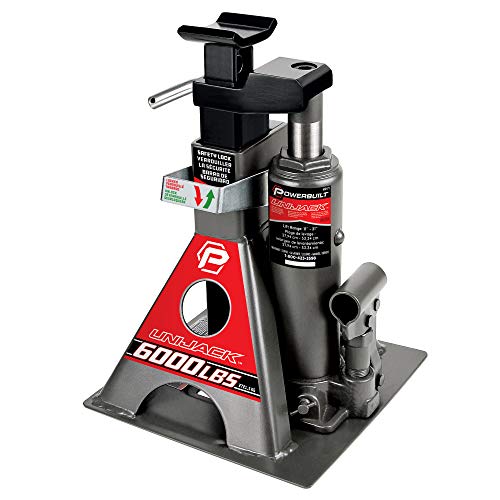
Powerbuilt 3-Ton Unijack All-in-One Hydraulic
The Powerbuilt 620471 Unijack integrates a hydraulic bottle jack and a mechanical ratcheting jack stand into a single unit, eliminating the danger of hydraulic pressure bleed-off. With a 6,000-pound capacity, an 11 to 21-inch lift range, and a wide steel base, it provides dependable single-point lifting and static holding for trucks and SUVs.
Pros
- Combines hydraulic bottle jack lifting and mechanical jack stand safety into one single-point tool
- Physical ratcheting safety lock prevents accidental vehicle drops caused by hydraulic pressure bleed-off
- Wide 9.88 x 9.75-inch base provides excellent stability on garage concrete and level paved surfaces
- Tall 21-inch maximum extension delivers ample working clearance for high-clearance trucks and SUVs
- Meets ANSI standards for portable automotive service equipment and includes a 1-year factory warranty
Cons
- Minimum collapsed height of 11 inches makes it unusable on low-clearance sedans and sports cars
- At 22.66 pounds per single unit, it is significantly heavier than standard individual mechanical jack stands
- Sold as an individual unit rather than a pair, requiring separate purchases if supporting an entire axle
VEVOR 3-Ton Double-Locking Jack Stands (Pair)
VEVOR 3-ton double-locking jack stands provide 6,000 pounds of static support per pair, combining a cast iron ratchet column with a secondary metal safety pin for added security. With a 10.8- to 16.3-inch height range and welded triangular base feet, they are well-suited for DIY oil changes, brake service, and garage maintenance.
Pros
- Double-locking mechanism pairs a positive ratchet pawl with a heavy metal safety pin for redundant mechanical security
- Welded triangular foot pads provide broader ground contact than bare stamped leg edges on garage floors
- 9 height adjustment stops allow rapid positioning between 10.8 and 16.3 inches
- Compact pyramid footprint and 11-pound total weight allow easy transport and organized garage storage
- Notched saddle profile cradles unibody seams and frame rails securely during maintenance
Cons
- A 10.8-inch minimum collapsed height may not clear aggressively lowered track cars without pre-lifting
- Notched bare metal saddle lacks rubber protective pads and may mar chassis paint or pinch welds without aftermarket adapters
- A 16.3-inch maximum extension limits utility for tall lifted 4x4 trucks or large commercial vehicles
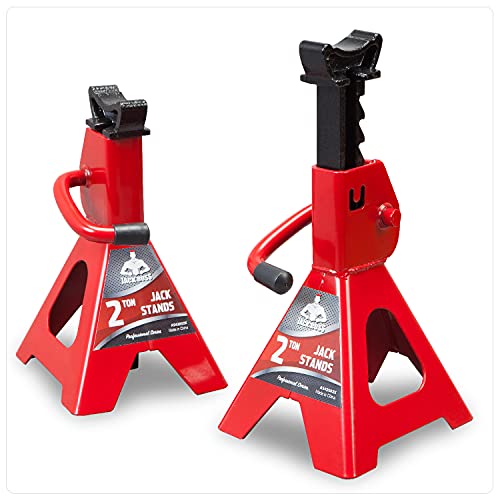
Jack Boss 2-Ton Low-Profile Ratchet Jack Stands
Designed for compact cars and small unibody vehicles, these Jack Boss low-profile jack stands combine a welded mild steel pyramid base with a ductile iron sawtooth ratchet bar spanning a 9.8-inch to 15-inch height range. They provide a lightweight, compact footprint for DIY garage maintenance, though the manufacturer explicitly advises against using them on trucks, large SUVs, or vehicles requiring over 15 inches of chassis clearance.
Pros
- Low 9.8-inch collapsed height fits easily under small passenger cars and lower unibody lift points
- Ductile iron sawtooth ratchet bar allows fast, tool-free height selection and positive pawl engagement
- Lightweight 10.5-pound overall build makes carrying, positioning, and garage storage simple
- Fully welded mild steel frame with protective powder coating guards against rust and shop grime
Cons
- Maximum 15-inch reach is too short for pickup trucks, full-size SUVs, or lifted off-road vehicles
- Single-pawl ratchet design lacks a secondary captive locking pin or redundant safety stop
- Steel concave saddle does not include rubber protection, which may mar painted unibody pinch welds without an aftermarket pad
VEVOR 6-Ton Double-Locking Jack Stands Pair
These VEVOR 6-ton (13,000-lb) double-locking jack stands pair a cast iron ratchet bar with carbon steel pyramid bases and secondary metal safety pins. Built for DIY mechanics, they provide dependable static support with notched saddles and triangular foot pads for trucks, SUVs, and passenger cars.
Pros
- Double-locking safety system incorporates a primary ratchet pawl and a physical metal safety pin
- Generous 6-ton (13,000 lbs) combined load rating provides adequate safety margins for passenger cars, SUVs, and half-ton pickups
- Welded triangular foot pads increase floor contact surface area and improve overall pyramid base stability
- Cast iron ratchet bar with protective rust-proof coating resists workshop corrosion
Cons
- Bare metal notched saddle can crush or bend bare unibody pinch welds without an aftermarket rubber adapter
- Stepped ratchet teeth offer incremental height settings rather than infinite micro-adjustability
- Requires auxiliary structural steel spreader plates if used on warm asphalt driveways to prevent indentation
ANTPOWER 3-Ton Double-Locking Jack Stands
The ANTPOWER 3-ton double-locking jack stands provide reliable static support for garage maintenance, pairing a ductile iron sawtooth ratchet column with a secondary steel side-locking pin. With an 11.2 to 16.8-inch height range and a fully welded pyramid steel base, they offer solid safety for compact cars, sedans, and light crossovers.
Pros
- Secondary side-pin lock adds physical redundancy alongside the primary ratchet pawl
- High-strength ductile iron ratchet bar provides positive sawtooth height adjustments
- Fully welded mild steel pyramid base delivers stable static support on level concrete slabs
- Protective powder-coated finish helps resist common garage moisture and chemical rust
- Manageable 14.3-pound total weight makes repositioning easy during four-corner vehicle setups
Cons
- Maximum 16.8-inch reach is insufficient for lifted 4x4s, full-size trucks, or vehicles with frame heights over 16 inches
- Bare steel saddle lacks a rubber pad, which may mar painted unibody pinch welds without an aftermarket adapter
- Conflicting product listing text notes both 6,000 lbs per pair and 6,600 lbs per stand, requiring conservative 3-ton pair load planning
TONDA 3-Ton Extra Tall Jack Stands
Built with an extended 13.39 to 21.06-inch lift range, these TONDA 3-ton jack stands deliver generous clearance for taller vehicles. The welded carbon steel frame and self-locking cast-iron ratchet bar provide stable, dependable support for regular garage maintenance.
Pros
- Supports up to 6,000 pounds per pair
- Extended 21.06-inch maximum height suits taller vehicles
- Durable welded carbon steel construction
- Wide pyramid base provides a stable footprint
- Self-locking ratchet bar engages automatically when raised
Cons
- High 13.39-inch minimum height limits low-clearance vehicles
- Combined weight of 17 pounds reduces portability
PRUTHY 3-Ton Double-Locking Jack Stands
The PRUTHY 3-Ton Jack Stand Pair provides static vehicle support rated up to 6,600 pounds across the pair, combining a ductile iron ratchet bar with an added metal safety pin for dual-locking peace of mind. Featuring an 11.4-inch to 16.9-inch height range and a wide stamped-steel pyramid base, they offer reliable stability for routine garage maintenance on sedans, crossovers, and small SUVs.
Pros
- Secondary metal safety pin adds a positive mechanical backup to the primary ratchet pawl mechanism
- Welded stamped-steel pyramid base provides solid footing and even weight distribution on level concrete floors
- Clear 11.4-inch to 16.9-inch elevation range works well for passenger cars, crossovers, and compact utility trailers
- Forged one-piece ductile iron ratchet column resists fracturing under static load
Cons
- Minimum collapsed height of 11.4 inches may be too tall for lowered sports cars without pre-lifting
- Maximum extension of 16.9 inches will not provide adequate clearance for lifted 4x4 trucks on oversized tires
- Metal saddle lacks included rubber protective pads to shield delicate pinch welds from cosmetic scratches
SALIFTFE 6-Ton Heavy Duty Jack Stands with Double
These SALIFTFE 6-ton jack stands deliver a 13,200-pound capacity per pair, combining alloy steel construction with a dual-pin locking mechanism for redundant under-vehicle safety. Featuring protective rubber saddle covers and an oversized stabilizing base, they offer secure static support for trucks, SUVs, and passenger cars.
Pros
- Robust 6-ton (13,200 lbs) combined capacity per pair provides heavy-duty static holding for pickups and SUVs
- Double pin locking system offers a reassuring secondary mechanical stop during vehicle support
- Protective rubber saddle tops prevent direct metal-to-metal contact and protect chassis paint
- Oversized foot base with anti-slip rubber pads enhances stability on smooth garage concrete slabs
- Generous 24-inch maximum height allows ample working room underneath for tall creepers and suspension service
Cons
- Minimum collapsed height of 12 to 16 inches may be too tall for low-profile sports cars without pre-lifting
- Substantial steel construction makes them bulkier to store and transport compared to lightweight aluminum paddock stands
- Requires broad steel load-spreader plates if used on asphalt driveways to prevent hot-weather surface indentation
Selecting the Right Ton Jack Stands for Ford F-150 Trucks
Determining the proper capacity rating for supporting a Ford F-150 requires balancing vehicle curb weight against necessary working height and chassis stability. While many DIY truck owners assume standard car stands are adequate, half-ton pickups present distinct mechanical challenges that make standard equipment hazardous. Choosing between 3-ton and 6-ton vehicle stands is not simply about preventing structural overload. The decision dictates whether your truck tires clear the garage floor, whether the base resists lateral tipping, and whether your boxed frame sits securely in the saddle.
Understanding Ford F-150 Curb Weight and Axle Load Distribution
A modern Ford F-150 typically has an unloaded curb weight ranging between 4,000 and 5,500 pounds depending on cab configuration, bed length, drivetrain, and engine choice. Models equipped with four-wheel drive, the heavy 3.5-liter PowerBoost hybrid powertrain, or extended crew cabs sit at the heavier end of that weight spectrum. When lifting either the front or rear end of the truck, the support equipment does not carry the full curb weight simultaneously. Instead, the stands support the axle load split, which typically concentrates approximately sixty percent of the vehicle weight over the front suspension and forty percent over the rear.
Adding aftermarket equipment such as steel bumpers, winches, heavy toolboxes, or cargo in the bed significantly increases the static load on the chassis. Gross Vehicle Weight Ratings on modern F-150 platforms can reach 7,000 to over 7,800 pounds when loaded. If you perform maintenance with cargo in the truck bed, that additional weight rests directly on your rear support points. Accounting for these static and shifting loads is essential to maintaining an adequate mechanical safety margin while working underneath.
How ANSI and ASME PASE Standards Define Jack Stand Load Ratings
Portable automotive service equipment in the United States is evaluated under ANSI/ASME PASE standards, which establish specific testing criteria and labeling rules for vehicle support devices. A critical detail that confuses many truck owners is that jack stand capacity ratings are designated per pair rather than per individual stand. For example, a pair of stands labeled as 3-ton provides a combined rated capacity of 6,000 pounds when used together across a single axle. An individual 3-ton stand is mechanically rated to carry only 3,000 pounds when loaded centrally on its saddle.
This per-pair rating distinction means that a 3-ton pair is operating near its capacity when holding the front end of a heavy crew-cab F-150 loaded with accessories. While manufacturer proof-load testing requires stands to endure loads beyond their stated rating without collapse, operating near the working limit leaves minimal margin for error. Mechanical shifting, uneven ground settling, or dynamic forces from heavy wrenching can easily redistribute vehicle weight onto a single corner. Stepping up to a 6-ton pair with a 12,000-pound combined capacity ensures the truck never approaches the structural yield threshold of the support equipment.
Why Standard 3-Ton Stands Fall Short on F-150 Working Height
Load capacity is only half the equation when supporting a full-size pickup truck. The primary reason standard 3-ton stands prove inadequate for an F-150 is their limited vertical extension range. Most conventional 3-ton automotive stands, such as standard stamped steel units, provide a maximum lift height between 15 and 16.5 inches. Because an F-150 features generous factory ground clearance and substantial suspension droop, a 16-inch stand often cannot reach the frame rails while allowing the front wheels to lift clear of the ground.
When you lift an F-150 by the frame, the suspension components decompress and the tires hang downward several inches before leaving the floor. If your support stands top out at 16 inches, the saddle may meet the frame rail just as the tires barely touch the concrete, leaving zero clearance for brake jobs or suspension work. Product specifications for models like the ANTPOWER 3-ton and Jack Boss 2-ton explicitly note that they are not recommended for large pickups or trucks with chassis heights exceeding 16 inches. Attempting to use short stands often tempts vehicle owners to make dangerous setup compromises that jeopardize workshop safety.
The Height and Clearance Advantage of 6-Ton Heavy-Duty Stands
Heavy-duty 6-ton stands solve the working height problem by offering an extended vertical envelope tailored to truck chassis geometry. Units such as the SALIFTFE 6-ton stands offer an adjustable range between 16 and 24 inches, providing the reach needed to clear tall truck tires and long-travel suspension linkages. Even specialized high-reach 3-ton alternatives, like the TONDA extra-tall stands that reach past 21 inches or the Powerbuilt Unijack with its 11-to-21-inch range, prioritize this extended height reach.
Having access to 20 to 24 inches of lift height allows you to place the saddles directly under the main boxed frame rails behind the front wheels. This positioning gives you full, unobstructed access to the front steering knuckles, control arms, sway bar end links, and brake calipers. Furthermore, extended height reach provides ample room beneath the oil pan, transmission bellhousing, and transfer case for fluid changes and driveline maintenance. Working under a full-size truck is far less fatiguing and substantially safer when you have adequate physical clearance.
Pyramid Base Footprints and Driveway Surface Stability
Vehicle stability under load depends directly on the geometry and footprint dimensions of the support stand base. Standard 3-ton passenger car stands typically feature a square or rectangular pyramid base measuring around 7 by 8 inches. By contrast, 6-ton truck stands feature broad footprints that often measure 9 by 10 inches or larger, creating a significantly wider mechanical stance. This wider stance drastically reduces the risk of lateral tip-over when you apply high breakaway torque to stubborn suspension bolts, lug nuts, or axle shaft retaining nuts.
Surface pressure is another critical factor when working outside on residential asphalt driveways. Because asphalt is a bituminous material that softens under direct summer heat, concentrated point loads from narrow stamped steel feet can easily penetrate or sink into the pavement. Heavy-duty truck stands often incorporate welded steel perimeter foot pads that distribute vehicle weight across a broader surface area. When evaluating residential setup configurations or comparing vehicle lifting equipment options for home maintenance, ground footprint stability should always remain a top priority.
Saddle Contours and Boxed Frame Rail Engagement
The physical interface between the jack stand saddle and the truck chassis plays a huge role in preventing catastrophic slippage. The Ford F-150 utilizes a fully boxed high-strength steel ladder frame that measures roughly three to four inches across its lower flange. Most small passenger car stands feature shallow saddles designed primarily for narrow pinch welds or compact unibody subframes. Placing a wide, flat truck frame rail across a shallow, narrow saddle creates an unstable point-contact condition that can slide when subjected to lateral vibration.
High-tonnage truck stands provide wider, deeper concave saddles that cradle broad frame sections securely. When supporting the rear of the truck beneath the solid axle assembly, a deep V-notch saddle profile fits neatly around the 3.5-inch steel axle tubes without marring the differential housing. Some heavy-duty models include thick vulcanized rubber covers that cushion the contact point and prevent metal-on-metal gouging. Protecting the frame coating from gouges prevents premature corrosion and keeps the chassis pristine over years of ownership.
Locking Mechanism Security: Ratchet Bars vs Pin-Lock Systems
Locking mechanisms on vehicle support equipment generally fall into two primary categories: cast ductile iron ratchet bars and solid steel cross-pin designs. Ratchet-bar stands offer rapid height adjustment, utilizing a weighted pawl that drops into sawtooth notches along the center post. However, vehicle owners who remember past equipment recalls often express hesitation regarding ratchet designs, especially when subjected to heavy side loads. To address these concerns, modern double-locking ratchet stands incorporate an independent steel safety pin that passes directly through the collar beneath the pawl.
Units such as the YELLOW JACKET 3-ton, VEVOR 6-ton, and PRUTHY double-locking stands utilize this redundant secondary pin to prevent accidental handle disengagement. Pin-style and screw-style stands eliminate the ratchet pawl entirely, relying on a solid forged steel through-pin that inserts horizontally through matching holes in the telescoping column. While pin-style stands take slightly longer to adjust, they provide complete visual confirmation of mechanical shear engagement. Regardless of the mechanism you choose, you must always verify that the locking pawl is fully seated in the tooth valley and that secondary pins are inserted before lowering vehicle weight.
Approved Chassis Support Locations on the Ford F-150
Positioning your jack stands correctly is vital to preventing expensive chassis damage and personal injury. On the front of a modern F-150, the primary support points are the heavy boxed frame rails directly behind the front wheel openings, or the reinforced lower control arm frame mounts. Never place support stands under thin sheet metal body panels, floor pans, transmission crossmembers, or steering tie rods, as these components will deform immediately under vehicle weight. Placing stands beneath the front boxed frame horn provides exceptional stability while servicing front brakes or wheel hubs.
For rear-end service, you have two primary factory-approved support options depending on the maintenance task. If you are replacing rear shocks or working on leaf springs where suspension droop is required, place the stands under the boxed frame rails ahead of the rear leaf spring front hangers. If you are performing a simple brake job, tire rotation, or differential fluid change, placing the saddles directly beneath the solid rear axle tubes on either side of the differential housing is both fast and secure. Always align the saddle contour so the axle tube rests squarely in the center of the cradle.
Step-by-Step Procedure for Supporting an F-150 Safely
Safe vehicle support begins long before you touch a hydraulic floor jack. Park your truck on a solid, level concrete floor, set the transmission firmly in Park, and engage the emergency parking brake. Place heavy rubber wheel chocks firmly against the front and rear of the tires remaining on the ground to prevent any vehicle rolling during the lifting process. Position a heavy-duty hydraulic floor jack under the front crossmember or rear differential housing according to manufacturer service guidelines, and raise the truck to the desired height.
Slide your pair of stands into position, adjusting the center posts so the saddles align directly beneath the designated frame rails or axle tubes. Ensure both stands are set to the identical notch height so the truck sits perfectly level once lowered. Slowly turn the release valve on your floor jack to transfer the vehicle weight gradually onto the jack stands, observing the contact points closely. Once the stands bear the full load, leave the hydraulic jack raised with slight clearance beneath the lift point as an unloaded secondary safety backup. Finally, perform an aggressive physical push test against the truck bumper to verify complete lateral stability before crawling underneath.
The Extreme Dangers of Makeshift Height Extenders
A common and extraordinarily hazardous mistake among truck owners is using makeshift spacers to compensate for short jack stands. When a 3-ton stand fails to reach the high frame rails of an F-150, some DIY mechanics place wooden blocks, bricks, or concrete pavers underneath the base or on top of the saddle. This practice is extremely dangerous and has caused catastrophic workshop accidents. Wooden blocks readily split along their grain lines under concentrated point loads, while brittle cinder blocks and bricks can shatter instantly without warning under dynamic weight.
Jack stands are engineered, load-tested, and certified as complete mechanical systems that rely on direct contact between their wide steel feet and a hard foundation. Inserting unrated spacers introduces unstable pivot points and dramatically increases the risk of lateral kick-out. If your existing jack stands cannot reach your F-150 frame rails with the wheels off the ground, the only safe solution is to purchase taller, heavy-duty 6-ton truck stands. Spending a modest amount on properly sized equipment is a minor investment compared to the devastating consequences of vehicle collapse.
Practical Selection Summary for F-150 Owners
Choosing the right ton jack stands for a Ford F-150 comes down to prioritizing working height, base stability, and mechanical safety margin. While a high-reach 3-ton stand can technically handle routine axle maintenance on a standard cab truck, a robust pair of 6-ton jack stands remains the superior choice for virtually all half-ton pickup applications. The 6-ton class delivers the necessary 20 to 24 inches of lift reach, an expansive pyramid base that resists lateral shifting, and a deep cradle that fits boxed frame rails properly.
Before starting any underbody project, always inspect your equipment for cracked perimeter welds, bent ratchet bars, worn pawl teeth, or missing safety pins. Keeping your stands clean, lubricating moving pawl pivots periodically, and retiring compromised units ensures reliable service for decades. Equipping your home garage with properly rated 6-ton stands gives you the peace of mind required to tackle brake jobs, suspension upgrades, and drivetrain maintenance with total confidence.
About the author
Hank O'Hop writes about automotive tools, hands-on repairs, and the challenges of maintaining and improving project cars. His published work covers workshop equipment, engine hoists, power tools, and garage upgrades, offering practical insights for readers who prefer to understand their equipment before putting it to work.