
How Long Can a Car Stay on Jack Stands: Duration and Safety Guide for 2026
Learn how long can a car stay on jack stands safely for garage storage in November 2026, covering chassis points, stability, and stands.
 By Emily Markham
Updated October 10, 2026


Long project builds, winter vehicle storage, and extensive transmission overhauls often leave home mechanics wondering exactly how long can a car stay on jack stands before stability becomes compromised. Unlike hydraulic floor jacks that rely on fluid pressure and internal seals prone to gradual pressure bleed, mechanical vehicle support stands utilize solid structural steel or ductile cast iron to lock elevation into place. When equipment complies with ANSI/ASME PASE standards and rests on level concrete, mechanical stands can theoretically support vehicle curb weight indefinitely without mechanical fatigue. Many enthusiasts planning extensive off-season maintenance also evaluate dedicated shop options by reviewing garage ceiling height requirements for automotive lifts to determine their optimal workshop clearance.
Prolonged vehicle elevation introduces unique challenges involving suspension bushing deflection, frame stress, and substrate settling that extend beyond simple load capacity. Placing thousands of pounds onto narrow stamped steel pyramid legs can cause gradual sinkage on softer surfaces like residential asphalt during warmer months. Understanding how weight transfer, secondary locking pins, and correct chassis placement influence long-term vehicle stability ensures your project car remains secure throughout months of inactivity.
| Award | Product | BJL Score About BJL ScoreThe BJL Score is our own rating from 0 to 10, based on performance, design and build, ease of use, and value. It reflects independent research and is never influenced by manufacturers, retailers, or affiliate commissions. Learn more › | |
|---|---|---|---|
| Best Overall |
YELLOW JACKET 3 Ton Double-Locking Steel Jack
|
9.2/10 | Buy |
| Best Value |
 Amazon Basics 3-Ton Steel Jack Stands |
8.9/10 | Buy |
| Best Premium |
 Powerbuilt 3-Ton Unijack All-in-One Hydraulic |
8.9/10 | Buy |
| Best Budget |
 Jack Boss 2-Ton Low-Profile Ratchet Jack Stands |
8.6/10 | Buy |
 TONDA 3-Ton Extra Tall Jack Stands |
8.4/10 | Buy | |
 PRUTHY 3-Ton Double-Locking Jack Stands |
8.3/10 | Buy | |
 JKWQFBOYAN 3-Ton Double-Locking Jack Stands |
7.8/10 | Buy |
YELLOW JACKET 3 Ton Double-Locking Steel Jack
The YELLOW JACKET 3-ton jack stand pair provides a 6,600-pound combined capacity with ductile iron ratchet columns and secondary metal locking pins for redundant garage safety. Featuring a welded stamped steel pyramid base and a 10-7/8-inch to 16-9/16-inch height range, they offer reliable static support for compact cars, crossovers, and midsize SUVs during routine maintenance.
Pros
- Double-locking system pairs a ductile iron ratchet bar with an independent metal safety pin for added physical redundancy
- Solid one-piece forged ductile iron center column provides reliable static tooth engagement across multiple height settings
- Welded stamped steel pyramid base features wide foot pads to support vehicle stability on flat concrete shop floors
- Practical height span of 10-7/8 inches to 16-9/16 inches covers common passenger vehicle maintenance tasks like brake jobs and oil changes
Cons
- The 10-7/8-inch collapsed height may sit too high for significantly lowered sports cars or vehicles with low front splitters
- Bare metal saddle lacks rubber cushioning pads, which may mar painted subframes or bend unprotected pinch welds without aftermarket adapters
- Maximum height reach of 16-9/16 inches is limited for lifted 4x4 trucks or high-clearance off-road vehicles requiring extended droop clearance
Amazon Basics 3-Ton Steel Jack Stands
The Amazon Basics 3-Ton Steel Jack Stand Pair delivers 6,000 pounds of reliable vehicle support certified to ASME PASE-2014 standards for portable automotive equipment. Featuring a self-locking ratchet bar and a compact steel footprint, this set is ideal for home garage DIYers servicing passenger cars and urban SUVs.
Pros
- Rated for 3 tons (6,000 lbs) per pair and meets ASME PASE-2014 portable automotive service standards
- Self-locking ratchet bar enables rapid, secure height adjustment without fiddling with separate pins
- Compact 7.5 x 7.0-inch footprint and 12.6-lb total weight make positioning and storage simple
- Protective rustproof coating over a durable steel frame helps resist corrosion from garage fluids
Cons
- 3-ton capacity is tailored for sedans and crossover SUVs, not full-size heavy-duty pickup trucks
- Ratchet assembly does not feature a secondary mechanical cross-locking pin for redundant backup
- Must be used exclusively on flat, solid concrete slabs to prevent uneven weight distribution or base sinking
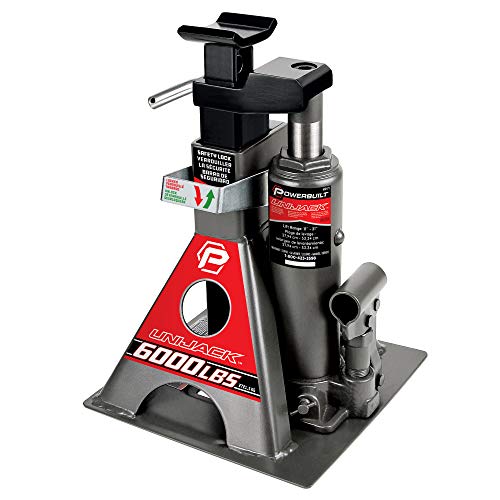
Powerbuilt 3-Ton Unijack All-in-One Hydraulic
The Powerbuilt 620471 Unijack integrates a hydraulic bottle jack and a mechanical ratcheting jack stand into a single unit, eliminating the danger of hydraulic pressure bleed-off. With a 6,000-pound capacity, an 11 to 21-inch lift range, and a wide steel base, it provides dependable single-point lifting and static holding for trucks and SUVs.
Pros
- Combines hydraulic bottle jack lifting and mechanical jack stand safety into one single-point tool
- Physical ratcheting safety lock prevents accidental vehicle drops caused by hydraulic pressure bleed-off
- Wide 9.88 x 9.75-inch base provides excellent stability on garage concrete and level paved surfaces
- Tall 21-inch maximum extension delivers ample working clearance for high-clearance trucks and SUVs
- Meets ANSI standards for portable automotive service equipment and includes a 1-year factory warranty
Cons
- Minimum collapsed height of 11 inches makes it unusable on low-clearance sedans and sports cars
- At 22.66 pounds per single unit, it is significantly heavier than standard individual mechanical jack stands
- Sold as an individual unit rather than a pair, requiring separate purchases if supporting an entire axle
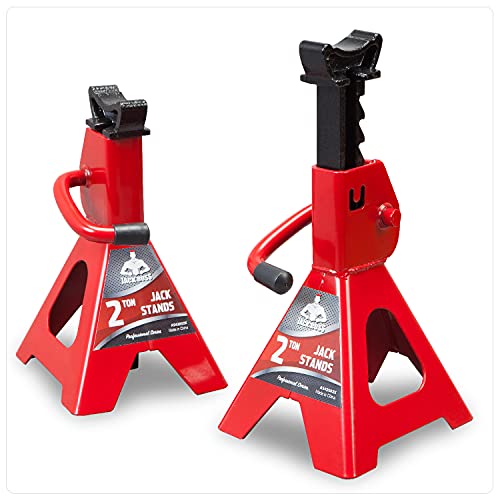
Jack Boss 2-Ton Low-Profile Ratchet Jack Stands
Designed for compact cars and small unibody vehicles, these Jack Boss low-profile jack stands combine a welded mild steel pyramid base with a ductile iron sawtooth ratchet bar spanning a 9.8-inch to 15-inch height range. They provide a lightweight, compact footprint for DIY garage maintenance, though the manufacturer explicitly advises against using them on trucks, large SUVs, or vehicles requiring over 15 inches of chassis clearance.
Pros
- Low 9.8-inch collapsed height fits easily under small passenger cars and lower unibody lift points
- Ductile iron sawtooth ratchet bar allows fast, tool-free height selection and positive pawl engagement
- Lightweight 10.5-pound overall build makes carrying, positioning, and garage storage simple
- Fully welded mild steel frame with protective powder coating guards against rust and shop grime
Cons
- Maximum 15-inch reach is too short for pickup trucks, full-size SUVs, or lifted off-road vehicles
- Single-pawl ratchet design lacks a secondary captive locking pin or redundant safety stop
- Steel concave saddle does not include rubber protection, which may mar painted unibody pinch welds without an aftermarket pad
TONDA 3-Ton Extra Tall Jack Stands
Built with an extended 13.39 to 21.06-inch lift range, these TONDA 3-ton jack stands deliver generous clearance for taller vehicles. The welded carbon steel frame and self-locking cast-iron ratchet bar provide stable, dependable support for regular garage maintenance.
Pros
- Supports up to 6,000 pounds per pair
- Extended 21.06-inch maximum height suits taller vehicles
- Durable welded carbon steel construction
- Wide pyramid base provides a stable footprint
- Self-locking ratchet bar engages automatically when raised
Cons
- High 13.39-inch minimum height limits low-clearance vehicles
- Combined weight of 17 pounds reduces portability
PRUTHY 3-Ton Double-Locking Jack Stands
The PRUTHY 3-Ton Jack Stand Pair provides static vehicle support rated up to 6,600 pounds across the pair, combining a ductile iron ratchet bar with an added metal safety pin for dual-locking peace of mind. Featuring an 11.4-inch to 16.9-inch height range and a wide stamped-steel pyramid base, they offer reliable stability for routine garage maintenance on sedans, crossovers, and small SUVs.
Pros
- Secondary metal safety pin adds a positive mechanical backup to the primary ratchet pawl mechanism
- Welded stamped-steel pyramid base provides solid footing and even weight distribution on level concrete floors
- Clear 11.4-inch to 16.9-inch elevation range works well for passenger cars, crossovers, and compact utility trailers
- Forged one-piece ductile iron ratchet column resists fracturing under static load
Cons
- Minimum collapsed height of 11.4 inches may be too tall for lowered sports cars without pre-lifting
- Maximum extension of 16.9 inches will not provide adequate clearance for lifted 4x4 trucks on oversized tires
- Metal saddle lacks included rubber protective pads to shield delicate pinch welds from cosmetic scratches
JKWQFBOYAN 3-Ton Double-Locking Jack Stands
These JKWQFBOYAN 3-ton ratchet jack stands feature a dual-locking setup with a cast iron ratchet bar and secondary metal safety pin supported by a wide carbon steel pyramid base. Designed for DIY maintenance on passenger cars, small trucks, and SUVs, they offer an accessible static support option for budget-conscious home mechanics.
Pros
- Double-locking design combines a ratchet handle mechanism with a metal safety pin for secondary security
- Wide pyramid base features triangular foot pads to distribute static chassis weight across level concrete
- Notched saddle profile helps locate vehicle edges and factory lift points
- Relatively lightweight at under 11 pounds for easy garage positioning and compact shelf storage
Cons
- Minimum collapsed and maximum extended height dimensions are not explicitly specified in the manufacturer data
- Listing notes CE conformity rather than the ASME PASE certification standards typical for U.S. commercial shops
- Notched metal saddle lacks rubber pads, which may require aftermarket pinch-weld protectors to prevent underbody marring
Extended Vehicle Storage on Mechanical Jack Stands
A properly supported car can physically remain on mechanical jack stands indefinitely without suffering structural stand failure. Mechanical jack stands rely on rigid cast iron or welded steel columns rather than pressurized fluids, meaning they do not slowly bleed off elevation over time. However, answering practical vehicle storage questions requires looking beyond the stands themselves to examine suspension wear, chassis distortion, and ground surface stability. Addressing these mechanical factors ensures that your car remains completely safe whether elevated for an afternoon brake replacement or several months of off-season storage.
Mechanical Holding Power Versus Hydraulic Bleed-Down
Hydraulic floor jacks are engineered strictly for lifting tasks, whereas mechanical jack stands are designed for stationary holding. Floor jacks rely on hydraulic fluid contained by rubber O-rings and valves that inevitably experience micro-leakage under continuous pressure. Leaving a vehicle supported solely by a hydraulic jack for even a few hours invites sudden failure as hydraulic pressure bleeds off and drops the chassis. Jack stands eliminate this hydraulic vulnerability by transferring vehicle weight directly through mechanical interlocks such as ductile iron ratchet teeth or solid steel cross-pins.
Static loads placed on structural steel stands do not degrade the metal as long as the weight remains safely below the yield strength of the material. Portable automotive service equipment adhering to ANSI/ASME PASE standards undergoes proof-load testing to verify structural stability under rated load. Because mechanical metals do not exhibit creep at ambient garage temperatures under rated loads, the stand itself will not bend or shorten over years of static support. Practical time limits on vehicle elevation arise from external variables like pavement settling, garage vibration, and prolonged suspension strain.
Suspension Component Stress During Prolonged Hanging Droop
Leaving a vehicle supported by its chassis for months causes the suspension to hang at full downward travel, commonly known as full droop. Factory suspension assemblies feature bonded rubber bushings in control arms, multi-link pivots, and sway bar mountings that are torqued at normal vehicle ride height. When wheels hang unsupported, these rubber bushings remain in a continuous state of torsional twist. Over extended periods, this continuous rotational tension can accelerate rubber dry-rot, cause micro-tearing in bushing elastomeric bonds, and lead to premature suspension squeaks upon reassembly.
Shock absorbers and strut assemblies also experience continuous downward extension when unsprung suspension weight hangs in the air. While internal hydraulic oil and gas charges inside modern dampers tolerate extension without failure, prolonged droop keeps internal rebound springs compressed against upper rod stops. Exposed polished shock shafts also become vulnerable to ambient moisture, dust, and humidity, which can pit chrome plating and subsequently damage oil seals when the vehicle returns to the road. Positioning jack stands under lower control arms or solid axle tubes maintains normal ride-height geometry and protects suspension bushings during prolonged layups.
Chassis Integrity and Long-Term Pinch-Weld Loading
Unibody vehicles concentrate their rigid structural strength across stamped sheet metal rocker seams known as factory pinch welds. Supporting a car on unibody pinch welds for hours during a routine brake service poses minimal risk when using proper support adapters. Over months of static elevation, however, the continuous concentration of hundreds of pounds on small stamped metal tabs can lead to gradual seam deformation. Bare steel stand saddles can also scrape protective undercoating away from pinch welds, exposing bare sheet metal to garage condensation and rust formation.
Body-on-frame vehicles, such as light trucks and traditional rear-wheel-drive platforms, handle prolonged stationary elevation with significantly greater resilience. Thick boxed steel frame rails distribute chassis weight evenly across broader surface areas without the localized crushing hazards inherent to stamped unibody seams. When elevating unibody passenger cars for multi-month restorations, using slotted rubber saddle pads or purpose-built pinch-weld adapters prevents metal gouging and spreads weight evenly across reinforced factory lift points. Owners planning long-term structural repairs often evaluate professional automotive lift options when multiple vehicles require extended off-ground storage in commercial settings.
Substrate Integrity: Concrete Slabs Versus Asphalt Settling Risks
The ground surface beneath your vehicle represents the single greatest safety variable during extended elevation. Poured concrete garage slabs offer compressive strengths generally between three thousand and four thousand pounds per square inch, providing a rock-solid foundation for months of vehicle storage. Concrete resists localized deformation, allowing the narrow stamped steel feet of pyramid-style jack stands to distribute thousands of pounds without shifting or indenting the floor. Even on concrete, mechanics should avoid placing stand feet over expansion joints, cracks, or floor drain slopes that could induce uneven loading.
Asphalt driveways present a serious hazard for cars left on jack stands for extended durations, particularly during warm weather. Asphalt is a petroleum-based flexible pavement that softens significantly under direct sunlight and high ambient temperatures. A typical vehicle distributes roughly fifteen hundred pounds across each front stand, creating intense point-load pressure on small stamped metal feet. Over days or weeks, stand legs can punch directly through softened asphalt, causing the vehicle to tilt laterally and potentially slide off its support saddles.
When vehicle elevation on asphalt or compacted surfaces is unavoidable, mechanics must disperse point-load forces across broader foundation plates. Placing heavy steel distribution plates under each stand foot creates a broad footprint that prevents localized pavement penetration. Solid hardwood pads of substantial thickness can serve as temporary load spreaders in dry conditions, but untreated wood splits easily along grain lines under focused point loads. Unrated concrete pavers, hollow cinder blocks, and stacked bricks should never be used beneath stand bases because brittle masonry shatters unpredictably under sustained concentrated weight.
Locking Mechanism Security: Ductile Iron Ratchets and Redundant Safety Pins
The locking mechanism of a jack stand determines its long-term mechanical security against accidental disengagement. Sawtooth ratchet-bar stands, such as models manufactured by Amazon Basics or Jack Boss, utilize ductile cast-iron center columns that engage a pivoting pawl inside the base collar. The angled teeth on ductile iron ratchet bars create a positive mechanical stop under vehicle weight that physically cannot disengage while downward load is applied. Ductile iron provides high impact resistance and tensile strength, ensuring that static downward forces do not fracture the locking pawl over months of stationary holding.
Double-locking jack stands, including designs from YELLOW JACKET and PRUTHY, add an extra layer of mechanical insurance for long-term project vehicles. These units pair the primary ductile iron ratchet pawl with a heavy-duty steel safety pin that slides directly through the base collar beneath the center column. Even if lateral garage vibration or accidental handle contact occurs, the solid metal safety pin prevents the center post from descending. This redundant locking design provides essential peace of mind when a car remains elevated for months in a residential garage.
Pin-type and Unijack combination designs provide unique structural advantages for extended vehicle maintenance schedules. The Powerbuilt Unijack combines a bottle jack mechanism with a ratcheting mechanical lock, allowing users to lift and hold vehicles using a single integrated footprint. Pin-style stands utilize solid through-pins that penetrate both the outer collar and inner center tube, eliminating tooth engagement entirely in favor of direct shear resistance. For vehicles stored long term, solid steel pins cannot slip or disengage, making them an exceptionally reliable choice for stationary winter projects.
Environmental Variables: Moisture, Corrosion, and Vibration in the Garage
Vehicles stored on stands for months inside residential garages encounter fluctuating humidity levels and seasonal temperature swings. Condensation often forms on cold garage floors during spring and autumn, creating a damp environment directly around stand bases. While powder-coated stamped steel frames resist rust effectively, untreated internal collar areas, ratchet teeth, and pivot pins remain vulnerable to surface oxidation over time. Rust accumulation inside ratchet tracks can cause mechanical pawls to bind or fail to seat completely into tooth roots when height adjustments are made.
Corrosion also threatens the vehicle components that remain in direct contact with steel jack stand saddles. Bare steel-on-steel contact between stand cradles and vehicle frame rails promotes galvanic interaction when moisture remains trapped against bare metal. Applying a light protective film of silicone spray to stand contact areas before extended storage helps deter rust without compromising friction. Using vulcanized rubber saddle pads isolates metal interfaces completely, preventing paint gouging and warding off moisture-induced corrosion throughout extended off-season storage periods.
Preparing Your Vehicle for Multi-Month Stand Storage
Proper vehicle preparation before extended elevation prevents catastrophic balance shifts and mechanical issues down the road. Begin by parking the vehicle on a completely level concrete slab, engaging the emergency brake firmly, and shifting the transmission into park or reverse. Position heavy-duty rubber wheel chocks securely against both sides of any tires that will remain in contact with the ground during initial lifting. If all four wheels are being elevated, lift the vehicle in matched pairs, raising the heavier end first to maintain chassis equilibrium.
Position jack stands strictly at reinforced factory lift points specified in the vehicle owner manual. Align the deepest recess of the stand saddle dead center beneath the factory pinch weld notch or boxed frame rail to prevent off-center side loading. Lower the hydraulic floor jack at a slow, controlled rate, allowing the chassis weight to settle completely onto the mechanical stand saddles. Once weight is fully transferred, lower the hydraulic jack slightly while leaving it positioned directly beneath a major crossmember as a secondary emergency clearance stop.
Before leaving the elevated vehicle unattended for the season, execute a thorough physical stability verification test. Firmly grip the vehicle bumper or fender with both hands and push laterally with moderate force to test for collar play, foot rocking, or frame shifting. If any stand leg lifts off the concrete or wobbles under lateral pressure, immediately raise the car, inspect the floor contact surface, and realign the stands. A properly settled vehicle on quality stands should feel as solid and immobile as if it were resting directly on its road tires.
Stand Selection Factors for Long-Term Storage Projects
Selecting vehicle support equipment for prolonged projects requires matching rated load capacity and structural geometry to your specific chassis requirements. ANSI/ASME PASE standards define load ratings per pair rather than per individual stand, meaning a three-ton pair provides six thousand pounds of total capacity across two units. For extended storage of sedans or urban crossovers, three-ton sets like the Amazon Basics or TONDA extra-tall models provide ample safety margins above vehicle curb weight. TONDA stands feature an extended lift range reaching over twenty-one inches, which accommodates tall suspension droop on light trucks and SUVs.
Low-clearance sports cars and lowered vehicles present different geometric challenges that demand low-profile support equipment. Jack Boss two-ton low-profile stands feature a collapsed height under ten inches, allowing them to slide smoothly under compact vehicles with tight ground clearance. For heavier trucks and SUVs, wider pyramid base footprints, such as those featured on YELLOW JACKET and PRUTHY three-ton models, disperse load weight across broad surface areas. Broad base dimensions maximize lateral stability, ensuring that vehicles subjected to winter garage drafts or incidental contact remain securely locked in place.
Ongoing Inspection Protocols for Extended Vehicle Layups
Even when a car is safely elevated on mechanical stands, owners should implement routine visual inspection protocols during prolonged storage months. Inspect each stand foot monthly to ensure the concrete slab has not shifted, cracked, or accumulated standing water from winter snowmelt. Verify that ratchet locking pawls remain seated in tooth roots and that redundant safety pins remain firmly inserted through collar alignment holes. Check around the vehicle perimeter to confirm that tires, project tools, or garage clutter have not shifted against stand bases or disturbed chassis balance.
Examine the chassis contact points for any signs of sheet metal flexing, saddle migration, or protective pad degradation over time. Temperature fluctuations can cause rubber adapters to compress or harden, which may require minor re-centering if settling occurs. Never attempt to adjust stand height or reposition support points while vehicle weight rests on the mechanical saddles. Always bring a hydraulic jack back under the designated factory lifting point, raise the chassis clear of the stand, make adjustments safely, and lower the vehicle back into position with full stability checks.
About the author
Emily Markham is an automotive aftermarket editor who has covered professional tools, workshop equipment, and the businesses that support vehicle repair since 2019. Her editorial background gives her a practical understanding of how technicians and shop owners evaluate equipment, product value, and long-term support.