
How Does a Car Jack Stand Work: Mechanical Principles and Safe Setup Guide for 2026
Learn %how does a car jack stand work% through mechanical load paths, ratchet pawls, and safe garage support practices updated for November 2026.
 By Christian Hazel
Updated October 10, 2026


Lifting an automobile off the pavement creates immediate danger if you rely solely on hydraulic pressure to keep thousands of pounds overhead. Hydraulic floor jacks use pressurized fluid that can bypass internal seals without warning, which makes stationary mechanical holding devices mandatory for any underbody repair. Understanding %how does a car jack stand work% begins with recognizing that these steel supports convert dynamic vehicle weight into static ground force through positive mechanical locking. Whether you plan an oil change, a brake caliper rebuild, or suspension maintenance, mechanical stands prevent sudden chassis drops. Before raising any vehicle in a tight space, verifying garage ceiling height requirements ensures sufficient overhead room to lift the chassis safely onto support columns.
A reliable support setup relies on rigid metallurgy, broad pyramid bases, and secure physical pawls or cross-pins rather than fluid dynamics. Home mechanics frequently wonder how slender columns of ductile iron or welded steel hold heavy trucks and unibody sedans steady while applying heavy breaker bar torque to stubborn suspension bolts. Every support stand distributes downward chassis pressure across a wide footprint to resist lateral tipping and ground deformation. Clarifying rated load capacity per pair under ANSI/ASME PASE standards protects equipment from dangerous overloading during DIY maintenance. Learning the internal physics and structural locking paths of these tools provides the confidence needed to work underneath a vehicle safely.
| Award | Product | BJL Score About BJL ScoreThe BJL Score is our own rating from 0 to 10, based on performance, design and build, ease of use, and value. It reflects independent research and is never influenced by manufacturers, retailers, or affiliate commissions. Learn more › | |
|---|---|---|---|
| Best Overall |
YELLOW JACKET 3 Ton Double-Locking Steel Jack
|
9.2/10 | Buy |
| Best Value |
 Amazon Basics 3-Ton Steel Jack Stands |
8.9/10 | Buy |
| Best Premium |
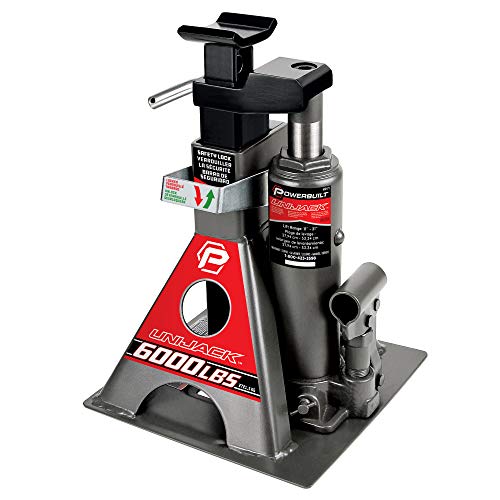 Powerbuilt 3-Ton Unijack All-in-One Hydraulic |
8.9/10 | Buy |
| Best Budget |
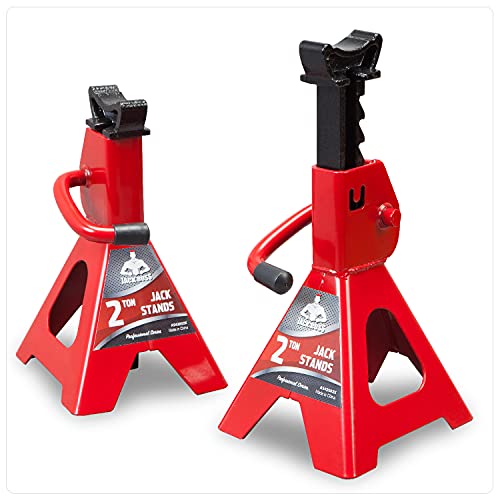 Jack Boss 2-Ton Low-Profile Ratchet Jack Stands |
8.6/10 | Buy |
 ANTPOWER 3-Ton Double-Locking Jack Stands |
8.4/10 | Buy | |
 JKWQFBOYAN 3-Ton Double-Locking Jack Stands |
7.8/10 | Buy |
YELLOW JACKET 3 Ton Double-Locking Steel Jack
The YELLOW JACKET 3-ton jack stand pair provides a 6,600-pound combined capacity with ductile iron ratchet columns and secondary metal locking pins for redundant garage safety. Featuring a welded stamped steel pyramid base and a 10-7/8-inch to 16-9/16-inch height range, they offer reliable static support for compact cars, crossovers, and midsize SUVs during routine maintenance.
Pros
- Double-locking system pairs a ductile iron ratchet bar with an independent metal safety pin for added physical redundancy
- Solid one-piece forged ductile iron center column provides reliable static tooth engagement across multiple height settings
- Welded stamped steel pyramid base features wide foot pads to support vehicle stability on flat concrete shop floors
- Practical height span of 10-7/8 inches to 16-9/16 inches covers common passenger vehicle maintenance tasks like brake jobs and oil changes
Cons
- The 10-7/8-inch collapsed height may sit too high for significantly lowered sports cars or vehicles with low front splitters
- Bare metal saddle lacks rubber cushioning pads, which may mar painted subframes or bend unprotected pinch welds without aftermarket adapters
- Maximum height reach of 16-9/16 inches is limited for lifted 4x4 trucks or high-clearance off-road vehicles requiring extended droop clearance
Amazon Basics 3-Ton Steel Jack Stands
The Amazon Basics 3-Ton Steel Jack Stand Pair delivers 6,000 pounds of reliable vehicle support certified to ASME PASE-2014 standards for portable automotive equipment. Featuring a self-locking ratchet bar and a compact steel footprint, this set is ideal for home garage DIYers servicing passenger cars and urban SUVs.
Pros
- Rated for 3 tons (6,000 lbs) per pair and meets ASME PASE-2014 portable automotive service standards
- Self-locking ratchet bar enables rapid, secure height adjustment without fiddling with separate pins
- Compact 7.5 x 7.0-inch footprint and 12.6-lb total weight make positioning and storage simple
- Protective rustproof coating over a durable steel frame helps resist corrosion from garage fluids
Cons
- 3-ton capacity is tailored for sedans and crossover SUVs, not full-size heavy-duty pickup trucks
- Ratchet assembly does not feature a secondary mechanical cross-locking pin for redundant backup
- Must be used exclusively on flat, solid concrete slabs to prevent uneven weight distribution or base sinking
Powerbuilt 3-Ton Unijack All-in-One Hydraulic
The Powerbuilt 620471 Unijack integrates a hydraulic bottle jack and a mechanical ratcheting jack stand into a single unit, eliminating the danger of hydraulic pressure bleed-off. With a 6,000-pound capacity, an 11 to 21-inch lift range, and a wide steel base, it provides dependable single-point lifting and static holding for trucks and SUVs.
Pros
- Combines hydraulic bottle jack lifting and mechanical jack stand safety into one single-point tool
- Physical ratcheting safety lock prevents accidental vehicle drops caused by hydraulic pressure bleed-off
- Wide 9.88 x 9.75-inch base provides excellent stability on garage concrete and level paved surfaces
- Tall 21-inch maximum extension delivers ample working clearance for high-clearance trucks and SUVs
- Meets ANSI standards for portable automotive service equipment and includes a 1-year factory warranty
Cons
- Minimum collapsed height of 11 inches makes it unusable on low-clearance sedans and sports cars
- At 22.66 pounds per single unit, it is significantly heavier than standard individual mechanical jack stands
- Sold as an individual unit rather than a pair, requiring separate purchases if supporting an entire axle
Jack Boss 2-Ton Low-Profile Ratchet Jack Stands
Designed for compact cars and small unibody vehicles, these Jack Boss low-profile jack stands combine a welded mild steel pyramid base with a ductile iron sawtooth ratchet bar spanning a 9.8-inch to 15-inch height range. They provide a lightweight, compact footprint for DIY garage maintenance, though the manufacturer explicitly advises against using them on trucks, large SUVs, or vehicles requiring over 15 inches of chassis clearance.
Pros
- Low 9.8-inch collapsed height fits easily under small passenger cars and lower unibody lift points
- Ductile iron sawtooth ratchet bar allows fast, tool-free height selection and positive pawl engagement
- Lightweight 10.5-pound overall build makes carrying, positioning, and garage storage simple
- Fully welded mild steel frame with protective powder coating guards against rust and shop grime
Cons
- Maximum 15-inch reach is too short for pickup trucks, full-size SUVs, or lifted off-road vehicles
- Single-pawl ratchet design lacks a secondary captive locking pin or redundant safety stop
- Steel concave saddle does not include rubber protection, which may mar painted unibody pinch welds without an aftermarket pad
ANTPOWER 3-Ton Double-Locking Jack Stands
The ANTPOWER 3-ton double-locking jack stands provide reliable static support for garage maintenance, pairing a ductile iron sawtooth ratchet column with a secondary steel side-locking pin. With an 11.2 to 16.8-inch height range and a fully welded pyramid steel base, they offer solid safety for compact cars, sedans, and light crossovers.
Pros
- Secondary side-pin lock adds physical redundancy alongside the primary ratchet pawl
- High-strength ductile iron ratchet bar provides positive sawtooth height adjustments
- Fully welded mild steel pyramid base delivers stable static support on level concrete slabs
- Protective powder-coated finish helps resist common garage moisture and chemical rust
- Manageable 14.3-pound total weight makes repositioning easy during four-corner vehicle setups
Cons
- Maximum 16.8-inch reach is insufficient for lifted 4x4s, full-size trucks, or vehicles with frame heights over 16 inches
- Bare steel saddle lacks a rubber pad, which may mar painted unibody pinch welds without an aftermarket adapter
- Conflicting product listing text notes both 6,000 lbs per pair and 6,600 lbs per stand, requiring conservative 3-ton pair load planning
JKWQFBOYAN 3-Ton Double-Locking Jack Stands
These JKWQFBOYAN 3-ton ratchet jack stands feature a dual-locking setup with a cast iron ratchet bar and secondary metal safety pin supported by a wide carbon steel pyramid base. Designed for DIY maintenance on passenger cars, small trucks, and SUVs, they offer an accessible static support option for budget-conscious home mechanics.
Pros
- Double-locking design combines a ratchet handle mechanism with a metal safety pin for secondary security
- Wide pyramid base features triangular foot pads to distribute static chassis weight across level concrete
- Notched saddle profile helps locate vehicle edges and factory lift points
- Relatively lightweight at under 11 pounds for easy garage positioning and compact shelf storage
Cons
- Minimum collapsed and maximum extended height dimensions are not explicitly specified in the manufacturer data
- Listing notes CE conformity rather than the ASME PASE certification standards typical for U.S. commercial shops
- Notched metal saddle lacks rubber pads, which may require aftermarket pinch-weld protectors to prevent underbody marring
The Mechanics and Structural Physics of Car Jack Stand Operation
A car jack stand operates on a simple yet vital mechanical principle: isolating a suspended vehicle chassis from dynamic hydraulic pressure and transferring its dead weight directly into the solid ground through a rigid mechanical column. When an automobile rests on a support stand, no moving fluids, flexible rubber bladders, or pneumatic valves bear the load. Instead, the entire downward gravitational force flows through a steel saddle, down a central vertical post, through a positive mechanical locking interface, and out through a wide four-legged pyramid base. This direct physical load path guarantees that the vehicle remains stationary even if workshop equipment fails nearby.
Many garage hobbyists overlook the fundamental difference between dynamic lifting mechanisms and static holding fixtures. While a floor jack relies on hydraulic pistons to elevate an axle or frame rail, it lacks the mechanical stability to hold that weight safely over time. Support stands solve this vulnerability by substituting compressible fluids with hardened metal components engineered specifically for high compressive loads. Exploring %how does a car jack stand work% reveals why structural geometry, locking pawl engagement, and material selection form the backbone of vehicle maintenance safety.
The Core Load-Bearing Mechanism: Ratchet Bars Versus Pin Systems
Modern vehicle support equipment primarily utilizes two mechanical locking styles to maintain elevated chassis height. The most prevalent design in residential garages is the ratchet-bar system, which incorporates a central column cast from heavy ductile iron. One vertical edge of this column features a series of angled sawtooth notches that correspond to a pivoting internal locking pawl located inside the outer steel collar. When you lift the center post upward, the pawl clicks over each tooth until you reach your desired working height, dropping firmly into the notch below.
In contrast, pin-style support stands rely on a tubular or square center post drilled with horizontal through-holes at regular height increments. To secure the column, the operator slides a solid forged steel cross-pin through both the outer collar and the inner support post. This configuration relies on pure shear stress across the diameter of the solid steel pin rather than tooth engagement. Both mechanisms prevent downward post movement through mechanical interference, but their adjustment speed and locking geometry differ substantially during garage setup.
Innovative hybrid units also exist in specialized workshop applications. For example, the Powerbuilt 3 Ton Unijack combines an internal hydraulic bottle jack with an external ratcheting safety bar in a single compact housing. This unique mechanism lifts the vehicle hydraulically and locks mechanically along a notched bar simultaneously, preventing the post from collapsing if internal hydraulic pressure drops. Regardless of whether a stand uses a ratcheting tooth track, a solid shear pin, or an integrated unijack assembly, the primary objective remains absolute mechanical locking.
How Ratchet Pawls and Counterweight Action Engage Under Chassis Weight
The internal action of a ratcheting jack stand relies on gravity, leverage, and friction to secure vehicle weight. The central column features sawtooth teeth angled upward at approximately forty-five degrees on their lower surface and cut perfectly flat on their top landing. Inside the base collar, a cast ductile iron pawl pivots on a heavy steel rivet or pin. A weighted external release handle connects to this pawl, ensuring that gravity constantly pulls the locking wedge inward toward the center post teeth whenever the handle rests in its downward position.
As you raise the saddle to meet the vehicle frame, the pawl rides smoothly up the angled ramp of each tooth and falls into the valley beneath it with a sharp metallic click. When you stop lifting, the flat underside of the ductile iron pawl rests directly against the horizontal shelf of the ratchet tooth. Once the weight of the car transfers onto the saddle, immense downward pressure clamps the tooth shelf against the pawl face. This high compressive force generates intense friction, making it physically impossible to lift the release handle or disengage the pawl while the stand carries the load.
To provide an extra layer of structural reassurance, several manufacturers integrate redundant locking mechanisms. Models like the YELLOW JACKET Car Jack Stands 3 Ton with Double Locking and the ANTPOWER Car Jack Stands 3 Ton incorporate a secondary metal safety pin inserted horizontally through the base collar directly beneath the ratchet bar. If an accidental impact strikes the release handle or extreme vibration occurs during heavy hammering, this secondary pin prevents the pawl from shifting out of its seated position. This redundant physical block satisfies the safety preferences of many cautious DIY mechanics.
Hydraulic Floor Jacks Versus Stationary Jack Stands
A common misconception among beginner mechanics is that a hydraulic floor jack is sufficient for supporting a vehicle during an inspection or quick repair. Floor jacks rely on pressurized hydraulic oil contained by internal O-rings, check valves, and release screws to push a lifting arm upward. If an internal seal ruptures, debris enters a ball-seat valve, or the release valve creeps open, the hydraulic fluid bypasses into the reservoir. This loss of hydraulic pressure causes the lifting arm to collapse instantly without any audible warning.
Stationary jack stands eliminate fluid reliance entirely by converting vertical vehicle load into static mechanical compression. The stamped steel base, welded frame, and cast iron post do not depend on pressure retention or moving fluids to sustain their rated capacity. While a hydraulic floor jack is the correct tool for the dynamic task of raising the chassis, it must never serve as the working support. Exploring dedicated automotive lift systems illustrates how commercial shops manage vehicle elevation, but home garages achieve reliable mechanical isolation by pairing hydraulic jacks with rigid stationary stands.
Proper garage safety protocol dictates that after the floor jack lifts the chassis to the required clearance, you position the jack stands beneath reinforced structural points. You then slowly turn the floor jack release valve to lower the vehicle onto the stands until the mechanical columns bear the full load. Once the vehicle rests solidly on the stands, the floor jack can be lowered slightly, maintaining zero pressure while remaining nearby as an emergency secondary barrier. This procedure guarantees that 100 percent of the vehicle weight rests on solid metal rather than fluid seals.
Understanding ANSI/ASME PASE Load Capacity Ratings Per Pair
Understanding load capacity conventions is critical when evaluating how support stands protect a vehicle. In the United States, portable automotive service equipment is evaluated under ANSI/ASME PASE standards. A vital rule established by these standards is that jack stand capacity ratings denote the combined weight capacity of a matched pair, not the rating of a single stand. For instance, a pair of stands designated as 3-ton capacity is engineered to support a total load of 6,000 pounds when used together across an axle, meaning each individual stand supports 3,000 pounds.
Some manufacturers supply units with slightly elevated structural metrics. For example, the YELLOW JACKET and ANTPOWER 3-ton models list a 6,600-pound pair capacity, while the Amazon Basics Steel Jack Auto Stands and Car Jack Stands by JKWQFBOYAN feature a standard 6,000-pound rating. Meanwhile, compact units like the Jack Boss Jack Stands Low Profile offer a 2-ton rating, supporting up to 4,000 pounds across two stands. Confusing per-pair ratings with individual stand capacities creates a dangerous overloading risk that can compromise structural integrity.
When selecting support equipment, you must compare the stand rating against your vehicle Gross Axle Weight Rating (GAWR) rather than solely checking total curb weight. A front-engine passenger sedan may carry sixty percent of its curb weight over the front suspension, creating a concentrated downward force on the front axle stands. Utilizing 3-ton stands for a typical passenger car or compact crossover provides an ample safety cushion. For full-size pickup trucks, large body-on-frame SUVs, or commercial vans, stepping up to heavy-duty 6-ton stands ensures appropriate structural margins and working height reach.
Base Geometry, Footprint Stance, and Ground Surface Stability
The ability of a jack stand to hold a vehicle steady depends heavily on the geometry of its base frame. Most automotive stands feature a wide pyramid design with four stamped steel legs welded together with horizontal bracing. This pyramidal structure creates a broad quadrilateral stance that projects outward significantly further than the top saddle. By widening the base footprint, the stand dramatically lowers the center of gravity of the support assembly, helping it resist tipping forces caused by wind, accidental bumps, or mechanical leverage.
Ground contact points play a crucial role in preventing base deflection and surface penetration. Units such as the JKWQFBOYAN 3-ton model and the YELLOW JACKET feature wide perimeter foot pads welded to the bottom of each leg. These steel pads distribute the concentrated downward load across a greater surface area, reducing the pounds per square inch exerted on the floor. Without these foot pads, narrow steel leg edges can bite into garage surfaces, gouge floor coatings, or destabilize the vehicle during high-torque mechanical operations.
Working surface hardness is equally critical for maintaining vehicle stability. Jack stands should always be positioned on level, cured concrete slabs that resist high point-load compression. Asphalt driveways soften considerably under direct summer sunlight, allowing the narrow feet of a loaded stand to sink into the pavement and tilt the vehicle. Furthermore, mechanics must never place makeshift wooden blocks, paving bricks, or hollow cinder blocks beneath the feet or saddle to gain extra height. These unrated materials can fracture suddenly under concentrated compressive loads, resulting in immediate catastrophic collapse.
Saddle Profiles and Vehicle Chassis Interface Compatibility
The top saddle forms the critical physical contact point where the vehicle chassis transfers its weight into the stand column. Stand saddles generally feature a curved, concave cradle designed to capture round axle tubes, solid control arms, or heavy truck perimeter frame rails. The raised horns on either side of the saddle cradle prevent the vehicle component from sliding laterally off the support post. Models like the Jack Boss Low Profile utilize a large concave saddle specifically contoured to support vehicle chassis points without slipping.
Modern passenger cars with unibody construction require special attention because they lack heavy steel perimeter frames. Instead, these vehicles feature reinforced pinch-weld seams along the lower rocker panels designated by the manufacturer as factory jacking points. Placing a bare curved metal saddle directly against a thin unibody pinch weld can bend or crush the sheet metal seam, stripping protective paint coatings and initiating rust. In severe cases, off-center placement on a pinch weld can cause the seam to fold flat, destabilizing the contact interface.
To safely support unibody vehicles, mechanics often utilize slotted vulcanized rubber saddle adapters that slip over the metal cradle. The deep groove in the rubber pad cradles the vertical pinch weld seam while distributing the load against the reinforced floor pan structure behind it. This soft yet high-density barrier prevents metal-on-metal gouging, preserves rocker seam alignment, and enhances frictional grip. Always consult your vehicle owner manual to locate the reinforced structural lift points before positioning any support saddles underneath the body.
Step-by-Step Procedure for Lowering Vehicle Weight Onto Stands
Executing a controlled weight transfer from your lifting device to the support stands requires methodical preparation and discipline. Begin by parking the vehicle on a level concrete surface, shifting the transmission into park or reverse, and firmly engaging the emergency brake. Place heavy rubber wheel chocks firmly against the front and rear of the tires remaining on the ground to prevent rolling. Using a suitable hydraulic floor jack, raise the vehicle from an approved central jacking point until the wheels clear the floor by several inches.
Slide your matched pair of jack stands into position directly beneath the vehicle designated factory support points, such as the front subframe or pinch welds. Raise the center ratchet columns evenly until the saddles sit approximately one half inch beneath the chassis contact points, confirming that the pawls engage securely into horizontal tooth notches. If using double-locking units like the ANTPOWER or YELLOW JACKET stands, slide the secondary safety pins through the collars. Familiarizing yourself with proper garage vehicle lifting equipment protocols ensures that every step follows disciplined mechanical best practices.
Slowly turn the floor jack release handle counterclockwise to lower the chassis gradually onto the stand saddles. Observe both stands closely during descent to ensure the load settles dead center within the concave cradles rather than catching on outer saddle horns. Once the stands bear the full vehicle weight, release hydraulic pressure on the floor jack completely, leaving the saddle barely touching the chassis as an unloaded fail-safe. Finally, grasp the vehicle bumper or fender and execute a firm lateral push test to confirm rock-solid stability before crawling underneath.
Structural Inspection and Retirement Criteria for Garage Stands
Because support equipment carries enormous weight, periodic visual inspections are vital for detecting structural fatigue before catastrophic failure occurs. Before every use, inspect the ductile iron ratchet column for signs of wear, chipping, or rounding on the horizontal tooth edges. The teeth must display sharp, clean square landings where the locking pawl seats. Any rounding, cracking, or casting voids along the ratchet track indicates severe metal fatigue that warrants immediate retirement of the stand.
Examine the welded steel base frame for signs of distortion, cracked welds, or bent pyramid legs. Check that all four foot pads rest flat and coplanar on a level floor without rocking or wobbling when unloaded. On double-locking and pin-style stands, verify that the through-pins remain straight, free from bending or shear notches, and that retaining chains or clips keep pins secured to the unit. Furthermore, keep the ratchet collar free from grease, oil, and road grit, which can gum up pawl springs and prevent the counterweighted wedge from seating completely.
Knowing when to decommission and replace a vehicle support stand is fundamental to home workshop safety. If a stand has suffered an impact drop, displays warped sheet metal, exhibits hairline fissures in base welds, or lacks clear ANSI/ASME PASE capacity labeling, take it out of service immediately. High-quality vehicle support tools provide years of dependable service when treated with care, but they should never be pushed past their design limits or repaired with amateur welds. Disciplined maintenance, precise placement, and understanding mechanical load paths guarantee safe underbody working clearance on every DIY project.
About the author
Christian Hazel is an automotive journalist with extensive experience covering four-wheel-drive vehicles, mechanical upgrades, and off-road equipment. His background includes technical reviews, installation features, and project-vehicle coverage, bringing useful context to equipment choices for trucks, Jeeps, and off-road enthusiasts.