
Where to Place Jack Stands Under Front of Car: Safe Placement Guide for 2026
Learn where to place jack stands under front of car safely in November 2026. Explore reinforced pinch welds, subframe rails, and stable setup tips.
 By Christian Hazel
Updated October 10, 2026


Positioning support equipment beneath a raised vehicle requires absolute precision because the engine and transaxle concentrate most of a vehicle’s curb weight over the front axle. Finding reliable structural contact points prevents severe body crushing, suspension distortion, and catastrophic workshop accidents. Knowing where to place jack stands under front of car platforms allows home mechanics to tackle brake jobs, oil changes, and steering repairs with complete confidence. When planning garage projects, reviewing our garage ceiling clearance guide can help you evaluate working space and overhead requirements for various maintenance tasks.
Modern passenger cars feature unibody architectures with distinct reinforced tabs, whereas light trucks often use rigid boxed steel frame rails. Setting a vehicle down on thin floor pans or fragile radiator supports can punch holes straight through structural panels within seconds. Mechanical stability begins with high-quality support equipment, such as ductile iron ratchet stands or double-locking steel units complying with portable service equipment standards. Verifying ground firmness and identifying factory lift markings ensure every underbody maintenance session remains safe and predictable.
| Award | Product | BJL Score About BJL ScoreThe BJL Score is our own rating from 0 to 10, based on performance, design and build, ease of use, and value. It reflects independent research and is never influenced by manufacturers, retailers, or affiliate commissions. Learn more › | |
|---|---|---|---|
| Best Overall |
KOERZORE 3-Ton Jack Stands (Pair)
|
8.9/10 | Buy |
| Best Budget |
 Pencil Noise 3 Ton Double-Locking Jack Stands |
8.9/10 | Buy |
| Best Value |
 SENKEYFE 3-Ton Jack Stands (6,600 lbs Per Pair) |
8.9/10 | Buy |
| Best Premium |
 Amazon Basics 3-Ton Steel Jack Stands |
8.9/10 | Buy |
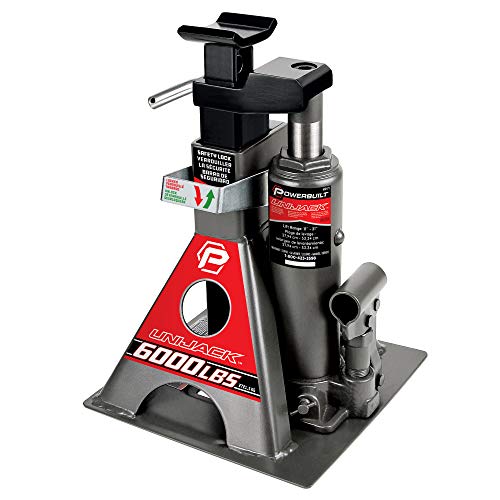 Powerbuilt 3-Ton Unijack All-in-One Hydraulic |
8.9/10 | Buy | |
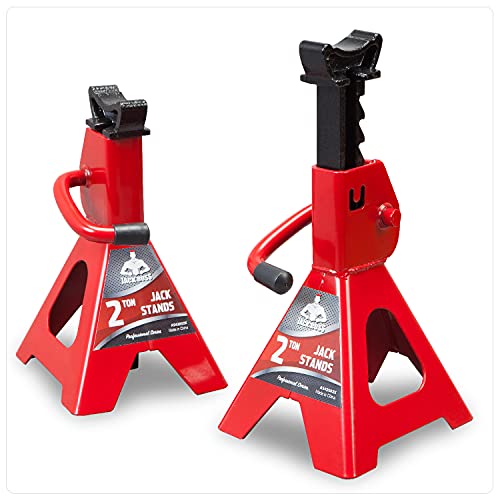 Jack Boss 2-Ton Low-Profile Ratchet Jack Stands |
8.6/10 | Buy | |
 ANTPOWER 3-Ton Double-Locking Jack Stands |
8.4/10 | Buy | |
 PRUTHY 3-Ton Double-Locking Jack Stands |
8.3/10 | Buy | |
 BIG RED Torin 3-Ton Steel Jack Stands |
8.0/10 | Buy | |
 JKWQFBOYAN 3-Ton Double-Locking Jack Stands |
7.8/10 | Buy |
KOERZORE 3-Ton Jack Stands (Pair)
Built for garage maintenance and oil changes, these KOERZORE jack stands feature a dual-locking mechanism and a wide pyramid base to support sedans and midsize SUVs safely.
Pros
- Dual-locking mechanism provides added fail-safe protection
- Wide pyramid base enhances stability on hard surfaces
- Concave saddle securely cradles vehicle frame points
- Lightweight 10.7-pound build allows easy garage portability
Cons
- Maximum 16.75-inch height restricts clearance on lifted trucks
- 3-ton capacity is insufficient for heavy-duty commercial vehicles
Pencil Noise 3 Ton Double-Locking Jack Stands
The Pencil Noise 3 Ton Jack Stands provide static vehicle support with a 6,000 lb total capacity per pair, combining a forged iron ratchet bar with a secondary safety pin. Featuring an 11.4-inch to 16.9-inch height range and a pyramid base, they are a practical choice for DIY maintenance on compact cars, crossovers, and UTVs.
Pros
- Dual-action locking mechanism features both a primary ratchet pawl and a secondary locking pin for redundant mechanical security.
- Sturdy forged iron ratchet bar offers quick height adjustments across multiple indexed locking positions.
- Wide pyramid base geometry delivers solid static stability on smooth, level concrete garage slabs.
- Practical 11.4-inch to 16.9-inch working range fits common DIY garage jobs like brake service, tire rotations, and oil changes.
Cons
- Not recommended or sized for full-size pickup trucks, commercial vans, or heavy off-road SUVs.
- Minimum collapsed height of 11.4 inches may require extra lifting clearance on lowered sports cars before stands can slide underneath.
- Bare metal saddle lacks pre-installed rubber padding, which may risk marring unprotected unibody pinch welds.
SENKEYFE 3-Ton Jack Stands (6,600 lbs Per Pair)
These SENKEYFE 3-ton jack stands deliver a 6,600-pound rated capacity per pair, combining an alloy steel frame with a secondary double-pin locking mechanism and protective rubber saddle covers. Designed for home garage maintainers working on sedans, crossovers, and light SUVs, they offer dependable static support and wide footpads for routine maintenance on level concrete.
Pros
- Secondary double-pin locking system provides mechanical redundancy beyond standard single-locking gravity pawls
- Includes protective rubber saddle covers to safeguard unibody contact points and painted frame surfaces
- Oversized footpads enhance base stability and distribute load weight across level concrete surfaces
- Lightweight design at approximately 11 pounds makes repositioning and garage storage easy
Cons
- Rated static capacity of 3 tons per pair is not suitable for heavy commercial vans or full-size three-quarter-ton pickups
- Maximum extension height of 17 inches may be limited for lifted 4x4 trucks on oversized off-road tires
- Requires smooth, level concrete; soft asphalt or unpaved driveways require heavy-gauge steel load-spreader plates
Amazon Basics 3-Ton Steel Jack Stands
The Amazon Basics 3-Ton Steel Jack Stand Pair delivers 6,000 pounds of reliable vehicle support certified to ASME PASE-2014 standards for portable automotive equipment. Featuring a self-locking ratchet bar and a compact steel footprint, this set is ideal for home garage DIYers servicing passenger cars and urban SUVs.
Pros
- Rated for 3 tons (6,000 lbs) per pair and meets ASME PASE-2014 portable automotive service standards
- Self-locking ratchet bar enables rapid, secure height adjustment without fiddling with separate pins
- Compact 7.5 x 7.0-inch footprint and 12.6-lb total weight make positioning and storage simple
- Protective rustproof coating over a durable steel frame helps resist corrosion from garage fluids
Cons
- 3-ton capacity is tailored for sedans and crossover SUVs, not full-size heavy-duty pickup trucks
- Ratchet assembly does not feature a secondary mechanical cross-locking pin for redundant backup
- Must be used exclusively on flat, solid concrete slabs to prevent uneven weight distribution or base sinking
Powerbuilt 3-Ton Unijack All-in-One Hydraulic
The Powerbuilt 620471 Unijack integrates a hydraulic bottle jack and a mechanical ratcheting jack stand into a single unit, eliminating the danger of hydraulic pressure bleed-off. With a 6,000-pound capacity, an 11 to 21-inch lift range, and a wide steel base, it provides dependable single-point lifting and static holding for trucks and SUVs.
Pros
- Combines hydraulic bottle jack lifting and mechanical jack stand safety into one single-point tool
- Physical ratcheting safety lock prevents accidental vehicle drops caused by hydraulic pressure bleed-off
- Wide 9.88 x 9.75-inch base provides excellent stability on garage concrete and level paved surfaces
- Tall 21-inch maximum extension delivers ample working clearance for high-clearance trucks and SUVs
- Meets ANSI standards for portable automotive service equipment and includes a 1-year factory warranty
Cons
- Minimum collapsed height of 11 inches makes it unusable on low-clearance sedans and sports cars
- At 22.66 pounds per single unit, it is significantly heavier than standard individual mechanical jack stands
- Sold as an individual unit rather than a pair, requiring separate purchases if supporting an entire axle
Jack Boss 2-Ton Low-Profile Ratchet Jack Stands
Designed for compact cars and small unibody vehicles, these Jack Boss low-profile jack stands combine a welded mild steel pyramid base with a ductile iron sawtooth ratchet bar spanning a 9.8-inch to 15-inch height range. They provide a lightweight, compact footprint for DIY garage maintenance, though the manufacturer explicitly advises against using them on trucks, large SUVs, or vehicles requiring over 15 inches of chassis clearance.
Pros
- Low 9.8-inch collapsed height fits easily under small passenger cars and lower unibody lift points
- Ductile iron sawtooth ratchet bar allows fast, tool-free height selection and positive pawl engagement
- Lightweight 10.5-pound overall build makes carrying, positioning, and garage storage simple
- Fully welded mild steel frame with protective powder coating guards against rust and shop grime
Cons
- Maximum 15-inch reach is too short for pickup trucks, full-size SUVs, or lifted off-road vehicles
- Single-pawl ratchet design lacks a secondary captive locking pin or redundant safety stop
- Steel concave saddle does not include rubber protection, which may mar painted unibody pinch welds without an aftermarket pad
ANTPOWER 3-Ton Double-Locking Jack Stands
The ANTPOWER 3-ton double-locking jack stands provide reliable static support for garage maintenance, pairing a ductile iron sawtooth ratchet column with a secondary steel side-locking pin. With an 11.2 to 16.8-inch height range and a fully welded pyramid steel base, they offer solid safety for compact cars, sedans, and light crossovers.
Pros
- Secondary side-pin lock adds physical redundancy alongside the primary ratchet pawl
- High-strength ductile iron ratchet bar provides positive sawtooth height adjustments
- Fully welded mild steel pyramid base delivers stable static support on level concrete slabs
- Protective powder-coated finish helps resist common garage moisture and chemical rust
- Manageable 14.3-pound total weight makes repositioning easy during four-corner vehicle setups
Cons
- Maximum 16.8-inch reach is insufficient for lifted 4x4s, full-size trucks, or vehicles with frame heights over 16 inches
- Bare steel saddle lacks a rubber pad, which may mar painted unibody pinch welds without an aftermarket adapter
- Conflicting product listing text notes both 6,000 lbs per pair and 6,600 lbs per stand, requiring conservative 3-ton pair load planning
PRUTHY 3-Ton Double-Locking Jack Stands
The PRUTHY 3-Ton Jack Stand Pair provides static vehicle support rated up to 6,600 pounds across the pair, combining a ductile iron ratchet bar with an added metal safety pin for dual-locking peace of mind. Featuring an 11.4-inch to 16.9-inch height range and a wide stamped-steel pyramid base, they offer reliable stability for routine garage maintenance on sedans, crossovers, and small SUVs.
Pros
- Secondary metal safety pin adds a positive mechanical backup to the primary ratchet pawl mechanism
- Welded stamped-steel pyramid base provides solid footing and even weight distribution on level concrete floors
- Clear 11.4-inch to 16.9-inch elevation range works well for passenger cars, crossovers, and compact utility trailers
- Forged one-piece ductile iron ratchet column resists fracturing under static load
Cons
- Minimum collapsed height of 11.4 inches may be too tall for lowered sports cars without pre-lifting
- Maximum extension of 16.9 inches will not provide adequate clearance for lifted 4x4 trucks on oversized tires
- Metal saddle lacks included rubber protective pads to shield delicate pinch welds from cosmetic scratches
BIG RED Torin 3-Ton Steel Jack Stands
The BIG RED Torin T43202 jack stands provide a 3-ton (6,000 lb) rated capacity per pair, combining a welded steel pyramid base with a double-locking pawl ratchet system. Specifically built for passenger cars rather than trucks or SUVs, they offer an 11-1/4-inch to 16-3/4-inch height range compliant with ASME standards for garage maintenance.
Pros
- Double-locking pawl and sawtooth ratchet bar add mechanical security against accidental release
- Meets ASME static safety standards for dependable support up to 6,000 lbs per pair
- Welded pyramid base design delivers solid stability on flat concrete shop slabs
- Lightweight 13.9-pound total package makes positioning and repositioning effortless for home DIYers
Cons
- Explicitly not suitable for tall SUVs, half-ton pickups, or lifted trucks due to the 16-3/4-inch maximum reach
- Minimum collapsed height of 11-1/4 inches requires sufficient floor jack lift stroke to position under low unibody chassis
- Bare steel saddle lacks integrated rubber pads, which may mark pinch welds without aftermarket adapters
JKWQFBOYAN 3-Ton Double-Locking Jack Stands
These JKWQFBOYAN 3-ton ratchet jack stands feature a dual-locking setup with a cast iron ratchet bar and secondary metal safety pin supported by a wide carbon steel pyramid base. Designed for DIY maintenance on passenger cars, small trucks, and SUVs, they offer an accessible static support option for budget-conscious home mechanics.
Pros
- Double-locking design combines a ratchet handle mechanism with a metal safety pin for secondary security
- Wide pyramid base features triangular foot pads to distribute static chassis weight across level concrete
- Notched saddle profile helps locate vehicle edges and factory lift points
- Relatively lightweight at under 11 pounds for easy garage positioning and compact shelf storage
Cons
- Minimum collapsed and maximum extended height dimensions are not explicitly specified in the manufacturer data
- Listing notes CE conformity rather than the ASME PASE certification standards typical for U.S. commercial shops
- Notched metal saddle lacks rubber pads, which may require aftermarket pinch-weld protectors to prevent underbody marring
Comprehensive Guide to Front Jack Stand Placement and Vehicle Support
Locating secure front support locations demands an understanding of vehicle chassis dynamics and weight distribution. Front-wheel-drive and all-wheel-drive passenger vehicles carry approximately sixty percent of their total mass directly over the front suspension assemblies. Mastering proper placement preserves chassis geometry and guarantees personal safety while working underneath.
Identifying Approved Front Structural Support Locations
Every production vehicle includes designated structural contact zones engineered to bear its full operating weight without warping. On unibody cars, these zones consist of reinforced vertical pinch welds along the rocker sills or heavy-gauge engine cradle rails. Consulting your vehicle owner service manual provides the exact factory diagrams for these load-bearing pick points.
Mechanics must strictly distinguish between true load-bearing structures and fragile suspension components. Lower control arms, tie rods, sway bars, and steering knuckles are designed for dynamic road forces rather than stationary vertical point loads. Resting a stand saddle against a hollow control arm can bend the stamping or tear the rubber pivot bushings.
Unibody front subframes often feature large through-bolts where the cradle mounts directly to the vehicle unibody apron. These heavy steel mounting bosses provide exceptionally solid secondary support locations when rocker seams are inaccessible. Positioning wide concave saddles directly beneath subframe reinforced corners distributes weight across boxed crossmembers without concentrating stress.
Unibody Pinch Welds Versus Boxed Frame Support
Unibody pinch welds consist of folded and spot-welded steel seams that run continuously along the bottom edge of the rocker panels. Factory front support notches are typically identified by small indentations or reinforced double-thickness tabs behind the front wheels. Using slotted vulcanized rubber saddle pads helps straddle the seam, allowing vehicle weight to transfer safely onto the surrounding reinforced sill structure.
Trucks, full-size vans, and traditional sport utility vehicles feature separate ladder frames constructed from thick stamped channel steel. On these heavy platforms, jack stand saddles should sit dead center beneath the flat horizontal surface of the boxed frame rails. Avoiding rivet heads, brake fluid lines, and electrical harnesses running along the frame rail is essential during saddle positioning.
Selecting the correct saddle geometry is just as important as choosing the structural contact point. Deep contoured saddles cradle rounded truck crossmembers, while shallow saddles or flat-top pads provide superior interface stability against wide subframes. Never use makeshift wood blocks or unrated spacers between the stand saddle and the frame rail, as wood can split along internal grain lines under load.
Work Surface Stability and Ground Preparation
Vehicle support equipment requires a hard, completely flat, and level substrate to maintain its rated load capacity and structural geometry. Poured residential concrete slabs offer optimal compressive strength and resist point-load indentation during heavy wrenching. Working on asphalt driveways introduces significant hazards, especially during warmer summer months when tar binders soften under ambient heat.
If working on asphalt is unavoidable, you must distribute the point load across a broader footprint using heavy-gauge solid steel distribution plates beneath each pyramid base. Never substitute plywood, fiberboard, or hollow cinder blocks for steel plates because compressed wood can crumble under multi-ton point loads. Solid footing guarantees that the vertical load vector remains aligned with the center axis of each stand column.
Wheel stabilization is an essential prerequisite before lifting the front axle off the pavement. Because front wheels leave the ground, the vehicle transmission park pawl cannot prevent the vehicle from rolling backward. Set the emergency parking brake firmly, and position heavy rubber wheel chocks tightly against both the front and rear of both back tires before hydraulic lifting begins.
Step-by-Step Front Lifting and Saddle Alignment
Begin the lifting sequence by locating the vehicle central front hydraulic jack point with a reliable trolley jack. Many passenger cars feature a reinforced front subframe crossmember or central engine cradle plate rated for hydraulic lifting. When evaluating equipment setups for regular shop maintenance, examining professional automotive lifting options can provide valuable context on static load capacities and chassis clearance.
Once the hydraulic floor jack raises the front tires to the desired working clearance, slide the jack stands beneath the designated side support points. Adjust both stands to the identical ratchet tooth notch or pin collar height so the front chassis remains level. Align the saddle notch dead center with the reinforced pinch weld or subframe rail, ensuring the stand column sits perpendicular to the ground.
If your vehicle lacks a central front hydraulic lifting point, raise each side individually in small incremental steps. Lift the driver side slightly, insert the first jack stand at a low height setting, and repeat the process on the passenger side. Incrementally stepping up each side maintains balance and prevents the stand saddles from slipping off angled contact points.
Weight Transfer and Mechanical Locking Verification
Transferring vehicle mass from the hydraulic floor jack onto stationary mechanical stands must be conducted with extreme care. Slowly twist the hydraulic jack release valve counterclockwise to allow the chassis to descend at a controlled, barely perceptible rate. Watch the saddles closely as the vehicle frame settles to confirm the contact points do not shift or slide off center.
Before crawling underneath, verify that one hundred percent of the vehicle weight rests completely on the jack stands. Hydraulic floor jacks rely on internal rubber O-rings and fluid pressure, making them susceptible to sudden hydraulic leak-down over time. Lower the jack saddle until it separates slightly from the front lifting crossmember, confirming the mechanical stands bear the entire static load.
Inspecting the locking mechanism engagement confirms positive mechanical retention under load. On ratchet-bar stands, verify that the ductile cast-iron pawl sits fully engaged into the deepest valley of the ratchet bar tooth. For double-locking units, slide the heavy steel secondary safety pin completely through the designated collar hole until its retaining latch locks securely in place.
The Lateral Stability Shake Test and Safety Redundancies
Conducting a physical stability check is the most critical safety verification step before placing any part of your body beneath a raised chassis. With all tools cleared and the vehicle resting fully on the stands, grasp the front bumper or front fender with both hands. Apply firm, controlled lateral and downward pushing force to rock the vehicle slightly against its support points.
Any audible creaking, mechanical shifting, or visible base rocking during the shake test indicates an unstable support interface. If a stand foot lifts off the concrete or the saddle shifts along the seam, immediately raise the chassis with the hydraulic jack and correct the alignment. It is far better to adjust your setup while standing beside the car than to discover instability while working underneath.
Experienced mechanics also employ secondary redundancy measures to create survival clearance in the unlikely event of equipment failure. Raise the hydraulic floor jack until its saddle barely touches the front crossmember without supporting any weight, leaving it as an unloaded secondary safety catch. Exploring dedicated vehicle service lift systems illustrates how commercial maintenance facilities implement multiple redundant mechanical locks to protect technicians.
Jack Stand Load Ratings and ANSI/ASME PASE Standards
Confusion regarding load capacity ratings represents a common and dangerous hazard among do-it-yourself automotive hobbyists. Under portable automotive service equipment standards established by ANSI and ASME PASE, jack stand capacity is rated per matched pair rather than per individual stand. A pair of stands labeled with a three-ton rating provides a total combined capacity of six thousand pounds across both units.
To determine whether your support equipment is adequate, cross-reference your vehicle Gross Vehicle Weight Rating found on the driver door jamb placard. Because the front axle of most passenger cars carries roughly sixty percent of total curb weight, calculate the static front axle load accordingly. Stepping up to larger capacity stands provides a broader base footprint, thicker steel gauge, and greater stability under heavy vehicle loads.
Check the product labeling and manufacturer documentation to verify formal compliance with ASME PASE standards. Certified equipment undergoes rigorous proof-load testing and structural deflection evaluations before reaching consumers. Never exceed the rated load capacity stamped on the stand base, and never mix unmatched stand models across the same axle during a lifting procedure.
Common Placement Errors and Undercarriage Protection
One frequent mistake occurs when DIY mechanics place stand saddles directly beneath the flat sheet metal of the passenger cabin floor pans. Floor pans consist of thin stamped steel engineered solely to support floor carpeting, seating, and occupant foot traffic. Subjecting floor sheet metal to concentrated vehicle weight punches the saddle straight through the floorboards, causing severe interior damage.
Another critical error involves positioning stands against fragile steering racks, aluminum subframe braces, or engine oil sumps. Setting a steel saddle against an aluminum oil pan or transaxle case can crack the casting, resulting in catastrophic fluid loss and expensive repairs. Ensure complete clearance around all fluid lines, wiring looms, and rubber brake hoses before transferring vehicle mass.
Asymmetrical stand heights also introduce dangerous instability and unwanted torsional stress across the vehicle chassis. Setting one stand higher than the other forces the vehicle into an awkward lateral tilt that side-loads the stand columns. Always count the visible ratchet teeth or pin adjustment holes on both sides to verify perfect height symmetry before lowering the vehicle.
Equipment Inspection, Maintenance, and Retirement Criteria
Regular maintenance and structural inspection ensure your vehicle support equipment remains completely dependable over years of garage service. Before every use, inspect the pyramid base legs and perimeter welds for any hairline cracks, metal fatigue, or flaking powder coat indicating structural strain. Examine the cast ductile iron ratchet bar teeth for rounding, chipping, or abnormal wear that could impair pawl engagement.
Keep the ratchet track and locking pawl pivot mechanism clean of grit, road grime, metal shavings, and dried grease. Operating the pawl release handle should produce a crisp, positive clicking sound as the counterweight drops smoothly into each tooth valley. Store your jack stands in a dry interior location away from road salt runoff and corrosive chemicals to prevent premature rust.
On pin-style models, check that the solid steel through-pin remains perfectly straight and that the safety retention cotter or wire chain is intact. Following thorough placement procedures, verifying solid structural contact points, and retiring damaged hardware guarantees safe, stress-free vehicle maintenance on every garage project. Consistent inspection protocols ensure you always work with complete mechanical confidence.
About the author
Christian Hazel is an automotive journalist with extensive experience covering four-wheel-drive vehicles, mechanical upgrades, and off-road equipment. His background includes technical reviews, installation features, and project-vehicle coverage, bringing useful context to equipment choices for trucks, Jeeps, and off-road enthusiasts.