
Where to Place Jack Stands for Oil Change: Safe Placement and Setup Guide for 2026
Learn where to place jack stands for oil change with safe chassis lift points and stable garage procedures in November 2026.
 By Mike Bumbeck
Updated October 10, 2026

Setting up a vehicle for a routine oil change requires absolute stability before anyone slides underneath the engine bay. Working beneath thousands of pounds of automotive machinery demands dependable mechanical support rather than trusting a hydraulic floor jack that can bleed down without warning. Knowing where to place jack stands for oil change procedures protects both your personal safety and your vehicle’s structural integrity. Positioning stands under reinforced factory lift points prevents bent rocker panels, crushed floor pans, or catastrophic slip hazards.
Modern vehicles feature specific load-bearing structural seams and frame points designed to handle vehicle weight safely. Using equipment with verified capacities, such as 2-ton or 3-ton ratings per pair compliant with ASME standards, ensures adequate holding power while removing stubborn oil drain plugs or tight filter housings. Home mechanics also balance garage space constraints, often comparing compact jack stands with more permanent installations outlined in an overhead vehicle lift clearance guide. Taking a few deliberate minutes to inspect your contact points and engage secondary locking pins transforms an intimidating under-car task into a safe, predictable weekend maintenance routine.
| Award | Product | BJL Score About BJL ScoreThe BJL Score is our own rating from 0 to 10, based on performance, design and build, ease of use, and value. It reflects independent research and is never influenced by manufacturers, retailers, or affiliate commissions. Learn more › | |
|---|---|---|---|
| Best Overall |
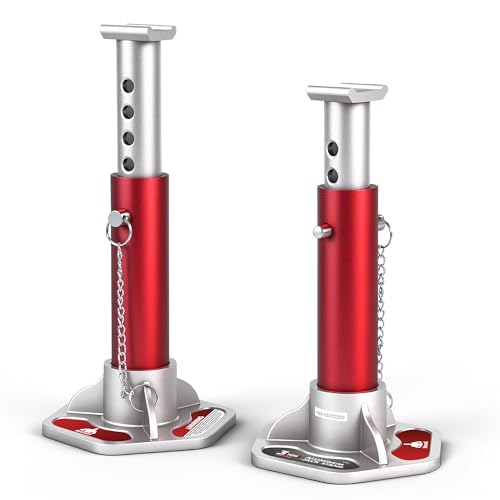
JACK BOSS 3 Ton Aluminum Jack Stands
|
9.1/10 | Buy |
| Best Budget |
 KOERZORE 3-Ton Jack Stands (Pair) |
8.9/10 | Buy |
 Jack Boss 2-Ton Low-Profile Ratchet Jack Stands |
8.6/10 | Buy |
JACK BOSS 3 Ton Aluminum Jack Stands
The JACK BOSS 3-Ton Aluminum Jack Stands provide a combined 6,000-lb static load capacity per pair, utilizing positive-locking support pins for secure vehicle support. Weighing roughly 10.3 pounds for the pair, these lightweight aluminum stands are well suited for DIY garage mechanics and track hobbyists who prioritize easy portability.
Pros
- Lightweight aluminum build weighs approximately 10.3 lbs per pair, making them far easier to carry than standard stamped-steel stands
- Captive locking pin mechanism provides positive, visual mechanical engagement through the center column
- Broad base profile offers a stable platform when placed squarely on level concrete garage floors
- Dual-tone red and silver finish resists garage moisture and workshop fluid exposure
Cons
- Combined 6,000-lb rating applies per pair, meaning each individual stand has a 3,000-lb limit and cannot support heavy commercial or full-size trucks
- Pin-style adjustment requires manual hole alignment, which takes slightly longer to set than quick-ratcheting ductile iron bars
- Bare aluminum saddle contact surfaces may mark or bend thin unibody pinch welds if used without protective rubber adapters
KOERZORE 3-Ton Jack Stands (Pair)
Built for garage maintenance and oil changes, these KOERZORE jack stands feature a dual-locking mechanism and a wide pyramid base to support sedans and midsize SUVs safely.
Pros
- Dual-locking mechanism provides added fail-safe protection
- Wide pyramid base enhances stability on hard surfaces
- Concave saddle securely cradles vehicle frame points
- Lightweight 10.7-pound build allows easy garage portability
Cons
- Maximum 16.75-inch height restricts clearance on lifted trucks
- 3-ton capacity is insufficient for heavy-duty commercial vehicles
Jack Boss 2-Ton Low-Profile Ratchet Jack Stands
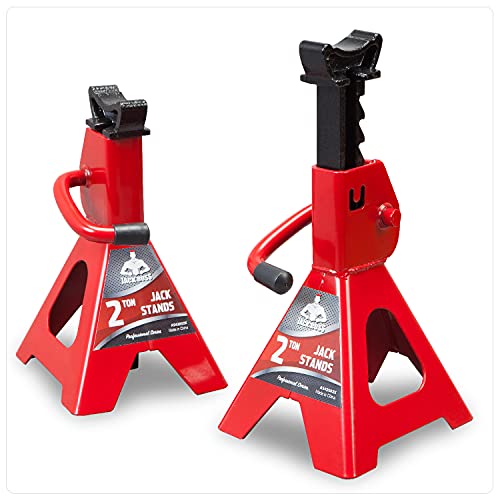
Designed for compact cars and small unibody vehicles, these Jack Boss low-profile jack stands combine a welded mild steel pyramid base with a ductile iron sawtooth ratchet bar spanning a 9.8-inch to 15-inch height range. They provide a lightweight, compact footprint for DIY garage maintenance, though the manufacturer explicitly advises against using them on trucks, large SUVs, or vehicles requiring over 15 inches of chassis clearance.
Pros
- Low 9.8-inch collapsed height fits easily under small passenger cars and lower unibody lift points
- Ductile iron sawtooth ratchet bar allows fast, tool-free height selection and positive pawl engagement
- Lightweight 10.5-pound overall build makes carrying, positioning, and garage storage simple
- Fully welded mild steel frame with protective powder coating guards against rust and shop grime
Cons
- Maximum 15-inch reach is too short for pickup trucks, full-size SUVs, or lifted off-road vehicles
- Single-pawl ratchet design lacks a secondary captive locking pin or redundant safety stop
- Steel concave saddle does not include rubber protection, which may mar painted unibody pinch welds without an aftermarket pad
Safe Support Point Selection and Execution for Oil Changes
Locating the correct support points under your chassis forms the foundation of any safe underbody vehicle service. An oil change requires you to reach the engine oil pan drain bolt and spin off the oil filter, which often sits deep within the lower engine bay. Sliding beneath a vehicle creates zero room for mechanical error, making support placement far more critical than simply lifting the chassis into the air.
Identifying Factory Lift Points on Unibody and Frame-Based Vehicles
Most modern passenger cars, hatchbacks, crossovers, and sedans utilize unibody construction rather than a separate structural frame. On unibody vehicles, the primary support locations are reinforced pinch welds running along the bottom edges of the rocker panels, directly behind the front wheels and just in front of the rear wheels. Vehicle manufacturers press two or three layers of sheet steel together and stamp small notches or dimples to indicate where support saddles belong. Placing jack stands outside these designated notches risks bending the rocker panel sheet metal or crushing the floor pan.
Traditional pickup trucks and large body-on-frame SUVs present a completely different structural profile that requires distinct support positioning. These vehicles feature heavy boxed steel frame rails or open C-channel sections running along each side of the chassis to support overall payload. When supporting a truck for an oil change, the jack stand saddles should sit square beneath the flat, horizontal portions of the main frame rail behind the front suspension. Avoid setting stands on curved frame transitions, angled kick-ups, or unreinforced crossmembers that could cause the vehicle to slide when weight settles.
Alternative Support Points: Front Subframes and Suspension Anchors
In certain garage situations, your hydraulic floor jack may occupy the factory pinch weld notch, forcing you to find a secondary support location for your stands. Front engine subframes, also known as engine cradles, often provide heavy-gauge steel mounting points capable of bearing chassis weight. Look for solid structural crossmembers or the robust steel brackets where the front lower control arms bolt into the unibody frame. The stand saddle must seat squarely against a flat, load-bearing plate rather than hollow tubular components or thin stamped control arm bodies.
Never position jack stands beneath steering tie rods, drive axles, sway bars, or sheet-metal floor pans. Setting vehicle weight onto an aluminum suspension arm or a thin stamped floor pan can cause immediate structural deformation, leading to costly alignment issues or punctured floorboards. Furthermore, never rest a stand directly beneath the engine oil pan or transmission housing. These cast aluminum or stamped steel oil pans are designed exclusively to hold lubricant, not to carry thousands of pounds of concentrated vehicle weight.
Workspace Preparation and Ground Stabilization Before Lifting
The surface supporting your jack stands is just as critical as the contact points on the vehicle chassis. Jack stands should only be placed on flat, level, poured concrete garage floors capable of handling high compressive point loads. Operating on dirt, loose gravel, or sloped driveways introduces severe tipping and settling hazards that mechanical locking pins cannot overcome. Asphalt driveways also present hidden risks during warm summer months, as narrow steel pyramid feet can punch through softened pavement under heavy point-load pressure.
Before reaching for your hydraulic floor jack, fully engage the vehicle parking brake to lock the rear wheels in place. Position heavy-duty rubber wheel chocks firmly against both the front and rear of the grounded tires on the opposite axle. For an oil change where only the front axle is raised, chocking the rear wheels prevents the car from rolling backward as the front leaves the ground. Taking these preparatory steps guarantees that the chassis remains completely stationary throughout the entire lifting and lowering sequence.
Transitioning Weight from the Hydraulic Jack to Jack Stands
A hydraulic floor jack serves exclusively to raise and lower the vehicle, never to hold it stationary while you work underneath. Hydraulic seals and internal check valves can fail without warning, resulting in immediate pressure loss and rapid vehicle collapse. To safely transfer chassis weight, raise the front of the vehicle using a designated central jacking point on the front subframe crossmember. This approach leaves the outer pinch weld notches completely clear and unobstructed, allowing you to slide your jack stands into position without spatial conflict.
Center each jack stand saddle directly beneath the reinforced factory support point before touching the jack release valve. When lowering the hydraulic floor jack, turn the release handle very slowly to ensure a controlled, millimeter-by-millimeter descent. Watch the saddles carefully as the vehicle settles to confirm that the contact points seat squarely into the center of each saddle pocket. Once the stands bear the full vehicle weight, lower the floor jack slightly further so it carries no load, but leave it positioned beneath a secondary structural point as an extra physical backup.
Ratchet Mechanisms, Double-Locking Systems, and Pin-Style Stands
Mechanical security relies entirely on the locking mechanism built into your vehicle support stands. Many popular garage stands, such as the KOERZORE 1 Pair 3 Ton Jack Stands for Cars, SUVs, employ a ductile iron sawtooth ratchet bar that engages at precise 0.7-inch intervals. This design allows quick, flexible height adjustments to match your exact working clearance requirements during an oil change. The KOERZORE stands also incorporate dual safety pins that insert horizontally through the frame collar, creating a mechanical barrier that prevents accidental pawl disengagement even under heavy vibration.
Other setups emphasize pin-type retention over ratcheting teeth to eliminate any concern regarding pawl casting wear. The JACK BOSS 3 Ton (6000 lbs) aluminum stands feature thick locking support pins that pass completely through the central load post and outer collar. This aluminum design yields a lightweight, portable structure that reduces physical strain when moving gear around the garage while maintaining a 3-ton capacity per pair. For DIYers considering larger long-term upgrades, evaluating dedicated garage vehicle lifting systems helps put these portable mechanical tools into perspective alongside fixed equipment.
Saddle Profiles, Slotted Adapters, and Pinch Weld Preservation
The geometric profile of the top saddle plays an essential role in stabilizing the chassis and preventing metal fatigue. Standard curved concave saddles, like those found on the Jack Boss Jack Stands Low Profile 2 Ton(4000 LBs), are engineered to cradle rounded axle tubes and frame members securely. However, placing a bare steel concave saddle directly against a thin unibody pinch weld can bend the vertical lip or chip away protective undercoating. Damaging this factory coating exposes bare sheet metal to road salt and moisture, accelerating structural corrosion around critical lift points.
To protect your unibody seams, consider using vulcanized rubber pinch weld adapters that sit directly inside the saddle pocket. These slotted rubber pads cradle the vertical metal seam while distributing vehicle weight across the reinforced floor structure adjacent to the seam. If slotted adapters are unavailable, ensure the pinch weld sits dead center in the deepest groove of the saddle so the weight transfers evenly to the base. Inspecting the contact point closely before sliding under the oil pan ensures the seam has not rolled over or slipped sideways.
Clearance Heights and Low-Profile Vehicle Access
Gaining adequate clearance beneath the front bumper is necessary to maneuver an oil drain pan and position your oil filter wrench. Compact cars and lowered sports sedans often feature low ground clearance that restricts entry for standard tall truck stands. The Jack Boss Jack Stands Low Profile 2 Ton(4000 LBs) addresses this challenge with a minimum collapsed height of 9.8 inches and an extension reach up to 15 inches. This lower starting height allows you to position the stand under lowered chassis points where taller stands physically cannot slide into place.
Conversely, high-clearance crossovers, light trucks, and SUVs require extended vertical reach to elevate the front tires safely. The KOERZORE stands provide an operating height range from 11-1/4 inches to 16-3/4 inches, giving DIY mechanics ample room to drain oil and replace filters on taller chassis platforms. Home mechanics managing diverse vehicle fleets often weigh the utility of high-lift stands against dedicated automotive lift equipment when planning major garage overhauls. Regardless of your vehicle type, never use makeshift wooden blocks, paving bricks, or unrated spacers beneath stand feet to gain artificial height, as concentrated loads can split lumber instantly along its grain.
Vehicle Leveling and Complete Engine Oil Drainage
An important consideration during an oil change is the physical angle of the vehicle and its impact on oil drainage. Raising only the front of the vehicle tilts the engine backward, which can alter how old oil pools inside the oil pan. On many vehicles, the oil pan drain plug is positioned at the rear of the pan, meaning a front-end lift actually tilts the remaining oil directly toward the drain hole for complete evacuation. Checking your oil pan design beforehand reveals whether a front-only lift helps or hinders full drainage.
If your vehicle features a front-facing drain plug or a side-mounted baffle system, tilting the car backward may trap half a quart of contaminated oil inside the pan. In these circumstances, supporting the vehicle at all four factory lift points using two matched pairs of jack stands keeps the chassis completely level. Achieving a level stance ensures proper drainage while providing uniform working clearance across the entire underbody. Never mix mismatched stands with vastly different base dimensions or height ratings when supporting a four-point lift.
The Lateral Push Test and Final Pre-Work Safety Verification
Before crawling under the vehicle with your socket wrench and oil collection pan, one non-negotiable physical verification step remains. Stand beside the front fender and give the vehicle a firm, vigorous push from the side and front bumper. This controlled shake test should rock the vehicle slightly on its suspension while the jack stand bases remain completely stationary and flush against the concrete floor. If any stand leg lifts, rocks, or shifts position, the vehicle is unstable and must be lifted and repositioned immediately.
Take a final look beneath the car to verify that all mechanical locking pins are fully inserted and that ratchet pawls are deeply seated into their corresponding teeth. Confirm that your oil drain pan fits easily under the oil plug without bumping against the stands or restricting your escape path. Taking these disciplined precautions ensures that where to place jack stands for oil change maintenance is never a matter of guesswork, but a standardized, dependable safety protocol that keeps you secure every time you turn a wrench.
About the author
Mike Bumbeck is an automotive journalist and hands-on product evaluator with a long-standing interest in classic vehicles, motorcycles, and practical garage equipment. His work brings a grounded perspective to automotive tools, maintenance products, and the details that matter when choosing gear for real-world use.