
Where Are Torin Jack Stands Made? Manufacturing and Safety for 2026
Investigating where are torin jack stands made reveals vital details on steel build quality, factory standards, and garage safety for November 2026.
 By Emily Markham
Updated October 10, 2026


Crawling beneath an automobile for an oil change, brake overhaul, or suspension rebuild requires complete confidence in stationary mechanical supports. While hydraulic floor jacks provide the initial lifting force, mechanical stands carry the sustained vehicle weight so technicians remain safe from hydraulic pressure failure. Many home mechanics and automotive hobbyists researching equipment origins ask where are torin jack stands made before trusting their chassis to modern support hardware. Understanding manufacturing roots helps clarify how global fabrication facilities balance high-volume metal stamping, robotic welding, and rigid quality oversight. When planning workshop setup alongside garage vertical clearance planning, knowing equipment origins provides practical reassurance for DIY garage safety.
Equipment reliability hinges on material composition, strict compliance with ASME PASE standards, and dependable locking mechanism geometry rather than brand labels alone. The where are torin jack stands made inquiry often stems from questions about material integrity, specifically whether cast ductile iron ratchet bars and welded steel pyramid bases maintain structural durability under heavy loads. Examining the global supply chain behind Torin, famously recognized for its BIG RED equipment line, helps buyers separate production location facts from safety misconceptions. Establishing realistic expectations regarding factory certifications, load rating conventions, and chassis contact points ensures garage mechanics select the right support capacity for every maintenance project.
| Award | Product | BJL Score About BJL ScoreThe BJL Score is our own rating from 0 to 10, based on performance, design and build, ease of use, and value. It reflects independent research and is never influenced by manufacturers, retailers, or affiliate commissions. Learn more › | |
|---|---|---|---|
| Best Overall |
Amazon Basics 3-Ton Steel Jack Stands
|
8.9/10 | Buy |
| Best Budget |
 Jack Boss 2-Ton Low-Profile Ratchet Jack Stands |
8.6/10 | Buy |
| Best Value |
 BIG RED Torin 3-Ton Steel Jack Stands |
8.0/10 | Buy |
| Best Premium |
 BIG RED T46002A 6-Ton Steel Jack Stands |
8.0/10 | Buy |
Amazon Basics 3-Ton Steel Jack Stands
The Amazon Basics 3-Ton Steel Jack Stand Pair delivers 6,000 pounds of reliable vehicle support certified to ASME PASE-2014 standards for portable automotive equipment. Featuring a self-locking ratchet bar and a compact steel footprint, this set is ideal for home garage DIYers servicing passenger cars and urban SUVs.
Pros
- Rated for 3 tons (6,000 lbs) per pair and meets ASME PASE-2014 portable automotive service standards
- Self-locking ratchet bar enables rapid, secure height adjustment without fiddling with separate pins
- Compact 7.5 x 7.0-inch footprint and 12.6-lb total weight make positioning and storage simple
- Protective rustproof coating over a durable steel frame helps resist corrosion from garage fluids
Cons
- 3-ton capacity is tailored for sedans and crossover SUVs, not full-size heavy-duty pickup trucks
- Ratchet assembly does not feature a secondary mechanical cross-locking pin for redundant backup
- Must be used exclusively on flat, solid concrete slabs to prevent uneven weight distribution or base sinking
Jack Boss 2-Ton Low-Profile Ratchet Jack Stands
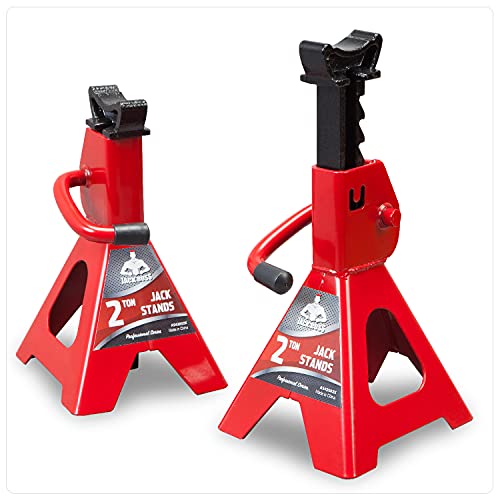
Designed for compact cars and small unibody vehicles, these Jack Boss low-profile jack stands combine a welded mild steel pyramid base with a ductile iron sawtooth ratchet bar spanning a 9.8-inch to 15-inch height range. They provide a lightweight, compact footprint for DIY garage maintenance, though the manufacturer explicitly advises against using them on trucks, large SUVs, or vehicles requiring over 15 inches of chassis clearance.
Pros
- Low 9.8-inch collapsed height fits easily under small passenger cars and lower unibody lift points
- Ductile iron sawtooth ratchet bar allows fast, tool-free height selection and positive pawl engagement
- Lightweight 10.5-pound overall build makes carrying, positioning, and garage storage simple
- Fully welded mild steel frame with protective powder coating guards against rust and shop grime
Cons
- Maximum 15-inch reach is too short for pickup trucks, full-size SUVs, or lifted off-road vehicles
- Single-pawl ratchet design lacks a secondary captive locking pin or redundant safety stop
- Steel concave saddle does not include rubber protection, which may mar painted unibody pinch welds without an aftermarket pad
BIG RED Torin 3-Ton Steel Jack Stands
The BIG RED Torin T43202 jack stands provide a 3-ton (6,000 lb) rated capacity per pair, combining a welded steel pyramid base with a double-locking pawl ratchet system. Specifically built for passenger cars rather than trucks or SUVs, they offer an 11-1/4-inch to 16-3/4-inch height range compliant with ASME standards for garage maintenance.
Pros
- Double-locking pawl and sawtooth ratchet bar add mechanical security against accidental release
- Meets ASME static safety standards for dependable support up to 6,000 lbs per pair
- Welded pyramid base design delivers solid stability on flat concrete shop slabs
- Lightweight 13.9-pound total package makes positioning and repositioning effortless for home DIYers
Cons
- Explicitly not suitable for tall SUVs, half-ton pickups, or lifted trucks due to the 16-3/4-inch maximum reach
- Minimum collapsed height of 11-1/4 inches requires sufficient floor jack lift stroke to position under low unibody chassis
- Bare steel saddle lacks integrated rubber pads, which may mark pinch welds without aftermarket adapters
BIG RED T46002A 6-Ton Steel Jack Stands
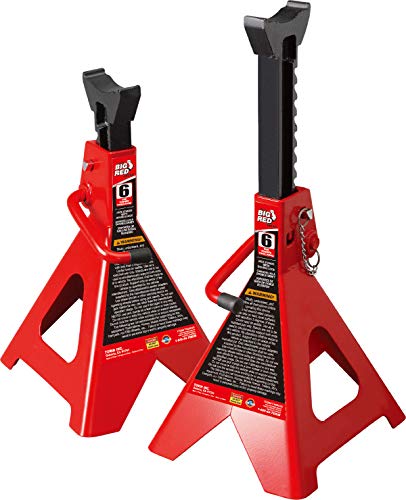
The BIG RED T46002A 6-ton jack stand pair delivers up to 12,000 pounds of combined static support using a sawtooth forged iron ratchet column backed by a removable steel safety pin. Engineered with an industrial-welded 10.6 by 9.3-inch pyramid base and a 15-3/8 to 23-13/16-inch height range, this set is an excellent choice for truck, SUV, and home garage maintenance.
Pros
- Double-locking safety system adds a removable through-pin to prevent accidental ratchet release
- Substantial 6-ton (12,000 lb) combined capacity handles half-ton pickups, full-size SUVs, and ATVs
- Wide 10.6 x 9.3-inch pyramid stance provides confident footing on flat concrete shop floors
- Generous 15-3/8-inch to 23-13/16-inch height range delivers abundant under-vehicle creeper clearance
- Sawtooth forged iron ratchet bar enables rapid, multi-position height changes
Cons
- Tall 15-3/8-inch minimum collapsed height will not fit under lowered sports cars or low-clearance sedans
- Bare steel saddle lacks rubber pads and can mark or bend unibody pinch welds without aftermarket adapters
- At 18 pounds total weight, the pair is bulkier to transport than lightweight aluminum paddock stands
The Manufacturing Origins, Engineering Standards, and Safe Operation of Torin Jack Stands
Torin jack stands are manufactured primarily in Changshu, Jiangsu Province, China, by Changshu Tongrun Auto Accessory Co., Ltd., with North American sales, distribution, and product support coordinated through Torin Inc. in Ontario, California. Changshu Tongrun ranks among the largest dedicated manufacturers of commercial hydraulic lifting equipment, mechanical jacks, and garage accessories in the world. Rather than operating as an isolated retail brand, the company engineers and produces vehicle support equipment for major private labels, retail hardware chains, and global tool distributors. Knowing where these tools originate helps home mechanics understand the engineering standards, material sourcing, and quality control systems that govern modern automotive garage equipment.
The Manufacturing Footprint of Changshu Tongrun and Torin
Changshu Tongrun Auto Accessory Co., Ltd. was established as a specialized lifting equipment manufacturer and has expanded over several decades into a massive industrial supplier. The manufacturing facilities in Jiangsu Province utilize high-volume automated metal stamping, computer-controlled forming presses, and dedicated robotic welding cells to produce millions of hydraulic floor jacks and support stands annually. Finished products travel through international shipping lanes to distribution hubs across North America, Europe, and Asia. Torin Inc., headquartered in Ontario, California, acts as the primary North American distribution arm, managing warranty claims, replacement parts, customer inquiries, and regulatory logistics for the domestic market.
Many garage mechanics encounter Torin products under the recognizable BIG RED label, which represents the company’s signature brand for consumer and light commercial vehicle maintenance. Beyond their proprietary product lines, Changshu Tongrun supplies contract manufacturing services to some of the most visible names in retail automotive tools. If two different jack stand brands appear almost identical in their stamped base geometry, cast ratchet teeth, or red powder-coated finish, they often originate from the exact same manufacturing lines in Changshu. This manufacturing concentration means that build quality across various retail tiers frequently shares identical metallurgical specifications, welding standards, and mechanical tolerances.
ASME PASE Safety Standards and Factory Quality Oversight
Automotive service equipment imported into North America must satisfy rigorous mechanical criteria established by the American Society of Mechanical Engineers under the ASME PASE standard. This standard governs portable automotive service equipment, defining stringent requirements for design, proof-load endurance, structural stability, and product labeling. Modern manufacturing facilities producing stands for the US market maintain ISO-compliant quality management protocols to verify that each production batch adheres to these engineering benchmarks. Independent testing agencies audit production runs to verify that structural welds, cast iron locking bars, and base pyramid legs withstand severe static loads without catastrophic yield failure.
Third-party testing protocols evaluate jack stands under off-center loading, extreme static weights, and angular tilt conditions to simulate real-world garage environments. ASME PASE compliance requires support stands to hold rated capacities without permanent plastic deformation, structural weld fracturing, or pawl slip. When evaluating support hardware from Torin or comparable brands such as Amazon Basics or Jack Boss, checking for ASME PASE compliance labeling provides objective reassurance regarding mechanical integrity. A recognized safety certification confirms that factory production batches underwent documented engineering evaluations rather than relying on unverified promotional claims.
Structural Metallurgy: Welded Steel Frames and Ductile Iron Bars
The structural foundation of a vehicle jack stand begins with its base housing, which modern manufacturers fabricate from heavy-gauge stamped mild steel or forged steel plates. Metal presses stamp flat steel sheets into contoured pyramid legs, which are then robotically fixtured and welded into an interlocking quadrilateral frame. A continuous perimeter weld joins the upright center collar to the supporting legs, creating a rigid tower that channels vehicle weight straight down toward the garage floor. Welded steel offers an excellent balance between tensile strength, cost efficiency, and ductility, allowing the frame to absorb normal garage vibrations without brittle stress cracking.
While the exterior pyramid base utilizes welded steel plate, the center ratchet bar demands a completely different material to withstand intense compressive forces. Manufacturers cast these multi-position sawtooth ratchet bars from ductile iron, also known as nodular cast iron, rather than standard gray cast iron. Ductile iron incorporates microscopic spherical graphite nodules that impart greater tensile flexibility, impact resistance, and elongation characteristics under compressive stress. This critical metallurgical property helps prevent sudden, brittle fracture across the ratchet teeth when an automobile chassis settles its full curb weight onto the saddle.
Ratchet Mechanisms and the Security of Double-Locking Pins
Ratchet-bar support stands rely on a directional sawtooth profile paired with a counterweighted ductile iron locking pawl. As a user lifts the center column, the angled teeth push past the pawl, which pivots upward before dropping securely into the adjacent tooth valley under gravitational pull. When mechanical weight transfers onto the top saddle, the load forces the pawl tighter into the tooth root, preventing downward movement through mechanical binding. The integrity of this mechanism depends heavily on precision casting tolerances, ensuring that pawl teeth mate fully with the ratchet bar without shallow tooth engagement or lateral play.
To provide an additional layer of workshop security, models like the BIG RED T46002A incorporate a secondary double-locking safety pin system. Once the ratchet bar settles at the desired working height, the user inserts a solid steel cross-pin through designated holes in the outer collar directly beneath the ratchet bar. This heavy-duty pin acts as an independent physical stop, mechanically blocking the center post from descending even if the primary pawl were somehow dislodged. The inclusion of a secondary locking pin creates mechanical redundancy that gives mechanics greater peace of mind during extended suspension or driveline maintenance.
Decoding ASME Load Ratings: Why Per-Pair Capacity Dictates Safe Sizing
A common point of confusion among automotive DIYers involves how manufacturers state rated load capacities on retail packaging. Under ASME PASE standards, jack stand load ratings designate the maximum working capacity for an operational pair of stands, not each individual unit. For example, a set of 3-ton stands like the BIG RED T43202 or Amazon Basics model is rated to support a combined total of 6,000 pounds when deployed together across an axle. Assuming that each individual stand holds 6,000 pounds on its own represents a dangerous misunderstanding that could lead to severe overloading of workshop equipment.
When selecting support stands for a passenger car, crossover, or truck, mechanics must calculate axle weight distribution rather than simply dividing curb weight evenly. Passenger vehicles with front-mounted engines typically exhibit a 60/40 weight split, meaning the front axle carries roughly sixty percent of the vehicle’s total mass. For full-size pickups, commercial vans, and lifted sport utility vehicles, stepping up to a 6-ton capacity pair like the BIG RED T46002A is highly recommended. Selecting support hardware with a rated capacity well above the vehicle axle load ensures that equipment components never approach their mechanical yield limits.
Working Clearance Envelopes: Minimum Collars and Maximum Lift Heights
Working clearance requirements vary drastically depending on the specific chassis architecture and suspension travel of the vehicle being serviced. Low-slung sports cars and compact commuter vehicles often feature minimal ground clearance, requiring support stands with low minimum collapsed heights. A low-profile unit like the Jack Boss 2-ton model features a minimum height of 9.8 inches, allowing it to slide easily beneath low rocker panels and designated factory subframe notches. Using a stand with an excessively tall collapsed collar can prevent proper positioning under a partially raised unibody chassis, creating awkward and unstable lifting angles.
Conversely, body-on-frame trucks and solid-axle off-road vehicles require extended maximum lift reach to account for extensive suspension droop. While heavy garage projects might eventually lead DIYers to research permanent professional vehicle lifting options, portable mechanical jack stands remain the backbone of most residential automotive setups. Heavy-duty 6-ton stands provide maximum extensions approaching 24 inches, providing sufficient vertical travel to clear large all-terrain tires and allow comprehensive suspension service. Comparing published minimum and maximum height ranges in inches ensures that the selected stands fit beneath low jack points while still reaching high truck frame rails.
Chassis Interface Alignment: Pinch Welds, Frame Rails, and Axles
The top saddle profile of a jack stand directly dictates how securely it mates with the vehicle’s structural load points. Most consumer jack stands feature a concave, cradle-style saddle designed to cup rounded solid axle tubes or flat frame rails. When supporting a solid rear axle, the saddle curves neatly around the axle housing, preventing lateral movement as long as the stand sits plumb. Modern unibody passenger cars present a different challenge because they rely on vertical pinch-weld seams along the lower rocker panels for lifting support, which can bend if bare metal saddles are applied directly without slotted rubber adapters.
Under no circumstances should garage mechanics use makeshift wooden blocks, paving bricks, or unrated metal spacers to bridge gaps between saddles and vehicle pick points. Concentrated automotive point loads easily split wooden lumber along natural grain lines, leading to sudden, catastrophic vehicle collapse while work is underway. Concrete pavers and bricks possess poor tensile strength and shatter unpredictably when subjected to localized compressive stresses. If a jack stand lacks the necessary height to reach an elevated chassis rail, the only safe solution is replacing the equipment with taller, higher-capacity stands designed for that application.
Garage Floor Mechanics: Concrete Slabs vs. Asphalt Driveways
The surface upon which jack stands rest is just as critical to vehicle stability as the metallurgy of the stands themselves. Smooth, poured concrete slabs provide an ideal high-compressive-strength foundation that resists localized deformation under concentrated multi-ton loads. Poured concrete garage floors distribute downward force evenly across a rigid substrate, ensuring that all four feet of a pyramid base maintain firm, planar contact. Before positioning stands, clearing away loose gravel, spilled oil, and floor debris ensures that the steel base feet sit flat without rocking or sliding under load.
Asphalt driveways, by contrast, present significant hazards due to the flexible, petroleum-based nature of bitumen binders, especially during warm summer months. Under hot ambient conditions, vehicle weight concentrated onto small steel foot pads exerts hundreds of pounds of pressure per square inch, causing stand legs to sink into softened asphalt. As one leg sinks deeper than the others, the stand tilts off its vertical axis, creating severe angular loading that can cause immediate tip-over failure. Mechanics working on asphalt must place thick, heavy-gauge steel load-distribution plates beneath each stand base to spread the concentrated ground pressure across a wide surface area.
Procedural Vehicle Lowering and the Physical Shake Test
Executing a safe vehicle support procedure begins long before the jack stand saddle touches the vehicle chassis. With the automobile parked on a flat, level concrete surface, the technician must firmly engage the emergency brake and place heavy rubber wheel chocks on both sides of the opposing tires. Once a hydraulic floor jack elevates the vehicle to the necessary height, the jack stands slide into position directly below manufacturer-designated chassis pick points. The ratchet bars are raised until the saddles sit within a half-inch of the contact surfaces, ensuring positive pawl tooth engagement before initiating weight transfer.
Lowering the vehicle must always be performed in a slow, controlled manner using the hydraulic jack’s release valve. Once full vehicle weight rests on the mechanical stands, the hydraulic jack should be unloaded slightly while remaining positioned beneath a crossmember as a secondary physical backup. Before crawling underneath, grasping the vehicle bumper or frame and performing an aggressive physical shake test confirms that the chassis sits locked without movement. Conducting this aggressive manual test while safely outside the vehicle envelope confirms that the chassis sits securely locked on its supports before any underbody wrenching begins.
Inspection Routines, Maintenance, and Retirement Criteria
Routine inspection of automotive jack stands ensures that subtle mechanical wear or structural fatigue never compromises workshop safety. Mechanics should regularly clean the ratchet bar tracks and inspect the sawtooth profile for rounded tooth crowns, metal chipping, or casting hairline fractures. Inspecting the spring-loaded pawl verifies that it pivots smoothly without binding on dirt, road grime, or dried factory grease. If a ratchet pawl fails to drop crisply into tooth valleys under its own counterweight, the mechanism must be cleaned and inspected before taking on vehicle weight.
Examining the stamped steel base housing is equally critical, focusing closely on perimeter welds, upright collar alignment, and base foot pads. A jack stand that has been dropped heavily or subjected to off-center loading may develop twisted pyramid legs that cause the stand to rock on flat concrete. If any foot lifts off the ground when unloaded on a flat floor, or if visual inspection reveals hairline weld fissures, the stand must be retired immediately. Jack stands are critical life-safety devices; never attempt to straighten bent steel legs, re-weld cracked collar joints, or use unapproved replacement pins on compromised equipment.
Knowing where Torin jack stands are made provides clear context regarding global manufacturing scale, ASME PASE compliance, and the structural integrity of modern garage tools. While Changshu Tongrun operates as a high-volume overseas manufacturing powerhouse, equipment safety ultimately depends on choosing appropriate weight capacities, verifying secondary locking pins, and practicing disciplined garage procedures. By pairing certified manufacturing hardware with level concrete working surfaces and thorough shake-test verifications, home mechanics can perform underbody vehicle maintenance with complete mechanical confidence.
About the author
Emily Markham is an automotive aftermarket editor who has covered professional tools, workshop equipment, and the businesses that support vehicle repair since 2019. Her editorial background gives her a practical understanding of how technicians and shop owners evaluate equipment, product value, and long-term support.