
What to Put Under Jack Stands: Ground Support and Stability Guide for 2026
Learn what to put under jack stands to prevent sinking on asphalt or uneven ground during vehicle maintenance in November 2026.
 By Larry Carley
Updated October 10, 2026


Setting up vehicle support equipment requires a thorough understanding of how concentrated weight interacts with the ground surface below. When home mechanics lift a passenger car or truck, the vehicle mass concentrates onto four relatively small metal feet. An improper foundation under those contact points creates severe safety hazards, including tipping, sinking, or sudden lateral shifts. Learning what to put under jack stands protects residential driveways from surface damage while maintaining structural stability during routine underbody maintenance.
Many driveway surfaces, especially warm asphalt or packed gravel, cannot reliably withstand thousands of pounds per square inch exerted by narrow stamped steel legs. Using properly rated load-distributing base plates or dense plywood pads spreads the vehicle weight over a much broader footprint. Home garage mechanics planning a dedicated workspace can also evaluate overhead garage clearance for vehicle lifts to understand how different lifting systems manage structural floor loads. Taking time to establish a level, rigid base ensures your support equipment holds firm before anyone crawls underneath.
| Award | Product | BJL Score About BJL ScoreThe BJL Score is our own rating from 0 to 10, based on performance, design and build, ease of use, and value. It reflects independent research and is never influenced by manufacturers, retailers, or affiliate commissions. Learn more › | |
|---|---|---|---|
| Best Overall |
Yarlung 4-Pack Adjustable Screw Jacks
|
8.9/10 | Buy |
| Best Premium |
 Amazon Basics 3-Ton Steel Jack Stands |
8.9/10 | Buy |
| Best Budget |
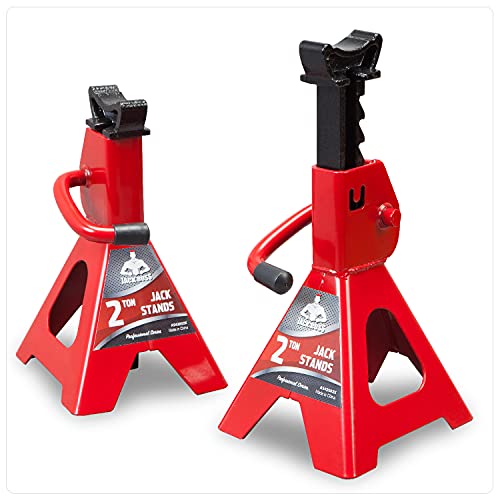 Jack Boss 2-Ton Low-Profile Ratchet Jack Stands |
8.6/10 | Buy |
 VEVOR 2-Ton Under Hoist Tripod Stand |
8.0/10 | Buy | |
 JKWQFBOYAN 3-Ton Double-Locking Jack Stands |
7.8/10 | Buy |
Yarlung 4-Pack Adjustable Screw Jacks
The Yarlung 4-Pack Adjustable Screw Jacks are compact steel and iron support posts offering a 4,500-pound load rating with continuous height adjustment from 4.2 to 7.4 inches secured by a mechanical jam nut. They provide dependable multi-point leveling for tight auxiliary spaces and floor structures, though their flat top plates and short stature are not intended to replace full-size automotive jack stands.
Pros
- Solid steel and iron fabrication providing a manufacturer-rated 4,500-pound static capacity
- Continuous micro-height adjustment from 4.2 inches to 7.4 inches using smooth machine threads
- Locking jam nut prevents unwanted screw movement once tightened into position
- Compact 4-inch footprint fits into tight clearance areas where standard stands cannot go
- Protective black finish helps guard against corrosion and moisture damage in damp work environments
Cons
- Short 4.2-inch to 7.4-inch working height does not provide sufficient creeper clearance for under-vehicle maintenance
- Flat 3.25-inch top plate lacks dedicated axle cradles or pinch-weld channels required for secure automotive lift points
- Requires a separate pipe wrench to firmly secure the locking jam nut against the support housing
Amazon Basics 3-Ton Steel Jack Stands
The Amazon Basics 3-Ton Steel Jack Stand Pair delivers 6,000 pounds of reliable vehicle support certified to ASME PASE-2014 standards for portable automotive equipment. Featuring a self-locking ratchet bar and a compact steel footprint, this set is ideal for home garage DIYers servicing passenger cars and urban SUVs.
Pros
- Rated for 3 tons (6,000 lbs) per pair and meets ASME PASE-2014 portable automotive service standards
- Self-locking ratchet bar enables rapid, secure height adjustment without fiddling with separate pins
- Compact 7.5 x 7.0-inch footprint and 12.6-lb total weight make positioning and storage simple
- Protective rustproof coating over a durable steel frame helps resist corrosion from garage fluids
Cons
- 3-ton capacity is tailored for sedans and crossover SUVs, not full-size heavy-duty pickup trucks
- Ratchet assembly does not feature a secondary mechanical cross-locking pin for redundant backup
- Must be used exclusively on flat, solid concrete slabs to prevent uneven weight distribution or base sinking
Jack Boss 2-Ton Low-Profile Ratchet Jack Stands
Designed for compact cars and small unibody vehicles, these Jack Boss low-profile jack stands combine a welded mild steel pyramid base with a ductile iron sawtooth ratchet bar spanning a 9.8-inch to 15-inch height range. They provide a lightweight, compact footprint for DIY garage maintenance, though the manufacturer explicitly advises against using them on trucks, large SUVs, or vehicles requiring over 15 inches of chassis clearance.
Pros
- Low 9.8-inch collapsed height fits easily under small passenger cars and lower unibody lift points
- Ductile iron sawtooth ratchet bar allows fast, tool-free height selection and positive pawl engagement
- Lightweight 10.5-pound overall build makes carrying, positioning, and garage storage simple
- Fully welded mild steel frame with protective powder coating guards against rust and shop grime
Cons
- Maximum 15-inch reach is too short for pickup trucks, full-size SUVs, or lifted off-road vehicles
- Single-pawl ratchet design lacks a secondary captive locking pin or redundant safety stop
- Steel concave saddle does not include rubber protection, which may mar painted unibody pinch welds without an aftermarket pad
VEVOR 2-Ton Under Hoist Tripod Stand
Designed to stabilize raised vehicles during underbody service, this heavy-duty stand offers up to 2 tons of auxiliary support across a 47.24 to 84.65-inch span. Its blend of preset pinned heights and a threaded fine-tuning handle makes it a practical addition for shops using two-post or four-post automotive lifts.
Pros
- Wide height adjustment range reaching over 84 inches
- Threaded handle allows precise fine-height adjustments
- Sturdy 3 mm carbon steel triangular base
- Textured rubber-metal saddle helps prevent slipping
Cons
- Tall minimum height requires a fully raised vehicle
- Wide 23.6-inch base demands ample bay space
- Relatively heavy at over 32 pounds to reposition
JKWQFBOYAN 3-Ton Double-Locking Jack Stands
These JKWQFBOYAN 3-ton ratchet jack stands feature a dual-locking setup with a cast iron ratchet bar and secondary metal safety pin supported by a wide carbon steel pyramid base. Designed for DIY maintenance on passenger cars, small trucks, and SUVs, they offer an accessible static support option for budget-conscious home mechanics.
Pros
- Double-locking design combines a ratchet handle mechanism with a metal safety pin for secondary security
- Wide pyramid base features triangular foot pads to distribute static chassis weight across level concrete
- Notched saddle profile helps locate vehicle edges and factory lift points
- Relatively lightweight at under 11 pounds for easy garage positioning and compact shelf storage
Cons
- Minimum collapsed and maximum extended height dimensions are not explicitly specified in the manufacturer data
- Listing notes CE conformity rather than the ASME PASE certification standards typical for U.S. commercial shops
- Notched metal saddle lacks rubber pads, which may require aftermarket pinch-weld protectors to prevent underbody marring
Comprehensive Guide to Surface Foundations and Saddle Protection
Determining what to put under jack stands depends on whether you are stabilizing the base against ground deformation or protecting your vehicle chassis at the saddle interface. Under the base feet, solid structural steel plates or dense, exterior-grade three-quarter-inch plywood sheets provide dependable load distribution over softer surfaces like asphalt. Between the saddle and the vehicle chassis, slotted vulcanized rubber pads or polyurethane seam protectors prevent metal-on-metal gouging while keeping pinch welds intact. Understanding the mechanical physics of these contact points prevents structural collapse and protects both your driveway and your vehicle frame.
Ground Pressure Dynamics and Why Driveway Surfaces Deform
Vehicle mass concentrates into tiny contact zones whenever a chassis rests on mechanical stands. A typical passenger vehicle weighing four thousand pounds places roughly one thousand pounds of direct downward force onto each support point during a two-wheel lift. When that load transfers through narrow stamped steel pyramid feet with small footprints, the localized pressure can easily exceed several hundred pounds per square inch. While cured commercial concrete handles compressive stresses exceeding three thousand pounds per square inch without issue, residential asphalt behaves very differently.
Asphalt is not a rigid solid like poured concrete; it is a flexible bituminous pavement that softens significantly in direct sunlight and ambient summer heat. Narrow metal feet bite directly into softened asphalt binder, sinking unevenly under continuous vehicle weight. Once a single foot punches into the pavement, the stand tilts off its vertical axis, creating dangerous side-loading forces. Side-loading compromises the structural integrity of the pyramid base, drastically increasing the likelihood of sudden vehicle slippage.
Outdoor repair jobs on gravel, dirt, or grass present even greater instability hazards than softening asphalt. Soil contains moisture and loose aggregate that shifts under dynamic mechanical vibration, such as when breaking loose stubborn suspension bolts. Even if a stand feels stable initially, applying a breaker bar to an axle nut transfers rotational torque through the chassis, driving one leg deeper into uncompacted ground. Establishing an unyielding, flat foundation under all four base corners remains essential whenever working outside a cured concrete garage.
Safe Base Underlayment Materials for Asphalt and Outdoor Surfaces
Heavy-gauge carbon steel plates measuring at least ten to twelve inches square and a minimum of one-quarter inch in thickness represent the gold standard for outdoor load distribution. A solid steel spreader plate completely resists point-load bending while distributing concentrated downward force across a surface area over one hundred square inches. Placing stamped pyramid feet dead center on a steel plate prevents asphalt gouging and stops individual legs from sinking into the pavement. Steel plates also provide a rigid, flat surface that eliminates wobble on slightly textured driveways.
High-grade three-quarter-inch to one-inch exterior plywood or marine-grade laminated plywood serves as a dependable, accessible underlayment option for residential driveways. The cross-laminated veneer construction gives structural plywood high resistance to shear forces and perpendicular compression. A single flat piece cut to twelve by twelve inches provides a rigid platform that prevents asphalt indentation under standard passenger cars. Plywood also offers natural surface friction that keeps painted metal feet from sliding across the pad.
Any board or plate placed beneath a stand must comfortably exceed the overall base dimensions of the equipment. If a stand features a base footprint of eight inches square, the underlayment should extend at least two inches beyond every leg to prevent edge tear-out or tipping. Never place stands across the seams of two separate boards or allow legs to overhang the supporting edge. Keeping the stand centered ensures that downward compressive forces distribute symmetrically across the entire subfloor surface.
Dangerous Makeshift Risers That Risk Catastrophic Structural Collapse
Many tragic workshop accidents occur when mechanics attempt to gain extra lifting height by resting jack stands on hollow concrete blocks or decorative bricks. Cinder blocks possess impressive compressive strength when loaded uniformly across their vertical cells, but point-loading from narrow metal feet shatters them instantly. Under the concentrated shock load of a settling vehicle, brittle concrete fractures with zero warning, dropping the chassis without hesitation. You must never place any hollow masonry, cinder blocks, or paving stones beneath your lifting equipment.
Stacking scrap pieces of softwood framing lumber, such as two-by-four or two-by-six studs, creates an extremely dangerous foundation. Dimensional construction lumber features parallel wood grain that easily splits along natural shear lines when subjected to concentrated, uneven metal contact. Furthermore, stacking multiple boards creates loose, unfastened friction layers that can slide horizontally under lateral forces. Particleboard and oriented strand board are even worse, as they crumble rapidly under localized compression and absorb moisture that degrades their binding resins.
Mechanics should also avoid placing soft rubber utility tiles, patio paving stones, or plastic leveling blocks under their vehicle supports. Pavers often conceal microscopic internal stress fractures from weathering, causing them to split cleanly under vehicle axle weight. Soft rubber tiles compress unpredictably, introducing unwanted elastic sway that destabilizes the vehicle during mechanical wrenching. If extra lifting height is required for high-clearance trucks or deep suspension travel, invest in properly sized, high-lift vehicle stands rather than stacking unrated risers.
Saddle Adapters and What to Put Between Jack Stands and the Chassis
Knowing what to put on top of the saddle is just as crucial as knowing what to put under the base. Modern unibody sedans, hatchbacks, and crossovers feature thin, vertical sheet-metal pinch welds along their rocker panels designated as factory lift points. Resting a bare, concave cast-iron or steel saddle directly against a bare pinch weld concentrates hundreds of pounds of pressure onto a narrow vertical seam. This direct metal-on-metal contact frequently crushes the pinch weld flat, cracking protective undercoating and exposing bare steel to rapid rust formation.
Specialized slotted rubber saddle pads slip over metal stand tops to provide a cushioned, supportive channel for factory pinch welds. The deep center groove allows the vertical seam to slide in freely, transferring the vehicle downward load onto the reinforced horizontal floor pan structure rather than buckling the seam. Vulcanized rubber offers high tensile strength and compression resistance, preventing the metal saddle from slicing through the pad while increasing frictional grip against the vehicle underbody. These inexpensive rubber inserts preserve factory seam sealer and prevent expensive rocker panel bodywork damage.
Trucks and body-on-frame SUVs with boxed steel frame rails or heavy solid axle tubes require different saddle protection. Placing a dense polyurethane puck or grooved rubber cushion between a steel saddle and a painted frame rail protects corrosion-resistant coatings from deep gouges. For projects requiring taller overhead reach and heavy-duty shop tools, reviewing dedicated vehicle lift equipment illustrates how commercial facilities utilize molded elastomer pads to maintain chassis stability without marring factory finishes. Matching the saddle contour to the specific vehicle frame component eliminates point contact and enhances overall friction.
Base Footprint Geometries and Built-In Manufacturer Foot Pads
Support equipment engineering plays a direct role in how weight distributes onto your ground surface. Models such as the Amazon Basics Steel Jack Auto Stands utilize stamped carbon steel legs arranged in a wide pyramid footprint to disperse weight effectively. Stamped pyramid frames that feature welded perimeter foot pads significantly increase the effective contact surface area compared to raw cut-metal leg ends. Welded foot pads help prevent the stand from cutting into hot asphalt and distribute forces evenly over supplementary plywood or steel spreader plates.
Low-profile car stands like the Jack Boss Low Profile 2 Ton model combine a welded mild-steel frame with wide pyramid foot bases to maintain lateral stability under lowered vehicles. Similarly, models like the JKWQFBOYAN 3-ton car jack stands incorporate broad pyramid bases equipped with triangular foot pads designed to expand the load-bearing area substantially. These triangular foot pads minimize localized ground gouging and provide a flatter seating plane when placed on smooth garage concrete or supplementary underlayment. The increased contact patch also stabilizes the stand against rotational forces when tightening lug nuts or suspension arms.
Not all support stands share the traditional four-leg automotive pyramid configuration. Screw-style house and floor jacks, such as the Yarlung 4 Pack Adjustable Support Jacks, utilize solid four-inch flat steel base plates that distribute loads across a uniform planar surface. Meanwhile, tall commercial equipment like the VEVOR Under Hoist Tripod Stand features rigid three-millimeter carbon-steel legs that form a broad triangular base specifically paired with rubber-and-metal top pads to dampen lateral shifts. Selecting the right stand geometry directly influences how effectively your chosen underlayment material handles mechanical stresses.
Pre-Lift Preparation and Mechanical Weight Transfer Protocols
Establishing a safe under-stand setup begins long before the hydraulic floor jack lifts the vehicle off its suspension. Walk the perimeter of your working area to locate hairline concrete cracks, asphalt depressions, or subtle floor slopes. Choose the flattest, most level section of the driveway or shop floor to ensure all four legs of each stand maintain uniform, perpendicular ground contact. Clean away loose gravel, spilled oil, and road grit that could cause a stand or spreader plate to slide out of alignment under load.
Always engage the emergency parking brake and place heavy-duty wheel chocks on both sides of the tires that remain firmly grounded on the pavement. Position your hydraulic floor jack under the manufacturer-approved central lifting point, raising the chassis smoothly to the desired service height. Slide the stands into position under the designated support points, centering the saddles directly beneath reinforced unibody pinch welds or boxed frame rails. Ensure that your base underlayment plates sit flat against the ground without rocking before beginning the lowering process.
Lower the hydraulic floor jack release valve slowly and deliberately, allowing the vehicle chassis to settle gently onto the stand saddles. Rushing this weight transfer can cause the vehicle to bounce, generating dynamic shock loads that can indent unreinforced asphalt or shift base plates out of position. Once the full vehicle weight rests on the mechanical stands, leave the hydraulic floor jack raised just below the lift point with minimal clearance as a redundant secondary fail-safe. This controlled descent ensures the underlayment boards absorb the load gradually without sudden shifts.
Verifying Positive Pawl Engagement and Performing the Physical Shake Test
Once the vehicle rests securely on the stands, conduct a visual inspection of every mechanical lock before beginning any repair work. For ratchet-style units like the Amazon Basics Steel Jack Auto Stands, confirm that the counterweighted ductile iron pawl has dropped completely into the valley between ratchet teeth. On double-locking designs like the JKWQFBOYAN 3-ton stands, ensure the secondary steel safety pin slides fully through the cast column and locks into place. For threaded units like the Yarlung adjustable screw jacks, verify that the locking collar nut is tightened down firmly with a wrench to prevent unintended thread rotation.
The final mandatory verification step before crawling beneath any raised automobile is the physical lateral shake test. Stand beside the vehicle, place both hands against a structural fender or bumper corner, and deliver two or three firm, forceful shoves. The vehicle may settle slightly on its rubber suspension bushings, but the jack stand bases and underlayment plates must remain entirely motionless against the ground. If you observe any rocking, foot lifting, or underlayment flex during this test, raise the vehicle immediately, realign your support foundation, and repeat the verification protocol.
Creating a stable foundation beneath your support equipment takes only a few minutes of preparation, yet it makes all the difference for garage safety. By sticking strictly to heavy-gauge steel plates or dense structural plywood under the feet, and using slotted vulcanized rubber pads on the saddles, you protect your pavement, preserve your vehicle frame, and eliminate catastrophic structural risks. Treating your support equipment with professional respect ensures that every weekend repair, brake overhaul, or oil change concludes smoothly and safely. Taking these disciplined precautions gives you complete confidence every time you work beneath a raised chassis.
About the author
Larry Carley is an experienced automotive technical writer and editor with more than four decades of work covering vehicle diagnostics, repair procedures, and automotive technology. His extensive technical writing helps readers understand mechanical systems, maintenance decisions, and the importance of accurate information when working on vehicles.