
How Much Can a 2 Ton Jack Stand Hold: Weight Capacity and Safety Guide for 2026
Understanding how much can a 2 ton jack stand hold helps you support vehicles safely during November 2026 garage maintenance without overloading equipment.
 By Larry Carley
Updated October 10, 2026


Supporting a vehicle for underbody maintenance requires complete confidence in the structural rating of your mechanical shop equipment. When planning routine service tasks like oil changes or brake inspections, many vehicle owners wonder %how much can a 2 ton jack stand hold% before lowering hundreds of pounds of steel onto the chassis contact points. A standard two-ton designation translates mathematically to 4,000 pounds, but determining how that weight distributes across your vehicle requires understanding industry standards and axle load dynamics. Working safely beneath an automobile depends entirely on recognizing whether a stated capacity applies to an individual support column or across a matched pair.
Equipment failure during garage service often stems from basic misunderstandings of static load ratings rather than structural flaws in the steel itself. While hydraulic floor jacks provide the mechanical force needed to raise a chassis, stationary vehicle stands must carry that dead weight without hydraulic bypass risks. Garage owners who evaluate their overall setup alongside a garage ceiling height guide often discover that stationary stands remain the primary frontline tool for residential maintenance. Mastering the exact load margins of your equipment ensures your working envelope remains secure throughout every wrench turn.
| Award | Product | BJL Score About BJL ScoreThe BJL Score is our own rating from 0 to 10, based on performance, design and build, ease of use, and value. It reflects independent research and is never influenced by manufacturers, retailers, or affiliate commissions. Learn more › | |
|---|---|---|---|
| Best Overall |
Amazon Basics 3-Ton Steel Jack Stands
|
8.9/10 | Buy |
| Best Premium |
 USYATO 6-Ton Heavy Duty Jack Stands with Double |
8.9/10 | Buy |
| Best Budget |
 VEVOR 3-Ton Double-Locking Jack Stands (Pair) |
8.8/10 | Buy |
 JMBHWD 3 Ton Double-Locking Jack Stands |
8.6/10 | Buy | |
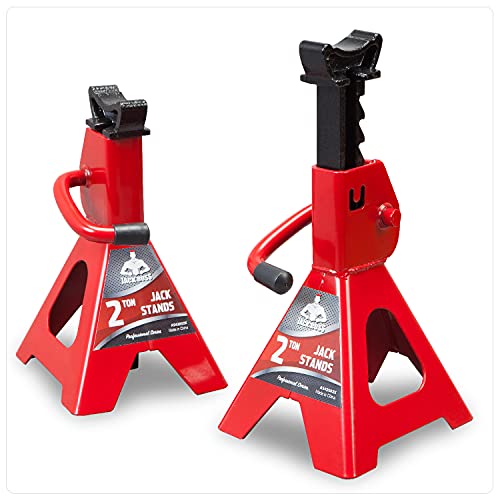 Jack Boss 2-Ton Low-Profile Ratchet Jack Stands |
8.6/10 | Buy | |
| Best Value |
 VEVOR 6-Ton Double-Locking Jack Stands Pair |
8.6/10 | Buy |
 VEVOR 2-Ton Under Hoist Tripod Stand |
8.0/10 | Buy |
Amazon Basics 3-Ton Steel Jack Stands
The Amazon Basics 3-Ton Steel Jack Stand Pair delivers 6,000 pounds of reliable vehicle support certified to ASME PASE-2014 standards for portable automotive equipment. Featuring a self-locking ratchet bar and a compact steel footprint, this set is ideal for home garage DIYers servicing passenger cars and urban SUVs.
Pros
- Rated for 3 tons (6,000 lbs) per pair and meets ASME PASE-2014 portable automotive service standards
- Self-locking ratchet bar enables rapid, secure height adjustment without fiddling with separate pins
- Compact 7.5 x 7.0-inch footprint and 12.6-lb total weight make positioning and storage simple
- Protective rustproof coating over a durable steel frame helps resist corrosion from garage fluids
Cons
- 3-ton capacity is tailored for sedans and crossover SUVs, not full-size heavy-duty pickup trucks
- Ratchet assembly does not feature a secondary mechanical cross-locking pin for redundant backup
- Must be used exclusively on flat, solid concrete slabs to prevent uneven weight distribution or base sinking
USYATO 6-Ton Heavy Duty Jack Stands with Double
These USYATO 6-ton jack stands pair cast-iron ratchet bars with removable steel safety pins for dual-lock static support. Featuring a broad pyramid base and protective rubber pads, they provide a 17.25-inch to 23.87-inch height range well suited for truck, SUV, and home garage maintenance.
Pros
- Dual-locking protection combining cast-iron ratchet pawls with manual secondary safety pins.
- Generous maximum extension height of 23.87 inches creates ample working clearance under trucks and SUVs.
- Included protective rubber saddle pads prevent chassis gouging and metal-on-metal slippage.
- Broad 10.6-inch by 9.2-inch pyramid base offers a steady footprint on level concrete slabs.
Cons
- Tall 17.25-inch minimum collapsed height will not fit under lowered sports cars or low-clearance sedans without lifting the chassis exceptionally high.
- Coarse ratchet increments provide fixed step levels rather than continuous micro-height adjustments.
- Base legs can dig into soft outdoor asphalt during warm weather without rigid load-spreader plates underneath.
VEVOR 3-Ton Double-Locking Jack Stands (Pair)
VEVOR 3-ton double-locking jack stands provide 6,000 pounds of static support per pair, combining a cast iron ratchet column with a secondary metal safety pin for added security. With a 10.8- to 16.3-inch height range and welded triangular base feet, they are well-suited for DIY oil changes, brake service, and garage maintenance.
Pros
- Double-locking mechanism pairs a positive ratchet pawl with a heavy metal safety pin for redundant mechanical security
- Welded triangular foot pads provide broader ground contact than bare stamped leg edges on garage floors
- 9 height adjustment stops allow rapid positioning between 10.8 and 16.3 inches
- Compact pyramid footprint and 11-pound total weight allow easy transport and organized garage storage
- Notched saddle profile cradles unibody seams and frame rails securely during maintenance
Cons
- A 10.8-inch minimum collapsed height may not clear aggressively lowered track cars without pre-lifting
- Notched bare metal saddle lacks rubber protective pads and may mar chassis paint or pinch welds without aftermarket adapters
- A 16.3-inch maximum extension limits utility for tall lifted 4x4 trucks or large commercial vehicles
JMBHWD 3 Ton Double-Locking Jack Stands
The JMBHWD 3-Ton Jack Stand pair provides a 6,000-pound total capacity per pair (3,000 pounds per individual stand) with a dual-action safety system pairing a serrated cast iron ratchet bar with a secondary locking pin. Featuring a 7.64-inch by 8.03-inch steel pyramid base and an 11.4-inch to 16.9-inch height envelope, this set is an accessible option for DIY mechanics maintaining sedans, crossovers, and compact passenger vehicles.
Pros
- Secondary locking pin provides redundant mechanical backup to prevent accidental release handle movement
- Stable 7.64-inch by 8.03-inch pyramid base stance helps prevent tipping when positioned on flat, solid concrete
- Cast iron serrated ratchet bar allows quick, stepped height adjustments between 11.4 and 16.9 inches
- Concave saddle profile securely cradles vehicle frame contact points and structural rails
Cons
- Manufacturer specifications clarify this model is not recommended for full-size pickup trucks, commercial vans, or large off-road SUVs
- Minimum collapsed height of 11.4 inches may prove too tall for low-slung sports cars or lowered vehicles without extended floor jack lift height
- Bare metal saddle lacks protective rubber pads, requiring careful placement or aftermarket adapters to avoid marring unibody pinch welds
Jack Boss 2-Ton Low-Profile Ratchet Jack Stands
Designed for compact cars and small unibody vehicles, these Jack Boss low-profile jack stands combine a welded mild steel pyramid base with a ductile iron sawtooth ratchet bar spanning a 9.8-inch to 15-inch height range. They provide a lightweight, compact footprint for DIY garage maintenance, though the manufacturer explicitly advises against using them on trucks, large SUVs, or vehicles requiring over 15 inches of chassis clearance.
Pros
- Low 9.8-inch collapsed height fits easily under small passenger cars and lower unibody lift points
- Ductile iron sawtooth ratchet bar allows fast, tool-free height selection and positive pawl engagement
- Lightweight 10.5-pound overall build makes carrying, positioning, and garage storage simple
- Fully welded mild steel frame with protective powder coating guards against rust and shop grime
Cons
- Maximum 15-inch reach is too short for pickup trucks, full-size SUVs, or lifted off-road vehicles
- Single-pawl ratchet design lacks a secondary captive locking pin or redundant safety stop
- Steel concave saddle does not include rubber protection, which may mar painted unibody pinch welds without an aftermarket pad
VEVOR 6-Ton Double-Locking Jack Stands Pair
These VEVOR 6-ton (13,000-lb) double-locking jack stands pair a cast iron ratchet bar with carbon steel pyramid bases and secondary metal safety pins. Built for DIY mechanics, they provide dependable static support with notched saddles and triangular foot pads for trucks, SUVs, and passenger cars.
Pros
- Double-locking safety system incorporates a primary ratchet pawl and a physical metal safety pin
- Generous 6-ton (13,000 lbs) combined load rating provides adequate safety margins for passenger cars, SUVs, and half-ton pickups
- Welded triangular foot pads increase floor contact surface area and improve overall pyramid base stability
- Cast iron ratchet bar with protective rust-proof coating resists workshop corrosion
Cons
- Bare metal notched saddle can crush or bend bare unibody pinch welds without an aftermarket rubber adapter
- Stepped ratchet teeth offer incremental height settings rather than infinite micro-adjustability
- Requires auxiliary structural steel spreader plates if used on warm asphalt driveways to prevent indentation
VEVOR 2-Ton Under Hoist Tripod Stand
Designed to stabilize raised vehicles during underbody service, this heavy-duty stand offers up to 2 tons of auxiliary support across a 47.24 to 84.65-inch span. Its blend of preset pinned heights and a threaded fine-tuning handle makes it a practical addition for shops using two-post or four-post automotive lifts.
Pros
- Wide height adjustment range reaching over 84 inches
- Threaded handle allows precise fine-height adjustments
- Sturdy 3 mm carbon steel triangular base
- Textured rubber-metal saddle helps prevent slipping
Cons
- Tall minimum height requires a fully raised vehicle
- Wide 23.6-inch base demands ample bay space
- Relatively heavy at over 32 pounds to reposition
Technical Analysis of Two-Ton Vehicle Support Limits and Garage Safety
A two-ton vehicle stand is rated to support a maximum static load of 4,000 pounds, which equals 1,814 kilograms of force. In international metric ratings, two metric tonnes correspond to approximately 4,409 pounds of downward mass. While this nominal figure provides a straightforward mathematical baseline, safely applying that capacity requires understanding how equipment standards define working limits. The true capability of any stand depends on whether the manufacturer rates the unit individually or as a synchronized pair under national safety protocols.
Many DIY mechanics assume that placing two separate two-ton units beneath a vehicle automatically provides four tons of total holding capacity. However, automotive safety specifications often designate load capacities on a per-pair basis, meaning two stands together hold 4,000 pounds total. Misinterpreting this foundational distinction can lead to severe structural overloading when working beneath modern passenger cars, crossovers, or light trucks. Examining the mechanical physics of vehicle support ensures you maintain adequate safety thresholds before turning a single bolt.
The Core Capacity Calculation: 4,000 Pounds and Rating Standards
The mathematical definition of a short ton in North America represents exactly 2,000 pounds of force. Therefore, a two-ton capacity rating denotes an operational threshold of 4,000 pounds. When reviewing automotive equipment, buyers encounter standards set by the American Society of Mechanical Engineers, known formally as the ANSI and ASME PASE portable service equipment standards. Under ASME PASE guidelines, jack stands sold in pairs must display a capacity rating reflecting the combined limit of the pair, meaning each individual stand carries 2,000 pounds.
Some aftermarket manufacturers, such as Jack Boss, explicitly package low-profile units rated at 4,000 pounds for a single stand rather than for the pair. Conversely, high-reach auxiliary tools like the VEVOR under-hoist tripod stand list a two-ton capacity of 4,409 pounds based on metric ton conversions. This discrepancy highlights why reading the physical specification placard on the stand collar is mandatory. Assuming an individual rating without confirming the ASME PASE designation creates an immediate safety hazard in the shop.
Safety testing protocols under ASME PASE require stands to withstand proof-load margins exceeding their nominal working ratings during manufacturing validation. These safety margins account for minor dynamic shifts, uneven weight distribution, and slight manufacturing variances in ductile iron or stamped steel. However, operators must never treat proof-load reserves as usable working capacity. Respecting the baseline 4,000-pound limit guarantees that mechanical components operate well within their structural yield limits.
Understanding Vehicle Curb Weight Versus Axle Load Distribution
Determining whether a two-ton stand setup can safely carry your vehicle begins with analyzing total curb weight. A typical compact sedan might register a total curb weight of 3,200 pounds on the scales. While this gross figure falls comfortably beneath a 4,000-pound per-pair threshold, vehicle weight rarely distributes evenly across all four chassis corners. Most modern road vehicles feature front-mounted engines and transaxles that shift a disproportionate share of mass toward the front suspension.
In typical front-wheel-drive passenger vehicles, the front axle often supports between 60 and 65 percent of the total vehicle curb weight. On a 3,500-pound crossover, a 60 percent front bias places roughly 2,100 pounds directly over the front jacking points. If your two-ton stands carry 4,000 pounds total as a pair, each stand bears an average load of 1,050 pounds, which remains within safe parameters. However, if vehicle curb weight approaches 4,500 pounds, a front axle carrying 2,700 pounds would overwhelm a standard 2,000-pound individual column rating.
For this reason, home mechanics frequently step up to three-ton models, like the Amazon Basics Steel Jack Auto Stands or the VEVOR three-ton double-locking stands, when lifting midsize sedans and urban SUVs. Stepping up to higher-rated hardware provides a substantial safety margin that easily accommodates heavy front-end powertrain components. Always reference the factory tire placard or driver door jamb sticker to verify your vehicle Gross Axle Weight Rating before positioning support stands.
Mechanical Locking Designs: Ratchet Bars, Safety Pins, and Screw Posts
The internal locking mechanism represents the primary safeguard preventing a raised vehicle from descending accidentally. Most automotive stands utilize a multi-position ratchet bar cast from ductile iron with angled sawtooth notches. As the operator raises the support post, a counterweighted iron pawl drops into the tooth valley, engaging mechanically under gravity. When the vehicle weight settles onto the saddle, downward force drives the pawl deeper into the ratchet tooth, creating a positive mechanical bind.
To eliminate the risk of accidental pawl disengagement, modern manufacturers increasingly implement redundant double-locking systems. Models such as the USYATO six-ton heavy-duty stands and the JMBHWD three-ton units integrate a removable steel safety pin that passes directly through the outer collar and ratchet bar. This secondary pin acts as a physical fail-safe, preventing the pawl from backing out even if external vibrations or contact disturb the release handle. Dual-locking architecture provides essential peace of mind when performing heavy wrenching underneath the vehicle.
Other equipment configurations employ threaded screw mechanisms or solid cross-pin arrangements rather than ratchet teeth. The VEVOR under-hoist tripod stand features a 30-millimeter threaded screw rod with a rotating handle that permits millimeter-level height adjustments beneath a commercial lift. Threaded screw collars eliminate incremental notch spacing, allowing precise contact against suspension crossmembers. Regardless of the mechanism style, operators must visually confirm complete pawl drop or cross-pin engagement before releasing hydraulic pressure.
Chassis Contact Points: Pinch Welds, Frame Rails, and Saddle Compatibility
A two-ton capacity rating becomes meaningless if the stand saddle fails to interface correctly with the vehicle structure. Modern unibody passenger cars utilize thin sheet-metal seams known as pinch welds along the lower rocker panels for factory lifting. Placing a narrow, bare steel concave saddle directly against a bare pinch weld can fold the metal seam and damage the rocker panel coating. Once the pinch weld bends under load, the chassis can shift sideways on the saddle top, creating an unstable support platform.
To prevent body damage, operators should utilize grooved vulcanized rubber saddle pads or purpose-built pinch-weld adapters. These accessories cradle the vertical pinch seam while transferring downward vehicle weight onto the reinforced floor pan flange. For body-on-frame light trucks and older utility vehicles, the heavy-gauge steel perimeter frame rail serves as the optimal contact zone. The broad concave saddle found on standard steel stands nests securely against horizontal frame sections, eliminating lateral slide risks.
When supporting solid live drive axles, the deep concave saddle cradles the round axle tube to prevent lateral displacement. Operators must strictly avoid using makeshift wooden blocks, paving bricks, or unrated spacers between the saddle and the chassis to gain extra height. Wood can split along its grain lines under concentrated steel saddle pressure, leading to an immediate vehicle drop. Always ensure direct, square metal-to-metal or rubber-to-metal contact at designated factory jacking locations.
Working Clearance: Minimum Collapsed Height Versus Lift Range
Load capacity must always be balanced against physical clearance and working height requirements. Low-profile sports cars and lowered passenger sedans feature minimal ground clearance that restricts access beneath the rocker panels. The Jack Boss low-profile two-ton stands offer a minimum collapsed height of 9.8 inches and a maximum reach of 15 inches. This compact entry profile allows the saddle to slide easily beneath low jacking points after a shallow hydraulic lift.
Conversely, larger sport utility vehicles and light pickup trucks require significantly taller support equipment to clear suspension droop. When servicing a truck, the suspension components drop downward as the frame rises, requiring stands with extended reaches of 20 inches or more. Heavy-duty options like the USYATO six-ton stands provide adjustable heights from 17.25 inches to 23.87 inches to bridge that gap. Using a short two-ton stand on a tall vehicle often leaves the tires resting on the ground, preventing brake or suspension maintenance.
Operating a ratchet stand near its absolute maximum extension height also reduces overall lateral rigidity. As the center ratchet bar extends further out of the base collar, mechanical leverage increases any slight tolerance play between the parts. Choosing a stand with a capacity and height envelope that places your required working height in the middle of its travel range ensures optimal stability. A taller stand with a broader pyramid base naturally provides superior resistance against tipping forces.
Ground Surface Physics: Concrete Slab Integrity Versus Asphalt Sinkage
The stability of any vehicle stand depends fundamentally on the ground surface supporting its base feet. Jack stands utilize stamped steel legs formed into a pyramid shape, concentrating vehicle weight into four compact contact patches. On a flat, level concrete garage floor, compressive strength is exceptionally high, preventing any measurable base movement. Concrete provides the rigid foundation necessary to maintain square vertical alignment under thousands of pounds of static load.
Asphalt driveways present a hidden structural hazard for automotive support equipment, particularly during warm summer months. Asphalt is a petroleum-based binder that softens under direct sunlight and high ambient temperatures. When a two-ton stand concentrates 1,000 to 2,000 pounds onto four small steel foot pads, the resulting pressure per square inch can easily punch through softened asphalt. If one corner foot sinks into the driveway, the entire stand tilts off-axis, rapidly shifting the vehicle center of gravity and risking a total tip-over.
To mitigate sinkage when concrete is unavailable, mechanics place heavy-gauge steel distribution plates beneath each stand base. A solid steel plate spreads the concentrated point load across a broad surface area, preventing asphalt deformation. Never place stands on loose gravel, dirt, or cracked paving, as shifting subgrade materials can cause sudden base displacement. Maintaining a perfectly level, solid floor prevents dangerous lateral shear forces from developing across the support legs.
Safe Step-by-Step Vehicle Support and Weight Transfer Procedure
Executing a safe vehicle lift requires following a disciplined, step-by-step mechanical procedure every single time. Begin by parking the vehicle on a flat concrete surface, shifting the transmission into park or reverse, and firmly engaging the emergency brake. Place heavy-duty rubber wheel chocks securely against both the front and rear of the tires remaining on the ground. This initial step prevents the vehicle from rolling forward or backward during the lifting process.
Next, position your hydraulic floor jack under the primary factory front or rear center lifting point. Raise the vehicle smoothly until the tires clear the ground and sufficient clearance exists to slide the support stands beneath the frame. Position each stand saddle directly centered under the designated factory support points, adjusting the ratchet bars to the desired height. Ensure that the locking pawls engage fully into the ratchet teeth, and insert secondary safety pins if your hardware includes them.
Slowly turn the hydraulic jack release valve counterclockwise to lower the chassis gradually onto the stand saddles. Do not drop the vehicle suddenly, as dynamic impact forces can exceed the static rating of the equipment. Once the vehicle rests fully on the stands, lower the hydraulic jack arm completely until zero vehicle weight remains on the jack. Leaving partial weight on a hydraulic jack creates a false sense of security, as internal hydraulic seals can seep fluid over time.
Before crawling underneath the chassis, perform a vigorous physical shake test at the vehicle bumper or fender. Push firmly against the body with both hands from multiple angles to verify that the car cannot rock, shift, or slide. If the stands wobble, creak, or display uneven foot contact, raise the vehicle immediately with the hydraulic jack and reposition the stands. Only crawl beneath the chassis once the vehicle demonstrates complete, rock-solid stability.
Equipment Inspection, Maintenance, and Retirement Criteria
Regular equipment maintenance and thorough visual inspections are essential for maintaining shop safety over the lifespan of your stands. Before every lifting session, inspect the welded joints around the pyramid base and collar for any hairline fissures, flaking paint, or metal deformation. Check the ductile iron ratchet bar for chipped, rounded, or excessively worn teeth that could impede positive pawl engagement. Examine the locking pawl pivot pin to ensure it rotates smoothly and drops cleanly into each tooth valley under spring or gravity tension.
Clean accumulated grease, road grit, and metal shavings from the internal column channels using a degreaser and shop rag. Foreign debris lodged in the ratchet track can prevent the pawl from seating to its full design depth, creating an acute slippage hazard. Check secondary safety pins for bending, rust, or damage to their retaining cotters or lanyards. Never modify a jack stand by drilling holes, grinding ratchet teeth, or attempting to weld cracked structural components at home.
Establish clear retirement criteria to remove compromised equipment from service permanently. If a stand sustains an off-center drop, develops a bent center post, or exhibits cracked welds, dispose of it immediately so it cannot be reused. Units that have been subjected to unexplained overloading or show signs of severe structural corrosion should be retired without hesitation. Maintaining equipment in pristine condition guarantees that every support point functions exactly as intended.
Matching Vehicle Types to Appropriate Stand Tonnage and Hardware
Selecting the correct stand hardware requires aligning capacity and physical geometry with the specific vehicles in your garage. For small front-wheel-drive sedans and lightweight sports coupes, compact two-ton units like the Jack Boss low-profile stands provide adequate capacity and easy entry. These low-profile stands excel in tight quarters where standard height collars cannot slide beneath lowered factory jacking points. They provide a reliable solution for routine brake service, tire rotations, and engine oil changes on compact platforms.
When servicing midsize family sedans, crossovers, and compact SUVs, stepping up to three-ton equipment offers superior versatility. Options such as the VEVOR three-ton double-locking stands and the JMBHWD three-ton units provide 6,000 pounds of capacity per pair alongside generous height adjustments. Home mechanics setting up comprehensive workshops often compare stationary support hardware with commercial automotive lift options when outfitting spaces for larger projects. Higher capacity stands also feature broader pyramid bases that increase resistance against lateral tipping during high-torque bolt removal.
For half-ton pickup trucks, full-size SUVs, and commercial vans, heavy-duty six-ton stands like the USYATO six-ton models represent the necessary equipment standard. These robust units deliver wide pyramid stances, extended lift reaches, and massive load capacities capable of supporting heavy frame rails. Enthusiasts evaluating permanent garage upgrades often review residential vehicle lift equipment alongside heavy-duty stands to optimize their maintenance workflow. Whatever equipment you choose, operating within rated weight limits and verifying mechanical locks guarantees safe, dependable vehicle support.
Ultimately, knowing how much your support stands can hold allows you to tackle automotive maintenance with total mechanical confidence. Always verify whether capacity ratings apply to individual posts or matched pairs under ASME PASE standards, and cross-reference those figures with your vehicle axle weights. By combining conservative load calculations with proper contact point placement, redundant locking mechanisms, and level concrete surfaces, you ensure a safe and stable workshop environment every time you lift a chassis.
About the author
Larry Carley is an experienced automotive technical writer and editor with more than four decades of work covering vehicle diagnostics, repair procedures, and automotive technology. His extensive technical writing helps readers understand mechanical systems, maintenance decisions, and the importance of accurate information when working on vehicles.