
How Long Can a Car Be on Jack Stands: Safe Duration, Storage, and Setup for 2026
Learn how long can a car be on jack stands safely, covering static vehicle storage, substrate stability, and locking safety for November 2026.
 By Larry Carley
Updated October 10, 2026


Restoring a classic drivetrain, performing an extensive transmission overhaul, or storing a sports car over the winter often requires keeping a vehicle elevated for prolonged periods. Home garage mechanics frequently ask how long can a car be on jack stands before metal fatigue, structural shifting, or safety hazards arise. While hydraulic floor jacks depend on pressurized fluid seals that can bleed down over time, mechanical support stands rely on solid steel and cast ductile iron to maintain elevation without pressure loss.
Achieving stable long-term elevation requires understanding static load distribution, ground substrate strength, and positive mechanical locking systems. Supporting a vehicle properly protects factory unibody seams and frame coatings while preventing dangerous chassis settling. Even if you are reviewing a garage vehicle height planning guide to prepare for future shop enhancements, mastering stationary vehicle elevation on dedicated mechanical stands provides the foundation for safe, confident long-term garage projects.
| Award | Product | BJL Score About BJL ScoreThe BJL Score is our own rating from 0 to 10, based on performance, design and build, ease of use, and value. It reflects independent research and is never influenced by manufacturers, retailers, or affiliate commissions. Learn more › | |
|---|---|---|---|
| Best Overall |
YELLOW JACKET 3 Ton Double-Locking Steel Jack
|
9.2/10 | Buy |
| Best Budget |
 KOERZORE 3-Ton Jack Stands (Pair) |
8.9/10 | Buy |
 Pencil Noise 3 Ton Double-Locking Jack Stands |
8.9/10 | Buy | |
| Best Value |
 Amazon Basics 3-Ton Steel Jack Stands |
8.9/10 | Buy |
| Best Premium |
 Powerbuilt 3-Ton Unijack All-in-One Hydraulic |
8.9/10 | Buy |
 Jack Boss 2-Ton Low-Profile Ratchet Jack Stands |
8.6/10 | Buy | |
 VEVOR 6-Ton Double-Locking Jack Stands Pair |
8.6/10 | Buy | |
 ANTPOWER 3-Ton Double-Locking Jack Stands |
8.4/10 | Buy | |
 PRUTHY 3-Ton Double-Locking Jack Stands |
8.3/10 | Buy | |
 JKWQFBOYAN 3-Ton Double-Locking Jack Stands |
7.8/10 | Buy |
YELLOW JACKET 3 Ton Double-Locking Steel Jack
The YELLOW JACKET 3-ton jack stand pair provides a 6,600-pound combined capacity with ductile iron ratchet columns and secondary metal locking pins for redundant garage safety. Featuring a welded stamped steel pyramid base and a 10-7/8-inch to 16-9/16-inch height range, they offer reliable static support for compact cars, crossovers, and midsize SUVs during routine maintenance.
Pros
- Double-locking system pairs a ductile iron ratchet bar with an independent metal safety pin for added physical redundancy
- Solid one-piece forged ductile iron center column provides reliable static tooth engagement across multiple height settings
- Welded stamped steel pyramid base features wide foot pads to support vehicle stability on flat concrete shop floors
- Practical height span of 10-7/8 inches to 16-9/16 inches covers common passenger vehicle maintenance tasks like brake jobs and oil changes
Cons
- The 10-7/8-inch collapsed height may sit too high for significantly lowered sports cars or vehicles with low front splitters
- Bare metal saddle lacks rubber cushioning pads, which may mar painted subframes or bend unprotected pinch welds without aftermarket adapters
- Maximum height reach of 16-9/16 inches is limited for lifted 4x4 trucks or high-clearance off-road vehicles requiring extended droop clearance
KOERZORE 3-Ton Jack Stands (Pair)
Built for garage maintenance and oil changes, these KOERZORE jack stands feature a dual-locking mechanism and a wide pyramid base to support sedans and midsize SUVs safely.
Pros
- Dual-locking mechanism provides added fail-safe protection
- Wide pyramid base enhances stability on hard surfaces
- Concave saddle securely cradles vehicle frame points
- Lightweight 10.7-pound build allows easy garage portability
Cons
- Maximum 16.75-inch height restricts clearance on lifted trucks
- 3-ton capacity is insufficient for heavy-duty commercial vehicles
Pencil Noise 3 Ton Double-Locking Jack Stands
The Pencil Noise 3 Ton Jack Stands provide static vehicle support with a 6,000 lb total capacity per pair, combining a forged iron ratchet bar with a secondary safety pin. Featuring an 11.4-inch to 16.9-inch height range and a pyramid base, they are a practical choice for DIY maintenance on compact cars, crossovers, and UTVs.
Pros
- Dual-action locking mechanism features both a primary ratchet pawl and a secondary locking pin for redundant mechanical security.
- Sturdy forged iron ratchet bar offers quick height adjustments across multiple indexed locking positions.
- Wide pyramid base geometry delivers solid static stability on smooth, level concrete garage slabs.
- Practical 11.4-inch to 16.9-inch working range fits common DIY garage jobs like brake service, tire rotations, and oil changes.
Cons
- Not recommended or sized for full-size pickup trucks, commercial vans, or heavy off-road SUVs.
- Minimum collapsed height of 11.4 inches may require extra lifting clearance on lowered sports cars before stands can slide underneath.
- Bare metal saddle lacks pre-installed rubber padding, which may risk marring unprotected unibody pinch welds.
Amazon Basics 3-Ton Steel Jack Stands
The Amazon Basics 3-Ton Steel Jack Stand Pair delivers 6,000 pounds of reliable vehicle support certified to ASME PASE-2014 standards for portable automotive equipment. Featuring a self-locking ratchet bar and a compact steel footprint, this set is ideal for home garage DIYers servicing passenger cars and urban SUVs.
Pros
- Rated for 3 tons (6,000 lbs) per pair and meets ASME PASE-2014 portable automotive service standards
- Self-locking ratchet bar enables rapid, secure height adjustment without fiddling with separate pins
- Compact 7.5 x 7.0-inch footprint and 12.6-lb total weight make positioning and storage simple
- Protective rustproof coating over a durable steel frame helps resist corrosion from garage fluids
Cons
- 3-ton capacity is tailored for sedans and crossover SUVs, not full-size heavy-duty pickup trucks
- Ratchet assembly does not feature a secondary mechanical cross-locking pin for redundant backup
- Must be used exclusively on flat, solid concrete slabs to prevent uneven weight distribution or base sinking
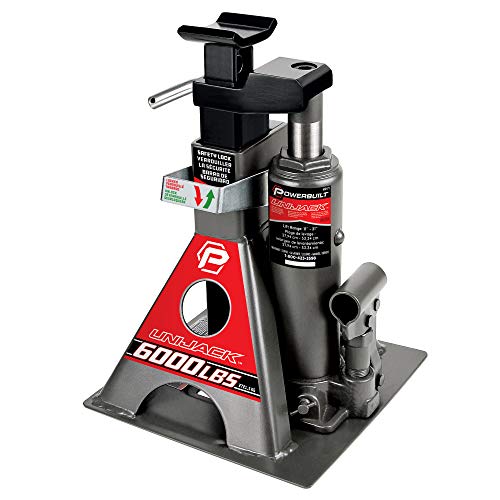
Powerbuilt 3-Ton Unijack All-in-One Hydraulic
The Powerbuilt 620471 Unijack integrates a hydraulic bottle jack and a mechanical ratcheting jack stand into a single unit, eliminating the danger of hydraulic pressure bleed-off. With a 6,000-pound capacity, an 11 to 21-inch lift range, and a wide steel base, it provides dependable single-point lifting and static holding for trucks and SUVs.
Pros
- Combines hydraulic bottle jack lifting and mechanical jack stand safety into one single-point tool
- Physical ratcheting safety lock prevents accidental vehicle drops caused by hydraulic pressure bleed-off
- Wide 9.88 x 9.75-inch base provides excellent stability on garage concrete and level paved surfaces
- Tall 21-inch maximum extension delivers ample working clearance for high-clearance trucks and SUVs
- Meets ANSI standards for portable automotive service equipment and includes a 1-year factory warranty
Cons
- Minimum collapsed height of 11 inches makes it unusable on low-clearance sedans and sports cars
- At 22.66 pounds per single unit, it is significantly heavier than standard individual mechanical jack stands
- Sold as an individual unit rather than a pair, requiring separate purchases if supporting an entire axle
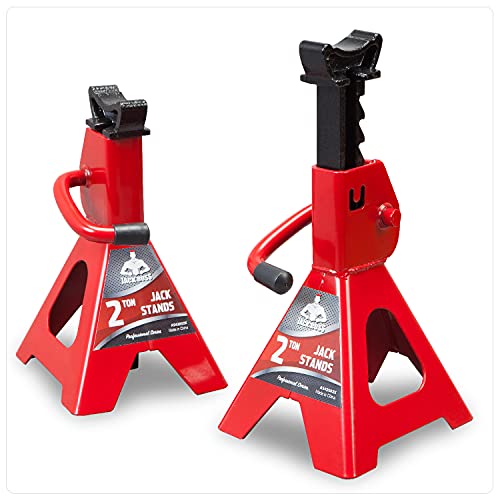
Jack Boss 2-Ton Low-Profile Ratchet Jack Stands
Designed for compact cars and small unibody vehicles, these Jack Boss low-profile jack stands combine a welded mild steel pyramid base with a ductile iron sawtooth ratchet bar spanning a 9.8-inch to 15-inch height range. They provide a lightweight, compact footprint for DIY garage maintenance, though the manufacturer explicitly advises against using them on trucks, large SUVs, or vehicles requiring over 15 inches of chassis clearance.
Pros
- Low 9.8-inch collapsed height fits easily under small passenger cars and lower unibody lift points
- Ductile iron sawtooth ratchet bar allows fast, tool-free height selection and positive pawl engagement
- Lightweight 10.5-pound overall build makes carrying, positioning, and garage storage simple
- Fully welded mild steel frame with protective powder coating guards against rust and shop grime
Cons
- Maximum 15-inch reach is too short for pickup trucks, full-size SUVs, or lifted off-road vehicles
- Single-pawl ratchet design lacks a secondary captive locking pin or redundant safety stop
- Steel concave saddle does not include rubber protection, which may mar painted unibody pinch welds without an aftermarket pad
VEVOR 6-Ton Double-Locking Jack Stands Pair
These VEVOR 6-ton (13,000-lb) double-locking jack stands pair a cast iron ratchet bar with carbon steel pyramid bases and secondary metal safety pins. Built for DIY mechanics, they provide dependable static support with notched saddles and triangular foot pads for trucks, SUVs, and passenger cars.
Pros
- Double-locking safety system incorporates a primary ratchet pawl and a physical metal safety pin
- Generous 6-ton (13,000 lbs) combined load rating provides adequate safety margins for passenger cars, SUVs, and half-ton pickups
- Welded triangular foot pads increase floor contact surface area and improve overall pyramid base stability
- Cast iron ratchet bar with protective rust-proof coating resists workshop corrosion
Cons
- Bare metal notched saddle can crush or bend bare unibody pinch welds without an aftermarket rubber adapter
- Stepped ratchet teeth offer incremental height settings rather than infinite micro-adjustability
- Requires auxiliary structural steel spreader plates if used on warm asphalt driveways to prevent indentation
ANTPOWER 3-Ton Double-Locking Jack Stands
The ANTPOWER 3-ton double-locking jack stands provide reliable static support for garage maintenance, pairing a ductile iron sawtooth ratchet column with a secondary steel side-locking pin. With an 11.2 to 16.8-inch height range and a fully welded pyramid steel base, they offer solid safety for compact cars, sedans, and light crossovers.
Pros
- Secondary side-pin lock adds physical redundancy alongside the primary ratchet pawl
- High-strength ductile iron ratchet bar provides positive sawtooth height adjustments
- Fully welded mild steel pyramid base delivers stable static support on level concrete slabs
- Protective powder-coated finish helps resist common garage moisture and chemical rust
- Manageable 14.3-pound total weight makes repositioning easy during four-corner vehicle setups
Cons
- Maximum 16.8-inch reach is insufficient for lifted 4x4s, full-size trucks, or vehicles with frame heights over 16 inches
- Bare steel saddle lacks a rubber pad, which may mar painted unibody pinch welds without an aftermarket adapter
- Conflicting product listing text notes both 6,000 lbs per pair and 6,600 lbs per stand, requiring conservative 3-ton pair load planning
PRUTHY 3-Ton Double-Locking Jack Stands
The PRUTHY 3-Ton Jack Stand Pair provides static vehicle support rated up to 6,600 pounds across the pair, combining a ductile iron ratchet bar with an added metal safety pin for dual-locking peace of mind. Featuring an 11.4-inch to 16.9-inch height range and a wide stamped-steel pyramid base, they offer reliable stability for routine garage maintenance on sedans, crossovers, and small SUVs.
Pros
- Secondary metal safety pin adds a positive mechanical backup to the primary ratchet pawl mechanism
- Welded stamped-steel pyramid base provides solid footing and even weight distribution on level concrete floors
- Clear 11.4-inch to 16.9-inch elevation range works well for passenger cars, crossovers, and compact utility trailers
- Forged one-piece ductile iron ratchet column resists fracturing under static load
Cons
- Minimum collapsed height of 11.4 inches may be too tall for lowered sports cars without pre-lifting
- Maximum extension of 16.9 inches will not provide adequate clearance for lifted 4x4 trucks on oversized tires
- Metal saddle lacks included rubber protective pads to shield delicate pinch welds from cosmetic scratches
JKWQFBOYAN 3-Ton Double-Locking Jack Stands
These JKWQFBOYAN 3-ton ratchet jack stands feature a dual-locking setup with a cast iron ratchet bar and secondary metal safety pin supported by a wide carbon steel pyramid base. Designed for DIY maintenance on passenger cars, small trucks, and SUVs, they offer an accessible static support option for budget-conscious home mechanics.
Pros
- Double-locking design combines a ratchet handle mechanism with a metal safety pin for secondary security
- Wide pyramid base features triangular foot pads to distribute static chassis weight across level concrete
- Notched saddle profile helps locate vehicle edges and factory lift points
- Relatively lightweight at under 11 pounds for easy garage positioning and compact shelf storage
Cons
- Minimum collapsed and maximum extended height dimensions are not explicitly specified in the manufacturer data
- Listing notes CE conformity rather than the ASME PASE certification standards typical for U.S. commercial shops
- Notched metal saddle lacks rubber pads, which may require aftermarket pinch-weld protectors to prevent underbody marring
Static Vehicle Support: How Long a Chassis Can Safely Rest on Stands
A vehicle can safely remain on quality mechanical jack stands indefinitely, provided the stands rest on solid level concrete and their rated load capacity per pair exceeds the supported vehicle weight. Structural steel frames and cast ductile iron ratchet columns do not experience the internal seal decay or fluid bleed-down common to hydraulic lifting tools. As long as environmental factors like rust do not compromise the equipment and the ground surface does not deform, stationary vehicle stands will hold a car for weeks, months, or even years without catastrophic failure.
While the mechanical hardware itself does not wear out simply from holding static weight, prolonged chassis elevation introduces specific variables that require close attention. Garage floor substrate integrity, suspension bushing tension, unibody contact point protection, and secondary mechanical locking redundancies all dictate whether a long-term setup remains safe over months of downtime. Understanding these physical forces ensures that your vehicle remains perfectly stable throughout any multi-month restoration or seasonal storage cycle.
The Mechanical Difference Between Static Stands and Hydraulic Jacks
Hydraulic floor jacks and bottle jacks are engineered strictly for dynamic lifting, never for stationary load holding. Hydraulic systems rely on internal fluid pressure held by synthetic O-rings, check valves, and machined cylinder walls. Over hours or days, minuscule fluid bypass past internal seals causes the lift arm to creep downward, creating an immediate crushing hazard if anyone works beneath the vehicle. In contrast, mechanical vehicle stands translate downward chassis force directly through rigid steel legs and positive mechanical stops into the shop floor.
Under the ANSI/ASME PASE safety standards for portable automotive service equipment, vehicle support stands undergo proof-load verification to ensure structural integrity under heavy static loads. The rated capacity listed on automotive stands, such as standard three-ton or six-ton ratings, represents the total capacity per pair rather than per individual unit. Because mechanical stands contain no pressurized fluids or moving hydraulic seals, static weight within their rated limits does not cause gradual height loss. Leaving a vehicle resting entirely on mechanical stands eliminates the catastrophic drop hazard inherent to hydraulic mechanisms.
Substrate Stability and Garage Floor Load-Bearing Over Time
The ground surface beneath your vehicle stands plays a massive role in how long a vehicle can stay elevated safely. A flat, poured concrete garage slab offers high compressive strength capable of supporting concentrated point loads without shifting. Stamped steel pyramid legs with welded perimeter foot pads distribute vehicle mass efficiently across cured concrete slabs. On solid concrete, static stands can support an automobile for months without measurable foundation movement or tipping risk.
Asphalt driveways and outdoor surfaces present a severe risk for extended vehicle elevation. Asphalt is an oil-based, flexible aggregate that softens dramatically under warm ambient temperatures and direct sunlight. The concentrated pounds per square inch exerted by narrow stand feet can slowly sink into hot asphalt over days or weeks, causing the vehicle to tilt unevenly. While using heavy steel distribution plates under stand bases can help disperse surface pressure on borderline substrates, soft ground should never be trusted for long-term project storage.
Chassis Loading and Unibody Pinch-Weld Protection Over Months
Sustained point-loading on delicate vehicle contact points can lead to cosmetic or structural damage if stands are positioned improperly. Unibody passenger cars utilize thin sheet-metal pinch welds along the rocker panels designed to interface with factory emergency jacks. Placing bare curved steel saddles directly against these narrow seams can bend the metal flange, scrape protective seam sealer, and invite hidden corrosion during extended storage. Using slotted vulcanized rubber adapters cradles the unibody seam and distributes static pressure evenly along reinforced structural sections.
Full-frame trucks and SUVs with boxed chassis rails or solid axle tubes tolerate static point loads much better than unibody vehicles. However, precise saddle placement remains critical to avoid pinching brake lines, crushing electrical wiring harnesses, or denting fuel tanks routed along the frame channel. Never attempt to gain extra lift clearance by placing makeshift wooden blocks, paving bricks, or unrated spacers between the saddle and the chassis. Wood grain can split without warning under static vehicle weight, causing an immediate, catastrophic chassis drop.
Suspension Bushing Strain and Full Droop Considerations
When a vehicle is supported by its chassis frame rails or unibody pinch welds, the suspension components hang downward at full droop. In modern vehicles, rubber suspension bushings are clamped at factory ride height, meaning full suspension droop twists the elastomeric bushings into a state of continuous torsional pre-load. Leaving a chassis elevated with the suspension dangling for several months can accelerate bushing fatigue or cause minor tearing in aged rubber control arm bushings. Dampers and shock absorber shafts also remain fully extended, exposing polished chrome piston rods to ambient garage moisture.
If you plan to keep a vehicle elevated for winter storage or extended projects, supporting the chassis under solid axles or lower control arms keeps the suspension at natural ride height. This approach relaxes control arm bushings, minimizes damper seal stress, and prevents flat-spotting on expensive performance tires by taking tire tread completely off the ground. For extensive brake, steering, or suspension overhauls where wheels and control arms must move freely, frame-based support remains necessary. Just ensure you lubricate exposed damper shafts and torque critical suspension pivot bolts only after the vehicle weight rests fully on its wheels again.
Evaluating Mechanical Locking Mechanisms for Multi-Month Projects
The type of locking mechanism built into your vehicle stands dictates its overall security during long-term elevation. Standard ratchet-bar stands, such as the Amazon Basics steel models or Jack Boss low profile units, utilize a ductile iron center column with angled sawtooth teeth. The counterweighted pawl drops into the tooth valley, holding the column firmly in place under downward load. While ratchet designs offer rapid height adjustment, accidental bumping of the release handle during garage work creates understandable anxiety for home mechanics.
Double-locking jack stands provide an essential secondary mechanical fail-safe that makes multi-month vehicle storage substantially safer. Models like the YELLOW JACKET three-ton stands, KOERZORE pairs, Pencil Noise stands, VEVOR six-ton supports, and ANTPOWER units incorporate a heavy-duty metal safety pin that slides directly through the mast collar. This through-pin physically blocks the ratchet pawl from disengaging, preventing accidental handle movement from dropping the load. Pin-type stands and hybrid unijack designs like the Powerbuilt bottle jack combination similarly utilize positive mechanical stops to eliminate mechanical slipping risks.
Environmental Hazards and Corrosion During Extended Elevation
Unconditioned residential garages experience wide swings in temperature and humidity that can affect elevated vehicles and supporting equipment. Bare cast-iron ratchet teeth and uncoated safety pins can develop surface oxidation if exposed to persistent condensation over several seasons. While durable powder-coated welded steel frames resist corrosion effectively, moisture trapped between the center post and collar can cause binding over time. Applying a light film of non-detergent oil or dry lubricant to unpainted ratchet teeth and pivot pins prevents oxidation without attracting excessive dirt.
Elevated project vehicles are also vulnerable to environmental hazards such as vermin nesting in open engine bays and moisture accumulating in static wheel bearings. In coastal or humid climates, unpainted brake rotors quickly build a heavy layer of surface rust while hanging stationary on stands. When setting up long-term storage, keeping the garage well-ventilated and periodically inspecting stand contact surfaces ensures that corrosion does not compromise the vehicle structure or the lifting hardware. Consulting a dedicated workshop lifting equipment overview can help clarify how permanent bay setups manage climate and static weight considerations.
Safety Procedures for Multi-Week Chassis Support
Establishing a safe multi-week vehicle setup starts with thorough preparation before the wheels ever leave the garage floor. Always park the vehicle on level, solid concrete, place the transmission in park or reverse gear, and firmly engage the emergency brake. Place heavy-duty rubber wheel chocks securely against both sides of the tires remaining on the ground to prevent rolling during initial jacking. If elevating the entire vehicle onto four stands, lift one end at a time, keeping the lift increments modest to minimize chassis tilt angles.
Once you align the stand saddles directly beneath factory reinforced lift points, lower the hydraulic floor jack slowly and smoothly. Ensure that 100 percent of the vehicle weight transfers onto the stands, confirming that each stand leg contacts the concrete squarely without rocking. Once lowered, insert secondary safety pins through the mast collars to engage redundant locking protection. Leave the hydraulic floor jack resting just a fraction of an inch below an approved lift point with zero pressure applied, serving as a silent tertiary backup without holding static weight.
Before leaving the car elevated for days or weeks, conduct a vigorous physical shake test from outside the vehicle footprint. Push firmly against the vehicle bumper and quarter panel in both lateral and longitudinal directions to verify total stability. If the chassis wobbles, creaks, or shifts on the saddles, immediately raise the car with the hydraulic jack and reposition the stands. Exploring our heavy-duty vehicle support systems guide provides valuable context on maintaining rigid chassis stability during demanding repair tasks.
Re-Commissioning and Lowering the Vehicle After Prolonged Elevation
Bringing a car back down to the ground after weeks or months on stands requires the same careful discipline as raising it. Begin by walking around the vehicle to inspect all four stand bases for any signs of concrete cracking, debris accumulation, or foundation shifting. Check the vehicle undercarriage for tools, drain pans, or electrical cords that could become pinched beneath tires or suspension components during descent. Verify that all four tires are inflated to recommended factory pressures before taking the chassis off its supports.
Position your hydraulic floor jack under the primary front or rear lift point, raise the chassis just enough to unweight the stand saddles, and carefully pull the secondary safety pins. Release the ratchet pawls, lower the center columns to their minimum collapsed height, and slide the stands safely clear of the vehicle perimeter. Lower the hydraulic jack gradually to return the tires to the floor, re-chock the wheels, and repeat the process on the opposing axle. Pump the brake pedal several times to seat brake pads and inspect fluid levels before starting the engine.
A vehicle can remain elevated on jack stands for months without mechanical failure as long as high-quality hardware, level concrete foundations, and redundant locking mechanisms are maintained. Choosing stands certified under ANSI/ASME PASE standards, utilizing secondary safety pins, and conducting thorough stability checks gives you total confidence throughout any prolonged automotive project.
About the author
Larry Carley is an experienced automotive technical writer and editor with more than four decades of work covering vehicle diagnostics, repair procedures, and automotive technology. His extensive technical writing helps readers understand mechanical systems, maintenance decisions, and the importance of accurate information when working on vehicles.