
Where to Place a Car Jack Stand: Practical Guide for 2026
Learn where to place a car jack stand safely on pinch welds and frame rails in November 2026, covering weight ratings, stable setup, and shake testing.
 By Mike Bumbeck
Updated October 10, 2026


Setting up a vehicle for safe underbody maintenance requires identifying solid structural contact points before ever loosening a lug nut or sliding under a chassis. Many home mechanics struggle with determining where to place a car jack stand because modern unibody vehicles and traditional body-on-frame trucks require completely different support strategies. Resting vehicle weight on sheet metal floor pans or fragile rocker panels can cause catastrophic structural crushing and severe personal injury. Understanding factory lift points and pairing your vehicle with rated support equipment ensures the chassis remains completely stable during high-torque mechanical repairs. If you are planning an extensive workshop setup, evaluating your workspace alongside a garage ceiling height guide can also help clarify overhead clearance limits.
Every safe automotive lift procedure relies on transferring weight from a hydraulic floor jack onto mechanical stands that comply with strict ANSI/ASME PASE standards. Hydraulic jacks provide lifting power through fluid pressure, but internal seal failure or valve bypass can cause sudden, unannounced leak-down. High-quality support equipment, such as ductile iron ratchet-bar units or secondary pin-locking stands, delivers rigid mechanical holding power that cannot bleed down over time. Placing these supports dead center beneath reinforced unibody pinch welds, heavy-duty boxed frame rails, or solid axle tubes creates a stable, immovable foundation. Taking a few extra minutes to confirm proper load distribution and saddle alignment protects both your vehicle and your physical safety.
| Award | Product | BJL Score About BJL ScoreThe BJL Score is our own rating from 0 to 10, based on performance, design and build, ease of use, and value. It reflects independent research and is never influenced by manufacturers, retailers, or affiliate commissions. Learn more › | |
|---|---|---|---|
| Best Overall |
KOERZORE 3-Ton Jack Stands (Pair)
|
8.9/10 | Buy |
| Best Premium |
 Amazon Basics 3-Ton Steel Jack Stands |
8.9/10 | Buy |
 Powerbuilt 3-Ton Unijack All-in-One Hydraulic |
8.9/10 | Buy | |
| Best Budget |
 Jack Boss 2-Ton Low-Profile Ratchet Jack Stands |
8.6/10 | Buy |
| Best Value |
 ANTPOWER 3-Ton Double-Locking Jack Stands |
8.4/10 | Buy |
 PRUTHY 3-Ton Double-Locking Jack Stands |
8.3/10 | Buy | |
 BIG RED Torin 3-Ton Steel Jack Stands |
8.0/10 | Buy | |
 JKWQFBOYAN 3-Ton Double-Locking Jack Stands |
7.8/10 | Buy |
KOERZORE 3-Ton Jack Stands (Pair)
Built for garage maintenance and oil changes, these KOERZORE jack stands feature a dual-locking mechanism and a wide pyramid base to support sedans and midsize SUVs safely.
Pros
- Dual-locking mechanism provides added fail-safe protection
- Wide pyramid base enhances stability on hard surfaces
- Concave saddle securely cradles vehicle frame points
- Lightweight 10.7-pound build allows easy garage portability
Cons
- Maximum 16.75-inch height restricts clearance on lifted trucks
- 3-ton capacity is insufficient for heavy-duty commercial vehicles
Amazon Basics 3-Ton Steel Jack Stands
The Amazon Basics 3-Ton Steel Jack Stand Pair delivers 6,000 pounds of reliable vehicle support certified to ASME PASE-2014 standards for portable automotive equipment. Featuring a self-locking ratchet bar and a compact steel footprint, this set is ideal for home garage DIYers servicing passenger cars and urban SUVs.
Pros
- Rated for 3 tons (6,000 lbs) per pair and meets ASME PASE-2014 portable automotive service standards
- Self-locking ratchet bar enables rapid, secure height adjustment without fiddling with separate pins
- Compact 7.5 x 7.0-inch footprint and 12.6-lb total weight make positioning and storage simple
- Protective rustproof coating over a durable steel frame helps resist corrosion from garage fluids
Cons
- 3-ton capacity is tailored for sedans and crossover SUVs, not full-size heavy-duty pickup trucks
- Ratchet assembly does not feature a secondary mechanical cross-locking pin for redundant backup
- Must be used exclusively on flat, solid concrete slabs to prevent uneven weight distribution or base sinking
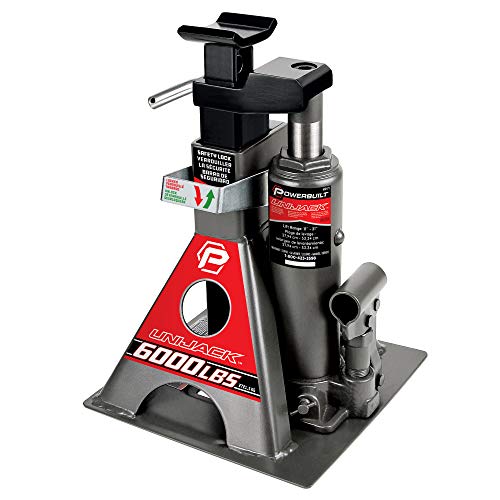
Powerbuilt 3-Ton Unijack All-in-One Hydraulic
The Powerbuilt 620471 Unijack integrates a hydraulic bottle jack and a mechanical ratcheting jack stand into a single unit, eliminating the danger of hydraulic pressure bleed-off. With a 6,000-pound capacity, an 11 to 21-inch lift range, and a wide steel base, it provides dependable single-point lifting and static holding for trucks and SUVs.
Pros
- Combines hydraulic bottle jack lifting and mechanical jack stand safety into one single-point tool
- Physical ratcheting safety lock prevents accidental vehicle drops caused by hydraulic pressure bleed-off
- Wide 9.88 x 9.75-inch base provides excellent stability on garage concrete and level paved surfaces
- Tall 21-inch maximum extension delivers ample working clearance for high-clearance trucks and SUVs
- Meets ANSI standards for portable automotive service equipment and includes a 1-year factory warranty
Cons
- Minimum collapsed height of 11 inches makes it unusable on low-clearance sedans and sports cars
- At 22.66 pounds per single unit, it is significantly heavier than standard individual mechanical jack stands
- Sold as an individual unit rather than a pair, requiring separate purchases if supporting an entire axle
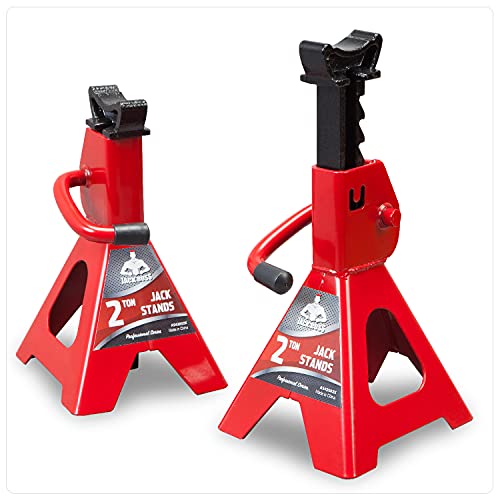
Jack Boss 2-Ton Low-Profile Ratchet Jack Stands
Designed for compact cars and small unibody vehicles, these Jack Boss low-profile jack stands combine a welded mild steel pyramid base with a ductile iron sawtooth ratchet bar spanning a 9.8-inch to 15-inch height range. They provide a lightweight, compact footprint for DIY garage maintenance, though the manufacturer explicitly advises against using them on trucks, large SUVs, or vehicles requiring over 15 inches of chassis clearance.
Pros
- Low 9.8-inch collapsed height fits easily under small passenger cars and lower unibody lift points
- Ductile iron sawtooth ratchet bar allows fast, tool-free height selection and positive pawl engagement
- Lightweight 10.5-pound overall build makes carrying, positioning, and garage storage simple
- Fully welded mild steel frame with protective powder coating guards against rust and shop grime
Cons
- Maximum 15-inch reach is too short for pickup trucks, full-size SUVs, or lifted off-road vehicles
- Single-pawl ratchet design lacks a secondary captive locking pin or redundant safety stop
- Steel concave saddle does not include rubber protection, which may mar painted unibody pinch welds without an aftermarket pad
ANTPOWER 3-Ton Double-Locking Jack Stands
The ANTPOWER 3-ton double-locking jack stands provide reliable static support for garage maintenance, pairing a ductile iron sawtooth ratchet column with a secondary steel side-locking pin. With an 11.2 to 16.8-inch height range and a fully welded pyramid steel base, they offer solid safety for compact cars, sedans, and light crossovers.
Pros
- Secondary side-pin lock adds physical redundancy alongside the primary ratchet pawl
- High-strength ductile iron ratchet bar provides positive sawtooth height adjustments
- Fully welded mild steel pyramid base delivers stable static support on level concrete slabs
- Protective powder-coated finish helps resist common garage moisture and chemical rust
- Manageable 14.3-pound total weight makes repositioning easy during four-corner vehicle setups
Cons
- Maximum 16.8-inch reach is insufficient for lifted 4x4s, full-size trucks, or vehicles with frame heights over 16 inches
- Bare steel saddle lacks a rubber pad, which may mar painted unibody pinch welds without an aftermarket adapter
- Conflicting product listing text notes both 6,000 lbs per pair and 6,600 lbs per stand, requiring conservative 3-ton pair load planning
PRUTHY 3-Ton Double-Locking Jack Stands
The PRUTHY 3-Ton Jack Stand Pair provides static vehicle support rated up to 6,600 pounds across the pair, combining a ductile iron ratchet bar with an added metal safety pin for dual-locking peace of mind. Featuring an 11.4-inch to 16.9-inch height range and a wide stamped-steel pyramid base, they offer reliable stability for routine garage maintenance on sedans, crossovers, and small SUVs.
Pros
- Secondary metal safety pin adds a positive mechanical backup to the primary ratchet pawl mechanism
- Welded stamped-steel pyramid base provides solid footing and even weight distribution on level concrete floors
- Clear 11.4-inch to 16.9-inch elevation range works well for passenger cars, crossovers, and compact utility trailers
- Forged one-piece ductile iron ratchet column resists fracturing under static load
Cons
- Minimum collapsed height of 11.4 inches may be too tall for lowered sports cars without pre-lifting
- Maximum extension of 16.9 inches will not provide adequate clearance for lifted 4x4 trucks on oversized tires
- Metal saddle lacks included rubber protective pads to shield delicate pinch welds from cosmetic scratches
BIG RED Torin 3-Ton Steel Jack Stands
The BIG RED Torin T43202 jack stands provide a 3-ton (6,000 lb) rated capacity per pair, combining a welded steel pyramid base with a double-locking pawl ratchet system. Specifically built for passenger cars rather than trucks or SUVs, they offer an 11-1/4-inch to 16-3/4-inch height range compliant with ASME standards for garage maintenance.
Pros
- Double-locking pawl and sawtooth ratchet bar add mechanical security against accidental release
- Meets ASME static safety standards for dependable support up to 6,000 lbs per pair
- Welded pyramid base design delivers solid stability on flat concrete shop slabs
- Lightweight 13.9-pound total package makes positioning and repositioning effortless for home DIYers
Cons
- Explicitly not suitable for tall SUVs, half-ton pickups, or lifted trucks due to the 16-3/4-inch maximum reach
- Minimum collapsed height of 11-1/4 inches requires sufficient floor jack lift stroke to position under low unibody chassis
- Bare steel saddle lacks integrated rubber pads, which may mark pinch welds without aftermarket adapters
JKWQFBOYAN 3-Ton Double-Locking Jack Stands
These JKWQFBOYAN 3-ton ratchet jack stands feature a dual-locking setup with a cast iron ratchet bar and secondary metal safety pin supported by a wide carbon steel pyramid base. Designed for DIY maintenance on passenger cars, small trucks, and SUVs, they offer an accessible static support option for budget-conscious home mechanics.
Pros
- Double-locking design combines a ratchet handle mechanism with a metal safety pin for secondary security
- Wide pyramid base features triangular foot pads to distribute static chassis weight across level concrete
- Notched saddle profile helps locate vehicle edges and factory lift points
- Relatively lightweight at under 11 pounds for easy garage positioning and compact shelf storage
Cons
- Minimum collapsed and maximum extended height dimensions are not explicitly specified in the manufacturer data
- Listing notes CE conformity rather than the ASME PASE certification standards typical for U.S. commercial shops
- Notched metal saddle lacks rubber pads, which may require aftermarket pinch-weld protectors to prevent underbody marring
Structural Chassis Anatomy and the Mechanics of Safe Jack Stand Placement
Locating the proper support positions on a motor vehicle requires understanding how the manufacturer engineered the chassis to handle mechanical stress. Placing stationary support stands beneath improper locations can buckle body panels, puncture fluid lines, or cause the vehicle to shift off its perch. Modern unibody commuter cars, body-on-frame trucks, and classic solid-axle vehicles each demand specific contact strategies to safely manage concentrated curb weight. Safe mechanical support starts with identifying these reinforced structural points, preparing a solid workspace, and following a disciplined weight transfer protocol.
Unibody Pinch Welds: Locating Reinforced Factory Lift Notches
Most modern sedans, hatchbacks, and compact crossovers utilize unibody construction where the vehicle body and structural frame form a single stamped steel shell. Along the lower rocker panels runs a continuous vertical seam known as the pinch weld. Vehicle manufacturers reinforce specific sections of this seam directly behind the front wheel openings and just ahead of the rear wheel arches. These reinforced notches are often designated by small stamped dimples, arrows, or deliberate cutouts indicating where support equipment must engage.
Positioning a jack stand outside of these reinforced zones creates immediate structural risk. Thin floor pans and standard rocker sheet metal lack the internal gussets required to support concentrated vehicle weight, meaning improper placement can easily crush the floorboard. In addition, bare steel concave saddles can fold or distort vertical pinch welds under heavy pressure. Many mechanics pair stands with slotted vulcanized rubber pads or utilize flat-top stands to cradle the reinforced seam without scraping protective factory undercoating.
Body-on-Frame Trucks and SUVs: Supporting Boxed Chassis Rails
Full-size pickup trucks, commercial vans, and traditional sport utility vehicles rely on a heavy body-on-frame platform consisting of rigid steel rails connected by structural crossmembers. These boxed or heavy C-channel frame rails serve as the primary load-bearing contact points for stationary workshop equipment. Placing stands directly beneath the flat bottom of the main longitudinal rails provides exceptional lateral stability because the thick structural steel manages high point loads without deflecting. Mechanics should position saddles along straight sections of the frame rail rather than along angled transitions near suspension brackets.
Working on elevated truck platforms also demands attention to working height limits and chassis clearances. Because light trucks feature long-travel suspensions that droop substantially when lifted, compact passenger car stands often lack the reach to keep tires elevated. Units such as ANTPOWER or Torin BIG RED 3-ton models provide extended maximum heights reaching past 16.7 inches, allowing saddles to contact elevated truck frame rails safely. Always inspect the inner frame rail surface prior to placement to ensure the saddle does not crush brake lines, fuel conduits, or electrical wiring.
Solid Live Axles and Independent Suspension Control Arms
Rear-wheel-drive trucks, off-road vehicles, and older passenger cars frequently utilize a solid rear axle housing rather than an independent suspension setup. When performing brake service or driveline maintenance, placing jack stands beneath the solid axle tubes is an accepted and effective procedure. Positioning the stands outboard near the leaf spring perches or coil spring buckets keeps the vehicle level and maintains normal suspension ride height. The deep concave saddle found on standard ratchet stands cradles the circular steel tube securely, preventing the axle from rolling or shifting laterally.
Conversely, mechanics must exercise extreme caution around modern independent suspension components. Stamped steel lower control arms, lightweight aluminum wishbones, and steering tie rods are never designed to support the concentrated weight of a vehicle. Resting a stand saddle beneath a curved control arm can deform suspension geometry, shear ball joints, or allow the arm to slip off as the bushing flexes. If pinch welds or frame rails are inaccessible, OEM service manuals typically designate robust front subframe mounting points or central engine cradle crossmembers as suitable alternative support locations.
The Physical Transition: Jacking Points Versus Jack Stand Placement Points
One of the most frequent challenges home mechanics encounter is managing the physical space overlap between the hydraulic floor jack and the jack stand. Because standard passenger vehicles often provide only a single reinforced pinch-weld notch at each wheel corner, placing a floor jack on that notch leaves no room for the stationary stand saddle. Resolving this conflict requires consulting the factory service manual to identify approved central jacking points. Many vehicles feature a reinforced central front engine crossmember or a solid rear differential case designed to lift an entire axle simultaneously, leaving the outer corner pinch welds open for stand placement.
Alternative vehicle support equipment can also resolve spatial jacking challenges when central lift points are absent. Specialized combination tools, such as the Powerbuilt 3 Ton Unijack, integrate a hydraulic bottle jack mechanism directly into a ratcheting mechanical support stand collar, lifting and locking the chassis from a single contact footprint. In dedicated professional workshops, technicians frequently bypass these single-point spatial restrictions entirely by using permanent vehicle lifts that elevate the entire perimeter frame simultaneously. For home DIY mechanics using standalone floor jacks and separate stands, lifting from a central structural member remains the cleanest method to clear factory corner notches.
Pre-Lift Staging: Ground Surface Integrity and Wheel Chocking Protocols
Before positioning any mechanical lifting device beneath a vehicle, the working surface beneath the equipment must be evaluated thoroughly. Jack stands exert immense point-load pressure through their relatively small base feet, requiring a flat, level, and solid concrete floor. Residential asphalt driveways pose serious hazards during warm weather because asphalt is a flexible petroleum-based substrate that softens under ambient heat. The narrow stamped steel feet of standard pyramid stands can penetrate softened asphalt, causing the stand to list sideways and drop the supported vehicle without warning.
If maintenance must be performed outside of a concrete garage floor, mechanics should place heavy structural steel plates beneath each stand base to distribute ground pressure across a wider surface area. Under no circumstances should anyone use wooden blocks, loose plywood sheets, paving stones, or hollow cinder blocks as ground shims or height extenders, as these materials shatter unpredictably under compression. In addition to firm ground staging, always apply the vehicle parking brake firmly and place heavy-duty rubber wheel chocks on both sides of the tires that remain in contact with the ground before lifting begins.
Locking Mechanism Engagement: Ratchet Pawls and Secondary Safety Pins
Modern automotive jack stands utilize distinct mechanical locking configurations to support rated loads safely under static vehicle conditions. The most common format is the sawtooth ratchet bar, featured on models from Amazon Basics, Jack Boss, and KOERZORE. In these designs, a ductile iron ratchet bar slides through the outer collar while an internal counterweighted pawl engages individual cast teeth. Adjusting the post upward produces an audible click as the pawl resets into each subsequent tooth valley. Mechanics must visually confirm that the pawl drops fully into the tooth recess rather than balancing on a tooth crest.
To prevent accidental disengagement from handle contact or severe vibration, many manufacturers incorporate redundant mechanical safety features. Stands from ANTPOWER and PRUTHY feature double-locking assemblies that pair the automatic ratchet pawl with a steel safety cross-pin inserted through the collar. This secondary pin acts as an immovable physical stop beneath the ratchet column, ensuring the post cannot drop if the release handle is bumped. Solid pin-type stands offer a similar safety profile by replacing ratchet teeth with through-drilled steel crossbars that slide through solid collar holes.
Controlled Weight Transfer and the Unloaded Jack Failsafe
Transferring chassis weight from an active hydraulic floor jack onto stationary mechanical stands requires slow, measured control. Once the stands are centered beneath the designated factory lift points and raised to equal height settings, the operator should slowly turn the hydraulic jack release valve counterclockwise. Feathering the release valve allows the vehicle to descend millimeters at a time, ensuring the structural contact point meets the center of the stand saddle evenly. Rapid lowering can generate sudden dynamic shock loads that exceed the static capacity of the stands or shift the vehicle chassis off-center.
Once the full weight of the vehicle rests firmly on the jack stand saddles, the hydraulic floor jack must be lowered completely so it carries zero vehicle load. Hydraulic jacks rely on pressurized hydraulic fluid and internal rubber seals that can degrade or bypass pressure unexpectedly, making them completely unsuitable as holding devices. After lowering the floor jack completely, mechanics should raise the jack saddle just enough to rest a quarter-inch beneath a nearby structural crossmember without carrying load. This practice establishes an unloaded secondary barrier that provides extra peace of mind while working beneath the elevated chassis.
The Physical Shake Test: Lateral Stability Verification Before Underbody Access
Verifying vehicle stability before crawling beneath an elevated chassis is the single most critical safety rule in automotive maintenance. Even if the stands appear visually straight and properly locked, subtle unevenness in the garage floor or slight off-center saddle contact can create severe lateral instability. The mandatory method for confirming chassis security is the vigorous lateral shake test. With the vehicle fully lowered onto the stands and the hydraulic jack unloaded, the technician must firmly grasp the vehicle bumper or fender and push firmly with deliberate body weight from multiple angles.
A properly supported vehicle should feel completely rigid and move only slightly on its tire sidewalls if two wheels remain grounded. If any jack stand rocks, shifts across the concrete, or demonstrates collar play during the shake test, you must immediately raise the chassis and reposition the equipment. Enthusiasts undertaking extensive chassis teardowns often invest in commercial vehicle lift systems to eliminate stand repositioning across multi-day jobs. For home mechanics using floor stands, performing this physical shake test confirms that all four pyramid feet carry uniform ground pressure before you work underneath.
Calculating ANSI/ASME PASE Capacity: Pair Ratings Versus Axle Weights
Understanding load capacity conventions is vital to preventing equipment overloading in residential workshops. Under ANSI/ASME PASE safety standards governing portable automotive service equipment, jack stand weight ratings apply to the pair rather than to an individual stand. A pair of stands marked with a 3-ton capacity is engineered to support a total combined load of 6,000 pounds, meaning each individual stand carries a rated working limit of 3,000 pounds. Misinterpreting this rating as 6,000 pounds per single stand can lead to dangerous overloading scenarios when supporting heavier pickups or commercial vans.
Calculating necessary stand capacity requires examining your vehicle Gross Vehicle Weight Rating along with its front and rear axle weight distribution. Most front-wheel-drive sedans carry approximately sixty percent of their curb weight across the front axle due to the transverse engine and transaxle assembly. When lifting the front end of a 4,000-pound sedan, the front stands must support roughly 2,400 pounds of concentrated load. Pairing that vehicle with a 3-ton stand set, such as Amazon Basics or Torin BIG RED units, provides a generous safety cushion that easily accommodates standard vehicle weight splits.
Saddle Profile Geometry and Avoiding Dangerous Makeshift Spacers
The interface between the jack stand saddle and the vehicle chassis dictates how securely weight is transferred into the ground. Standard ratchet stands feature a broad concave saddle designed to cradle round axles and flat truck frame rails. On unibody passenger cars, however, this curved steel profile can concentrate pressure along narrow pinch-weld edges, leading to bent seams or cracked protective undercoating. Utilizing stands equipped with flat tops or slotted vulcanized rubber pads distributes load evenly along the chassis sill while preventing metal-on-metal friction and finish abrasion.
Under no circumstances should anyone place makeshift wooden blocks, lumber scraps, or unrated metal spacers between the saddle and the chassis to gain extra lifting height. Wood grains split and crush unpredictably under concentrated point loads, which can cause sudden vehicle shifts and catastrophic drops. If a vehicle requires additional clearance, mechanics must choose stands engineered with taller vertical columns and wider base footprints rather than stacking unstable spacers. Low-profile cars benefit from models like the Jack Boss 2-ton stands with collapsed heights down to 9.8 inches, while lifted trucks require purpose-built high-lift support equipment.
Inspection Protocols, Maintenance, and Safe Lowering Procedures
Regular visual inspection of vehicle support equipment is essential for maintaining a safe working environment over years of garage service. Before each lifting operation, thoroughly examine the welded seams along the pyramid base legs and collar joints to ensure there are no hairline stress cracks or flaking powder coat indicating metal fatigue. Inspect the ductile iron ratchet bar and internal pawl teeth closely for signs of rounding, chipping, or excessive wear. Any jack stand that exhibits bent base legs, wallowed pin holes, cracked welds, or structural damage from an accidental shock drop must be discarded immediately.
Completing vehicle maintenance requires executing the lowering procedure with the same methodical caution used during initial setup. Begin by sliding the hydraulic floor jack back under the central lift point and raising the vehicle just enough to relieve all weight from the stand saddles. Once clearance is established, disengage secondary safety pins, lower the center posts completely into their collars, and remove the stands from beneath the car. Lower the floor jack slowly until the tires rest on the ground, torque all lug nuts to factory specifications while the wheels are weighted, and remove the wheel chocks to complete the job safely.
About the author
Mike Bumbeck is an automotive journalist and hands-on product evaluator with a long-standing interest in classic vehicles, motorcycles, and practical garage equipment. His work brings a grounded perspective to automotive tools, maintenance products, and the details that matter when choosing gear for real-world use.