
How Many Jack Stands for Oil Change? Safe Garage Setup Guide for 2026
Learn how many jack stands for oil change safely in November 2026 with essential vehicle support tips, stability checks, and proper weight ratings for home garages.
 By Christian Hazel
Updated October 10, 2026


Crawling beneath several thousand pounds of automotive machinery to pull a drain plug requires complete confidence in your mechanical support setup. Determining how many jack stands for oil change is one of the most critical safety questions any home mechanic must answer before sliding an oil drain pan under the engine. While a hydraulic floor jack elevates your vehicle into position, it relies on pressurized fluid that can bypass internal seals without warning. Safe underbody vehicle maintenance always requires positive mechanical support to prevent catastrophic crushing injuries while you work. Reviewing your workspace layout and overall garage ceiling height requirements can also help you plan a comfortable and secure vehicle lifting procedure.
Most routine oil changes require a minimum of two sturdy jack stands placed securely under the front factory lift points while the rear tires remain firmly planted on level ground. Some specific chassis designs or drivetrain configurations require four stands to keep the vehicle completely level for accurate fluid draining and refill measurements. Understanding how load ratings apply, how oil pan angles influence drainage, and how to position stands properly eliminates guesswork in the driveway. Investing in quality support equipment featuring verified ANSI/ASME PASE compliance ensures your vehicle remains stable from the moment you loosen the drain bolt to the final torque check on the oil filter.
| Award | Product | BJL Score About BJL ScoreThe BJL Score is our own rating from 0 to 10, based on performance, design and build, ease of use, and value. It reflects independent research and is never influenced by manufacturers, retailers, or affiliate commissions. Learn more › | |
|---|---|---|---|
| Best Overall |
KOERZORE 3-Ton Jack Stands (Pair)
|
8.9/10 | Buy |
| Best Value |
 Amazon Basics 3-Ton Steel Jack Stands |
8.9/10 | Buy |
| Best Premium |
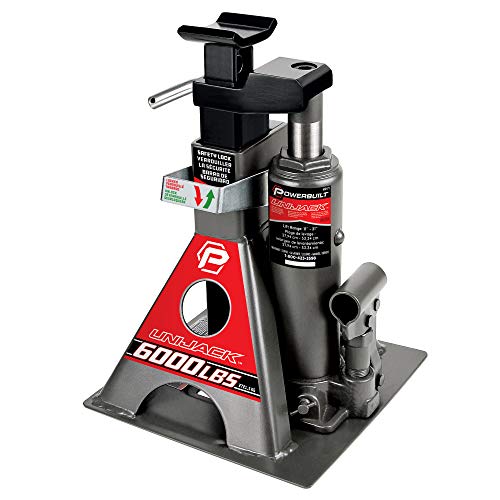 Powerbuilt 3-Ton Unijack All-in-One Hydraulic |
8.9/10 | Buy |
| Best Budget |
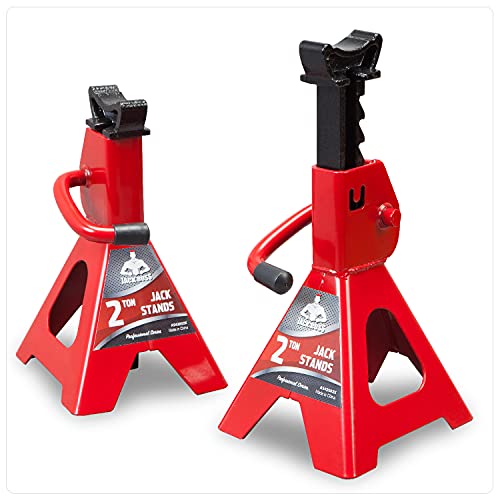 Jack Boss 2-Ton Low-Profile Ratchet Jack Stands |
8.6/10 | Buy |
KOERZORE 3-Ton Jack Stands (Pair)
Built for garage maintenance and oil changes, these KOERZORE jack stands feature a dual-locking mechanism and a wide pyramid base to support sedans and midsize SUVs safely.
Pros
- Dual-locking mechanism provides added fail-safe protection
- Wide pyramid base enhances stability on hard surfaces
- Concave saddle securely cradles vehicle frame points
- Lightweight 10.7-pound build allows easy garage portability
Cons
- Maximum 16.75-inch height restricts clearance on lifted trucks
- 3-ton capacity is insufficient for heavy-duty commercial vehicles
Amazon Basics 3-Ton Steel Jack Stands
The Amazon Basics 3-Ton Steel Jack Stand Pair delivers 6,000 pounds of reliable vehicle support certified to ASME PASE-2014 standards for portable automotive equipment. Featuring a self-locking ratchet bar and a compact steel footprint, this set is ideal for home garage DIYers servicing passenger cars and urban SUVs.
Pros
- Rated for 3 tons (6,000 lbs) per pair and meets ASME PASE-2014 portable automotive service standards
- Self-locking ratchet bar enables rapid, secure height adjustment without fiddling with separate pins
- Compact 7.5 x 7.0-inch footprint and 12.6-lb total weight make positioning and storage simple
- Protective rustproof coating over a durable steel frame helps resist corrosion from garage fluids
Cons
- 3-ton capacity is tailored for sedans and crossover SUVs, not full-size heavy-duty pickup trucks
- Ratchet assembly does not feature a secondary mechanical cross-locking pin for redundant backup
- Must be used exclusively on flat, solid concrete slabs to prevent uneven weight distribution or base sinking
Powerbuilt 3-Ton Unijack All-in-One Hydraulic
The Powerbuilt 620471 Unijack integrates a hydraulic bottle jack and a mechanical ratcheting jack stand into a single unit, eliminating the danger of hydraulic pressure bleed-off. With a 6,000-pound capacity, an 11 to 21-inch lift range, and a wide steel base, it provides dependable single-point lifting and static holding for trucks and SUVs.
Pros
- Combines hydraulic bottle jack lifting and mechanical jack stand safety into one single-point tool
- Physical ratcheting safety lock prevents accidental vehicle drops caused by hydraulic pressure bleed-off
- Wide 9.88 x 9.75-inch base provides excellent stability on garage concrete and level paved surfaces
- Tall 21-inch maximum extension delivers ample working clearance for high-clearance trucks and SUVs
- Meets ANSI standards for portable automotive service equipment and includes a 1-year factory warranty
Cons
- Minimum collapsed height of 11 inches makes it unusable on low-clearance sedans and sports cars
- At 22.66 pounds per single unit, it is significantly heavier than standard individual mechanical jack stands
- Sold as an individual unit rather than a pair, requiring separate purchases if supporting an entire axle
Jack Boss 2-Ton Low-Profile Ratchet Jack Stands
Designed for compact cars and small unibody vehicles, these Jack Boss low-profile jack stands combine a welded mild steel pyramid base with a ductile iron sawtooth ratchet bar spanning a 9.8-inch to 15-inch height range. They provide a lightweight, compact footprint for DIY garage maintenance, though the manufacturer explicitly advises against using them on trucks, large SUVs, or vehicles requiring over 15 inches of chassis clearance.
Pros
- Low 9.8-inch collapsed height fits easily under small passenger cars and lower unibody lift points
- Ductile iron sawtooth ratchet bar allows fast, tool-free height selection and positive pawl engagement
- Lightweight 10.5-pound overall build makes carrying, positioning, and garage storage simple
- Fully welded mild steel frame with protective powder coating guards against rust and shop grime
Cons
- Maximum 15-inch reach is too short for pickup trucks, full-size SUVs, or lifted off-road vehicles
- Single-pawl ratchet design lacks a secondary captive locking pin or redundant safety stop
- Steel concave saddle does not include rubber protection, which may mar painted unibody pinch welds without an aftermarket pad
Understanding Jack Stand Quantity and Vehicle Support for an Oil Change
Supporting a raised vehicle securely demands an uncompromising focus on chassis balance, structural pick points, and load distribution. When planning routine maintenance, knowing exactly how many support units to deploy protects both your physical safety and your vehicle mechanical components. This guide breaks down the engineering principles, chassis geometry, and procedural steps necessary to achieve an immovable garage setup.
Two Stands Versus Four Stands: Determining the Right Configuration
In the vast majority of standard DIY garage scenarios, using two jack stands across the front axle provides the necessary clearance and safety margin for an oil change. Since most passenger vehicles and light trucks have front-mounted engines, lifting just the front end allows straightforward access to the oil pan drain plug and oil filter. The rear wheels remain securely on the ground, creating a stable triangular base of support as long as the parking brake is set and sturdy wheel chocks are positioned. This two-point front lift setup is fast to execute, highly stable on flat ground, and minimizes the mechanical complexity of hoisting the entire vehicle off the floor.
Raising a vehicle onto four jack stands becomes necessary under specific mechanical conditions. If your vehicle features an oil pan with a side-facing or front-facing drain plug, tilting the vehicle backward on two front stands might trap a substantial amount of old, contaminated oil inside the pan. In addition, dry-sump lubrication systems and modern engines with sensitive electronic dipsticks often require the vehicle to be perfectly level on all four corners to verify accurate oil refill levels. Many home mechanics also choose to elevate the entire vehicle on four stands when combining an oil change with a full four-wheel tire rotation or brake inspection.
Choosing between a two-stand and a four-stand setup fundamentally balances operational convenience against mechanical necessity. Setting up four stands requires raising the front, placing two supports, and then carefully jacking the rear while monitoring the front stands for lateral shifting. If your service manual confirms that elevating the front alone allows complete oil evacuation, a two-stand setup remains the preferred and safest garage method. When your vehicle requires full leveling, taking the time to position four properly rated stands provides a flat, stable platform for thorough service.
The Extreme Danger of Using a Single Stand or a Hydraulic Jack Alone
Using only one jack stand during an oil change is an exceptionally dangerous practice that must never be attempted. Supporting a vehicle on a single stand creates a hazardous pivot axis that can cause the vehicle to twist, slip off the saddle, or violently tip sideways under the slightest disturbance. Even reaching under the chassis to break loose an over-torqued drain plug applies lateral force that can easily topple a single support post. Balanced support requires paired stands resting at symmetrical structural locations across the vehicle frame or unibody seams.
Equally hazardous is the temptation to rely entirely on a hydraulic floor jack without mechanical stands in place. Hydraulic jacks are engineered strictly for lifting, not for sustained stationary holding. Internal hydraulic seals, check valves, and O-rings are subject to sudden failure or gradual pressure loss, allowing the vehicle to descend silently within seconds. Working beneath a vehicle held only by hydraulic pressure introduces a catastrophic hazard that has caused countless fatal shop accidents.
Mechanical jack stands eliminate this risk by transferring vehicle weight directly through rigid steel or ductile iron columns down to broad pyramid bases. Pairing stands ensures that the weight of the elevated axle is split evenly between two rigid, stationary pillars. This mechanical rigidity holds the chassis steady even when you pull firmly on a ratchet handle or maneuver an oil filter wrench in cramped quarters.
Oil Pan Geometry and How Elevation Angle Impacts Complete Draining
The physical location and orientation of the engine oil drain plug dictate whether tilting your vehicle on two front stands is advantageous or counterproductive. Most traditional front-engine vehicles place the oil drain plug at the rear edge of the oil pan. In these designs, elevating the front end on two stands actually improves oil drainage by tilting the bottom of the pan downward toward the plug, encouraging dirty oil and suspended sediment to flush out completely.
Certain vehicles feature drain plugs mounted on the side or toward the front of the sump, where tilting the front end upward creates a dam that retains contaminated oil. Leaving a half-quart of dirty oil behind defeats the purpose of the oil change and degrades the fresh oil immediately after refilling. If you discover that your vehicle drain plug is not positioned at the rear face of the pan, you should elevate all four corners equally on four stands or use drive-on service ramps to keep the chassis level.
Checking your vehicle service manual or inspecting the oil pan underside before lifting provides clear direction on pan geometry. Consulting documentation also clarifies the exact oil capacity and refill verification procedure specified by the manufacturer. If your car lacks a traditional physical dipstick and relies on an in-dash electronic sensor, maintaining a level vehicle during the drain and fill process prevents inaccurate oil level readings.
Understanding Load Ratings: Why ANSI/ASME PASE Rates Stands by the Pair
Misinterpreting jack stand capacity ratings is a widespread issue among DIYers that can lead to unintentional overloading. Under modern ANSI/ASME PASE (Portable Automotive Service Equipment) standards, jack stand load ratings apply to the capacity of the pair, not an individual stand. A pair of stands marked as 3-ton capacity is certified to support up to 6,000 pounds combined, meaning each individual stand carries a rated working limit of 3,000 pounds.
To select the correct capacity, compare the rated pair limit against the Gross Vehicle Weight Rating (GVWR) and axle weight distribution listed on your driver door jamb sticker. Passenger cars and crossovers with a 60/40 front weight bias place the majority of their curb weight over the front suspension where the engine and transmission sit. When supporting the front end of a 4,000-pound sedan, the two front stands will carry approximately 2,400 pounds, which fits comfortably within a 2-ton or 3-ton pair capacity.
Commercial options like the Amazon Basics Steel Jack Auto Stands or KOERZORE 1 Pair 3 Ton Jack Stands provide a certified 6,000-pound pair capacity that suits most sedans, minivans, and urban crossovers. For compact cars or lowered vehicles, low-profile options such as the Jack Boss Jack Stands Low Profile 2 Ton model offer a 4,000-pound rating with a collapsed height starting at 9.8 inches. Always maintain a generous safety margin rather than operating near the absolute limit of your equipment. Exploring heavier automotive lifting equipment can give you perspective on shop-grade safety thresholds.
Chassis Contact Points: Pinch Welds, Boxed Frame Rails, and Saddle Compatibility
Proper placement of jack stand saddles is just as crucial as having the correct number of stands. On modern unibody passenger cars, vehicle manufacturers designate reinforced pinch-weld notches along the rocker panels as factory support points. Resting bare curved steel saddles directly against thin unibody seams can crush the sheet metal, damage protective undercoatings, and cause rust-inducing metal deformation.
Using slotted vulcanized rubber saddle pads or pinch-weld adapters allows the stand to cradle the reinforced seam without gouging metal or bending adjacent body panels. For body-on-frame pickup trucks and traditional SUVs, stand saddles should be placed beneath flat, sturdy sections of the boxed ladder frame or solid axle tubes. Avoid positioning stands under floor pans, suspension control arms, steering linkages, or exhaust pipes, as none of these components are designed to bear vehicle weight.
Never place makeshift spacers, wooden blocks, bricks, or concrete pavers between the jack stand saddle and the vehicle chassis to gain extra height. Concentrated vehicle weight can crack bricks or cause lumber to split cleanly along grain lines under load, resulting in instantaneous chassis collapse. If your vehicle requires additional working clearance, invest in stands with an extended maximum lift height rather than using unrated garage materials.
Mechanical Locking Designs: Ratchet Bars, Dual Pins, and Integrated Units
The locking mechanism is the primary safety barrier preventing a jack stand column from dropping unexpectedly. Sawtooth ratchet-bar stands, such as the Amazon Basics and Jack Boss models, utilize a counterweighted ductile iron pawl that drops into deep teeth along the center post. When vehicle weight rests on the saddle, the downward force mechanically binds the pawl into the tooth pocket, preventing accidental disengagement while the stand remains loaded.
Double-locking jack stands, like the KOERZORE 3-ton pair, incorporate a secondary manual steel safety pin that passes directly through the collar beneath the ratchet bar. This redundant pin acts as a positive mechanical backup that physically blocks the ratchet post from descending even in the rare event of pawl movement or severe vibration. Pin-style and double-locking configurations provide an added layer of security that gives home mechanics tremendous peace of mind.
Integrated vehicle support equipment, such as the Powerbuilt 3 Ton Unijack, combines a hydraulic bottle jack and a ratcheting jack stand into a single compact housing. This hybrid design lifts the chassis and mechanically locks into place with an internal ratcheting safety bar at the same structural point. This eliminates the tricky two-step dance of lifting from one jacking point and squeezing a stand into a tight adjacent factory slot on compact truck frames. Evaluating these configurations alongside heavy vehicle support tools highlights how mechanical locking designs have evolved for residential use.
Driveway and Garage Surfaces: Managing Point Load and Sinking Hazards
The floor beneath your jack stands plays a major role in vehicle stability during an oil change. Jack stands concentrate thousands of pounds of vehicle weight onto four narrow steel feet at the base of each pyramid stand. Poured, level concrete floors provide the ideal compressive strength to support these concentrated point loads without shifting, cracking, or yielding.
Working on an asphalt driveway poses serious safety risks, particularly during warm summer months when solar heat softens the bituminous binder. Under heavy chassis weight, narrow jack stand feet can punch directly into softened asphalt, causing the vehicle to tilt precariously and potentially slide off the saddles. If you must work on asphalt, place thick, solid structural steel plates or heavy composite pads beneath all four feet of each stand to distribute the load over a broader surface area.
Never set up jack stands on uncompacted dirt, loose gravel, or sloped ground. An incline induces lateral shear forces on the stand columns, dramatically increasing the likelihood of tipping when you apply torque to chassis components. Always ensure your workspace is flat, clean, and free of debris that could cause stand feet to sit unevenly.
Systematic Execution: Lifting, Lowering, and Transferring Chassis Weight
Executing a safe vehicle lift begins with proper vehicle staging before the floor jack touches the frame. Park the vehicle on a level concrete surface, engage the transmission in park or reverse, and firmly pull the emergency parking brake. Place heavy-duty rubber wheel chocks on both the front and rear sides of the rear tires to prevent any forward or backward rolling motion when the front end is raised.
Position your hydraulic floor jack beneath the manufacturer-recommended central front jacking point, such as a reinforced engine crossmember or front subframe loop. Slowly raise the front of the vehicle until the tires clear the floor with enough height to slide your jack stands into position. Adjust both jack stand ratchet bars to the exact same tooth height, ensuring the saddles line up squarely beneath the left and right front pinch welds or frame rails.
Gradually turn the release valve on your hydraulic floor jack to lower the vehicle slowly onto the jack stand saddles. Watch closely as the vehicle contacts the stands, ensuring the chassis settles dead center in the concave cradles without tilting or twisting. Once full vehicle weight rests on the stands, lower the floor jack just enough to relieve hydraulic pressure while leaving the jack pad positioned half an inch below the crossmember as an extra safety backup.
Physical Verification: The Garage Shake Test and Secondary Failsafes
Before crawling underneath the engine to access the oil filter and drain plug, you must perform a mandatory physical verification known as the shake test. Stand at the front corner of the vehicle and push firmly on the bumper and fender with your hands, rocking the vehicle laterally with moderate force. A properly supported vehicle will remain rock-solid on its stands, while an unstable or misaligned stand will immediately reveal wobble or shifting before you place yourself in harm’s way.
In addition to the shake test, maintaining secondary redundant safety measures costs nothing and offers immense protection. Leaving your hydraulic floor jack positioned just beneath a solid structural crossmember acts as an emergency catch if a stand ever experiences an unforeseen failure. If you have removed wheels for additional clearance or concurrent brake work, sliding the removed wheels flat under the rocker panels provides an extra physical barrier against ground impact.
Taking a systematic approach to vehicle support turns a routine oil change into a safe, routine maintenance procedure. By utilizing two sturdy, properly rated jack stands for standard front lifts, verifying level requirements for unusual pans, and never compromising on mechanical locking integrity, you can service your engine with total confidence. When you take the time to set up your vehicle correctly on the ground, every underbody maintenance task becomes safer and far less stressful.
About the author
Christian Hazel is an automotive journalist with extensive experience covering four-wheel-drive vehicles, mechanical upgrades, and off-road equipment. His background includes technical reviews, installation features, and project-vehicle coverage, bringing useful context to equipment choices for trucks, Jeeps, and off-road enthusiasts.