
Where Do You Place Jack Stands Under a Car: Safe Placement and Setup Guide for 2026
Where Do You Place Jack Stands Under A Car safely using factory pinch welds, frame rails, and axles for November 2026 garage work.
 By Peter Nelson
Updated October 10, 2026


Setting up a vehicle for underbody service requires absolute confidence in your mechanical support foundation before ever sliding underneath. Hydraulic floor jacks are engineered strictly for lifting, which means relying on them alone invites catastrophic hydraulic pressure drop or seal failure. When tackling routine brake repairs, exhaust replacements, or oil changes, knowing where do you place jack stands under a car ensures that thousands of pounds of steel rest squarely on engineered structural hardpoints rather than vulnerable floor pans. Understanding these critical contact surfaces protects both your physical safety and your vehicle chassis from severe structural distortion.
Different chassis architectures present distinct structural load paths, ranging from reinforced unibody pinch welds to boxed steel truck frames and solid axle tubes. Applying concentrated tonnage against the wrong sheet metal area can crush rocker panels, pinch fuel lines, or compromise unibody integrity. When planning under-chassis access, home mechanics weighing jack stands against permanent lifting systems often examine garage ceiling height planning considerations to determine their overall shop clearance. Pairing proper support locations with stable, certified support stands featuring wide pyramid bases and positive locking mechanisms guarantees steady vehicle elevation throughout any mechanical project.
| Award | Product | BJL Score About BJL ScoreThe BJL Score is our own rating from 0 to 10, based on performance, design and build, ease of use, and value. It reflects independent research and is never influenced by manufacturers, retailers, or affiliate commissions. Learn more › | |
|---|---|---|---|
| Best Overall |
YELLOW JACKET 3 Ton Double-Locking Steel Jack
|
9.2/10 | Buy |
| Best Budget |
 KOERZORE 3-Ton Jack Stands (Pair) |
8.9/10 | Buy |
| Best Value |
 Amazon Basics 3-Ton Steel Jack Stands |
8.9/10 | Buy |
| Best Premium |
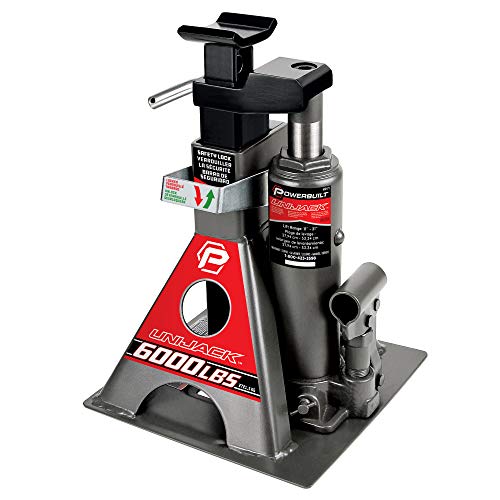 Powerbuilt 3-Ton Unijack All-in-One Hydraulic |
8.9/10 | Buy |
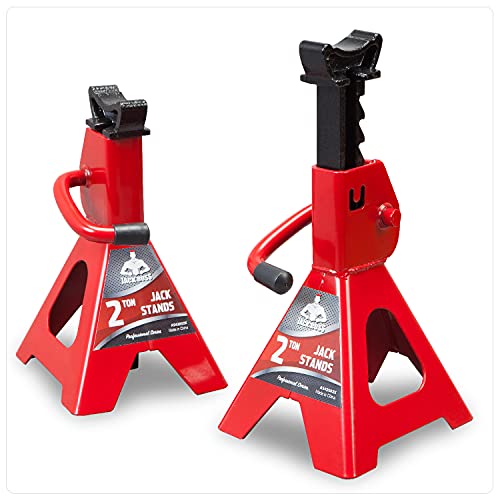 Jack Boss 2-Ton Low-Profile Ratchet Jack Stands |
8.6/10 | Buy | |
 ANTPOWER 3-Ton Double-Locking Jack Stands |
8.4/10 | Buy | |
 JKWQFBOYAN 3-Ton Double-Locking Jack Stands |
7.8/10 | Buy |
YELLOW JACKET 3 Ton Double-Locking Steel Jack
The YELLOW JACKET 3-ton jack stand pair provides a 6,600-pound combined capacity with ductile iron ratchet columns and secondary metal locking pins for redundant garage safety. Featuring a welded stamped steel pyramid base and a 10-7/8-inch to 16-9/16-inch height range, they offer reliable static support for compact cars, crossovers, and midsize SUVs during routine maintenance.
Pros
- Double-locking system pairs a ductile iron ratchet bar with an independent metal safety pin for added physical redundancy
- Solid one-piece forged ductile iron center column provides reliable static tooth engagement across multiple height settings
- Welded stamped steel pyramid base features wide foot pads to support vehicle stability on flat concrete shop floors
- Practical height span of 10-7/8 inches to 16-9/16 inches covers common passenger vehicle maintenance tasks like brake jobs and oil changes
Cons
- The 10-7/8-inch collapsed height may sit too high for significantly lowered sports cars or vehicles with low front splitters
- Bare metal saddle lacks rubber cushioning pads, which may mar painted subframes or bend unprotected pinch welds without aftermarket adapters
- Maximum height reach of 16-9/16 inches is limited for lifted 4x4 trucks or high-clearance off-road vehicles requiring extended droop clearance
KOERZORE 3-Ton Jack Stands (Pair)
Built for garage maintenance and oil changes, these KOERZORE jack stands feature a dual-locking mechanism and a wide pyramid base to support sedans and midsize SUVs safely.
Pros
- Dual-locking mechanism provides added fail-safe protection
- Wide pyramid base enhances stability on hard surfaces
- Concave saddle securely cradles vehicle frame points
- Lightweight 10.7-pound build allows easy garage portability
Cons
- Maximum 16.75-inch height restricts clearance on lifted trucks
- 3-ton capacity is insufficient for heavy-duty commercial vehicles
Amazon Basics 3-Ton Steel Jack Stands
The Amazon Basics 3-Ton Steel Jack Stand Pair delivers 6,000 pounds of reliable vehicle support certified to ASME PASE-2014 standards for portable automotive equipment. Featuring a self-locking ratchet bar and a compact steel footprint, this set is ideal for home garage DIYers servicing passenger cars and urban SUVs.
Pros
- Rated for 3 tons (6,000 lbs) per pair and meets ASME PASE-2014 portable automotive service standards
- Self-locking ratchet bar enables rapid, secure height adjustment without fiddling with separate pins
- Compact 7.5 x 7.0-inch footprint and 12.6-lb total weight make positioning and storage simple
- Protective rustproof coating over a durable steel frame helps resist corrosion from garage fluids
Cons
- 3-ton capacity is tailored for sedans and crossover SUVs, not full-size heavy-duty pickup trucks
- Ratchet assembly does not feature a secondary mechanical cross-locking pin for redundant backup
- Must be used exclusively on flat, solid concrete slabs to prevent uneven weight distribution or base sinking
Powerbuilt 3-Ton Unijack All-in-One Hydraulic
The Powerbuilt 620471 Unijack integrates a hydraulic bottle jack and a mechanical ratcheting jack stand into a single unit, eliminating the danger of hydraulic pressure bleed-off. With a 6,000-pound capacity, an 11 to 21-inch lift range, and a wide steel base, it provides dependable single-point lifting and static holding for trucks and SUVs.
Pros
- Combines hydraulic bottle jack lifting and mechanical jack stand safety into one single-point tool
- Physical ratcheting safety lock prevents accidental vehicle drops caused by hydraulic pressure bleed-off
- Wide 9.88 x 9.75-inch base provides excellent stability on garage concrete and level paved surfaces
- Tall 21-inch maximum extension delivers ample working clearance for high-clearance trucks and SUVs
- Meets ANSI standards for portable automotive service equipment and includes a 1-year factory warranty
Cons
- Minimum collapsed height of 11 inches makes it unusable on low-clearance sedans and sports cars
- At 22.66 pounds per single unit, it is significantly heavier than standard individual mechanical jack stands
- Sold as an individual unit rather than a pair, requiring separate purchases if supporting an entire axle
Jack Boss 2-Ton Low-Profile Ratchet Jack Stands
Designed for compact cars and small unibody vehicles, these Jack Boss low-profile jack stands combine a welded mild steel pyramid base with a ductile iron sawtooth ratchet bar spanning a 9.8-inch to 15-inch height range. They provide a lightweight, compact footprint for DIY garage maintenance, though the manufacturer explicitly advises against using them on trucks, large SUVs, or vehicles requiring over 15 inches of chassis clearance.
Pros
- Low 9.8-inch collapsed height fits easily under small passenger cars and lower unibody lift points
- Ductile iron sawtooth ratchet bar allows fast, tool-free height selection and positive pawl engagement
- Lightweight 10.5-pound overall build makes carrying, positioning, and garage storage simple
- Fully welded mild steel frame with protective powder coating guards against rust and shop grime
Cons
- Maximum 15-inch reach is too short for pickup trucks, full-size SUVs, or lifted off-road vehicles
- Single-pawl ratchet design lacks a secondary captive locking pin or redundant safety stop
- Steel concave saddle does not include rubber protection, which may mar painted unibody pinch welds without an aftermarket pad
ANTPOWER 3-Ton Double-Locking Jack Stands
The ANTPOWER 3-ton double-locking jack stands provide reliable static support for garage maintenance, pairing a ductile iron sawtooth ratchet column with a secondary steel side-locking pin. With an 11.2 to 16.8-inch height range and a fully welded pyramid steel base, they offer solid safety for compact cars, sedans, and light crossovers.
Pros
- Secondary side-pin lock adds physical redundancy alongside the primary ratchet pawl
- High-strength ductile iron ratchet bar provides positive sawtooth height adjustments
- Fully welded mild steel pyramid base delivers stable static support on level concrete slabs
- Protective powder-coated finish helps resist common garage moisture and chemical rust
- Manageable 14.3-pound total weight makes repositioning easy during four-corner vehicle setups
Cons
- Maximum 16.8-inch reach is insufficient for lifted 4x4s, full-size trucks, or vehicles with frame heights over 16 inches
- Bare steel saddle lacks a rubber pad, which may mar painted unibody pinch welds without an aftermarket adapter
- Conflicting product listing text notes both 6,000 lbs per pair and 6,600 lbs per stand, requiring conservative 3-ton pair load planning
JKWQFBOYAN 3-Ton Double-Locking Jack Stands
These JKWQFBOYAN 3-ton ratchet jack stands feature a dual-locking setup with a cast iron ratchet bar and secondary metal safety pin supported by a wide carbon steel pyramid base. Designed for DIY maintenance on passenger cars, small trucks, and SUVs, they offer an accessible static support option for budget-conscious home mechanics.
Pros
- Double-locking design combines a ratchet handle mechanism with a metal safety pin for secondary security
- Wide pyramid base features triangular foot pads to distribute static chassis weight across level concrete
- Notched saddle profile helps locate vehicle edges and factory lift points
- Relatively lightweight at under 11 pounds for easy garage positioning and compact shelf storage
Cons
- Minimum collapsed and maximum extended height dimensions are not explicitly specified in the manufacturer data
- Listing notes CE conformity rather than the ASME PASE certification standards typical for U.S. commercial shops
- Notched metal saddle lacks rubber pads, which may require aftermarket pinch-weld protectors to prevent underbody marring
Locating Factory Support Points and Positioning Jack Stands Safely
Positioning vehicle support equipment accurately requires identifying structural hardpoints engineered to sustain concentrated corner loads. Placing stationary stands beneath cosmetic sheet metal or steering linkages leads directly to chassis deformation and dangerous slippage. Mastering designated contact locations beneath passenger compartments, subframes, and solid axles establishes a dependable foundation for any underbody repair routine.
Identifying Unibody Pinch Welds and Factory Notch Indicators
Modern passenger cars and crossover SUVs utilize unibody construction, integrating the vehicle body and structural chassis into a single stamped steel unit. Along the lower rocker panels, manufacturer assembly processes fuse multiple sheet metal layers into vertical seams known as pinch welds. Small cutouts, pressed arrows, or indented notches designate exactly where factory engineers intend support fixtures to engage.
Standard curved steel saddles on universal jack stands can crimp thin pinch welds if the load bears directly on the metal edge. Using slotted vulcanized rubber saddle pads or pinch-weld adapters allows the saddle to cradle the seam without metal gouging. Visual inspection confirms the vertical seam rests squarely within the center saddle channel rather than teetering on outer saddle horns.
Front-engine vehicles carry roughly sixty percent of their curb weight over the front axle assembly, making front pinch-weld placement especially critical. Lowering the chassis inboard from the reinforced seam risks punching straight through thin floor pan sheet metal. Always align the center of the jack stand saddle with the reinforced factory notch indicator to maintain balanced chassis stability.
Supporting Body-on-Frame Trucks and Boxed Chassis Rails
Full-size pickup trucks and traditional body-on-frame SUVs feature heavy-gauge steel perimeter frames beneath the vehicle body. These boxed or C-channel frame rails serve as optimal contact surfaces for stationary vehicle supports due to high torsional rigidity. Placing jack stands directly beneath longitudinal frame rails provides exceptional stability during heavy suspension work or transmission servicing.
Position the jack stand saddle beneath flat, horizontal sections of the main frame rail rather than sloped transition zones near bumper mounts. Technicians must also ensure the saddle clears external brake lines, fuel conduits, and electrical harnesses clipped along the frame. Crushing an exposed hydraulic brake line against a rigid steel frame rail introduces severe safety hazards and expensive repair work.
Long-travel truck suspensions require stands with expansive vertical reach, such as tall three-ton units or combination bottle jack stands. For instance, the Powerbuilt 3 Ton Unijack provides a lift range extending from 11 to 21 inches, accommodating elevated truck frames easily. Choosing stands engineered for taller chassis heights ensures stable engagement without compromising internal collar overlap.
Solid Axle Housing and Suspension Cradle Placement
Rear-wheel-drive trucks, vintage automobiles, and heavy-duty utility vehicles frequently incorporate solid rear axle housings containing the differential assembly. Supporting the rear chassis directly beneath tubular axle tubes represents an industry-standard method for rear brake and driveline maintenance. Deep concave saddles cradle the round steel axle housing securely, preventing rotational slip while the chassis remains elevated.
Front-wheel-drive vehicles without traditional frame rails often feature bolted structural subframes or engine cradles fabricated from thick stamped or cast steel. Heavy subframe mounting bolts and reinforced crossmember junctions provide reliable contact surfaces when rocker pinch welds are obstructed. Applying concentrated corner loads against thin steering support shields or radiator supports causes immediate structural failure.
Independent rear suspension assemblies present unique challenges because rear control arms, toe links, and trailing arms pivot under dynamic loads. Never position jack stand saddles directly beneath stamped steel lower control arms unless the factory service manual specifically designates them as acceptable. Supporting the vehicle on fixed subframe mounting pads isolates suspension components, allowing safe removal of shocks, springs, and hub assemblies.
Ground Surface Preparation and Driveway Load Distribution
The ground surface beneath your vehicle supports exerts as much influence on operational safety as the mechanical integrity of the stands themselves. Poured concrete garage slabs with a smooth, level finish provide the ideal foundation, delivering high compressive strength and zero surface deflection. Working on unpaved gravel, dirt, or cracked masonry introduces severe tipping risks as stands settle unevenly under concentrated corner loads.
Residential asphalt driveways present hidden dangers, especially during warm summer months when heat softens the petroleum-based binder. Narrow steel feet on loaded jack stands concentrate immense pressure per square inch, easily punching into softened asphalt. Stands like the KOERZORE 3 Ton model incorporate a wide 7.7-inch by 7.7-inch base with perimeter welding to improve ground stability. Similarly, models featuring welded triangular foot pads, such as the JKWQFBOYAN 3 Ton units, distribute downward pressure across a broader surface area to minimize sinking risks.
Makeshift height extenders such as stacked wooden boards, concrete bricks, or plastic pavers must never be positioned beneath jack stands. Concentrated point pressure from steel pyramid feet will easily split wood along its natural grain lines or crush brittle cinder blocks into rubble. Maintaining direct, unyielding contact between the wide pyramid base and flat, solid ground represents a non-negotiable safety requirement.
Step-by-Step Lifting and Mechanical Weight Transfer
Lifting a vehicle safely begins with immobilizing the tires that remain in contact with the ground throughout the operation. Engage the vehicle parking brake firmly and shift manual transmissions into first gear or automatic transmissions into park. Place heavy-duty wheel chocks snugly against both front and rear tread faces of tires staying on the pavement to prevent accidental roll.
Position your hydraulic floor jack beneath the manufacturer-designated central jacking point, crossmember, or differential housing before pumping the handle. Raise the vehicle smoothly until tires clear the ground and sufficient vertical clearance allows jack stands to slide into position. Slide stands into place, aligning the center of each saddle directly beneath the factory pinch weld, frame rail, or axle tube.
Transferring weight from the hydraulic floor jack to mechanical stands requires slow, deliberate rotation of the hydraulic release valve. Open the release valve slightly, allowing the vehicle chassis to settle millimeter by millimeter squarely into the center of both saddles. Once full vehicle weight rests on the stands, verify that all four pyramid feet maintain solid, gap-free contact with the ground.
Never rely on a hydraulic jack to hold vehicle weight while you perform maintenance underneath an elevated chassis. Hydraulic seals can rupture or leak down without warning, causing the lifting arm to drop rapidly and crushing anything beneath. After lowering the chassis onto the stands, snug the hydraulic jack lightly against the frame as an unloaded secondary safety catch. While home garages rely on portable stands, dedicated commercial facilities often invest in commercial shop lift options to streamline extensive underbody overhauls.
Mechanical Locking Systems and Engagement Verification
Jack stands rely on positive mechanical engagement rather than hydraulic fluid pressure to support heavy automotive loads indefinitely. Ratchet-bar designs utilize a vertical center column forged with angled sawtooth teeth that engage a spring-loaded or counterweighted ductile iron pawl. Ductile cast iron is commonly chosen for ratchet bars because it offers high compressive strength and resists brittle cracking under vertical loads.
Modern safety-conscious designs implement secondary mechanical locking pins to provide a redundant fail-safe against accidental handle release. Stands like the YELLOW JACKET 3 Ton, KOERZORE 3 Ton, and ANTPOWER 3 Ton models combine an automatic ratchet pawl with a heavy steel safety pin. The operator inserts this metal pin directly through the stand collar beneath the ratchet bar, physically blocking downward travel even if the release handle is bumped.
Self-locking ratchet mechanisms must also comply with rigorous engineering standards, such as the ASME PASE-2014 safety specification for portable automotive service equipment. The Amazon Basics Steel Jack Auto Stands, for example, feature a self-locking ratchet system built to satisfy ASME PASE-2014 compliance guidelines. When raising any ratchet stand, verify visually that the internal pawl has seated completely into the deepest root of the sawtooth pocket.
ANSI/ASME PASE Capacity Ratings and Vehicle Curb Weight Calculation
Understanding load rating conventions is paramount to preventing catastrophic structural collapse under heavy vehicle loads. Under standardized ANSI/ASME PASE criteria, automotive jack stands are universally rated by the pair rather than as individual holding units. A set of stands designated with a three-ton rating holds a combined total of 6,000 pounds when used together across an axle. Assuming that a single three-ton stand supports 6,000 pounds on its own creates dangerous overloading hazards that push equipment beyond engineered safety margins.
To select appropriate equipment, check your vehicle door jamb placard for the Gross Vehicle Weight Rating (GVWR) and gross axle weight ratings. Passenger sedans weighing 3,500 pounds place roughly 2,100 pounds across the front axle, making a standard pair of three-ton stands completely sufficient. Full-size pickup trucks weighing 6,000 pounds or more require heavier ratings to maintain a comfortable safety buffer above actual axle loads.
Vehicle ride height also determines which stand specifications match your garage maintenance requirements. Lowered sports cars and compact coupes often cannot clear tall stands, requiring low-profile models such as the Jack Boss 2 Ton stands with a 9.8-inch minimum collapsed height. Garages servicing diverse vehicle fleets frequently explore stationary automotive service lifts to eliminate height limitations entirely during comprehensive drivetrain repairs.
Performing the Mandatory Vehicle Shake Test and Final Safety Protocols
Before crawling beneath any raised vehicle, performing a vigorous physical shake test serves as the ultimate safety verification. Stand beside the vehicle near the front fender or rear quarter panel with both feet planted firmly on the ground. Grasp the vehicle body firmly and push side-to-side and up-and-down with moderate, controlled body weight to simulate wrenching torque.
A properly positioned vehicle supported on level ground will feel completely solid and immovable during the lateral push test. If you observe slight rocking, one of the pyramid base feet may be suspended above a floor depression or the saddle may be misaligned. In that scenario, raise the hydraulic jack slightly, reposition the offending stand to achieve flush ground contact, and lower the chassis again.
Ongoing equipment inspection ensures your garage stands maintain their structural integrity across years of demanding maintenance projects. Examine the welded seams connecting the pyramid legs to the central collar periodically, checking for hairline cracks, flaking paint, or metal fatigue. Inspect the ductile iron teeth on the center ratchet post to verify they have not rounded off from repeated point impacts.
About the author
Peter Nelson is an automotive writer whose published work includes off-road jacks, power tools, vehicle maintenance, and garage equipment. His coverage connects product features with practical applications, helping readers think through equipment choices for everyday repairs, project vehicles, and off-road situations.