
How to Work a Jack Stand: Safe Setup and Operation Guide for 2026
Learn How To Work A Jack Stand safely with proper weight ratings, solid placement, and step-by-step vehicle support procedures updated for November 2026.
 By Mike Bumbeck
Updated October 10, 2026


Working under a raised vehicle demands absolute mechanical confidence because hydraulic jacks are engineered solely to lift, never to sustain stationary weight. Learning How To Work A Jack Stand transforms risky DIY repairs into a stable, controlled process by replacing hydraulic pressure with solid structural steel or ductile iron columns. Many home mechanics struggle with determining proper factory lift points, calculating axle weight distributions, and confirming positive mechanical lock engagement. Understanding how rated load capacity functions per pair under ANSI and ASME PASE standards prevents dangerous overload hazards on residential garage floors.
Before tackling routine maintenance like brake jobs, fluid changes, or suspension adjustments, operators must prepare the working surface and secure the chassis. Setting up stationary vehicle support on flat, level concrete ensures balanced weight distribution while eliminating lateral tipping forces. While full-size home workshops often reference a garage ceiling height guide for permanent service bays, portable support equipment remains the standard backbone for home garages. Mastering How To Work A Jack Stand guarantees that your vehicle remains rigidly planted throughout high-torque mechanical operations, protecting both your vehicle chassis and personal safety.
| Award | Product | BJL Score About BJL ScoreThe BJL Score is our own rating from 0 to 10, based on performance, design and build, ease of use, and value. It reflects independent research and is never influenced by manufacturers, retailers, or affiliate commissions. Learn more › | |
|---|---|---|---|
| Best Overall |
VEVOR 3/4-Ton Underhoist Support Stand
|
9.2/10 | Buy |
| Best Value |
 Amazon Basics 3-Ton Steel Jack Stands |
8.9/10 | Buy |
| Best Premium |
 Powerbuilt 3-Ton Unijack All-in-One Hydraulic |
8.9/10 | Buy |
| Best Budget |
 Jack Boss 2-Ton Low-Profile Ratchet Jack Stands |
8.6/10 | Buy |
 ANTPOWER 3-Ton Double-Locking Jack Stands |
8.4/10 | Buy | |
 JKWQFBOYAN 3-Ton Double-Locking Jack Stands |
7.8/10 | Buy |
VEVOR 3/4-Ton Underhoist Support Stand
The VEVOR 3/4-Ton Underhoist Support Stand provides 1,653.5 lbs of mechanical holding capacity with a 52.8-inch to 76.0-inch working range, featuring a smooth thrust-bearing spin handle and self-locking threaded screw. It is an essential safety and service accessory for DIY mechanics and shop technicians using two-post or four-post automotive lifts to support heavy driveline components and maintain vehicle balance.
Pros
- Thrust bearing dramatically reduces turning effort when making micro-adjustments under heavy component loads
- Continuous acme threaded rod provides millimeter-precise height positioning without fixed-pin lock increments
- Rubber-padded saddle cradles exhaust tubing, driveshafts, and transmission pans without scratching or denting
- Compact 25.6-pound overall weight allows easy repositioning around two-post swing arms and under-car service bays
Cons
- Operates strictly via manual spin screw rather than a rapid foot-pedal hydraulic assist mechanism
- Engineered exclusively for partial component support and vehicle stabilization, not for independently lifting entire vehicles
- Maximum 76-inch height reach may require auxiliary cribbing when working under high-clearance truck lifts at full lock
Amazon Basics 3-Ton Steel Jack Stands
The Amazon Basics 3-Ton Steel Jack Stand Pair delivers 6,000 pounds of reliable vehicle support certified to ASME PASE-2014 standards for portable automotive equipment. Featuring a self-locking ratchet bar and a compact steel footprint, this set is ideal for home garage DIYers servicing passenger cars and urban SUVs.
Pros
- Rated for 3 tons (6,000 lbs) per pair and meets ASME PASE-2014 portable automotive service standards
- Self-locking ratchet bar enables rapid, secure height adjustment without fiddling with separate pins
- Compact 7.5 x 7.0-inch footprint and 12.6-lb total weight make positioning and storage simple
- Protective rustproof coating over a durable steel frame helps resist corrosion from garage fluids
Cons
- 3-ton capacity is tailored for sedans and crossover SUVs, not full-size heavy-duty pickup trucks
- Ratchet assembly does not feature a secondary mechanical cross-locking pin for redundant backup
- Must be used exclusively on flat, solid concrete slabs to prevent uneven weight distribution or base sinking
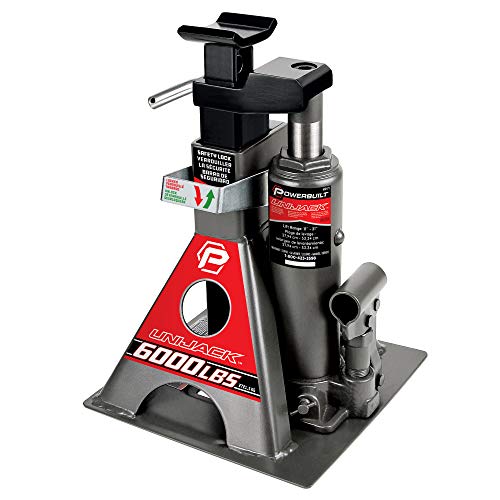
Powerbuilt 3-Ton Unijack All-in-One Hydraulic
The Powerbuilt 620471 Unijack integrates a hydraulic bottle jack and a mechanical ratcheting jack stand into a single unit, eliminating the danger of hydraulic pressure bleed-off. With a 6,000-pound capacity, an 11 to 21-inch lift range, and a wide steel base, it provides dependable single-point lifting and static holding for trucks and SUVs.
Pros
- Combines hydraulic bottle jack lifting and mechanical jack stand safety into one single-point tool
- Physical ratcheting safety lock prevents accidental vehicle drops caused by hydraulic pressure bleed-off
- Wide 9.88 x 9.75-inch base provides excellent stability on garage concrete and level paved surfaces
- Tall 21-inch maximum extension delivers ample working clearance for high-clearance trucks and SUVs
- Meets ANSI standards for portable automotive service equipment and includes a 1-year factory warranty
Cons
- Minimum collapsed height of 11 inches makes it unusable on low-clearance sedans and sports cars
- At 22.66 pounds per single unit, it is significantly heavier than standard individual mechanical jack stands
- Sold as an individual unit rather than a pair, requiring separate purchases if supporting an entire axle
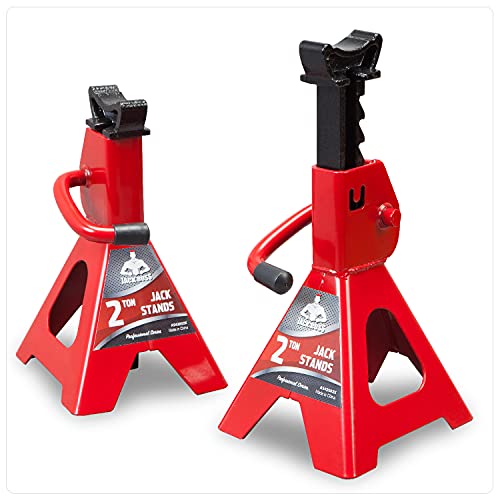
Jack Boss 2-Ton Low-Profile Ratchet Jack Stands
Designed for compact cars and small unibody vehicles, these Jack Boss low-profile jack stands combine a welded mild steel pyramid base with a ductile iron sawtooth ratchet bar spanning a 9.8-inch to 15-inch height range. They provide a lightweight, compact footprint for DIY garage maintenance, though the manufacturer explicitly advises against using them on trucks, large SUVs, or vehicles requiring over 15 inches of chassis clearance.
Pros
- Low 9.8-inch collapsed height fits easily under small passenger cars and lower unibody lift points
- Ductile iron sawtooth ratchet bar allows fast, tool-free height selection and positive pawl engagement
- Lightweight 10.5-pound overall build makes carrying, positioning, and garage storage simple
- Fully welded mild steel frame with protective powder coating guards against rust and shop grime
Cons
- Maximum 15-inch reach is too short for pickup trucks, full-size SUVs, or lifted off-road vehicles
- Single-pawl ratchet design lacks a secondary captive locking pin or redundant safety stop
- Steel concave saddle does not include rubber protection, which may mar painted unibody pinch welds without an aftermarket pad
ANTPOWER 3-Ton Double-Locking Jack Stands
The ANTPOWER 3-ton double-locking jack stands provide reliable static support for garage maintenance, pairing a ductile iron sawtooth ratchet column with a secondary steel side-locking pin. With an 11.2 to 16.8-inch height range and a fully welded pyramid steel base, they offer solid safety for compact cars, sedans, and light crossovers.
Pros
- Secondary side-pin lock adds physical redundancy alongside the primary ratchet pawl
- High-strength ductile iron ratchet bar provides positive sawtooth height adjustments
- Fully welded mild steel pyramid base delivers stable static support on level concrete slabs
- Protective powder-coated finish helps resist common garage moisture and chemical rust
- Manageable 14.3-pound total weight makes repositioning easy during four-corner vehicle setups
Cons
- Maximum 16.8-inch reach is insufficient for lifted 4x4s, full-size trucks, or vehicles with frame heights over 16 inches
- Bare steel saddle lacks a rubber pad, which may mar painted unibody pinch welds without an aftermarket adapter
- Conflicting product listing text notes both 6,000 lbs per pair and 6,600 lbs per stand, requiring conservative 3-ton pair load planning
JKWQFBOYAN 3-Ton Double-Locking Jack Stands
These JKWQFBOYAN 3-ton ratchet jack stands feature a dual-locking setup with a cast iron ratchet bar and secondary metal safety pin supported by a wide carbon steel pyramid base. Designed for DIY maintenance on passenger cars, small trucks, and SUVs, they offer an accessible static support option for budget-conscious home mechanics.
Pros
- Double-locking design combines a ratchet handle mechanism with a metal safety pin for secondary security
- Wide pyramid base features triangular foot pads to distribute static chassis weight across level concrete
- Notched saddle profile helps locate vehicle edges and factory lift points
- Relatively lightweight at under 11 pounds for easy garage positioning and compact shelf storage
Cons
- Minimum collapsed and maximum extended height dimensions are not explicitly specified in the manufacturer data
- Listing notes CE conformity rather than the ASME PASE certification standards typical for U.S. commercial shops
- Notched metal saddle lacks rubber pads, which may require aftermarket pinch-weld protectors to prevent underbody marring
Complete Operational Guide: How to Work a Jack Stand Safely
Operating stationary vehicle support equipment requires an exact sequence of mechanical checks, physical verifications, and structural alignments. Placing heavy steel or cast iron stands beneath a raised automobile is not simply a matter of sliding metal under the chassis. A safe setup balances chassis weight across rigid mechanical columns, isolating the vehicle from hydraulic pressure loss and dangerous lateral movement. Following a disciplined procedure ensures complete stability before any technician or home mechanic positions their body beneath the frame.
Understanding Rated Load Capacity and the Per-Pair Rule
Understanding how equipment manufacturers define load ratings is the initial step in safe vehicle support. Under portable automotive service equipment standards established by ANSI and ASME PASE, jack stand capacity is universally stated per pair rather than per individual unit. A pair rated at 3 tons, such as the Amazon Basics Steel Jack Auto Stands, provides a combined safe working load of 6,000 pounds when both stands share the load evenly. Attempting to support a 6,000-pound axle load on a single 3-ton stand creates an immediate mechanical overload hazard.
Calculating the necessary working margin begins by reviewing the gross vehicle weight rating on the driver door jamb placard. Most passenger sedans and compact crossovers carry roughly sixty percent of their curb weight over the front drive axle. Heavy front-engine trucks and sport utility vehicles concentrate even greater mass forward, requiring robust capacity buffers. Selecting support rated well beyond the target axle weight prevents structural distortion, base weld fatigue, and casting failure under sustained working loads.
Inspecting Ground Conditions and Substrate Integrity
A jack stand is only as secure as the ground surface supporting its base geometry. Poured residential concrete slabs offer the compressive strength required to handle localized point loads without shifting. Stamped steel pyramid legs concentrate several thousand pounds of vehicle weight onto small metal contact points. Working on soft asphalt driveways, dirt, crushed gravel, or unreinforced pavers introduces significant risk of base penetration and catastrophic vehicle tipping.
Sunlight and ambient summer heat soften asphalt binders, allowing narrow stand legs to punch directly through the blacktop surface under concentrated vehicle weight. While high-capacity commercial setups and dedicated car lift systems rely on anchored foundation pads, portable stands require flat, cured concrete surfaces. If an emergency repair forces temporary work on asphalt, operators must place thick, heavy-gauge steel distribution plates under each stand base to distribute ground pressure across a wide footprint. Never rely on plywood scraps, particle board, or brittle masonry pavers, which crack easily under shear stress.
Pre-Lift Chassis Preparation and Wheel Chocking
Stabilizing the vehicle begins before the hydraulic floor jack ever touches a lifting point. Park the automobile on flat, level ground, shut off the ignition, and engage the mechanical emergency brake firmly. Automatic transmissions must rest securely in park, while manual transmissions should remain locked in first gear or reverse. These mechanical driveline engagements lock the drive wheels and prevent unintended rolling as the chassis tilts upward during lifting.
Mechanical chocks must lock the wheels remaining in contact with the ground on both sides of the tire tread. When lifting the front axle, place heavy rubber or stamped steel chocks behind and in front of both rear tires. Conversely, chock the front tires whenever raising the rear suspension, especially since front wheels lack parking brake clamping mechanisms on most production vehicles. Solid chocking arrests rotational travel and prevents the vehicle from walking off stationary stands as height changes.
Locating Approved Structural Support Points
Placing a support saddle against unapproved sheet metal can crush floor pans, rupture fuel lines, or bend fragile suspension components. Vehicle manufacturers designate reinforced lifting points engineered to handle structural vehicle loads without buckling. On unibody automobiles, these contact zones usually consist of reinforced pinch-weld seams situated directly behind the front wheel arches and ahead of the rear wheels. Consult the factory owner manual to identify the exact factory notch locations along the rocker pinch seam.
Body-on-frame trucks and full-size sport utility vehicles provide sturdy boxed frame rails that accept broader saddle cradles. For rear axle work on solid-axle vehicles, placing a contoured V-notch saddle directly under the heavy steel axle tube provides exceptional stability. Compact models like the Jack Boss Jack Stands Low Profile 2 Ton(4000 LBs) feature concave saddles designed to cup structural suspension members on smaller vehicles. Always position the saddle dead center under the designated hard point to avoid off-center loading and lateral slippage.
Step-by-Step Raising and Saddle Positioning
Begin the lifting procedure by rolling a rated hydraulic floor jack beneath a factory-approved central jacking point. Central crossmembers, rear differential housings on solid axles, or front subframe pads allow operators to raise both sides of an axle simultaneously. Pump the hydraulic jack handle smoothly until the tires clear the pavement with adequate clearance for your planned service. Keep a close watch on the floor jack body, ensuring its cast steel wheels roll slightly forward to track the vehicle lifting arc naturally.
Slide the support stands beneath the reinforced chassis points once the vehicle reaches target working height. Align the center cradle of each saddle directly beneath the factory contact point, keeping the stand base perfectly square with the chassis. Avoid angling the pyramid legs or cocking the center post, which creates uneven ground pressure and induces bending moments in the vertical column. Both stands along an axle should sit at matching height notches to ensure the vehicle remains perfectly level across its track width.
Engaging Ratchet Pawls and Secondary Safety Pins
Adjusting vertical height depends on the specific mechanical locking design of your vehicle support stands. On ratchet-bar models, pull the ductile iron center post upward until the saddle touches the chassis contact surface. The weighted ratchet pawl drops into the precision teeth along the sawtooth column, emitting a distinct mechanical click at every notch. Ensure the pawl tooth seats completely into the base of the tooth pocket rather than resting precariously on an outer tooth edge.
Enhanced safety models, such as the ANTPOWER Car Jack Stands 3 Ton (6,600 lbs) and Car Jack Stands, Jack Stands 3Ton (6000lb), incorporate a dual-locking architecture with an independent safety pin. Once the primary ductile iron ratchet locks into position, insert the heavy-gauge steel pin fully through the collar and ratchet bar. Secure the retaining cotter or locking clip to prevent the pin from vibrating loose during heavy mechanical repairs. This redundant pin acts as an absolute mechanical stop, preventing column collapse even if the ratchet pawl mechanism experiences unexpected release forces.
Gradual Weight Transfer and Hydraulic Offloading
Lowering vehicle mass onto stationary supports is a critical transition that requires smooth, deliberate control. Slowly turn the release valve on your hydraulic floor jack counterclockwise by fractions of an inch. Never spin the valve open rapidly, which drops the suspension abruptly and shocks the stand columns with dynamic impact loads. Allow the chassis to ease gently into the contoured saddles, watching both contact points to confirm that the vehicle settles square and flat.
Continue opening the hydraulic release valve until the jack saddle fully separates from the vehicle chassis by a fraction of an inch. Jack stands are engineered to support static loads independently, and leaving hydraulic pressure engaged creates an unstable dual-pivot system. Close the hydraulic jack release valve and leave the jack sitting lightly below the crossmember as an unloaded secondary safety barrier. All vehicle weight must transfer completely onto the mechanical stands before proceeding to workspace entry.
Performing the Mandatory Lateral Push Test
Never crawl beneath an automobile immediately after lowering the hydraulic jack. Verifying chassis stability through a deliberate, aggressive physical push test is a non-negotiable garage safety protocol. Stand firmly beside the vehicle, place both hands against a sturdy structural body panel like a fender or bumper, and shake the vehicle vigorously from side to side. The entire assembly should feel solid, rigid, and immovable, showing zero independent rocking between the stands and the concrete floor.
Observe all four feet of each stand base while applying lateral force. If any leg lifts off the ground, or if the saddle shifts along the pinch weld seam, the setup is compromised. Should you detect any rocking, immediately raise the hydraulic jack, inspect the ground surface for debris, realign the stand saddles, and repeat the lowering process. Taking thirty seconds to confirm absolute stability eliminates catastrophic shifting before you expose your limbs or torso to underbody working areas.
Operating Hybrid and Threaded Support Hardware
Specialized vehicle maintenance often benefits from alternative mechanical lifting and holding designs. The all-in-one Powerbuilt 3 Ton, Bottle Jack and Jack Stands combines a hydraulic bottle jack with an integrated ratcheting safety bar inside a single wide-base unit. This hybrid configuration allows operators to lift and mechanically lock the chassis at a single structural point, eliminating the complex handoff between a floor jack and a secondary stand. Its broad base footprint also reduces ground sinkage risks when leveling vehicles or working on diverse surfaces.
For elevated driveline maintenance where vehicles rest on overhead shop lifts, underhoist support equipment provides auxiliary stability. Units like the VEVOR Underhoist Support Stand 3/4 Ton Capacity feature a threaded screw rod, spin handle, and thrust bearing for fine height adjustments between 52.8 and 76.0 inches. These screw-style stands support individual heavy subassemblies like transmissions, catalytic converters, and transfer cases rather than holding entire vehicles. The self-locking Acme screw threads prevent creeping under static pressure, allowing technicians to stabilize heavy components during suspension drops.
Critical Safety Prohibitions and Maintenance Rules
Maintaining absolute safety under a vehicle requires strict adherence to operational boundaries. Never stack dimensional lumber, cinder blocks, hollow bricks, or unrated metal spacers beneath a stand base to gain working height. Wood can split along its grain without warning under concentrated point loads, while brittle masonry blocks crumble instantly under heavy compressive weight. If your vehicle suspension requires taller clearance, invest in dedicated high-lift truck stands engineered with wide pyramid footprints and certified vertical extension tubes.
Routine inspection of your support equipment guarantees long-term mechanical reliability. Regularly inspect the base perimeter welds for hairline cracks, flaking paint, or metal deformation that indicates past overloading. Check the ductile iron ratchet teeth and pawl edges for metal rounding, burrs, or chipped engagement corners. Wipe away grease, road grit, and metal shavings from the column channels to keep the locking pawl counterweight swinging freely. If a stand shows bent legs, cracked castings, or damaged locking pins, retire and replace it immediately.
Mastering proper vehicle support procedures ensures that every garage maintenance task concludes safely and predictably. Pairing ANSI and ASME PASE certified stands with careful wheel chocking, structural hard-point alignment, and deliberate lateral shake testing creates a dependable working environment beneath your vehicle. Taking the time to execute each mechanical step methodically transforms demanding DIY repairs into safe, professional garage achievements.
About the author
Mike Bumbeck is an automotive journalist and hands-on product evaluator with a long-standing interest in classic vehicles, motorcycles, and practical garage equipment. His work brings a grounded perspective to automotive tools, maintenance products, and the details that matter when choosing gear for real-world use.