
What Are Jack Stands Used For: Safe Setup and Garage Guide for 2026
Understand what are jack stands used for to safely support vehicle weight during garage maintenance in November 2026. Learn proper placement, ratings, and safe setup.
 By Peter Nelson
Updated October 10, 2026


Crawling underneath a raised chassis requires an unwavering mechanical barrier between several thousand pounds of automotive metal and the garage floor. While a hydraulic floor jack lifts an axle or subframe into position, relying on pressurized hydraulic fluid to suspend that load creates a severe safety hazard because internal seals can weep or suffer sudden pressure loss. Understanding exactly what are jack stands used for clarifies why dedicated mechanical supports are essential for every DIY oil change, brake job, and exhaust repair. These rigid steel or aluminum units take over the vehicle load entirely, providing an unyielding foundation that keeps the chassis immobile while you apply high torque to stubborn suspension bolts.
Standard safety practices dictate that hydraulic jacks are strictly lifting mechanisms, whereas jack stands are purpose-built holding devices engineered to sustain rated weight for hours or days. Home mechanics weighing residential garage setups often compare mobile supports against garage ceiling height planning for vehicle lifts when organizing their workspace. Incorporating certified stands with compliant load ratings per pair, solid base geometry, and positive mechanical locking pins ensures that routine maintenance never compromises personal safety.
| Award | Product | BJL Score About BJL ScoreThe BJL Score is our own rating from 0 to 10, based on performance, design and build, ease of use, and value. It reflects independent research and is never influenced by manufacturers, retailers, or affiliate commissions. Learn more › | |
|---|---|---|---|
| Best Overall |
YELLOW JACKET 3 Ton Double-Locking Steel Jack
|
9.2/10 | Buy |
| Best Value |
 Amazon Basics 3-Ton Steel Jack Stands |
8.9/10 | Buy |
| Best Premium |
 Powerbuilt 3-Ton Unijack All-in-One Hydraulic |
8.9/10 | Buy |
| Best Budget |
 Jack Boss 2-Ton Low-Profile Ratchet Jack Stands |
8.6/10 | Buy |
 JKWQFBOYAN 3-Ton Double-Locking Jack Stands |
7.8/10 | Buy |
YELLOW JACKET 3 Ton Double-Locking Steel Jack
The YELLOW JACKET 3-ton jack stand pair provides a 6,600-pound combined capacity with ductile iron ratchet columns and secondary metal locking pins for redundant garage safety. Featuring a welded stamped steel pyramid base and a 10-7/8-inch to 16-9/16-inch height range, they offer reliable static support for compact cars, crossovers, and midsize SUVs during routine maintenance.
Pros
- Double-locking system pairs a ductile iron ratchet bar with an independent metal safety pin for added physical redundancy
- Solid one-piece forged ductile iron center column provides reliable static tooth engagement across multiple height settings
- Welded stamped steel pyramid base features wide foot pads to support vehicle stability on flat concrete shop floors
- Practical height span of 10-7/8 inches to 16-9/16 inches covers common passenger vehicle maintenance tasks like brake jobs and oil changes
Cons
- The 10-7/8-inch collapsed height may sit too high for significantly lowered sports cars or vehicles with low front splitters
- Bare metal saddle lacks rubber cushioning pads, which may mar painted subframes or bend unprotected pinch welds without aftermarket adapters
- Maximum height reach of 16-9/16 inches is limited for lifted 4x4 trucks or high-clearance off-road vehicles requiring extended droop clearance
Amazon Basics 3-Ton Steel Jack Stands
The Amazon Basics 3-Ton Steel Jack Stand Pair delivers 6,000 pounds of reliable vehicle support certified to ASME PASE-2014 standards for portable automotive equipment. Featuring a self-locking ratchet bar and a compact steel footprint, this set is ideal for home garage DIYers servicing passenger cars and urban SUVs.
Pros
- Rated for 3 tons (6,000 lbs) per pair and meets ASME PASE-2014 portable automotive service standards
- Self-locking ratchet bar enables rapid, secure height adjustment without fiddling with separate pins
- Compact 7.5 x 7.0-inch footprint and 12.6-lb total weight make positioning and storage simple
- Protective rustproof coating over a durable steel frame helps resist corrosion from garage fluids
Cons
- 3-ton capacity is tailored for sedans and crossover SUVs, not full-size heavy-duty pickup trucks
- Ratchet assembly does not feature a secondary mechanical cross-locking pin for redundant backup
- Must be used exclusively on flat, solid concrete slabs to prevent uneven weight distribution or base sinking
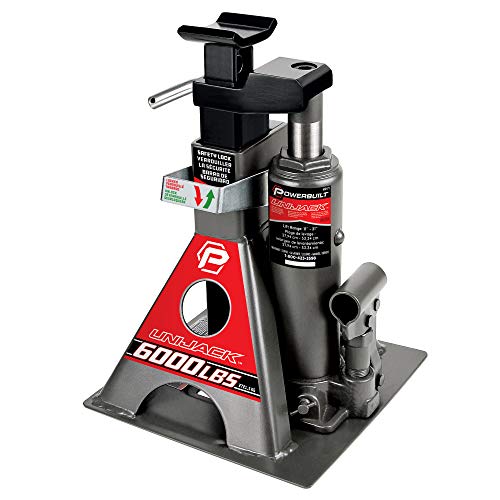
Powerbuilt 3-Ton Unijack All-in-One Hydraulic
The Powerbuilt 620471 Unijack integrates a hydraulic bottle jack and a mechanical ratcheting jack stand into a single unit, eliminating the danger of hydraulic pressure bleed-off. With a 6,000-pound capacity, an 11 to 21-inch lift range, and a wide steel base, it provides dependable single-point lifting and static holding for trucks and SUVs.
Pros
- Combines hydraulic bottle jack lifting and mechanical jack stand safety into one single-point tool
- Physical ratcheting safety lock prevents accidental vehicle drops caused by hydraulic pressure bleed-off
- Wide 9.88 x 9.75-inch base provides excellent stability on garage concrete and level paved surfaces
- Tall 21-inch maximum extension delivers ample working clearance for high-clearance trucks and SUVs
- Meets ANSI standards for portable automotive service equipment and includes a 1-year factory warranty
Cons
- Minimum collapsed height of 11 inches makes it unusable on low-clearance sedans and sports cars
- At 22.66 pounds per single unit, it is significantly heavier than standard individual mechanical jack stands
- Sold as an individual unit rather than a pair, requiring separate purchases if supporting an entire axle
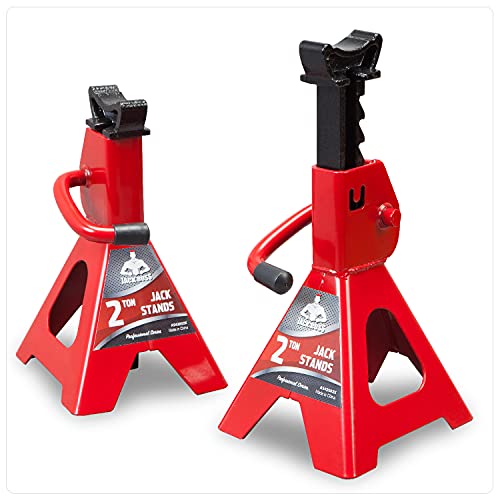
Jack Boss 2-Ton Low-Profile Ratchet Jack Stands
Designed for compact cars and small unibody vehicles, these Jack Boss low-profile jack stands combine a welded mild steel pyramid base with a ductile iron sawtooth ratchet bar spanning a 9.8-inch to 15-inch height range. They provide a lightweight, compact footprint for DIY garage maintenance, though the manufacturer explicitly advises against using them on trucks, large SUVs, or vehicles requiring over 15 inches of chassis clearance.
Pros
- Low 9.8-inch collapsed height fits easily under small passenger cars and lower unibody lift points
- Ductile iron sawtooth ratchet bar allows fast, tool-free height selection and positive pawl engagement
- Lightweight 10.5-pound overall build makes carrying, positioning, and garage storage simple
- Fully welded mild steel frame with protective powder coating guards against rust and shop grime
Cons
- Maximum 15-inch reach is too short for pickup trucks, full-size SUVs, or lifted off-road vehicles
- Single-pawl ratchet design lacks a secondary captive locking pin or redundant safety stop
- Steel concave saddle does not include rubber protection, which may mar painted unibody pinch welds without an aftermarket pad
JKWQFBOYAN 3-Ton Double-Locking Jack Stands
These JKWQFBOYAN 3-ton ratchet jack stands feature a dual-locking setup with a cast iron ratchet bar and secondary metal safety pin supported by a wide carbon steel pyramid base. Designed for DIY maintenance on passenger cars, small trucks, and SUVs, they offer an accessible static support option for budget-conscious home mechanics.
Pros
- Double-locking design combines a ratchet handle mechanism with a metal safety pin for secondary security
- Wide pyramid base features triangular foot pads to distribute static chassis weight across level concrete
- Notched saddle profile helps locate vehicle edges and factory lift points
- Relatively lightweight at under 11 pounds for easy garage positioning and compact shelf storage
Cons
- Minimum collapsed and maximum extended height dimensions are not explicitly specified in the manufacturer data
- Listing notes CE conformity rather than the ASME PASE certification standards typical for U.S. commercial shops
- Notched metal saddle lacks rubber pads, which may require aftermarket pinch-weld protectors to prevent underbody marring
The Engineering and Practical Applications of Vehicle Support Stands
Vehicle support equipment exists to transform an elevated, potentially unstable automotive mass into a rigid, motionless working platform. While an automobile is mobile on its suspension, elevating it removes the dampening engineered into the chassis, concentrating thousands of pounds onto narrow mechanical contact points. Understanding what are jack stands used for requires looking at both physical vehicle maintenance requirements and the operational limits of hydraulic equipment. Every maintenance procedure performed beneath a vehicle chassis depends completely on the structural integrity of dedicated support stands.
Static Mechanical Support Versus Dynamic Hydraulic Lifting
Hydraulic floor jacks and bottle jacks are engineered strictly for lifting, meaning their operational role is dynamic movement rather than prolonged static holding. Inside any hydraulic jack, pressurized hydraulic fluid acts against an internal cylinder to push the lifting arm upward. If an internal O-ring seal degrades, a release valve weeps, or a hydraulic line suffers minor pressure loss, the lifting arm will gradually descend without warning. This gradual descent creates an immediate crush hazard for anyone positioned beneath the chassis, making sole reliance on hydraulic pressure unsafe.
Mechanical stands eliminate this vulnerability by replacing pressurized fluid with solid structural steel or cast ductile iron. Once the vehicle reaches the desired service height, stands receive the load, transferring chassis weight directly down through wide pyramid legs into the shop floor. Stand designs such as the Amazon Basics Steel Jack Auto Stands incorporate self-locking ratchets that maintain mechanical support indefinitely without relying on hydraulic fluid integrity. Specialized hybrid tools like the Powerbuilt 3 Ton, Bottle Jack and Jack Stands unijack combine hydraulic lifting with an integrated ratcheting safety bar, offering both lifting action and positive mechanical holding in one compact footprint.
Critical Vehicle Contact Points: Pinch Welds, Frame Rails, and Axles
Automobile chassis construction dictates exactly where support stands can be positioned safely. Modern unibody passenger cars lack traditional perimeter frame rails, relying instead on reinforced sheet-metal seams known as pinch welds along the rocker panels. Placing a bare, curved steel saddle directly against a thin unibody pinch weld can bend or crush the seam, cracking factory undercoating and initiating premature rust. Using stands with appropriate saddle geometry or dedicated slotted rubber adapters helps distribute load across the reinforced lift notch without damaging the delicate rocker seams.
Body-on-frame trucks and solid-axle off-road rigs present entirely different interface requirements for garage equipment. These heavy vehicles feature thick, boxed steel frame rails or round axle tubes that can support substantial concentrated weight without deforming. A broad, concave saddle such as the one found on the Jack Boss Jack Stands Low Profile 2 Ton(4000 LBs) cradles the frame rail, preventing the chassis from shifting laterally during service. Home mechanics evaluating garage equipment against freestanding automotive lift alternatives must recognize that whether using portable stands or full-bay systems, proper contact point alignment remains essential.
Locking Mechanism Architectures: Ratchet Bars, Through-Pins, and Redundancies
The internal mechanism that secures a stand at its selected height is a primary factor in overall equipment reliability. Traditional ratchet-bar stands utilize a central column forged from ductile cast iron featuring angled sawtooth notches along one edge. A counterweighted pawl inside the base collar pivots into these teeth as the bar rises, automatically dropping into the root of each notch to prevent downward movement. The Amazon Basics Steel Jack Auto Stands utilize this self-locking ratchet configuration, which complies with ASME PASE-2014 standards to provide rapid height adjustment with dependable mechanical engagement.
To provide extra security against accidental handle release or pawl disengagement, modern manufacturers often implement dual-redundancy systems. The YELLOW JACKET Car Jack Stands 3 Ton with Double feature a secondary metal safety pin that inserts directly through the collar and ratchet column. This physical cross-pin acts as a mechanical deadbolt, preventing the ductile iron bar from dropping even if the primary release handle is inadvertently bumped. Similar dual security designs appear on the Car Jack Stands, Jack Stands 3Ton (6000lb), combining handle-locking ratchet bars with wear-resistant safety pins to reinforce workshop peace of mind.
Decoding Load Ratings: ANSI/ASME PASE Standards and Per-Pair Capacities
Understanding weight capacity terminology is critical for avoiding dangerous vehicle overloading. Under current ANSI/ASME PASE (Portable Automotive Service Equipment) standards, jack stand capacities are explicitly rated per pair rather than per individual unit. A package labeled as a 3-ton capacity stand pair is certified to support a combined total of 6,000 pounds when both stands are deployed together under a single axle. Assuming that each individual stand holds 3 tons is a dangerous misinterpretation that can cut intended safety margins in half.
Calculating the required stand capacity begins with checking the vehicle Gross Vehicle Weight Rating (GVWR) on the driver door jamb placard. Even though a pair of stands typically supports only one end of a vehicle at a time, weight distribution is rarely an even fifty-fifty split across axles. Front-engine passenger cars and heavy diesel pickup trucks carry a significant majority of their overall mass over the front axle. Matching the equipment load limit to the specific vehicle weight envelope prevents structural fatigue in the base weldments, ensuring that rated capacities comfortably exceed actual working loads.
Height Envelopes: Minimum Collapsed Entry to High-Lift Reach
A stand must fit physically beneath the vehicle before it can support any weight, making minimum collapsed height a critical dimensional specification. Lowered sports cars, performance coupes, and vehicles with aggressive aerodynamic body kits have minimal ground clearance. If a stand has a tall collapsed collar, it cannot slide beneath the factory lift points even after a low-profile hydraulic jack has raised the chassis. The Jack Boss 2 Ton stands address this challenge with a minimum collapsed height of 9.8 inches, allowing easy positioning beneath low-clearance rocker panels.
At the opposite end of the spectrum, high-clearance four-wheel-drive trucks, lifted SUVs, and off-road rigs require substantial maximum extension reach. When lifting a truck with large off-road tires, the long-travel suspension droops several inches before the tires break contact with the floor. The Powerbuilt 3 Ton Unijack features an extended lift range reaching from 11 inches up to 21 inches, providing sufficient vertical travel to secure elevated truck frames. Midsize crossovers operate effectively within intermediate ranges, such as the YELLOW JACKET 3 Ton stands with their 10-7/8 inch to 16-9/16 inch stroke, ensuring appropriate working clearance.
Ground Surface Mechanics: Concrete Integrity and Asphalt Sinkage Risks
The ground surface beneath vehicle supports dictates whether the setup remains completely stable or suffers catastrophic tilt. Jack stands must always be positioned on flat, level, high-strength poured concrete slabs. When thousands of pounds rest on four narrow steel legs, the resulting pressure per square inch is immense. Smooth, cured concrete resists this compressive load without deflecting, keeping the center column perfectly plumb throughout the repair process.
Asphalt driveways present a severe hazard that many DIY vehicle owners overlook during warm summer months. Asphalt softens considerably under solar heating, allowing narrow stamped steel legs to bite directly into the pavement and sink unevenly under load. Once one stand sinks even a fraction of an inch, the entire chassis tilts, shifting weight laterally and creating an imminent tipping hazard. Upgraded models counter this risk with wide pyramid foot bases equipped with welded triangular perimeter foot pads, as seen on the Car Jack Stands, Jack Stands 3Ton (6000lb), which disperse surface pressure over a larger footprint.
Safe Weight Transfer and the Non-Negotiable Push Test
Safely transferring vehicle weight onto support stands requires a methodical mechanical procedure. The process begins on level ground by engaging the parking brake and placing heavy-duty rubber wheel chocks on both sides of the tires remaining on the surface. After raising the vehicle with an approved hydraulic floor jack, position the stands beneath the factory support points and slowly lower the jack. The descent should be smooth and gradual, allowing the vehicle contact points to settle dead center into the saddle notches while verifying positive ratchet tooth engagement.
Once all vehicle weight rests entirely on the mechanical stands, drop the hydraulic jack saddle just slightly below the lift point as an unloaded secondary safety backup. Before crawling underneath, always perform a vigorous physical push test by grasping the bumper or fender and shaking the vehicle firmly in multiple directions. If the stands are positioned properly on level concrete, the entire assembly should feel completely solid, showing zero rocking or foot lift. Mechanics evaluating garage equipment against permanent shop lift systems recognize that this physical stability verification remains non-negotiable across every manual lifting procedure.
Structural Inspection and Retirement Criteria for Garage Equipment
Like any critical vehicle service tool, support stands require periodic visual inspection to ensure mechanical integrity over years of garage ownership. Welded steel joints around the base pyramid, collar sleeve, and foot pads should be examined regularly for signs of stress cracks, rust pitting, or weld porosity. Stamped steel frames coated with durable powder coat resist corrosion effectively, but chipped paint can expose bare metal to moisture over time. Any visible hairline fracture along a structural weld seam warrants immediate equipment retirement.
The central moving components require equally thorough examination before each service session. On ratchet-bar stands, inspect the cast ductile iron teeth along the column to confirm that the edges remain sharp and square. If the teeth show rounding, chipping, or excessive wear from repeated use, the locking pawl may fail to seat deeply into the tooth root, creating slippage hazards. Check the release handle pivot and counterweight spring to ensure the pawl snaps smoothly into each notch without binding on dirt or garage debris.
Selecting Support Equipment for Specific Maintenance Demands
Matching stand specifications to your vehicle fleet and maintenance routine ensures safe, efficient wrenching for years to come. Home mechanics servicing compact commuter cars benefit from low-profile, welded steel options like the Jack Boss 2 Ton units, which slide effortlessly under low rockers while offering dependable sawtooth adjustments. Drivers maintaining midsize crossovers, SUVs, or light pickups find greater utility in 3-ton models like the YELLOW JACKET stands, which combine double-locking pin redundancy with extended height travel. Evaluating capacity per pair, collapsed height, and saddle geometry guarantees reliable performance across every maintenance milestone.
Investing in dependable, certified support hardware establishes a safe foundation for every underbody automotive project. Always confirm that stands carry explicit compliance markings such as ASME PASE-2014, inspect locking mechanisms before applying chassis load, and enforce the mandatory vehicle push test without exception. By treating vehicle support as a disciplined safety procedure rather than an afterthought, you ensure that every brake overhaul, oil change, and exhaust repair is completed with total peace of mind.
About the author
Peter Nelson is an automotive writer whose published work includes off-road jacks, power tools, vehicle maintenance, and garage equipment. His coverage connects product features with practical applications, helping readers think through equipment choices for everyday repairs, project vehicles, and off-road situations.