
What Size Floor Jack for Ram 2500: Practical Sizing Guide for 2026
What Size Floor Jack For Ram 2500 requires balancing truck axle weight and suspension travel. Learn capacity and lift height requirements for November 2026.
 By Mike Bumbeck
Updated October 13, 2026


Heavy-duty three-quarter-ton pickups demand substantial lifting power, uncompromising hydraulic stability, and extended vertical reach during garage maintenance. Working beneath a vehicle with a curb weight between 6,500 and 8,000 pounds requires knowing exactly what size floor jack for ram 2500 applications demand. Heavy front-end weight biases, particularly on models equipped with the Cummins turbo-diesel engine, place significant dynamic loads on any garage lifting equipment. Choosing the wrong working load limit risks hydraulic cylinder failure, frame bending, or dangerous vehicle slippage on the shop floor.
A standard passenger car jack cannot handle the physical mass or high frame clearance of these trucks. Most mechanics look for at least a three-ton hydraulic service jack, while many heavy-duty truck owners prefer a four-ton unit to ensure an adequate safety buffer. In addition to raw tonnage ratings, vertical stroke height is equally vital to overcome suspension droop before the tires leave the concrete. When evaluating garage equipment, comparing car ramps with jack stands highlights why stable mechanical support is mandatory alongside any hydraulic lifting setup.
| Award | Product | BJL Score About BJL ScoreThe BJL Score is our own rating from 0 to 10, based on performance, design and build, ease of use, and value. It reflects independent research and is never influenced by manufacturers, retailers, or affiliate commissions. Learn more › | |
|---|---|---|---|
| Best Overall |
SKYFISH 2-Ton All-in-One Screw Jack
|
9.1/10 | Buy |
| Best Value |
 SATA 3-Ton Heavy-Duty Steel Floor Jack |
8.9/10 | Buy |
| Best Budget |
 DNA Motoring TOOLS-00234 2-Ton Hydraulic Trolley |
8.8/10 | Buy |
| Best Premium |
 Jack Boss 3-Ton Low Profile Floor Jack |
8.8/10 | Buy |
 AUTOWN 3-Ton Hydraulic Floor Jack |
8.6/10 | Buy | |
 BIG RED T83006 3-Ton Floor Jack |
8.3/10 | Buy | |
 AV Steel 4 Ton Heavy-Duty Hydraulic Floor Jack |
8.3/10 | Buy |
SKYFISH 2-Ton All-in-One Screw Jack
Combining a mechanical screw lift with an integrated locking stand, this 4,000-pound unit delivers leak-free vehicle lifting without requiring separate jack stands. Its broad base and collapsible handle make it a reliable roadside tool for trucks and SUVs on uneven terrain.
Pros
- Built-in lock eliminates the need for separate jack stands
- Mechanical screw drive avoids hydraulic fluid leak risks
- Wide base prevents tipping on soft or off-road ground
- Modular handle breaks down for easy trunk storage
Cons
- High minimum height of 8.16 inches excludes low-clearance cars
- Manual screw drive requires more physical effort than hydraulics
- Two-ton limit is insufficient for fully loaded heavy-duty trucks
SATA 3-Ton Heavy-Duty Steel Floor Jack
This SATA 3-ton heavy-duty steel floor jack combines a low-clearance chassis with a dual-piston rapid lift pump and an extended 19-1/8-inch maximum lift height. Factory reviewed to 1.5 times its rated 6,600-pound capacity, it provides dependable lifting muscle for home garage mechanics servicing passenger sedans, crossovers, and light pickups.
Pros
- Generous 3-ton (6,600 lb) rated capacity with factory proof evaluation to 1.5 times maximum load for enhanced structural confidence.
- Dual-piston rapid lift mechanism cuts unladen pump strokes to bring the saddle to vehicle contact points rapidly.
- Wide 3-3/4-inch to 19-1/8-inch elevation range accommodates low passenger cars as well as standard crossovers and light trucks.
- Rugged industrial-grade steel chassis offers dependable torsional rigidity and resistance to frame deformation.
- Precision slow-release descent valving helps prevent abrupt drops when settling the vehicle onto mechanical stands.
Cons
- Substantial 70-pound dry chassis weight makes manual lifting into high truck beds or mobile transport physically demanding.
- Bare steel saddle does not include a pre-installed slotted rubber pinch weld pad, requiring aftermarket protection for delicate unibody seams.
- Extended 28.3-inch steel chassis requires adequate clearance behind the vehicle to pump the handle comfortably in compact single-car bays.
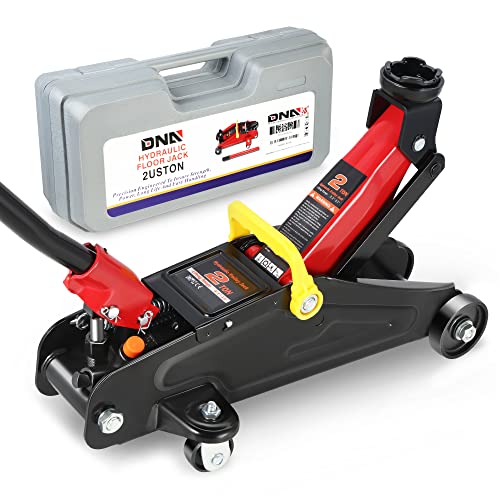
DNA Motoring TOOLS-00234 2-Ton Hydraulic Trolley
The DNA Motoring TOOLS-00234 is a compact 2-ton (4,000 lb) hydraulic trolley floor jack featuring a 5.1-inch to 13-inch lifting span and built-in overload protection. Engineered for DIY mechanics servicing passenger sedans and compact cars, it provides rapid vehicle lifting that must be supported with auxiliary mechanical jack stands.
Pros
- Manageable 4,000 lb capacity easily raises compact and mid-size passenger cars for wheel and brake service
- Built-in hydraulic overload valve prevents internal damage if overloaded beyond the rated capacity
- Rear swivel casters allow quick and precise positioning under factory lift points
- Compact frame footprint fits easily in residential garages with restricted floor space
Cons
- Maximum lift height is capped at 13 inches, limiting workspace depth for heavy underbody repairs
- Minimum 5.1-inch collapsed saddle height may not clear heavily lowered or track-tuned sports cars
- Not rated or recommended for full-size pickup trucks, commercial vans, or large three-row SUVs
Jack Boss 3-Ton Low Profile Floor Jack
Built with a hybrid aluminum and steel frame, this 3-ton floor jack pairs a low 3-15/16-inch minimum clearance with a dual-piston rapid pump. It serves as a versatile lifting solution for low-slung sedans as well as standard SUVs and minivans.
Pros
- Low-profile 3-15/16-inch minimum lifting clearance
- Fast elevation with dual-piston hydraulic pump
- Hybrid aluminum and steel frame construction
- Protective rubber saddle shields vehicle chassis
- Meets rigorous ANSI/ASME PASE safety standards
Cons
- At 58.5 pounds, it remains relatively heavy to transport
- 18-5/16-inch max height may be limiting for lifted trucks
AUTOWN 3-Ton Hydraulic Floor Jack
Built with heavy-gauge alloy steel, this 3-ton jack delivers a high 7.1 to 20.9-inch reach tailored for trucks and SUVs. Its rapid-lift hydraulic system and cross-grooved rubber pad provide stable, efficient lifting during maintenance.
Pros
- Substantial 6,600-pound capacity supports full-size vehicles
- Generous 20.9-inch maximum elevation height
- Fast elevation with minimal handle pumping
- Textured rubber saddle pad prevents frame slipping
- Removable handle allows compact garage storage
Cons
- High 7.1-inch minimum height does not fit low-clearance sedans
- Heavy alloy steel construction makes transport cumbersome
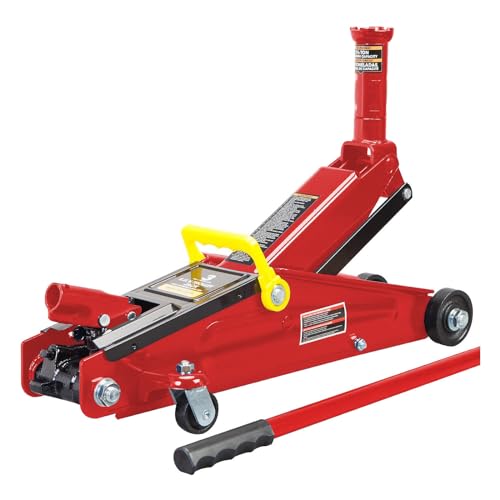
BIG RED T83006 3-Ton Floor Jack
Engineered for high-riding trucks and SUVs, the BIG RED T83006 delivers up to 20-7/8 inches of lift height with an extended saddle neck. Its 6,000-pound capacity and integrated overload bypass provide reliable lifting power for routine garage maintenance.
Pros
- Generous 20-7/8 inch maximum lift height
- Extended saddle neck reaches high truck frames quickly
- Built-in safety bypass valve prevents overloading
- Smooth 360-degree swivel casters ease garage positioning
Cons
- Minimum 5-7/8 inch height is tall for low-profile cars
- Single-piston pump requires more strokes than dual-piston models
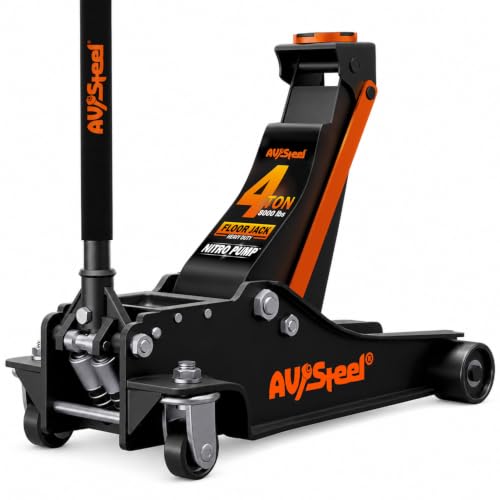
AV Steel 4 Ton Heavy-Duty Hydraulic Floor Jack
The AV Steel 4-ton hydraulic floor jack provides 8,000 lbs of lifting capacity and a 4-1/4-inch to 19-3/4-inch vertical range powered by a rapid dual-piston pump. Built with a rigid 87.3-pound all-steel chassis, it offers home garage mechanics and truck owners dependable lifting strength for standard passenger cars, crossovers, and half-ton pickups.
Pros
- Substantial 4-ton (8,000-lb) capacity easily handles heavy front and rear axle loads on half-ton pickups, large SUVs, and vans.
- Dual-piston rapid pump quickly raises the saddle to chassis contact points with minimal handle pumping strokes.
- Rigid 87.3-pound all-steel frame delivers superior stationary stability on home garage floors.
- Built-in overload protection valve guards the hydraulic cylinder against accidental over-capacity operation.
Cons
- Substantial 87.3-pound gross chassis weight makes vehicle trunk transport or mobile hauling physically demanding.
- Collapsed saddle height of 4-1/4 inches will not clear low-slung sports cars or lowered vehicles without drive-on ramps.
- Maximum lift height of 19-3/4 inches is not designed for lifted 4x4 trucks or long-travel off-road suspensions.
Understanding Floor Jack Sizing and Lift Dynamics for Heavy-Duty Ram Trucks
A Ram 2500 requires a floor jack with a minimum rated capacity of 3 tons (6,000 pounds), though a 3.5-ton or 4-ton (8,000-pound) hydraulic service jack provides a far safer operational margin for routine maintenance. In addition to weight capacity, the jack must deliver a maximum lift height of at least 20 to 22 inches to overcome substantial suspension droop and successfully lift heavy truck tires off the ground. Selecting a jack based solely on tonnage without verifying vertical stroke height often leaves heavy-duty truck owners unable to complete basic tire rotations or brake repairs.
Ram 2500 Curb Weight Dynamics and Axle Load Calculations
Curb weight across the Ram 2500 platform varies widely depending on cab style, bed length, drivetrain, and engine selection. A crew-cab model with a gas engine typically weighs around 6,800 to 7,200 pounds, while a diesel-powered configuration easily pushes curb weight past 7,800 or 8,200 pounds. When lifting a vehicle with a hydraulic trolley jack, you never lift the entire truck all at once. Raising an individual axle or single corner supports approximately 50 to 60 percent of the total vehicle mass at any given moment.
On a Cummins diesel model, that front axle load can easily reach 4,500 to 5,000 pounds due to the heavy cast-iron engine block and heavy-duty front suspension components. Placing a two-ton jack under that front corner subjects the hydraulic circuit to immediate over-pressurization near or beyond its working load limit. Operating near the absolute ceiling of a tool creates severe safety hazards, accelerates seal degradation, and increases the risk of sudden valve bypass. Sizing up to a three-ton or four-ton service jack ensures the lifting mechanism operates comfortably within its engineered safety envelope.
Why Compact Two-Ton Floor Jacks Present Severe Operational Hazards
Lightweight utility jacks rated for two tons (4,000 pounds) remain popular for compact passenger cars, but they pose significant hazards on heavy-duty pickups. Manufacturers of standard two-ton trolley jacks, including DNA Motoring, explicitly state that their compact units are not recommended for pickup trucks or full-size SUVs. The primary limitation stems from structural frame rigidity, hydraulic cylinder bore diameter, and limited base plate dimensions. Attempting to lift the front end of a three-quarter-ton truck with a compact jack can twist the steel side plates or blow out internal hydraulic seals.
Even specialized mechanical screw jacks, such as the Skyfish two-ton unit with an integrated locking mechanism, face severe load constraints when applied to a Ram 2500. While mechanical locking collars eliminate hydraulic drift, a 4,000-pound capacity leaves virtually zero safety buffer when raising the diesel-weighted front end. Using equipment right at its structural threshold also requires tremendous manual effort on the crank handle or pump arm. Heavy truck maintenance demands dedicated service equipment built with wider chassis footprints and higher load ratings to maintain stable ground contact.
Lift Height Requirements: Overcoming Three-Quarter-Ton Suspension Travel
Tonnage capacity means very little if the hydraulic saddle cannot raise the truck high enough to clear the ground. Ram 2500 pickups feature long-travel solid front axles with tall coil springs and heavy rear leaf springs that exhibit substantial suspension droop. When lifting directly from the vehicle frame rails, the chassis must rise several inches before the suspension fully unloads and the tire begins to elevate. Standard automotive jacks with maximum heights between 13 and 18 inches frequently run out of hydraulic stroke while the tire remains firmly planted on the garage floor.
To overcome this droop, a floor jack intended for three-quarter-ton trucks requires an extended lift range reaching at least 20 to 22 inches. Models like the AUTOWN three-ton service jack feature an extended range from 7.1 to 20.9 inches, making them well suited for full-size pickups and utility vehicles. Similarly, the BIG RED three-ton hydraulic trolley jack incorporates an extra-long saddle neck to reach 20-7/8 inches of elevation without requiring unsafe wood blocks or makeshift spacers. That extra vertical travel allows the hydraulic ram to lift the chassis high enough for mechanical stands to lock securely into place.
Lift Point Geometry: Solid Axle Tubes Versus Boxed Frame Rails
Choosing the correct jacking location directly impacts how much vertical lift height you need and prevents expensive undercarriage damage. Lifting from the solid front axle tube or the rear axle housing requires less vertical stroke because the hydraulic ram raises the tires directly without waiting for suspension droop. However, positioning a metal saddle against a smooth, round axle tube introduces slipping risks if the saddle lacks an aggressive perimeter flange or textured pad. The cross-grooved rubber pad on the AUTOWN jack or the large cradled saddle on the BIG RED unit helps maintain secure contact with round axle housings.
Lifting from the heavy boxed frame rails provides an alternative method, particularly when servicing suspension components, but it demands significantly more hydraulic travel. Technicians must avoid placing the saddle beneath steering linkages, thin suspension control arms, or the stamped sheet metal lip of the differential cover. Reviewing safe vehicle elevation methods provides useful perspective on maintaining balanced load geometry during underbody work. Taking time to align the saddle squarely under reinforced factory frame sections prevents structural gouging and ensures vertical force vectors remain true throughout the lift.
Heavy-Duty Plate Steel Versus Aluminum Chassis Rigidity
Frame material selection creates a distinct balance between structural stiffness, garage floor stability, and physical portability. Heavy-duty three-quarter-ton trucks generate substantial lateral forces if a jack shifts slightly during elevation, making frame rigidity paramount. Full-size steel units, such as the AV Steel four-ton floor jack, weigh over 87 pounds and utilize thick structural plate steel side assemblies. This substantial weight creates an exceptionally rigid platform that resists frame flex, chassis twisting, and caster deflection when supporting heavy front-end truck assemblies.
Hybrid models constructed from aluminum and steel side plates, like the Jack Boss three-ton racing jack, offer greater maneuverability for technicians who must transport their tools between work sites. These hybrid frames combine lightweight aluminum side plates with welded steel lift arms to reduce overall tool weight while maintaining a 6,600-pound load rating. However, for a dedicated home shop or heavy-duty garage where a Ram 2500 is regularly serviced, a full-weight steel jack remains the preferred choice. The extra mass and wide stance of solid steel construction provide peace of mind and unwavering stability under massive static loads.
Dual-Piston Rapid Pump Systems Under Heavy Resistance
Raising several thousand pounds of truck suspension requires a hydraulic pump mechanism that minimizes physical operator strain. Single-piston hydraulic floor jacks draw fluid through a single displacement chamber, requiring dozens of full handle strokes to raise the lift arm to full height. In contrast, dual-piston rapid lift designs utilize two staggered pump pistons operating within a shared hydraulic block. Units from SATA, Jack Boss, and AV Steel feature dual-piston pumps that quickly raise the saddle to the vehicle chassis in just a few initial strokes.
Once the saddle contacts the truck frame or axle and hydraulic resistance builds, the dual-piston system balances fluid flow to maintain manageable handle effort. Pumping a single-piston jack under heavy front-axle load can fatigue the user and slow down routine maintenance tasks considerably. A dual-piston assembly reduces handle effort significantly, allowing the operator to focus on vehicle stability and alignment rather than struggling against hydraulic backpressure. For heavy vehicles like a three-quarter-ton pickup, a rapid-pump hydraulic system transforms an exhausting chore into a smooth, controlled lifting sequence.
Universal Joint Lowering Control and Load Descent Dynamics
Lowering a heavy-duty truck demands just as much mechanical precision as lifting it off the shop floor. Inexpensive trolley jacks often utilize simple pin-and-gear or direct-drive release mechanisms that can bind or release abruptly under high pressure. When supporting a 4,500-pound truck axle, a sudden quarter-turn of a sensitive release valve can cause the vehicle to drop violently onto its suspension. This abrupt impact can damage suspension bushings, destabilize adjacent equipment, or cause serious injury to anyone working nearby.
Professional-grade floor jacks feature a universal joint gear assembly connected directly to the handle shaft and hydraulic release valve. This universal joint design allows micro-metered rotational control regardless of handle angle, ensuring smooth, progressive fluid return to the reservoir. SATA and AV Steel incorporate precision slow-release bypass valves specifically engineered to prevent accidental drops under heavy loads. Maintaining total control over lowering speed ensures that the truck settles onto mechanical stands or the ground with absolute gentleness and stability.
Garage Staging and Jack Stand Transfer Protocols
A hydraulic floor jack is strictly an active lifting mechanism and must never be treated as a static load-holding device. Internal hydraulic pressure relies entirely on synthetic rubber O-rings and micro-machined check valves that can weep, bypass, or lose pressure unexpectedly over time. Working beneath any vehicle, especially an 8,000-pound pickup, supported only by a hydraulic jack presents an extreme, life-threatening hazard. Every vehicle lift must conclude with the immediate transfer of weight onto mechanical jack stands rated to handle the axle load.
Before pumping the jack, the technician must park the vehicle on a smooth, level concrete surface and engage the emergency brake. Chocking the wheels remaining in ground contact is essential to prevent horizontal rolling while the lifted axle is elevated. Reviewing recommendations on managing vehicle stability on inclines reinforces why lifting on uneven or sloped driveways is fundamentally dangerous. Once the jack raises the frame to the desired height, position heavy-duty jack stands under reinforced chassis points and slowly lower the jack until the mechanical stands carry the full load.
Hydraulic System Maintenance: Air Purging and Fluid Replenishment
Heavy lifting cycles subject hydraulic fluid and internal seals to elevated temperatures, mechanical stress, and gradual aeration. If a floor jack begins to feel spongy, fails to lift under heavy load, or stops short of its maximum height, trapped air is usually the culprit. Air enters the closed hydraulic circuit during transit, rough handling, or when operating the jack with low reservoir oil levels. Purging this trapped air restores firm hydraulic resistance and ensures the cylinder achieves full stroke extension under heavy truck loads.
Purging the system requires opening the release valve fully and pumping the handle rapidly through several dozen cycles while the saddle remains unloaded. If fluid replenishment is necessary, only dedicate anti-foaming ISO VG 22 or ISO VG 32 hydraulic jack oil should be added through the reservoir fill plug. Introducing automotive motor oil, brake fluid, or automatic transmission fluid will destroy internal nitrile rubber seals within weeks. Using proper hydraulic oil maintains correct viscosity, prevents internal corrosion, and ensures the relief valves function reliably when lifting heavy vehicles.
Final Sizing Verdict for Ram 2500 Maintenance
Choosing the right lifting tool for a Ram 2500 comes down to pairing adequate working load limit with sufficient vertical reach. A three-ton (6,000-pound) floor jack represents the absolute minimum safe baseline for lifting an individual corner or axle on these trucks. Stepping up to a heavy-duty four-ton (8,000-pound) steel service jack provides the ultimate peace of mind, especially for models carrying a heavy Cummins diesel engine. Verifying that the jack achieves a maximum lift height of at least 20 to 22 inches ensures you can overcome suspension droop without resorting to unsafe lifting blocks.
Pair that high-capacity jack with a wide steel chassis, dual-piston rapid lift hydraulics, and a smooth universal-joint release valve for effortless control. Never compromise on safety by omitting wheel chocks or working under a vehicle without secondary mechanical jack stands firmly locked in place. Investing in properly sized lifting equipment protects your vehicle, preserves your tools, and ensures every garage service project proceeds with total confidence and safety.
About the author
Mike Bumbeck is an automotive journalist and hands-on product evaluator with a long-standing interest in classic vehicles, motorcycles, and practical garage equipment. His work brings a grounded perspective to automotive tools, maintenance products, and the details that matter when choosing gear for real-world use.