
Why Does My Floor Jack S Short Handle Make Lowering Unsafe? Practical Guide for 2026
Learn why does my floor jack s short handle make lowering unsafe and how to control vehicle descent safely in this garage guide for November 2026.
 By Peter Nelson
Updated October 28, 2026


Hydraulic floor jacks rely on fluid displacement to lift thousands of pounds with modest physical effort, but controlling the descent of that massive weight requires exceptional precision. When a technician or weekend hobbyist asks why does my floor jack s short handle make lowering unsafe, the answer centers on mechanical leverage and hydraulic release valve control. A short operating lever drastically reduces rotational leverage, turning what should be a slow, metered release into an abrupt, unpredictable drop that threatens both the operator and the vehicle chassis.
Lowering an elevated vehicle onto dedicated mechanical jack stands requires micro-adjustments to prevent dangerous shock loads. Standard shop jacks utilize long, two-piece steel levers to provide wide rotational arcs, giving the user fine control over the internal hydraulic needle valve. Without that extended reach and mechanical advantage, overcoming the initial friction of a loaded release valve often results in over-rotation, causing rapid fluid bypass and sudden vehicle drops.
| Award | Product | BJL Score About BJL ScoreThe BJL Score is our own rating from 0 to 10, based on performance, design and build, ease of use, and value. It reflects independent research and is never influenced by manufacturers, retailers, or affiliate commissions. Learn more › | |
|---|---|---|---|
| Best Overall |
Jack Boss 2-Ton Hydraulic Floor Jack and Jack
|
9.2/10 | Buy |
| Best Value |
 Jack Boss 3 Ton Fast Lift Steel Hydraulic Floor |
9.1/10 | Buy |
| Best Premium |
 Jack Boss 3-Ton Low Profile Floor Jack |
8.8/10 | Buy |
 Jack Boss 3-Ton Low Profile Floor Jack |
8.8/10 | Buy | |
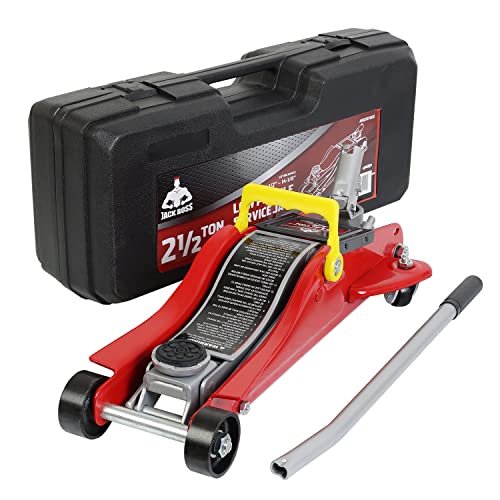 Jack Boss 2.5-Ton Low Profile Floor Jack |
8.6/10 | Buy | |
| Best Budget |
 Swellisher Steel Flooring Jack |
8.0/10 | Buy |
Jack Boss 2-Ton Hydraulic Floor Jack and Jack
This Jack Boss combo pairs a compact 2-ton trolley jack with two 2-ton mild steel jack stands designed for light passenger cars and compact unibody commuters. With a listed 4,000-lb single stand working load limit and welded steel construction, it offers an accessible lifting and static support setup for routine driveway maintenance.
Pros
- Convenient starter combo supplying both the hydraulic lifting tool and static vehicle support stands in one package
- Welded mild steel frame construction eliminates bolted joint movement under load
- Stated 4,000-lb capacity per individual stand accommodates common light passenger car curb weights
- Protective red powder coating delivers dependable surface resistance against shop fluids and moisture
- Hydraulic floor jack includes an integrated automatic overload safety valve to prevent over-pressurization
Cons
- Strictly limited by the manufacturer against use with pickup trucks, full-size SUVs, or heavy commercial vehicles
- Minimum stand collapsed height of 10.8 inches requires adequate chassis clearance for safe floor jack transfer
- Hydraulic trolley jack maximum lift of 13.4 inches creates a narrow handoff window to the 10.8-inch stand base height
Jack Boss 3 Ton Fast Lift Steel Hydraulic Floor
The Jack Boss 3-ton fast lift hydraulic service jack delivers a 6,600-pound capacity with a working range of 5.15 to 18.3 inches. Built with heavy-duty steel and a precise universal joint release valve, it provides dependable lifting for garage maintenance, trucks, and SUVs.
Pros
- Robust 3-ton (6,600 lb) working load limit suitable for cars, SUVs, and light trucks
- Versatile 5.15-inch to 18.3-inch lifting range provides ample reach for brake and suspension service
- Universal joint release mechanism allows smooth, gradual descent control
- 360-degree rear swivel casters and rigid steel front wheels allow easy positioning under vehicle lift points
- Certified to meet ANSI/ASME PASE safety standards
Cons
- 5.15-inch collapsed height may not clear ultra-low ground clearance or lowered sports cars
- Heavier steel chassis footprint is best suited for garage floors rather than compact roadside storage
- Requires a smooth, firm concrete surface to roll and position safely without sinking
Jack Boss 3-Ton Low Profile Floor Jack
Built with a low 3-1/8-inch minimum clearance and an expansive 20-inch maximum lift, this dual-pump hydraulic jack delivers quick lifting and controlled lowering for cars, SUVs, and light trucks. Its heavy steel construction and rotating rear casters provide garage mechanics with dependable positioning and stability during routine maintenance.
Pros
- Low 3-1/8 inch profile clears lowered chassis
- Dual pumps lift vehicles quickly and efficiently
- Generous 20 inch maximum lift suits higher vehicles
- Controlled descent prevents abrupt drops
- Durable steel build with protective anti-corrosion coating
Cons
- Solid steel build adds noticeable weight during transport
- Full-sized frame requires substantial garage storage space
Jack Boss 3-Ton Low Profile Floor Jack
Built with a hybrid aluminum and steel frame, this 3-ton floor jack pairs a low 3-15/16-inch minimum clearance with a dual-piston rapid pump. It serves as a versatile lifting solution for low-slung sedans as well as standard SUVs and minivans.
Pros
- Low-profile 3-15/16-inch minimum lifting clearance
- Fast elevation with dual-piston hydraulic pump
- Hybrid aluminum and steel frame construction
- Protective rubber saddle shields vehicle chassis
- Meets rigorous ANSI/ASME PASE safety standards
Cons
- At 58.5 pounds, it remains relatively heavy to transport
- 18-5/16-inch max height may be limiting for lifted trucks
Jack Boss 2.5-Ton Low Profile Floor Jack
Designed for home garages, this compact hydraulic trolley jack slides easily under low-clearance sedans with its 3.5-inch minimum height. Its 5,500-pound capacity and bundled carrying case make routine tire changes and undercarriage maintenance straightforward to manage and store.
Pros
- Low 3.5-inch minimum height fits low-clearance vehicles
- Includes hard-shell case for organized storage
- Four 360-degree swivel casters allow easy positioning
- Integrated overload valve enhances operating safety
- Padded handle protects vehicle bodywork from damage
Cons
- 14-inch maximum lift height limits high-clearance vehicle use
- Weighs over 35 pounds, making transport somewhat heavy
Swellisher Steel Flooring Jack
The Swellisher Hardwood Flooring Jack is a 5.6-pound all-steel manual lever positioning tool built to straighten and secure 5/16-inch to 3/4-inch flooring planks rather than lift motor vehicles. It offers reliable hands-free clamping force for DIY homeowners and workshop builders tackling stubborn, warped boards in tight spaces.
Pros
- Solid carbon steel construction holds up against high manual leverage without bending
- Adjustable jaw accommodates a wide range of plank thicknesses from 5/16 inch to 3/4 inch
- Lever mechanism holds boards firmly in place for hands-free nailing and fastening
- Weighs under 5.6 pounds for effortless one-handed portability around working spaces
Cons
- Indexed under automotive floor jacks on retail catalogs despite possessing zero vehicle lifting capability
- Manual lever design provides no hydraulic power, wheels, or vertical lifting stroke
- Limited strictly to horizontal woodworking, trailer decking, and flooring alignment jobs
Why Floor Jack Handle Length Directly Dictates Lowering Safety
A short floor jack handle makes lowering unsafe primarily because it deprives the operator of rotational leverage and angular sensitivity when opening the hydraulic release valve. Under the heavy load of a vehicle, internal hydraulic pressure exerts tremendous force against the release valve check needle, creating high initial resistance to turning. When an operator tries to rotate a stubby handle against this resistance, the sudden transition from static friction to dynamic movement causes the valve to snap open too far. This sudden fluid release dumps hydraulic oil back into the reservoir instantly, causing the vehicle to drop precipitously rather than lowering in a controlled manner.
The Mechanical Physics of Rotational Torque and Valve Breakaway Force
Rotational torque is the mathematical product of applied muscular force and the distance from the center of rotation. In a hydraulic floor jack, turning the release valve requires overcoming the friction created by high fluid pressure pressing against the internal threads and valve seat. When you operate a full-length service jack handle measuring over forty inches, the wide radius allows you to generate smooth, effortless rotational torque with minimal hand pressure. A short handle measuring only ten or twelve inches cuts that mechanical advantage drastically, demanding substantial physical force simply to start the valve moving.
This high force requirement triggers a dangerous mechanical phenomenon known as breakaway slip. Because the operator must grip and twist the short lever aggressively to overcome static friction, their forearm muscles are fully tense when the valve finally yields. The moment static friction breaks into dynamic friction, mechanical resistance drops sharply, and the operator inevitably over-rotates the handle past the intended point of engagement. On a pressurized hydraulic cylinder, even a few extra degrees of valve rotation creates an oversized orifice through which hydraulic oil surges unchecked. That uncontrolled surge removes hydraulic support under the vehicle ram in a fraction of a second.
Angular Resolution and Micro-Metering Hydraulic Fluid Flow
Controlled vehicle descent depends on micro-metering the flow of pressurized hydraulic fluid through a narrow needle valve or check ball port. The rate of descent is strictly governed by the cross-sectional area of that opening, which changes based on tiny fractions of a degree of handle rotation. A long service jack handle provides superior angular resolution because hand travel at the grip translates into very small angular rotations at the base. Moving your hands two inches along the outer arc of a long handle might turn the release valve only one or two degrees, allowing fluid to bleed out at a safe, whisper-quiet pace.
With a short handle, that crucial angular resolution virtually disappears. Because the outer radius of the handle is compact, moving your hand by the same two inches rotates the release valve by fifteen or twenty degrees. This coarse gearing turns the release valve into an all-or-nothing switch rather than a gradual flow regulator. Instead of shaving millimeters of height per second to align with chassis lift points, the hydraulic ram collapses rapidly. Mechanics often describe this sensation as feeling like the floor jack dropped out from under the car, an experience that creates immediate hazards in a home garage.
Operator Ergonomics, Line of Sight, and the Danger Zone
Beyond the internal hydraulics, handle length dictates where the operator must position their body during vehicle lowering. A long handle allows you to stand or kneel several feet away from the vehicle perimeter, providing an unobstructed sightline across the undercarriage. From this safe vantage point, you can easily monitor how the frame rails settle onto support stands and watch for unexpected suspension shifts. Operating from a distance keeps your head, shoulders, and limbs well outside the vehicle drop shadow at all times.
A short handle forces the user into an awkward, compromised crouch directly adjacent to the rocker panels or wheel arches. In this confined posture, your hands and arms must operate within the crush zone beneath the vehicle overhang just to reach the valve mechanism. Your field of view becomes severely restricted, preventing you from checking whether the opposite side jack stand is tilted or slipping out of alignment. If the vehicle shifts on its contact pads during an abrupt descent, having your body pinned in close proximity to descending steel creates an unacceptable risk of severe personal injury.
Universal Joint Mechanisms Versus Direct Pin Drives
The internal mechanical connection between the handle socket and the release valve plays a massive role in lowering predictability. Professional garage service jacks incorporate a precision universal joint, often called a U-joint, to transmit rotational force smoothly regardless of the handle elevation angle. This universal joint maintains consistent gear engagement and eliminates binding when you twist the handle with the arm raised or lowered. The combination of an articulated joint and a long leverage bar provides tactile feedback that informs the user exactly when the valve starts cracking open.
Compact floor jacks with short handles frequently bypass universal joints entirely, relying instead on simple pin-and-slot drives or direct gear meshes. These simplified mechanisms tend to bind and catch when rotational force is applied at an angle, creating artificial resistance that masks fluid pressure. When an operator tries to twist a short handle connected to a direct pin assembly, they must fight both internal hydraulic pressure and mechanical friction from binding metal. Once the binding clears, the handle snaps open violently, eliminating any possibility of a smooth, feather-light lowering process.
Shock Loading Hazards on Jack Stands and Suspension Components
When an elevated vehicle descends smoothly, its static weight transfers gradually from the hydraulic saddle onto the waiting support structure. This controlled transition allows the vehicle chassis to settle squarely into the saddle cradles of mechanical stands without disturbing their base plates. If a short handle causes an abrupt drop, that static mass gains downward velocity, converting into an aggressive dynamic shock load upon contact. Automotive service equipment is engineered to support substantial static weight, but sudden impact loads can exceed structural limits and trigger disastrous failures.
Dynamic shock loads pose severe hazards when lifting a single side of an axle or lowering unibody vehicles with thin pinch weld seams. A vehicle that slams down onto a jack stand can kick the stand out from underneath the frame rail, especially on smooth or painted garage concrete. The impact can also bend sheet metal pinch welds, crush composite rocker molding, or shock delicate suspension bushings and ball joints. Preserving vehicle structural integrity and maintaining stand stability requires steady, millimeter-scale descent speeds that short levers simply cannot deliver reliably.
Comparing Compact Trolley Handles to Full-Length Service Jack Levers
Examining equipment categories reveals why handle design varies so significantly between mobile emergency tools and shop service jacks. Compact units such as the Jack Boss 2.5 Ton hydraulic low profile trolley jack prioritize compact storage and quick trunk transportation by utilizing short, sectional handles. Similarly, lightweight kits like the Jack Boss 2T hydraulic floor jack combo provide portable lifting capability paired with matching stands for occasional maintenance. These smaller tools perform effectively when pumping up compact cars, but their shortened handles inherently require much greater finesse and attention during the release sequence.
Heavy-duty garage equipment approaches lowering control with dedicated engineering solutions. Robust steel models like the Jack Boss Floor Jack 3 Ton Capacity Fast Lift feature rugged universal joints and full-length two-piece steel handles designed for fine load metering. High-capacity units like the Jack Boss 3 Ton Low Profile racing jack combine aluminum frames with extended dual-piece handles to deliver maximum leverage without sacrificing garage mobility. Note that specialty equipment like the Swellisher hardwood flooring jack uses mechanical lever arms strictly for pulling floorboards into position and lacks any hydraulic release system, highlighting why automotive lifting tools require specific descent controls.
Safe Operating Techniques for Jacks with Compact Handles
If you must operate a compact hydraulic floor jack with a short handle, employing specific two-handed control techniques can mitigate descent risks. Never attempt to open the release valve with one hand while leaning casually over the tool, as one-handed operation encourages sudden twisting motions. Instead, position both hands on the grip, using one hand to supply slow forward rotational torque while the opposing hand applies counter-resistance. This opposing hand technique acts as a physical damper, preventing the handle from spinning freely the moment static friction breaks.
Practicing micro-rotation while the jack is unloaded can help you develop muscle memory for the specific valve engagement point. Pay close attention to internal maintenance, ensuring the release valve stem and return spring remain clean and lightly lubricated with anti-foaming ISO VG 22 or 32 hydraulic oil. Contaminants, old fluid varnish, or corrosion inside the valve passage can cause sticking, which magnifies the twitchy behavior of a short handle. Never use makeshift pipe extensions or cheater bars on a short handle, as doing so can bend the valve stem or shear the drive pin clean off.
Essential Pre-Descent Inspection and Garage Safety Protocols
Executing a safe vehicle descent requires thorough preparation long before your hands touch the release valve mechanism. Begin by verifying that all tools, creepers, oil drain pans, and air hoses are completely cleared from beneath the chassis. Ensure that all wheels remaining on the ground are blocked securely with heavy rubber chocks in both forward and reverse directions. Check that your secondary mechanical jack stands are positioned squarely under reinforced factory lift points, such as boxed frame sections or designated subframe crossmembers, rather than thin floor pans.
When you are ready to lower, pump the hydraulic floor jack just high enough to take the vehicle weight off the jack stands before removing them. Once the stands are pulled clear, assume a stable kneeling stance that keeps your torso completely outside the vehicle track. Turn the release valve with feather-light, millimeter adjustments, listening for the quiet hiss of hydraulic oil bypassing the seal. If the vehicle begins descending faster than an inch every few seconds, immediately pause your rotation to arrest downward momentum, confirming that the floor jack maintains total control from the apex of the lift down to the garage floor.
Maintaining complete command over vehicle elevation requires understanding the physical limitations of your garage equipment. While compact trolley jacks offer undeniable storage convenience, their abbreviated levers demand heightened caution and precise two-handed modulation to avoid sudden drops. Upgrading to a full-length service jack with a precision universal joint delivers the rotational leverage and fine angular resolution necessary for smooth, predictable load control. Always verify that vehicle weight transfers securely onto mechanical supports, keep your body outside the descent perimeter, and treat every hydraulic lowering sequence with deliberate mechanical care.
About the author
Peter Nelson is an automotive writer whose published work includes off-road jacks, power tools, vehicle maintenance, and garage equipment. His coverage connects product features with practical applications, helping readers think through equipment choices for everyday repairs, project vehicles, and off-road situations.