
Can You Use Car Ramps on a Slope? Practical Guide for 2026
Can you use car ramps on a slope? Learn the physics, critical tipping risks, and essential vehicle lifting safety guidelines for October 2026.
 By Hank O'Hop
Updated October 10, 2026

Preparing for routine chassis inspections or DIY oil changes often brings up a critical question regarding driveway geography: can you use car ramps on a slope? Many home mechanics face driveways that possess an incline, leading them to wonder whether modern composite or steel service ramps can safely elevate a vehicle on an angled surface. The straightforward engineering reality is that drive-on ramps are calibrated strictly for flat, level horizontal slabs. Elevating a vehicle introduces severe shifts in gravitational balance, dynamic weight transfer, and downhill vector forces that compromise stability. Adhering to rigorous garage equipment safety standards requires understanding why an incline destroys the frictional grip and structural equilibrium of portable vehicle ramps.
When a car rests on an inclined driveway, gravity pulls the vehicle both downward into the pavement and laterally toward the base of the hill. Attempting to drive up onto ramps under these conditions creates substantial ramp skidding hazards, uneven axle loading, and dangerous chassis roll angles. Whether working with lightweight high-density structural foam units or heavy-duty stamped steel platforms, stable underbody clearance demands a level surface. A failure to recognize these physical constraints puts your vehicle at risk of falling off the platform edge or crushing underbody components. Prioritizing correct staging conditions protects both your vehicle investment and your personal safety before crawling underneath any elevated vehicle.
| Award | Product | BJL Score About BJL ScoreThe BJL Score is our own rating from 0 to 10, based on performance, design and build, ease of use, and value. It reflects independent research and is never influenced by manufacturers, retailers, or affiliate commissions. Learn more › | |
|---|---|---|---|
|
YZHUPTE 3.9-Inch Heavy-Duty Rubber Curb Ramp Set
|
8.3/10 | Buy | |
| Best Budget |
 Black Widow Low-Profile Car Ramps - 2.5-Inch Lift |
8.8/10 | Buy |
| Best Value |
 METFUIN 1.6-Inch Rubber Curb Ramp Set (2-Pack) |
8.8/10 | Buy |
 Race Ramps 56-Inch Foam Car Service Ramps |
8.1/10 | Buy | |
 WECARLLE 3.1-Inch Rubber Curb Ramps 2-Pack |
7.8/10 | Buy | |
 Tomioka Racing Super Slopes Low Profile Car |
8.6/10 | Buy | |
| Best Overall |
 Cusco A517 SL99 Low Down Jack Assist Ramp Set |
9.2/10 | Buy |
 WECARLLE 2.8-Inch Rubber Curb Ramps (2-Pack) |
8.3/10 | Buy | |
| Best Premium |
 Race Ramps 67-Inch XT 2-Piece Car Service Ramps |
8.3/10 | Buy |
YZHUPTE 3.9-Inch Heavy-Duty Rubber Curb Ramp Set
The YZHUPTE 3.9-inch rubber curb ramp pair provides a durable, 3-ton capacity transition designed to help low-clearance vehicles and sports cars clear driveway curbs and garage thresholds without scraping. With dense rubber construction, drainage channels, and six steel anchors, it offers a sturdy ground-level approach for home garages.
Pros
- Heavy-duty 3-ton rated rubber build handles cars, crossovers, and light trucks without cracking
- Low 3.9-inch rise with a 38.5-inch run provides a gentle slope that prevents scraping low-profile splitters
- Supplied with 6 stainless steel anchors for permanent, slide-free ground mounting
- Built-in drainage cutouts prevent standing water from pooling beneath the ramps
Cons
- At 3.9 inches of vertical rise, this is a threshold transition ramp and does not provide enough height for full undercarriage maintenance
- Lacks a raised forward wheel stop lip, requiring external wheel chocks if used for stationary tire elevation
- Explicitly not compatible with rounded Miami-style storm gutter curbs or recessed drainage channels
Black Widow Low-Profile Car Ramps - 2.5-Inch Lift
Featuring a gradual 9.05-degree approach angle and a 2.5-inch lift height, the Black Widow low-profile plastic ramps provide practical clearance for oil changes or floor jack placement on low-slung vehicles. Rated for a 5,000 lb axle capacity (10,000 lb GVW), this set of two is well suited for DIY mechanics maintaining lowered cars, sports coupes, and daily drivers.
Pros
- Gentle 9.05-degree approach angle reduces bumper scrape risk on low-clearance vehicles
- Solid weight rating of 5,000 lbs per axle (10,000 lbs GVW) for passenger vehicles and light trucks
- Heavy-duty honeycomb plastic build distributes weight while minimizing water and dirt accumulation
- Compact 27.5-inch length makes storage simple in small home garages and workshops
Cons
- Modest 2.5-inch vertical rise offers limited room for creepers or extensive undercarriage work
- Narrow 7.75-inch width may result in tire overhang if used with wide performance tires
- Slight end stop lip requires cautious throttle control and a spotter to avoid driving off the edge
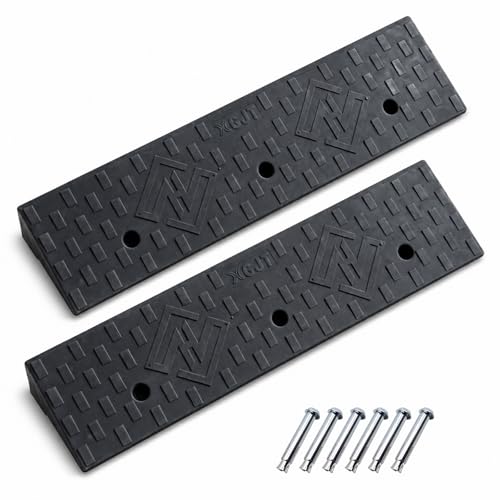
METFUIN 1.6-Inch Rubber Curb Ramp Set (2-Pack)
The METFUIN 1.6-inch heavy-duty rubber curb ramp 2-pack provides 11,000 pounds of load capacity to bridge driveway aprons, sidewalk lips, and garage thresholds without scraping low vehicle fascias. Built from dense, oil-resistant rubber with a channeled grid base, it offers a reliable transition solution for lowered sports cars, full-size trucks, and shop equipment.
Pros
- Massive 11,000-pound load capacity easily supports passenger cars, heavy trucks, and utility equipment
- Dense, oil- and weather-resistant rubber construction absorbs impact without cracking or brittle cold-weather failure
- Integrated grid base and textured upper tread deliver dependable anti-skid stability on concrete and asphalt
- Includes pre-drilled holes and three expansion bolts for optional permanent surface anchoring
Cons
- Modest 1.6-inch rise is strictly for threshold and curb clearance, not for undercarriage oil changes or fluid maintenance
- Heavy dense-rubber build emits a noticeable initial rubber odor when unboxed and placed in enclosed garages
- Width of 9.84 inches requires careful tire alignment when mounting with wide truck or performance tires
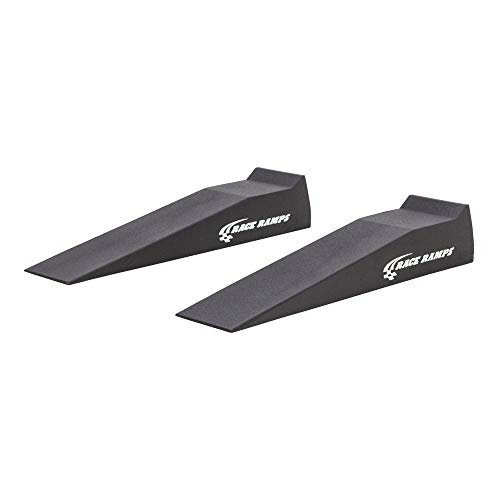
Race Ramps 56-Inch Foam Car Service Ramps
The Race Ramps 56-inch single-piece service ramps feature a gentle 10.75-degree incline and an 8-inch lift designed specifically for low-clearance sports cars and lowered vehicles. With a solid polyurea-coated foam build supporting 1,500 pounds per ramp and weighing only 10 pounds each, they are ideal for home mechanics seeking floor-safe, low-effort vehicle elevation.
Pros
- Gentle 10.75-degree incline angle helps clear low-profile front splitters and bumpers
- Ultralight design at approximately 10 pounds per ramp for effortless transport
- High-density polystyrene core with polyurea coating will not scratch or mark finished garage floors
- Generous 8-inch vertical lift provides open access for routine oil changes and maintenance
- Includes integrated carry straps for straightforward garage handling and storage
Cons
- Weight limit of 1,500 lbs per ramp is strictly intended for passenger cars and excludes heavy-duty trucks or large full-size SUVs
- Single-piece 56-inch solid design cannot be detached for side creeper access like two-piece modular models
- Substantial 56-inch length requires dedicated wall or floor storage space in compact home garages
WECARLLE 3.1-Inch Rubber Curb Ramps 2-Pack
The WECARLLE 3.1-inch rubber curb ramp set offers a rugged 7,000-lb capacity and built-in cable channels to smooth out harsh driveway lips and garage thresholds. It is an ideal solution for low-clearance sports car owners and DIY mechanics looking to protect splitters and underbody components from scraping.
Pros
- Durable dense rubber build supports up to 7,000 lbs without cracking or shifting under weight
- 3.1-inch rise smooths out abrupt concrete curbs to prevent low-profile bumper and splitter damage
- Integrated underside channel protects shop air hoses and electrical cords from tire pinch
- Pre-drilled mounting holes allow optional permanent bolt-down installation on concrete
Cons
- 3.1-inch rise is built for threshold bridging rather than direct undercarriage oil change working room
- 8.66-inch width requires careful tire alignment when guiding wide performance or truck rubber
- Lacks a raised forward wheel stop because it is engineered as a drive-over transition ramp rather than a static lift stand
Tomioka Racing Super Slopes Low Profile Car
The Tomioka Racing Super Slopes are low-profile service ramps featuring a gentle 9.05-degree incline and a 6,600-pound pair capacity. Providing 2.56 inches of lift, they are an ideal solution for lowered cars and sports vehicles that need quick floor jack clearance or basic maintenance elevation.
Pros
- Ultra-low 9.05-degree approach angle minimizes the risk of bumper and front lip scraping
- Solid 6,600 lb per-pair load capacity provides reliable structural support for passenger vehicles
- Compact nesting design stores flat and easily tucks away under garage toolboxes
- Honeycomb pattern delivers drive-on tire traction while allowing moisture drainage
- Integrated anti-slip base pads assist with initial drive-on stability
Cons
- Modest 2.56-inch vertical lift is designed primarily for floor jack access rather than full undercarriage creeper work
- 7-3/4-inch ramp width requires careful wheel alignment with wide performance tires to avoid shoulder overhang
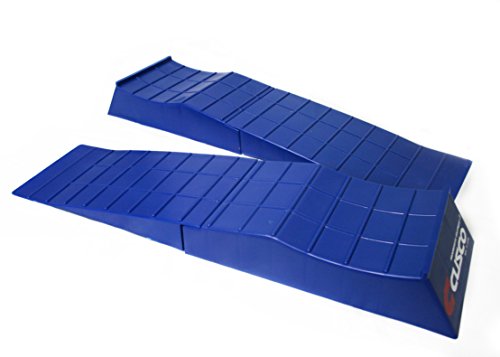
Cusco A517 SL99 Low Down Jack Assist Ramp Set
The Cusco A517 SL99 is a lightweight ABS two-piece jack assist ramp set designed to give low-clearance vehicles the initial lift needed to slide a floor jack underneath. Featuring a longer approach distance and a detachable slope, it is an ideal garage solution for sports car and lowered vehicle owners.
Pros
- Two-piece detachable construction lets you remove the approach incline once parked to maximize working clearance for floor jacks and creepers
- Extended ramp length creates a gradual incline to protect low front bumper lips and aerodynamic splitters
- Lightweight ABS resin structure makes transport to track events and quick garage setups effortless
- Distinctive blue color offers clear visual alignment when driving onto the ramp pads
Cons
- Engineered strictly as a low-rise jack assist rather than a high-lift standalone service ramp for deep undercarriage access
- Manufacturer data does not list explicit numerical weight ratings or Gross Vehicle Weight Ratings (GVWR), requiring conservative vehicle matching
- Smooth polymer base can push forward on slick or dusty epoxy floors without clean placement and steady, gentle throttle modulation
WECARLLE 2.8-Inch Rubber Curb Ramps (2-Pack)
The WECARLLE 2.8-Inch Rubber Curb Ramp 2-Pack delivers dense 7,000-pound load support to bridge driveway lips and garage thresholds without scraping low-clearance front splitters. It is a practical, heavy-duty solution for sports car owners, home garages, and DIYers needing an approach helper or jack-assist clearance step.
Pros
- Dense heavy-duty rubber build supports up to 7,000 lbs without structural deflection
- Low 2.8-inch rise protects aggressive front lips and lowered vehicle splitters from scraping curbs
- Underside cable channel safeguards shop cords and air lines during vehicle transit
- Pre-drilled mounting holes allow semi-permanent anchoring to concrete or asphalt
- Slip-resistant tread pattern provides dependable drive-on traction in damp weather
Cons
- Designed for threshold and curb transitions rather than full underbody maintenance clearance
- Lacks raised forward roll-off wheel stops found on standard automotive service ramps
- Ten-inch depth requires steady throttle input and careful wheel alignment on approach
Race Ramps 67-Inch XT 2-Piece Car Service Ramps
The Race Ramps 67-inch XT two-piece car service ramps provide a gentle 10.8-degree approach angle and a generous 10-inch lift height using solid high-density foam construction. They are ideal for lowered sports cars, performance coupes, and DIY mechanics who need easy undercarriage access without scraping front splitters or scuffing garage floors.
Pros
- Ultra-gentle 10.8-degree incline easily clears low-profile sports cars and aggressive front splitters
- Removable incline section provides unobstructed side creeper access directly behind the front wheel
- Solid high-density foam core will not scuff epoxy floors and weighs only around 17 pounds
- Generous 10-inch lift height gives ample room for oil changes and transmission maintenance
- Built-in raised forward stop helps prevent tire overrun when mounting the ramps
Cons
- Significant 67-inch overall length requires adequate longitudinal garage floor space during vehicle setup
- Weight rating of 1,500 pounds per ramp is not intended for heavy-duty three-quarter-ton pickups or large commercial vans
- Higher initial cost compared to entry-level stamped steel or hollow plastic service ramps
Engineering Realities and Incline Hazards: Can You Use Car Ramps On A Slope
The direct, non-negotiable answer to whether can you use car ramps on a slope is an absolute no. Automotive service equipment manufacturers, vehicle workshop manuals, and industrial safety organizations explicitly mandate that portable drive-on service ramps must only be used on a hard, level, and flat concrete surface. Operating ramps on an incline alters the fundamental physics of vehicle support, turning a reliable lifting tool into a precarious tipping hazard. Understanding the exact mechanical forces, gravitational shifts, and component limitations explains why even a modest driveway slope creates unacceptable risks during vehicle maintenance.
Gravitational Vectors and Lateral Shear Forces on Incline Surfaces
Every portable service ramp depends on pure vertical compression to maintain its rated structural strength and ground grip. When placed on a perfectly flat concrete slab, the entire downward force generated by vehicle curb weight pushes directly perpendicular to the floor, maximizing the static friction of integrated rubber pads or textured bases. On an inclined driveway, this downward gravitational vector splits into two separate forces: a reduced normal force pushing into the asphalt and a parallel shear force dragging downhill. This downhill shear force constantly attempts to slide the ramp out from under the tires.
The static friction coefficient of dry concrete is easily overwhelmed when shear forces act against the bottom of an unanchored ramp. Drive-wheel torque makes this instability significantly worse when ascending an inclined surface. As front-wheel-drive tires attempt to pull the car upward, or rear-wheel-drive tires push the front wheels against the incline ramp face, the horizontal thrust can kick the ramp forward or spit it out behind the tire. Once the base breaks traction on a slope, the ramp slides uncontrollably, dropping the vehicle chassis onto suspension parts or body panels before the vehicle reaches the top platform.
Vehicle Center of Gravity Shifts and Axle Load Imbalances
Vehicle mass distribution is engineered around a carefully balanced center of gravity that assumes four wheels rest on a level horizontal plane. Most passenger cars, crossovers, and light trucks carry a front-axle bias of fifty to sixty percent of their total curb weight due to the engine and transmission assembly. Staging car ramps on a sloped driveway introduces pitch and roll dynamics that dramatically skew this distribution. If the car faces uphill on a slope, significant weight shifts rearward onto the grounded axle, reducing the normal force needed to keep the front ramp cradles stable.
Conversely, pointing the vehicle downhill while attempting to drive the front wheels onto ramps forces an excessive percentage of vehicle weight onto the front suspension. This concentrated mass can rapidly exceed the stated axle pair capacity or per-ramp working load limits of portable equipment. Because weight ratings assume a balanced split across both sides of the elevated axle, any lateral driveway tilt compounds the danger by overloading a single ramp. An overloaded corner causes structural deflection, increasing the probability of platform failure or lateral tipping as the chassis leans into the downhill gradient.
Parking Brake Limitations and Wheel Chock Physics on a Slope
Secondary mechanical restraints that work reliably on flat garage floors can fail when subjected to gravity on an incline. In the vast majority of consumer passenger cars and light trucks, the mechanical parking brake acts exclusively upon the rear wheels through cables or electronic calipers. When a DIY mechanic backs rear wheels onto ramps on a slope, the grounded front wheels have no mechanical parking brake assistance whatsoever. Relying solely on the transmission parking pawl inside an automatic gearbox or leaving a manual transmission in first gear places tremendous mechanical stress on delicate drivetrain components.
Wheel chocks also suffer from severe physical limitations when deployed on an angle. On a level slab, a heavy-duty rubber chock wedges firmly under the tire tread, acting as a stationary barrier against accidental roll-back. On a sloped driveway, the downhill gravitational vector pushes the tire against the chock with continuous, unrelenting pressure. If the driveway surface contains loose gravel, moisture, or slick sealed asphalt, the chock itself can slide across the ground under the rolling momentum of a multi-ton vehicle. Once the chock slips, nothing prevents the vehicle from rolling off the platform and crushing whatever lies beneath.
Compound Approach Angles and Front Splitter Clearance Dilemmas
Calculating whether a low-clearance vehicle will clear a ramp requires evaluating the vehicle approach angle against the ramp slope. Vehicle approach angle is mathematically defined as the arctangent of front ground clearance divided by front overhang distance. Under normal conditions on a flat floor, low-profile sports car ramps feature gentle approach angles between eight and ten degrees to prevent scraping delicate front splitters, air dams, or painted bumpers. Standard service ramps feature steeper approach angles ranging from fifteen to seventeen degrees, which work well for stock sedans, crossovers, and pickup trucks.
Introducing a sloped driveway completely distorts this geometric relationship by creating compound approach angles. If a vehicle drives uphill onto ramps, the transition between the driveway slope and the ramp face becomes severely compressed, causing the front bumper to strike the ramp incline long before the tire contact patch makes contact. If attempting to ascend ramps while facing downhill, the breakover angle at the top platform becomes excessively sharp, risking severe high-centering and underbody scraping. These angular mismatches frequently lead to cracked front fascias, torn aerodynamic undertrays, and violent ramp shifts during ascent.
Material Integrity Under Angled Compression: Foam, Composite, and Steel
The structural materials used in portable service equipment are engineered to withstand compressive loads directed straight through their vertical axis. Solid high-density structural foam units, such as high-end expanded polystyrene ramps coated with protective polyurea, rely on uniform cellular compression across their entire bottom surface. Injection-molded honeycomb composites, such as heavy-duty plastic ramps, depend on internal vertical lattice walls to bear thousands of pounds of axle weight. Welded tubular and stamped steel service ramps utilize structural cross-braces designed to channel load downward into perimeter floor rails.
When any of these structures are placed on an angled plane, the downward force of the vehicle applies asymmetric lateral shear across the material matrix. In structural foam, uneven angled loads concentrate extreme pressure on the rear edge of the wheel cradle, leading to permanent cellular crush and premature structural degradation. Hollow honeycomb polymer walls experience off-axis bending moments that can lead to sudden stress whitening, rib buckling, or catastrophic plastic fractures. Welded steel ramps risk weld shear and torsional twisting when uneven ground prevents all four corners of the base frame from contacting the floor uniformly.
Tire footprint behavior also changes under off-axis compression on narrow platform channels. Premium low-profile ramps and heavy-duty service platforms offer usable platform widths designed to support standard tire footprints without allowing sidewall spillover. When a vehicle rests on a slope, lateral tire deflection causes the rubber tread to bunch against the outer retaining lip of the ramp cradle. This localized sidewall pinch damages internal tire cords and concentrates tire weight on a thin strip of the ramp edge, drastically reducing the effective safety margin built into the equipment.
The Impact of Incline Angles on Automotive Fluid Servicing Accuracy
Safety risks aside, performing routine underbody fluid servicing on an inclined surface creates significant maintenance inaccuracies. Internal combustion engines, manual transmissions, transfer cases, and differentials are engineered with oil pans and fluid reservoirs that assume the vehicle sits level during inspection. Oil drain plugs are strategically placed at the lowest point of the oil pan sump under flat conditions. When a vehicle is lifted on a slope, the fluid pool shifts away from the drain hole, leaving dirty oil, metallic sludge, and contaminants trapped inside the engine casing.
Checking fluid levels on an uneven plane can cause severe mechanical damage to critical drivetrain components. Differential and manual transmission fill plugs function as overflow inspection ports, where proper fluid level is reached when fluid barely weeps from the bottom threads of the opening. If the vehicle is tilted on a sloped driveway, the fluid level inside the casing sits at an angle, leading to either drastic over-filling or chronic fluid starvation. Over-filling leads to oil aeration, foaming, and blown axle seals, while under-filling starves precision gears and bearings of necessary lubrication during high-speed operation.
Proper Procedures for Staging Service Ramps on Flat, Level Slabs
Executing a safe vehicle elevation begins with choosing a clean, completely flat concrete garage bay or level outdoor parking pad. Inspect the surface carefully for oil slicks, standing water, loose gravel, or deep expansion joints that could compromise ramp foot traction. Brushed concrete surfaces naturally offer superior mechanical grip compared to smooth-troweled or slick epoxy-coated garage floors. If working on slick polyaspartic coatings, placing textured heavy-duty rubber grip mats beneath each ramp base prevents initial drive-wheel kick-out and ensures the ramps stay firmly planted during ascent.
Position both ramps directly in line with the front or rear tires, verifying that the steering wheel is centered dead ahead. Approach the incline at a slow, controlled crawl using gentle throttle feathering or smooth clutch modulation to overcome the crest of the ramp without spinning the drive wheels. As the tires roll over the incline peak, feel for the tactile drop into the concave platform pocket and gently rest against the raised forward stop lip. Enlisting an attentive spotter standing safely outside the vehicle path ensures you stop immediately upon reaching the platform center without overshooting the forward edge.
Once the vehicle is seated securely in the ramp cradles, engage non-negotiable secondary safety redundancies immediately. Pull the emergency parking brake lever firmly, shift automatic transmissions into Park, or leave manual gearboxes engaged in first gear or reverse. Wedge heavy-duty rubber wheel chocks tightly behind both grounded tires to eliminate any potential rolling movement in either direction. For ultimate underbody protection, position secondary jack stands beneath the factory unibody pinch welds or structural frame rails before crawling underneath to begin work. If your home workspace lacks adequate flat ground, exploring portable automotive lift alternatives can provide reliable mechanical elevation designed for variable residential settings.
Safer Alternatives When Level Driveway Space Is Unavailable
DIY mechanics who lack a flat residential driveway must avoid compromising on safety rules to finish an oil change or exhaust repair. When an inclined driveway is your only immediate property feature, seeking out a nearby level location represents the smartest practical decision. A flat concrete parking pad at a friend’s workshop, a rented community garage bay, or an empty level slab provides the secure foundation necessary for drive-on ramps. Alternatively, scheduling larger mechanical services at a facility equipped with dedicated shop lifting equipment ensures your vehicle is elevated safely without risking life or machinery.
Some home hobbyists attempt to level their ramps on a slope using wooden boards, paving stones, or custom blocks stacked underneath the low side. Stacking unanchored materials beneath portable service equipment is extraordinarily hazardous because wood splits, bricks crumble under concentrated point loads, and slick surfaces slip apart easily. Never construct makeshift leveling shims or place ramps on gravel, crushed stone, or soft asphalt on an incline. When proper level ground cannot be found, postponing underbody service until access to a flat concrete surface is secured remains the only responsible choice.
Maintaining personal safety during vehicle repair requires respecting the fundamental laws of gravity and equipment engineering. Drive-on car ramps provide an exceptionally fast, sturdy, and practical way to service oil pans, exhaust shields, and underbody components when used strictly as designed on flat ground. Attempting to deploy them on any sloped driveway introduces lateral shear forces, roll risks, structural strain, and fluid measuring errors that no careful driving technique can overcome. By insisting on a verified flat concrete slab, engaging redundant wheel chocks, and staging backup jack stands, you ensure every automotive maintenance task remains productive and completely safe.
About the author
Hank O'Hop writes about automotive tools, hands-on repairs, and the challenges of maintaining and improving project cars. His published work covers workshop equipment, engine hoists, power tools, and garage upgrades, offering practical insights for readers who prefer to understand their equipment before putting it to work.