
What Is Ali Certified Car Lift: Safety Standards and Practical Guide for 2026
Understanding what is ali certified car lift standards protects your garage workspace in November 2026. Learn how structural testing and mechanical locks ensure safety.
 By Peter Nelson
Updated October 10, 2026


Working on concrete garage floors with manual floor jacks and jack stands can limit service mobility and compromise workspace safety. Automotive hobbyists and professional technicians often reach a stage where installing a reliable vehicle lift becomes the most practical upgrade for their shop or residential bay. Understanding what is ali certified car lift standards mean helps buyers distinguish between independently verified shop equipment and uncertified hardware. Investing in the right machinery requires evaluating structural integrity, positive mechanical locking systems, and proper foundation anchoring before raising a vehicle overhead.
While many shop owners search for dependable residential car lift options to double parking capacity or streamline chassis maintenance, confusing manufacturer claims can cloud the decision. Certified lifts undergo rigorous third-party safety testing under national engineering standards, verifying that columns, arms, and hydraulics hold up under severe load conditions. Choosing between two-post surface-mounted models and versatile hydraulic car lift systems depends heavily on ceiling height, concrete foundation quality, and intended repair work. Knowing how third-party validation works guarantees that you select shop equipment built to protect both your vehicles and your physical safety.
| Award | Product | BJL Score About BJL ScoreThe BJL Score is our own rating from 0 to 10, based on performance, design and build, ease of use, and value. It reflects independent research and is never influenced by manufacturers, retailers, or affiliate commissions. Learn more › | |
|---|---|---|---|
| Best Overall |
WEIZE 11,000 lb Two-Post Car Lift with 220V 3HP
|
9.1/10 | Buy |
| Best Premium |
 MutsMover 11,000 LBS 4-Post Car Lift |
9.1/10 | Buy |
| Best Value |
 Kzoo Lift 7,000 lb Mid-Rise Portable Scissor Car |
8.9/10 | Buy |
 Weize 12,000-lb 2-Post Automotive Lift with 4HP |
8.8/10 | Buy | |
| Best Budget |
 Albott 7000 LBS Portable Scissor Car Lift |
8.6/10 | Buy |
 APlusLift 8SXLT 8,000 lb Extra Tall & Wide 4-Post |
8.6/10 | Buy | |
 Albott 7000 lb Portable Car Lift with Extension |
8.1/10 | Buy | |
 Albott 8000 LBS Portable Car Lift |
8.1/10 | Buy | |
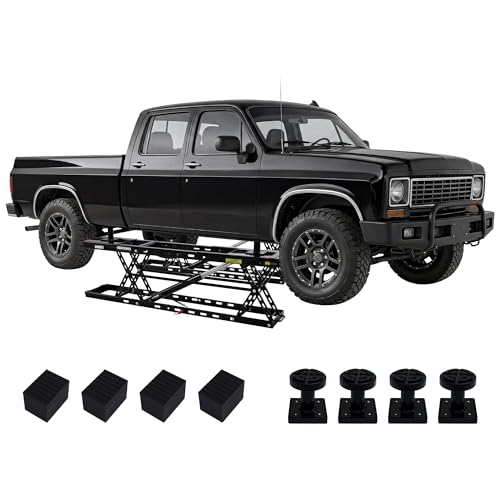 Albott 8000 LBS Portable Car Lift |
7.8/10 | Buy |
WEIZE 11,000 lb Two-Post Car Lift with 220V 3HP
The WEIZE 11,000-lb two-post automotive lift combines a high-output 220V 3HP hydraulic power unit with an open-floor layout for home garage mechanics and light commercial service bays. Requiring a dedicated 220V circuit, structural concrete slab, and dual-point lock disengagement, it offers substantial lifting capacity for sedans, SUVs, and work trucks.
Pros
- High 11,000-lb capacity easily handles heavier half-ton and three-quarter-ton trucks
- Wide 110.23-inch drive-through clearance makes vehicle positioning simple and stress-free
- Rugged 220V 3 HP hydraulic motor delivers dependable lifting muscle
- Clear-floor layout leaves garage floor completely open for transmission jacks and fluid drains
Cons
- Dual-point safety release requires walking to both columns to disengage locks before lowering
- Requires a dedicated 220V single-phase electrical hookup and an appropriate concrete foundation
- Heavy 1,426-lb shipping package requires a forklift, trailer ramp, or helpers for freight delivery offloading
MutsMover 11,000 LBS 4-Post Car Lift
The MutsMover 11,000 LBS 4-Post Car Lift provides an impressive 84.25-inch maximum rise height powered by a standard 110V 3.0HP hydraulic system, making it an ideal vehicle stacking solution for residential garages with high ceilings. Built from Q345 powder-coated steel with a single-point manual lock release, two drip trays, and a jack tray, it suits truck, SUV, and classic car owners looking to maximize vertical storage.
Pros
- High 11,000-lb capacity handles full-size trucks, SUVs, and passenger vehicles with ease.
- Convenient 110V 3.0HP motor avoids the need for dedicated 220V electrical installation in residential garages.
- Tall 84.25-inch maximum rise provides ample headroom for under-vehicle access and stacking taller lower vehicles.
- Single-point manual lock release eliminates running around to each column to trip individual latches.
- Ships with practical accessories including two drip trays and a sliding jack tray.
Cons
- Substantial 2,117-lb shipping crate measuring over 16 feet long mandates on-site forklift unloading, a tractor, or terminal pickup.
- Ceiling height requirement is demanding, as utilizing the full 84-inch lift height with a vehicle on top demands substantial vertical overhead clearance.
- Hydraulic fluid is not included in the package and must be purchased separately prior to initial bleeding and operation.
Kzoo Lift 7,000 lb Mid-Rise Portable Scissor Car
The Kzoo Lift 7,000 lb mid-rise scissor lift is a versatile electric-hydraulic vehicle hoist engineered for low-ceiling home garages and light service bays using standard 110V power. Featuring an ultra-low 4.3-inch collapsed height and a 39-inch maximum rise, it provides an accessible lifting solution for cars, SUVs, and light trucks without requiring commercial concrete anchoring.
Pros
- 7,000 lb capacity safely handles a wide fleet of passenger cars, SUVs, and light-duty trucks.
- Ultra-low 4.3-inch drive-over profile eliminates the need for auxiliary wooden blocks on lowered vehicles.
- Operates on standard 110V residential power, bypassing expensive 220V commercial electrical installations.
- 39-inch rise height provides convenient undercar access for garages with low ceiling clearances.
Cons
- Maximum 39-inch lift height requires working from a creeper or rolling stool rather than standing.
- Scissor structure under the platform restricts central underbody access compared to open-floor two-post lifts.
- Does not carry third-party Automotive Lift Institute (ALI) gold label certification.
Weize 12,000-lb 2-Post Automotive Lift with 4HP
The Weize 12,000-lb two-post automotive lift delivers heavy-duty lifting capacity backed by a 4-HP, 220V single-phase motor and a convenient single-point mechanical safety lock release. With an overall height of roughly 112.6 inches and a generous 101-inch drive-through width, it is a practical choice for DIY mechanics and service bays working on half-ton to one-ton trucks.
Pros
- Substantial 12,000-lb load rating accommodates heavy diesel trucks, work vans, and family SUVs
- Single-point safety lock release mechanism streamlines vehicle lowering and improves shop efficiency
- High-power 4-HP 220V hydraulic power unit delivers reliable lifting torque for heavy chassis
- Generous 101-inch drive-through clearance prevents mirror and wheel scuffing on wide utility vehicles
- Relatively compact 112.6-inch overall height fits garages with moderate 10-to-11-foot ceilings
Cons
- Requires a dedicated 220V single-phase electrical circuit and hardwired connection by a qualified electrician
- Heavy freight shipping weight of 1,574 pounds requires mechanical equipment such as a forklift or tractor for offloading
- Lacks third-party Automotive Lift Institute (ALI) gold label certification, which may affect municipal or commercial insurance requirements
Albott 7000 LBS Portable Scissor Car Lift
The Albott 7000 LBS Portable Car Lift delivers reliable frame-engaging lifting power with a 28-inch maximum rise height, making it an excellent unanchored solution for low-ceiling residential garages. Built from high-strength Q235B steel, it suits DIY mechanics and car enthusiasts tackling brake jobs, tire rotations, and chassis maintenance on level concrete.
Pros
- Substantial 7,000-lb capacity easily handles most domestic sedans, sports cars, and midsize SUVs
- Mobile four-wheel design eliminates permanent concrete drilling and fits well under standard 8-to-10-foot residential ceilings
- Includes extension panels and multi-height adapter blocks to reach factory frame contact points across different wheelbases
- Multiple mechanical locking positions allow safe, stable under-vehicle working heights off hydraulic pressure
Cons
- Maximum 28-inch rise height does not provide full standing headroom underneath the vehicle
- Weighs 401 pounds, which requires moderate physical effort to reposition or wheel across uneven garage thresholds
- Requires a minimum load of approximately 220 pounds on the frames to compress the return springs and initiate descent
APlusLift 8SXLT 8,000 lb Extra Tall & Wide 4-Post
The APlusLift 8SXLT is an 8,000-pound capacity extra tall and wide four-post car lift designed for residential vehicle storage, double parking, and DIY underbody service. Featuring an 82-inch lifting height, 99-inch drive-through width, and a standard 110V 1.5HP power unit, it is an ideal choice for home garage collectors seeking spacious clearance and complete accessory support.
Pros
- Convenient 110V 1.5HP power unit with included power cord operates on standard residential garage circuits without requiring 220V wiring
- Generous 82-inch rise height and 99-inch drive-through clearance accommodate taller vehicles and provide comfortable underbody standing headroom
- Arrives fully bundled with high-value accessories including a mobile caster kit, sliding jack tray, aluminum ramps, and drip trays
- Four-post drive-on configuration offers freestanding parking stability on level residential concrete without mandatory permanent floor anchors
- Supported by a comprehensive 3-year warranty along with CE safety evaluation documentation
Cons
- Heavy crated shipping weight of 1,850 pounds requires coordinated LTL freight offloading with an engine hoist, forklift, or wrecker service
- Carries European CE structural certification rather than third-party Automotive Lift Institute (ALI) gold label certification
- Hydraulic fluid is not included in the shipping package and must be purchased separately prior to pump priming and system bleeding
Albott 7000 lb Portable Car Lift with Extension
The Albott 7000 lb Portable Car Lift provides residential mechanics with reliable mid-rise lifting capacity without requiring permanent concrete anchors. Built from high-strength Q355B steel with dual mechanical locking pins, it delivers up to 20 inches of working height for brake jobs, tire rotations, and underbody maintenance.
Pros
- 7,000-pound lifting capacity accommodates a wide variety of passenger vehicles and half-ton trucks.
- Modular extension plates increase maximum jacking spread up to 70.7 inches for longer chassis.
- Dual mechanical safety locks ensure the raised vehicle is mechanically supported during undercar service.
- Compact folding frame design with integrated wall-mount handles preserves valuable garage floor space.
Cons
- Individual lifting frames weigh roughly 120 pounds each, requiring physical effort to position beneath vehicles.
- Maximum rise height of 20 inches provides practical clearance for wheel and suspension service, but does not allow full standing headroom.
- Hydraulic fluid is not included and requires sourcing ISO grade No. 46 hydraulic oil prior to first operation.
Albott 8000 LBS Portable Car Lift
The Albott 8,000 LBS Portable Car Lift is an unanchored, frame-engaging scissor lift system constructed from high-strength Q355B carbon steel and rated for vehicles up to 8,000 pounds. Featuring dual mechanical safety locking pins, an included 8.3-inch extension plate for 75-inch length stability, and a 22-inch lift height with rubber pads, this mobile unit is built for home garage DIY mechanics seeking reliable chassis clearance without permanent floor anchoring.
Pros
- Heavy-duty 8,000-pound rated capacity accommodates a wide range of consumer vehicles including many light trucks and SUVs
- Rigid Q355B carbon steel build provides dependable frame stability under load compared to basic steel alloys
- Dual mechanical safety locks and locking pins provide reliable physical engagement during elevated service work
- Completely unanchored operation eliminates the need for concrete core drilling, chemical anchors, or high ceilings
Cons
- Each individual frame weighs approximately 130 pounds, requiring physical effort to slide and align beneath vehicle jacking points
- Strict operational safety requirements mandate a flat, solid floor with no operating slopes exceeding 4 degrees
- Requires No. 46 hydraulic oil, which must be purchased separately prior to initial bleeding and operation
Albott 8000 LBS Portable Car Lift
The Albott 8000 LBS Portable Car Lift provides an 8,000-pound capacity frame-engaging scissor system constructed from high-tensile Q355B steel for low-ceiling residential garages. Featuring mechanical safety locks, dual locking pins, and extension plates reaching up to 75 inches, it suits DIYers and truck owners seeking serious lifting capability without permanent concrete anchoring.
Pros
- Substantial 8,000-lb gross capacity handles heavier consumer trucks and SUVs that exceed smaller portable units.
- Requires no permanent concrete slab anchor bolts, allowing free floor repositioning and low-ceiling garage clearance.
- Included extension plates lengthen frame support reach up to 75 inches to engage separated factory jacking points.
- Constructed from high-grade Q355B structural steel with dual locking pins for reliable mechanical safety.
Cons
- Individual frames weigh roughly 130 pounds each, requiring physical effort to slide and align beneath vehicles.
- Requires sourcing ISO No. 46 hydraulic fluid separately before initial setup and cylinder bleeding.
- Maximum lift height of 27.4 inches is restricted to creeper work and does not offer full standing undercarriage access.
Evaluating ALI Certification and Automotive Hoist Safety Engineering
An automotive lift must bear thousands of pounds suspended directly over a technician working underneath. The Automotive Lift Institute serves as the primary North American credentialing body that validates whether vehicle hoists meet strict structural, mechanical, and electrical benchmarks. Answering what is ali certified car lift equipment requires examining third-party safety testing rather than accepting manufacturer marketing at face value. Understanding these rigid standards helps garage owners protect their physical safety, satisfy commercial shop insurance mandates, and make informed equipment investments.
The Core Definition of an ALI Certified Car Lift
An ALI certified car lift represents a vehicle hoist independently tested and verified to comply with the ANSI/ALI ALCTV standard. This standard governs automotive lift construction, testing, and validation across North America. The Automotive Lift Institute does not manufacture hoists or perform the physical lab testing itself. Instead, it sponsors a rigorous credentialing program that relies on accredited Nationally Recognized Testing Laboratories to inspect and stress-test production hardware.
Manufacturer claims of compliance differ significantly from official third-party certification. Many overseas fabricators claim their products meet industry standards without submitting their machinery to independent validation. True certification requires an unannounced factory audit, continuous structural surveillance, and complete metallurgical verification of column steel and weld seams. A lift only earns certified status after every structural component, hydraulic cylinder, and safety mechanism clears these independent laboratory evaluations.
Nationally Recognized Testing Laboratories and the ANSI/ALI Standard
Third-party validation relies on Nationally Recognized Testing Laboratories like Intertek or Underwriters Laboratories to evaluate automotive equipment. These laboratories test production models against the ANSI/ALI ALCTV standard to confirm structural integrity and electrical safety. Technicians inspect every element, ranging from column baseplate thickness to hydraulic hose burst pressure. Any failure during laboratory analysis prevents the model from earning its certified rating until the manufacturer engineers a verified solution.
Electrical safety testing forms another mandatory pillar of the certification protocol. Laboratory engineers verify that hydraulic power units, electric motors, and control switches meet ANSI/UL 201 standards. This evaluation ensures that motor windings, internal wiring, and push-button switches operate without electrical shock or fire hazards under continuous shop duty cycles. Hoists carrying the certified label guarantee that both the structural steel and the high-voltage electrical components withstand demanding operating conditions.
Dynamic and Static Proof Load Engineering Protocols
Structural validation requires demanding proof-load experiments that push lift components well beyond their rated capacities. The ANSI/ALI ALCTV standard mandates a dynamic load test conducted at 115 percent of the lift’s rated lifting capacity. During this dynamic evaluation, the hoist must raise, lower, and mechanically lock the overload without hydraulic failure, excessive arm deflection, or column warping. This dynamic trial simulates real-world vehicle weight shifts during shop maintenance procedures.
Static proof testing subjects the lift structure to an even more punishing load benchmark. Laboratory technicians load the hoist to 150 percent of its stated capacity while resting on its mechanical safety locks. The structural steel, carriage pins, and locking pawls must support this static overload without permanent deformation or metal fatigue. By requiring a 150 percent proof threshold, the certification standard provides a substantial safety margin against accidental vehicle overloads.
Hydraulic circuits face equally rigorous burst pressure trials during laboratory validation. Hydraulic hoses and cylinder bodies must demonstrate a burst pressure rating equal to at least three times the system’s maximum operating pressure. Integrated velocity fuses must trigger instantly if a hydraulic hose ruptures, preventing rapid carriage descent. These fail-safe mechanisms ensure that a sudden fluid leak will not cause a catastrophic vehicle drop.
Recognizing the Physical Gold Label and Online Directory Listings
Legitimate certified vehicle lifts feature a distinctive serialized gold label permanently affixed to the primary column. This label displays the ALI logo, the ANSI/ALI ALCTV standard reference, and the accredited testing laboratory mark. Each gold label contains a unique serial number tracked directly by the institute. Counterfeit labels occasionally appear on unbranded imports, making physical inspection and validation essential for equipment buyers.
Equipment purchasers can independently verify any hoist by searching the official Automotive Lift Institute online directory. The directory lists every certified model by manufacturer, brand name, rated capacity, and approved accessories. If a specific model number does not appear in the active directory, the lift is not certified regardless of marketing claims. Savvy buyers always verify model numbers in the database before completing a commercial or residential purchase.
CE Certification Versus True Third-Party ALI Standards
Equipment buyers frequently encounter lifts advertising CE markings alongside their technical specifications. A CE marking indicates compliance with European Union health, safety, and environmental protection directives. However, European machinery directives often allow manufacturer self-certification for certain mechanical equipment without independent laboratory verification. An overseas factory can stamp a CE mark onto an unverified hoist after self-declaring that their engineering drawings meet relevant standards.
Commercial equipment like heavy-duty shop lifts must meet North American building codes that CE self-declaration does not satisfy. Municipal building inspectors and OSHA compliance officers in the United States and Canada mandate ANSI/ALI ALCTV certification. While products like the APlusLift 8SXLT list CE certified structural ratings tested to dynamic and static thresholds, commercial service shops require the official ALI gold label to clear local safety inspections. Residential hobbyists can weigh these distinctions against their personal safety tolerance and garage workspace requirements.
Mechanical Safety Locks and Fail-Safe Engagement Systems
Positive mechanical locking mechanisms serve as the primary line of defense against vehicle drops. Hydraulic cylinders supply the fluid force needed to raise a vehicle, but mechanical locks must carry the static load during service work. Certified lifts incorporate heavy-duty steel lock ladders with automatic spring-loaded pawls positioned inside each column. Technicians must lower the lift onto these mechanical locks immediately after reaching the desired working height.
Lock release configurations vary between single-point manual releases and dual-point levers. Two-post lifts from brands like WEIZE feature dual safety lock releases or single-point mechanisms that disengage column locks before lowering. Four-post lifts like the MutsMover 11,000 LBS 4-Post Car Lift utilize dual safety locks on each column coupled with a single-point manual release. Certified equipment requires that all locking pawls engage automatically at discrete height intervals, producing an audible click during ascent.
Secondary slack-cable safety mechanisms provide vital redundancy on cable-driven four-post hoists. If a lifting cable stretches unevenly or loses tension, internal slack-cable latches instantly pivot into the column ladder rungs. This mechanical interlock prevents the runway crossbeams from tilting or dropping if a single cable breaks. Verifying that safety latches move freely without binding remains a fundamental maintenance priority for every lift owner.
Cable Synchronization and Hydraulic Velocity Fuses
Two-post clear-floor lifts rely on dual steel equalization cables to maintain level carriage movement. Hydraulic fluid flows to slave cylinders through high-pressure lines, but mechanical wire ropes force both carriages to rise at identical speeds. If equalization cables loosen, one carriage can lift faster than the other, creating dangerous vehicle tilt. Certified hoists utilize heavy aircraft-grade wire ropes running over machined steel sheaves to guarantee reliable synchronization.
Hydraulic velocity fuses act as automatic shutoff valves installed directly at the cylinder fluid ports. If a hydraulic hose gets severed, fluid rushes out faster than normal operating flow rates. The sudden surge causes the internal velocity fuse to snap shut instantly, trapping hydraulic fluid inside the cylinder barrel. This hydraulic safety device prevents rapid descent, giving the operator time to stabilize the bay safely.
Concrete Slab Integrity, Compressive PSI, and Anchoring Standards
A vehicle lift derives its ultimate structural stability from the concrete foundation beneath its baseplates. Surface-mounted two-post lifts place massive tensile pull-out forces on anchor bolts when holding heavy trucks. Manufacturers specify a minimum concrete thickness of 4 inches with a compressive strength of at least 3,000 PSI cured for a minimum of 28 days. Drilling a test core or measuring existing slab depth ensures the floor can support heavy column loads.
Anchor bolt installation requires strict adherence to manufacturer embedment depth and torque ratings. Standard installation protocols require heavy-duty wedge anchors embedded at least 3.25 to 4 inches into solid concrete. Installers must maintain a minimum edge distance of 6 inches from expansion joints, relief cuts, or slab perimeters to prevent concrete breakout. Torquing anchors with a calibrated torque wrench prevents bolt pullout under high vehicle loads.
Post-tension concrete slabs present serious safety hazards for any surface-mounted lift installation. Many modern residential garages utilize post-tension cables pulled to high tension inside the concrete floor. Severing a post-tension cable while drilling anchor holes can cause explosive concrete blowout and catastrophic structural foundation failure. Property owners must hire professional ground-penetrating radar scanning services to locate post-tension tendons before drilling concrete baseplates.
Garage Ceiling Clearances and Overhead Shutoff Protection
Ceiling height limitations dictate the type of automotive lift a garage can accommodate safely. Clear-floor two-post lifts feature an overhead crossbeam connecting the two vertical columns. Certified clear-floor models incorporate a padded overhead shutoff bar wired to a microswitch. If an SUV roof contacts the padded bar, the microswitch instantly cuts electrical power to the hydraulic motor, preventing vehicle roof crushing.
Low-ceiling residential garages often lack the 12 feet of vertical clearance required for clear-floor designs. Floor-plate two-post lifts or mid-rise scissor lifts like the Kzoo 7,000 lbs model offer practical alternatives for bays with 9-foot ceilings. These lifts run hydraulic lines and equalization cables across the floor under a beveled steel threshold. While floor plates eliminate overhead obstructions, technicians must roll tool carts carefully over the protective floor cover.
Installing four-post parking platforms requires precise vertical calculation to ensure adequate vehicle stacking clearance. Homeowners must apply a standard stacking formula: lower vehicle height plus upper vehicle height plus runway thickness plus 4 to 6 inches for lock release clearance. Standard residential garage doors and overhead openers often interfere with stacked vehicles. Converting to high-lift door tracks and installing a wall-mounted jackshaft opener clears necessary overhead bay volume.
Electrical Circuits, Motor Horsepower, and Hydraulic Fluid Maintenance
Automotive lift power units require stable electrical branch circuits to run hydraulic pump motors efficiently. Lifts like the WEIZE 11,000 lbs two-post hoist utilize a 220V 3HP motor requiring a dedicated 30-amp single-phase circuit. Conversely, parking lifts like the MutsMover 11,000 LBS platform or Albott portable hoists operate on standard 110V power units drawing 15 to 20 amps. Undersized branch wiring or low line voltage can cause motor humming, slow lift speeds, and tripped circuit breakers.
Hydraulic systems demand clean fluid to lubricate internal pump gears and protect cylinder seals from premature wear. Manufacturers typically specify premium AW-32 or AW-46 anti-wear hydraulic oil for reliable all-weather operation. Portable lifts like the Albott 7000 LBS and 8000 LBS models specifically instruct operators to use No. 46 hydraulic oil. Regularly inspecting reservoir levels, checking hose fittings for weeping, and bleeding trapped air ensures smooth carriage elevation.
Commercial Shop Compliance and Residential Ownership Decisions
Commercial automotive facilities face legal and regulatory requirements that dictate lift selection. OSHA regulations under the General Duty Clause enforce automotive lift safety standards, frequently citing repair shops that operate uncertified or uninspected hoists. Insurance carriers also demand proof of annual lift inspections performed by ALI-certified inspectors. For professional business owners, purchasing certified lifts represents a mandatory risk-management decision.
Residential hobbyists and home mechanics operate outside commercial OSHA oversight, providing greater equipment flexibility. Many DIY mechanics successfully install heavy-duty hoists from brands like WEIZE, Albott, or APlusLift to perform maintenance in private garages. These lifts provide robust steel construction, solid mechanical locks, and reliable lifting capacities at budget-friendly price points. DIY owners must take personal responsibility for verifying concrete thickness, anchor bolt torque, and proper vehicle balancing.
Logistical delivery realities require careful planning when ordering automotive shop equipment. LTL freight carriers deliver crated steel columns on flatbed trailers without unloading assistance. Heavy lifts weighing several thousand pounds require a forklift, tractor, or rollback wrecker to offload safely at residential properties. Reviewing freight instructions, preparing unloading machinery, and staging assembly space ensures a smooth and safe garage installation.
Evaluating certified vehicle hoists comes down to understanding the structural safeguards, independent testing protocols, and mechanical locking systems that protect your workspace. Whether you choose an officially certified commercial hoist or an uncertified heavy-duty lift for your home garage, verifying foundation strength and operational clearances remains essential. Following manufacturer torque guidelines, maintaining hydraulic fluid purity, and engaging mechanical safety locks before every service job guarantees safe automotive lifting for years to come.
About the author
Peter Nelson is an automotive writer whose published work includes off-road jacks, power tools, vehicle maintenance, and garage equipment. His coverage connects product features with practical applications, helping readers think through equipment choices for everyday repairs, project vehicles, and off-road situations.