
How Tall Is a 4 Post Car Lift: Garage Clearance and Height Guide for 2026
Review how tall is a 4 post car lift, measure ceiling clearance, and evaluate two-car stacking formulas for your home workshop setup in October 2026.
 By Peter Nelson
Updated October 10, 2026
By Peter Nelson
Updated October 10, 2026
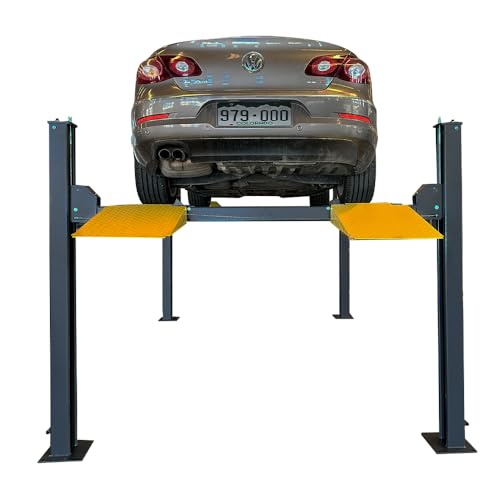
Garage ceiling clearance and overhead door travel create the most critical boundaries when planning vehicle storage or shop hoists. Residential spaces often present tight vertical restrictions where rafter tails, overhead garage door tracks, and garage door openers limit usable room. Knowing exactly how tall is a 4 post car lift helps prevent costly collisions between a vehicle roof and ceiling drywall while ensuring your structure can physically accommodate the equipment. Exploring modern residential car lift options allows homeowners to visualize footprint dimensions and column uprights before taking delivery.
Most standard four-post units feature column uprights ranging between 84 inches and 94 inches, but overall equipment height tells only half the story. The total vertical envelope depends on the thickness of the drive-on runways, the mechanical safety lock spacing, and the height of both parked vehicles. Evaluating your garage foundation, dedicated power connections, and overhead clearance before installation ensures that stacking a sports car or SUV remains smooth, predictable, and structurally sound.
| Award | Product | BJL Score About BJL ScoreThe BJL Score is our own rating from 0 to 10, based on performance, design and build, ease of use, and value. It reflects independent research and is never influenced by manufacturers, retailers, or affiliate commissions. Learn more › | |
|---|---|---|---|
| Best Overall |
AUTOKATO KT-4H850 3.0HP Four Post Lift Car Truck
|
9.2/10 | Buy |
| Best Budget |
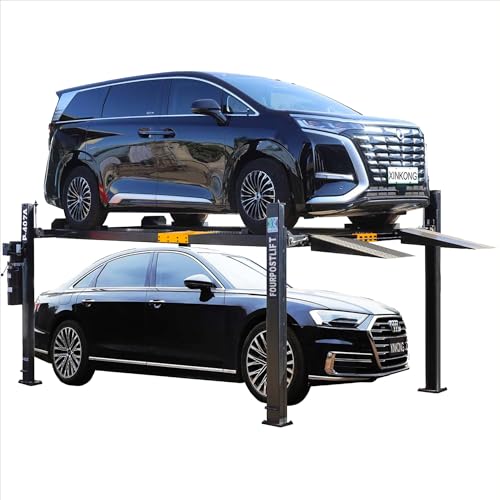 XK 4 Post Portable Parking Lift 8000 lb Movable
|
9.1/10 | Buy |
| Best Premium |
 KATOOL 9500lbs Heavy Duty 4/Four Post Car Lift
|
9.1/10 | Buy |
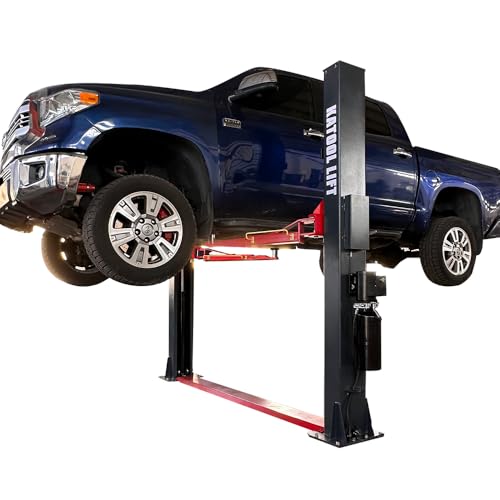 KATOOL 2 Post Lift 4.0HP 12000lbs Single Point
|
8.9/10 | Buy | |
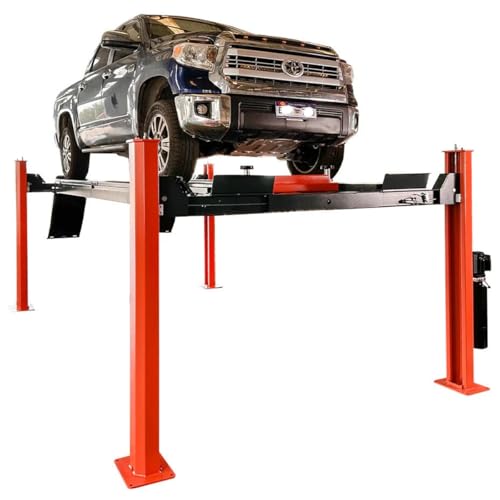 MutsMover 15,000 LBS 4-Post Car Lift
|
8.8/10 | Buy | |
| Best Value |
 KATOOL 8500lbs 3.0HP 4 Post Car Lift with Casters
|
8.6/10 | Buy |
 APlusLift 8SXLT 8000LB Extra Tall Long Wide 4-Post
|
8.6/10 | Buy | |
 KATOOL 8500 lbs 4-Post Portable Storage Service
|
8.3/10 | Buy | |
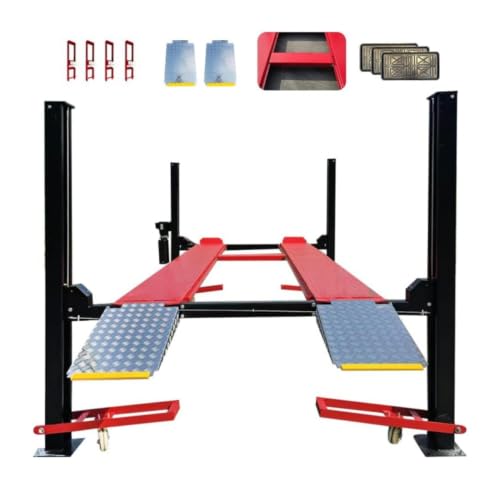 AUTOKATO KT-4H950 110V 3.0HP Four Post Lift Car
|
8.0/10 | Buy |
Comprehensive Guide to 4-Post Car Lift Dimensions and Ceiling Requirements
Determining the true vertical profile of a four-post parking and service lift requires evaluating multiple dimensions rather than a single column specification. While the vertical steel posts establish the baseline footprint, maximum runway rise, runway structural thickness, and vehicle heights determine whether a hoist will fit inside your garage. Home mechanics frequently confuse overall column height with under-runway working clearance, leading to unexpected installation challenges. Reviewing these dimensions in detail ensures your garage provides adequate vertical headroom for safe vehicle storage and ergonomic underbody maintenance.
Standard Column Heights Across 4-Post Lift Designs
Column height on typical residential four-post lifts generally falls between 84 inches and 95 inches, depending on lifting capacity and manufacturer design. Standard home storage units, such as an 8,000-pound or 8,500-pound model, often utilize columns standing roughly 7 feet to 7.5 feet high to clear standard garage door headers. Taller units, including extra-tall variants or heavy commercial hoists, feature column heights reaching 94 inches or higher to allow taller technicians to walk underneath without hunching. The APlusLift 8SXLT, for example, specifies an overall column height of 94 inches, while compact models often keep columns closer to 84 inches.
Commercial-grade four-post units designed for fleet maintenance or full-size pickup trucks often feature taller columns to support extended hydraulic cylinder strokes. Units like the MutsMover 15,000-pound capacity lift incorporate massive uprights to handle broad frame structures and long suspension travel. On these larger models, steel posts extend upward to accommodate robust crossbeams and multi-position safety ladders. Choosing between standard and extended column heights directly influences how high you can elevate a vehicle before the top mechanical lock engages.
Column Height Versus Under-Runway Working Clearance
Distinguishing between total column height, maximum runway rise, and clearance beneath the runways is essential when planning a hoist installation. The overall column height represents the physical top of the steel posts standing on your concrete floor. Maximum runway rise indicates how high the top surface of the drive-on platforms can travel when the hydraulic cylinder reaches full extension. The under-vehicle clearance, however, measures the distance from the garage floor to the underside of the runways, which determines whether you can walk or sit comfortably underneath.
In many popular 8,500-pound to 9,500-pound home storage lifts, maximum lifting height reaches between 70.8 inches and 84.5 inches. The KATOOL and AUTOKATO 9,500-pound platforms, for instance, offer lifting heights between 79 inches and 84.5 inches, giving ample room for full standing height. However, the drive-on runway structure itself is typically 4 to 5 inches thick due to internal crossmembers and steel reinforcing gussets. Subtracting the runway thickness from the top-of-runway elevation gives your true under-runway clearance, which is the actual space available for parking a lower vehicle.
The Two-Car Stacking Formula: Calculating Ceiling Clearance
Calculating whether your residential garage can safely accommodate two stacked vehicles requires a straightforward mathematical formula. The primary equation combines the lower vehicle height, the upper vehicle height, the runway structural thickness, and a safety margin for mechanical lock engagement. Written out, the formula is: Lower Vehicle Height plus Upper Vehicle Height plus Runway Thickness plus Safety Margin equals Total Minimum Ceiling Height. Applying this formula ensures you never attempt to raise a vehicle beyond the physical limits of your garage drywall or roof trusses.
Consider a realistic example where a homeowner wishes to store a sports coupe underneath an everyday compact crossover. If the lower sports car measures 52 inches tall and the upper crossover measures 66 inches tall, those vehicles alone require 118 inches of vertical room. Adding 5 inches for the steel runway structure brings the combined height to 123 inches. Including an essential 4-inch buffer for locking clearance results in a required ceiling height of 127 inches, which is approximately 10 feet and 7 inches.
If you intend to stack two low-slung sports cars, the vertical clearance requirement becomes significantly more manageable for standard residential garages. Two vehicles measuring 50 inches in height combined with a 5-inch runway and a 4-inch lock buffer require only 109 inches, or roughly 9 feet and 1 inch of ceiling clearance. Evaluating these dimensions using verified vehicle specifications prevents surprises during initial operation. Many homeowners exploring hydraulic car lift systems discover that minor variations in roof pitch or ceiling drywall framing determine whether their planned two-car configuration is feasible.
Factoring In Safety Lock Ladder Travel and Release Clearance
Mechanical safety locks are fundamental to four-post lift design, preventing catastrophic vehicle descent in the event of hydraulic pressure loss. These safety systems utilize heavy steel lock ladders welded or fitted inside each column, paired with spring-loaded locking dogs on the crossbeams. When you raise a vehicle to a desired parking position, you must elevate the runways slightly past the target lock ladder tooth to allow the mechanical latch to drop into place. Once the latch swings clear, you gently lower the hydraulic pressure so the entire load rests securely on the steel column stops.
This overtravel requirement demands that your garage ceiling provide at least 2 to 4 inches of clearance above the final parked position of the top vehicle. If your ceiling height exactly matches the combined height of the two vehicles and runways, you will not have sufficient room to lift the carriage above the lock latch. Attempting to force the power unit against ceiling joists can dent vehicle sheet metal or damage garage framing. Always factor this necessary lock-clearing stroke into your vertical ceiling measurements before choosing a four-post parking lift.
Single-point manual lock release systems, featured on lifts from brands like AUTOKATO and KATOOL, simplify lowering by disengaging all four corner latches simultaneously. When lowering the hoist, the operator raises the carriages an inch or two to unload the latches before pulling the manual release lever. Without adequate overhead clearance, releasing the mechanical locks becomes impossible because the top vehicle cannot rise to clear the ladder teeth. Maintaining a generous overhead buffer guarantees safe, bind-free engagement and disengagement during daily operation.
Overhead Garage Door Track and Opener Obstructions
Ceiling height measurements must never be taken solely from the center of an empty garage floor without considering overhead equipment. In residential garages, the open garage door and its horizontal steel tracks represent the lowest physical barrier in the room. A garage with an 11-foot finished ceiling might only offer 8 feet of usable clearance beneath the horizontal tracks when the overhead door is rolled back. Center-mounted garage door openers and ceiling-mounted fluorescent lighting also introduce substantial overhead hazards that can contact the roof of a raised vehicle.
Converting standard garage doors to high-lift configurations is one of the most effective methods for regaining wasted vertical headroom. Standard garage doors typically curve inward at approximately 7 to 8 feet above the floor, hanging horizontally across valuable overhead airspace. A high-lift track conversion extends the vertical door tracks closer to the ceiling drywall before curving into the horizontal position. Pairing this track adjustment with a wall-mounted jackshaft opener removes the central hanging motor, opening valuable vertical clearance directly above the lift columns.
Concrete Slab Depth, Compressive Strength, and Floor Slope
Structural foundation integrity is vital for long-term safety, even though four-post lifts distribute vehicle weight across four wide baseplates. Most manufacturers recommend installing a four-post hoist on a concrete floor with a minimum thickness of 4 inches and a compressive strength of at least 3,000 PSI cured for 28 days. Although four-post lifts generate lower anchor pull-out stresses than two-post surface-mounted lifts, an unreinforced or crumbling slab remains a severe hazard. Test-drilling your concrete in an inconspicuous spot helps verify slab depth before assembling heavy steel uprights.
Floor slope is another critical variable that impacts column plumbness, runway levelness, and mechanical lock alignment. Most residential garage floors are intentionally poured with a slight slope toward the main overhead door to facilitate water drainage. If the floor slope exceeds manufacturer tolerances, the lift crossbeams may bind in the column channels or safety locks may engage unevenly. Steel horseshoe shims placed beneath column baseplates allow you to plumb the posts and achieve a level runway plane across all four corners.
Dedicated Electrical Circuit Requirements: 110V Versus 220V
Power unit electrical specifications dictate operational convenience, lift cycle speeds, and necessary garage wiring upgrades. Many residential four-post storage lifts, including units from XK, APlusLift, and KATOOL, operate on standard 110V single-phase electrical power. A 110V hydraulic power unit generally requires a dedicated 20-amp circuit breaker to handle motor startup amperage without tripping home breakers. Operating on 110V power eliminates the expense of installing new electrical subpanels, making setup straightforward for home garage hobbyists.
Larger commercial models and high-capacity units frequently utilize 220V to 240V single-phase motors to achieve rapid ascent speeds and higher hydraulic pressures. Heavy-duty units such as the 15,000-pound MutsMover rely on 220V power to drive a 4.0-horsepower motor, lifting full-size trucks effortlessly. Choosing a 220V system reduces overall motor heat buildup during repetitive cycling, which is advantageous for busy repair and restoration shops. When shopping among heavy-duty car lifts, evaluating your electrical panel’s spare breaker capacity helps avoid surprise electrical contracting expenses.
Mobility and Anchoring: Caster Kit Dynamics Versus Floor Bolting
One of the greatest practical advantages of four-post lifts is their capability to function as freestanding, movable platforms. Models from AUTOKATO, XK, and KATOOL frequently include heavy-duty polyurethane caster kits that attach directly to the crossbeams. When the runways are lowered, the crossbeams lever against the caster wheels, lifting the steel column baseplates off the concrete floor. This allows a single person to push and maneuver the entire lift around an empty garage bay to reconfigure parking arrangements.
While mobile caster kits offer tremendous flexibility, leaving a four-post lift permanently unanchored carries specific operational tradeoffs. Unanchored lifts can slowly walk or shift across smooth concrete floors as vehicles repeatedly drive on and off the runways. If you plan to work on heavy commercial trucks, conduct aggressive suspension repairs, or use rolling bridge jacks frequently, bolting the columns to the concrete floor provides superior structural rigidity. Anchor bolts prevent column movement, ensure strict plumb alignment, and stabilize the lift against incidental vehicle contact.
Freight Delivery Logistics and Residential Receiving Realities
Preparing for the physical arrival of a four-post lift is a crucial aspect of the purchasing process that many buyers underestimate. These hoists ship via less-than-truckload freight as massive steel bundles weighing anywhere from 1,700 pounds to over 4,000 pounds. Freight delivery carriers deliver using full-size 53-foot semi-truck trailers that often cannot navigate narrow residential suburban streets or steep rural driveways. Furthermore, standard residential delivery options rarely include liftgate offloading because the crated runways exceed standard liftgate platform dimensions.
Buyers must generally provide equipment to unload the heavy crate, such as a forklift, tractor with pallet forks, or an arranged rollback tow truck. If mechanical offloading equipment is unavailable at your residence, opting for terminal pickup at the local freight shipping depot is often the safest alternative. At the freight terminal, dock workers can load the crate directly onto your open utility trailer or flatbed pickup truck. Inspecting the metal crating for shipping damage and signing the bill of lading with clear notation of any freight distress protects your warranty rights.
Accurately determining hoist dimensions and vertical clearance transforms an ambitious garage storage plan into a successful installation. Always verify your total garage ceiling height, subtract overhead door track intrusions, and execute the two-car stacking formula using your exact vehicle measurements. Remember to reserve at least 4 inches of clearance above the upper vehicle to enable smooth mechanical safety lock disengagement. Double-checking concrete condition, electrical circuit capacity, and freight receiving logistics ensures your four-post lift provides decades of dependable vehicle storage and ergonomic mechanical service.
About the author
Peter Nelson is an automotive writer whose published work includes off-road jacks, power tools, vehicle maintenance, and garage equipment. His coverage connects product features with practical applications, helping readers think through equipment choices for everyday repairs, project vehicles, and off-road situations.