
Why You Must Use Jack Stands With a Floor Jack: Critical Safety and Mechanical Guide for 2026
Understanding why you must use jack stands with a floor jack protects you from catastrophic hydraulic failure during garage maintenance in November 2026.
 By Hank O'Hop
Updated October 28, 2026

Lifting a vehicle off the garage floor introduces immense potential energy that must be controlled with absolute mechanical certainty. A hydraulic service jack relies entirely on pressurized fluid moving past internal valves to raise thousands of pounds of steel, glass, and automotive machinery. However, hydraulic pressure is an active mechanical force subject to sudden seal blowout, thermal contraction, and valve leakage. Understanding why you must use jack stands with a floor jack separates safe home maintenance from life-threatening garage accidents. When deciding on vehicle support equipment, many DIY mechanics start by comparing car ramps to jack stands to evaluate the most secure foundation for underbody service.
A hydraulic trolley jack is engineered strictly to elevate a chassis, not to maintain static elevation while a technician works underneath. Without solid mechanical locks bearing the load, even a tiny speck of debris lodging inside a hydraulic check valve can cause an elevated vehicle to drop instantly without warning. Pairing your service jack with heavy-duty ASME PASE compliant jack stands transfers the dynamic vehicle mass onto a solid, non-hydraulic foundation. Taking the time to seat your car securely on mechanical supports protects your vehicle pinch welds, preserves your hydraulic seals, and guarantees that you return safely from underneath the chassis.
| Award | Product | BJL Score About BJL ScoreThe BJL Score is our own rating from 0 to 10, based on performance, design and build, ease of use, and value. It reflects independent research and is never influenced by manufacturers, retailers, or affiliate commissions. Learn more › | |
|---|---|---|---|
| Best Overall |
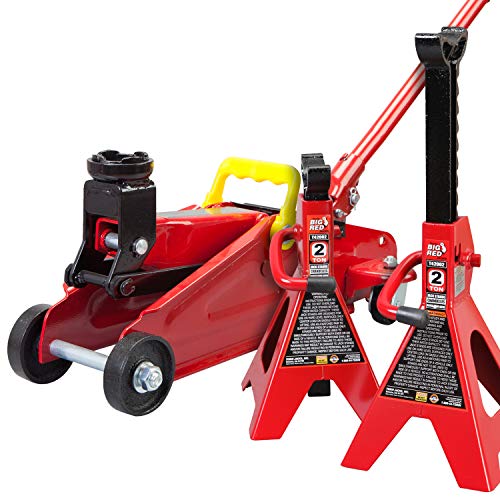
BIG RED T82001 2-Ton Floor Jack Combo
|
9.2/10 | Buy |
| Best Premium |
 BIG RED 2-Ton Hydraulic Trolley Floor Jack Combo |
9.1/10 | Buy |
| Best Budget |
 Jack Boss 2-Ton Low-Profile Ratchet Jack Stands |
8.6/10 | Buy |
 K Tool International 63097A 2-Ton Trolley Jack |
8.6/10 | Buy | |
 Amylove 4-Piece Universal Rubber Jack Stand Pads |
8.4/10 | Buy | |
 Winturbor 3-Ton Low Profile Jack with Stands |
8.1/10 | Buy | |
| Best Value |
 DNA Motoring 2-Ton Jack and Stands Kit |
8.0/10 | Buy |
 DNA Motoring 2-Ton Floor Jack and Stands Kit |
8.0/10 | Buy |
BIG RED T82001 2-Ton Floor Jack Combo
Pairing a 2-ton hydraulic trolley jack with two matching ratchet stands, this BIG RED set provides essential lifting equipment for compact and mid-size passenger cars. Integrated steel casters, an overload bypass system, and a built-in handle make garage servicing straightforward and portable.
Pros
- Includes matching 2-ton stands with secure ratchet locks
- Safety bypass valve prevents dangerous overloading during use
- Swivel casters and top handle ensure easy positioning
- Heavy-duty steel build provides dependable strength
Cons
- 13-3/8-inch maximum lift height is low for lifted SUVs
- 2-ton capacity restricts use on heavier full-size trucks
- 5-1/4-inch minimum clearance cannot fit low-profile sports vehicles
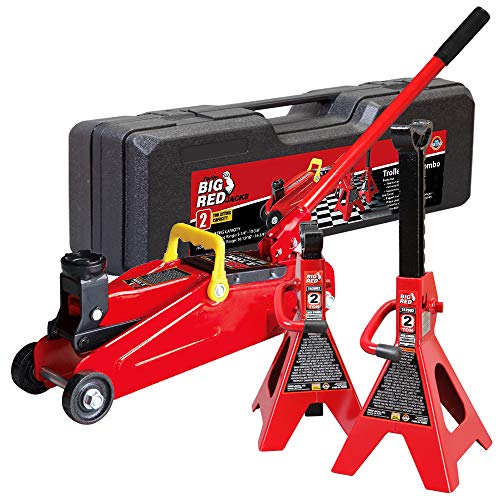
BIG RED 2-Ton Hydraulic Trolley Floor Jack Combo
The BIG RED T82001S is a compact 2-ton hydraulic trolley service jack combo bundled with two matching ratcheting jack stands and a blow-mold carrying case. Delivering a 5.5-inch to 13.4-inch lift range with integrated overload protection, this kit is an ideal portable maintenance setup for DIY mechanics working on compact sedans, small coupes, and light passenger cars.
Pros
- All-in-one starter kit includes both the lifting trolley jack and two rated mechanical support stands in a single case
- Built-in hydraulic overload valve provides an essential safety safeguard against accidental over-capacity operation
- 360-degree swivel saddle and rear caster make positioning straightforward in confined single-car garage bays
- Sawtooth ratchet bars on the stands lock quickly and positively into place across five height positions
Cons
- Maximum lift height of 13.4 inches will not provide enough vertical reach to overcome suspension droop on full-size trucks or high-clearance SUVs
- Minimum collapsed saddle height of 5.5 inches is too tall to clear slammed track cars or sports vehicles with low front splitters
- Standard single-piston hydraulic pump requires more handle cycles to reach full extension than high-displacement rapid-pump units
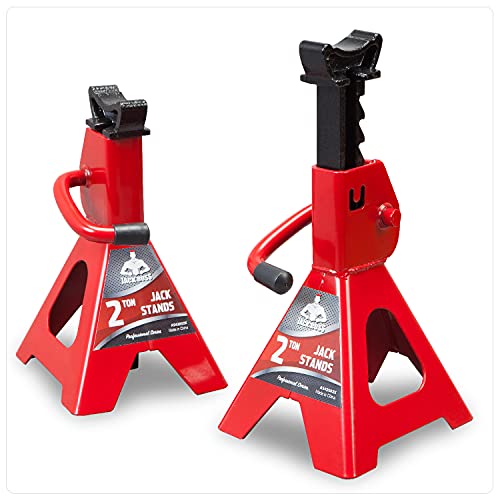
Jack Boss 2-Ton Low-Profile Ratchet Jack Stands
Designed for compact cars and small unibody vehicles, these Jack Boss low-profile jack stands combine a welded mild steel pyramid base with a ductile iron sawtooth ratchet bar spanning a 9.8-inch to 15-inch height range. They provide a lightweight, compact footprint for DIY garage maintenance, though the manufacturer explicitly advises against using them on trucks, large SUVs, or vehicles requiring over 15 inches of chassis clearance.
Pros
- Low 9.8-inch collapsed height fits easily under small passenger cars and lower unibody lift points
- Ductile iron sawtooth ratchet bar allows fast, tool-free height selection and positive pawl engagement
- Lightweight 10.5-pound overall build makes carrying, positioning, and garage storage simple
- Fully welded mild steel frame with protective powder coating guards against rust and shop grime
Cons
- Maximum 15-inch reach is too short for pickup trucks, full-size SUVs, or lifted off-road vehicles
- Single-pawl ratchet design lacks a secondary captive locking pin or redundant safety stop
- Steel concave saddle does not include rubber protection, which may mar painted unibody pinch welds without an aftermarket pad
K Tool International 63097A 2-Ton Trolley Jack
Built from heavy-duty steel with rear swivel casters, this compact trolley jack offers up to 13 inches of lift for home garage maintenance. An integrated bypass safety valve and 4,000-pound capacity make it a dependable option for everyday car repairs.
Pros
- Durable heavy-duty steel frame
- Rear swivel casters ensure smooth maneuverability
- Integrated bypass safety valve prevents overextension
- One-year warranty covers materials and workmanship
Cons
- 13-inch maximum lift height limits utility on taller trucks
- 5.3-inch minimum height cannot clear ultra low-profile vehicles
Amylove 4-Piece Universal Rubber Jack Stand Pads
This four-piece rubber adapter set provides circular pucks and V-groove blocks designed to buffer unibody pinch welds and painted chassis rails against metal jack saddles. It is an affordable accessory for DIY garage mechanics seeking to prevent rocker seam bending and paint damage during routine maintenance.
Pros
- Two distinct shapes (round and V-groove) provide versatility across floor jacks and jack stands
- Effectively shields unibody pinch welds and painted rocker flanges from metal-on-metal crushing
- Durable rubber composition increases surface grip to minimize chassis slipping on slick metal saddles
- Four-piece bundle provides enough adapters to equip multiple lifting or static support points
Cons
- High-density rubber can gradually compress, gouge, or split under thin, sharp unibody seams under heavy vehicle weight
- No manufacturer-specified working load limit (WLL) or tonnage rating; relies on underlying stand capacity
- Round pucks may not seat flush in oversized commercial jack saddles or exceptionally shallow floor jack dishes
Winturbor 3-Ton Low Profile Jack with Stands
Engineered for garage maintenance, this floor jack lowers to 3.3 inches to clear low-slung chassis and lifts up to 18.5 inches. The included pair of 3-ton ratchet stands provides secure support during tire rotations and brake service.
Pros
- Low 3.3-inch clearance fits low-profile cars easily.
- Dual-piston pump provides rapid and efficient lifting.
- Includes a matching pair of 3-ton jack stands.
- Rubber saddle and foam bumper prevent vehicle damage.
Cons
- Heavy total weight at over 81 pounds.
- Jack stand height maxes out at 17.2 inches.
DNA Motoring 2-Ton Jack and Stands Kit
Tailored for standard passenger cars, this all-in-one steel lifting set pairs a 2-ton hydraulic floor jack with two matching ratchet stands. It provides essential lifting power and overload safety, though the 13-inch maximum lift height makes it unsuitable for trucks and large SUVs.
Pros
- Complete set includes floor jack and two matching stands
- Heavy-duty welded steel frame ensures dependable durability
- Built-in overload protection valve enhances operation safety
- Pyramid base on stands provides stable vehicle support
Cons
- Not suitable for pickup trucks or large SUVs
- Maximum jack lift height is limited to 13 inches
- Restricted strictly to vertical lifting applications
DNA Motoring 2-Ton Floor Jack and Stands Kit
This bundled kit pairs a 2-ton hydraulic floor jack with two matching ratchet stands, providing essential lifting equipment for standard passenger cars. Its modest 13-inch maximum lift height and 4,000-pound capacity make it ideal for basic maintenance on smaller vehicles.
Pros
- Includes both a hydraulic jack and two support stands
- Integrated overload protection valve enhances operational safety
- Swivel casters allow smooth and precise garage maneuvering
- Wide pyramid base on stands ensures stable vertical support
Cons
- Not suitable for pickup trucks or large SUVs
- Maximum jack lift height is limited to 13 inches
Understanding the Mechanical Principles of Elevated Vehicle Support
Hydraulic floor jacks and mechanical jack stands serve two entirely different engineering purposes in any automotive workshop. A hydraulic trolley jack is an active lifting mechanism designed to convert manual leverage into concentrated fluid pressure to overcome vehicle gravity. In contrast, a jack stand is a passive structural column engineered to support static loads through positive mechanical interlock. Overlooking this fundamental engineering boundary creates extreme danger because hydraulic fluid cannot provide a foolproof static hold. Resolving the search intent behind why you must use jack stands with a floor jack requires analyzing fluid physics, mechanical locking limits, and practical workshop protocols.
Hydraulic Fluid Dynamics and the Reality of Seal Bleed-Down
Hydraulic service jacks operate on Pascal’s principle, where force applied to a small pump piston displaces hydraulic fluid into a larger ram cylinder to generate massive lifting leverage. This entire hydraulic system relies on flexible nitrile rubber O-rings, polyurethane U-cup piston seals, and tiny steel check balls to maintain pressure within the fluid chamber. Over time, heat cycles, microscopic contaminants, and mechanical wear degrade these elastomeric seals. When a tiny leak develops around a cylinder gland or release valve seat, pressurized fluid seeps back into the low-pressure reservoir. This gradual fluid transfer causes the lifting arm to creep downward silently, slowly crushing anything caught beneath the chassis.
Catastrophic hydraulic failure can also strike instantaneously without any visible warning signs or gradual fluid weeping. If an internal check ball unseats due to metal shavings or an internal bypass valve spring fatigues under static strain, the hydraulic circuit loses pressure in a fraction of a second. Unlike mechanical columns, hydraulic jacks provide no secondary catch mechanism to halt a falling lift arm once fluid pressure drops. Environmental factors like temperature drops can also decrease internal fluid volume and pressure, causing an unattended jack to settle over an afternoon. Because you cannot see internal fluid cavitation or seal degradation with the naked eye, treating a hydraulic jack as a static vehicle support is an unacceptable risk.
Manufacturer Design Limits and Safety Bypass Limitations
Equipment manufacturers explicitly state across their technical documentation that hydraulic floor jacks are lifting instruments rather than stationary load-holding devices. Brands like BIG RED, K Tool International, and DNA Motoring clearly warn users that their hydraulic service jacks must never support an elevated load for prolonged periods. The technical manuals for these trolley jacks emphasize that immediate transfer to rated jack stands is mandatory before performing any vehicle inspection or service work. These warnings are not mere legal disclaimers; they reflect the core mechanical capabilities and operational boundaries of hydraulic cylinders.
Many DIY mechanics mistakenly assume that built-in overload protection valves will keep them safe while working under a raised vehicle. Floor jacks feature integrated safety bypass valves designed to prevent the operator from lifting an object that exceeds the tool’s maximum rated capacity. However, these bypass valves function exclusively during the active pumping phase to divert fluid when line pressure spikes beyond factory thresholds. They offer zero structural protection against static seal degradation, check valve contamination, or gradual hydraulic leak-down once pumping stops. Relying on an internal safety valve to support static vehicle weight misinterprets how hydraulic safety mechanisms operate in the real world.
Axle Load Distribution and Tonnage Capacity Math
Selecting properly rated equipment requires understanding the difference between total vehicle curb weight and localized axle lifting loads. When you elevate one end of a car or crossover using a trolley jack, you are not hoisting the entire curb weight of the automobile. The jack typically bears approximately 50 to 60 percent of the total vehicle mass, while the opposing wheels remaining on the pavement support the rest. For instance, raising the front end of a 4,000-pound sedan places roughly 2,400 pounds of load onto the lifting saddle. This distribution math explains why a 2-ton or 3-ton hydraulic floor jack provides an adequate safety margin for most domestic passenger cars and small SUVs.
Jack stand ratings, however, require careful verification regarding whether the stated capacity applies per stand or per pair. Standard ASME PASE guidelines require jack stands to be rated and sold in pairs, meaning a 2-ton set provides 4,000 pounds of combined static capacity when used together. Single stands from brands like Jack Boss or winturbor are designed to support their rated corner load when positioned under verified structural lift points. If you use a single 2-ton stand to support an entire vehicle axle, you risk overloading the ductile iron ratchet mechanism. Always ensure that the combined working load limit of your jack stand pair comfortably exceeds the gross axle weight rating listed on your driver’s door jamb placard.
Anatomy of Jack Stand Stability: Ratchet Bars and Pyramid Bases
Jack stands achieve absolute static stability by replacing hydraulic fluid pressure with rigid structural metallurgy. High-grade mechanical stands feature ductile iron ratchet bars cast with a multi-position sawtooth profile that mates directly against a heavy-duty locking pawl. When you raise the ratchet bar to your desired height, gravity and spring tension drive the self-locking pawl into the teeth, creating an unyielding mechanical wedge. Once vehicle weight settles onto the concave saddle, downward force drives the pawl even deeper into the ratchet notches. This mechanical interlock physically prevents the center post from descending unless the external release handle is intentionally disengaged under zero load.
The outer support frame of a quality jack stand is crafted from heavy-gauge stamped steel welded into a wide pyramid foot base. This broad four-legged perimeter distributes the downward vehicular force across a wide concrete footprint to prevent tipping and structural sinking. Brands like Jack Boss and BIG RED utilize fully welded pyramid bases that resist lateral torsion and frame deflection during heavy chassis loading. The deep concave saddle cradles the vehicle’s frame rail or pinch weld, preventing the contact point from shifting horizontally. Unlike rolling trolley jacks equipped with steel casters, a wide-base jack stand cannot roll or shift when you wrench on stubborn suspension bolts.
Protecting Vehicle Lift Points and Underbody Seams
Positioning lifting tools beneath modern automobiles demands precise placement to avoid severe structural body damage. Unibody passenger cars feature designated pinch weld flanges along the rocker panels that contain reinforced internal steel gussets designed to handle concentrated vertical loads. Lifting directly on these thin sheet metal seams with a bare steel jack saddle can crush the pinch weld, distort exterior body panels, or crack expensive rocker trim. Utilizing slotted rubber jack pads, such as those made by Amylove, cushions the contact interface and cradles the pinch weld flange inside a protective grooved channel.
Trucks and traditional body-on-frame SUVs present different structural contact requirements that require sturdy flat support. On these heavier platforms, technicians place floor jack saddles and jack stand heads directly beneath solid boxed frame rails, suspension control arm mounts, or rear axle tubes. Never position a floor jack saddle or jack stand under unsupported sheet metal floor pans, steering linkages, transmission casings, or thin engine oil pans. Crushing an oil pan or puncturing a floor pan creates expensive mechanical repairs and compromises vehicle balance on the lift head. When planning vehicle height, calculating required working height ensures you have sufficient room to position mechanical stands under these designated structural locations.
Safe Vehicle Elevation and Weight Transfer Protocols
Executing a safe lift requires strict adherence to an orderly, step-by-step garage workflow that eliminates accidental vehicle motion. Always position your automobile on a solid, level concrete floor; never attempt to raise a car on sloped asphalt, gravel, or soft soil where stands can sink. Shift an automatic transmission into Park, or engage first gear in a manual transmission, and firmly set the emergency parking brake. Place heavy-duty wheel chocks snugly in front of and behind the tires on the axle that will remain in contact with the ground. This prevents the vehicle from rolling backward or forward as the lifting arm arcs upward during the elevation stroke.
Align the floor jack saddle squarely beneath the approved central or side jacking point and verify that the rubber pad is centered. Pump the jack handle smoothly to elevate the chassis until the tires clear the concrete and you reach your desired working clearance. Slide your mechanical jack stands directly beneath the reinforced vehicle support points, adjusting the ductile iron ratchet bars to equal heights on both sides. Ensure that the locking pawls engage completely into the ratchet sawtooth notches before preparing to lower the vehicle. Proper alignment during this staging phase ensures that the vehicle mass centers perfectly over the pyramid base.
Lowering the vehicle onto the stands requires deliberate micro-metering using the jack’s release valve mechanism. Rotate the release handle slowly counterclockwise, cracking the universal joint or release valve just enough to let the hydraulic arm settle gradually. Allow the full vehicle weight to transfer smoothly onto the concave saddles of the jack stands until the floor jack saddle drops slightly free. Once the weight rests entirely on the stands, leave the floor jack positioned just below the frame as an extra redundant obstacle without bearing active weight. Before sliding any part of your body beneath the vehicle, vigorously push against the fender or bumper to confirm rock-solid lateral stability.
Diagnosing Hydraulic Wear and Operational Hazards
Routine inspection of your hydraulic floor jack helps you catch developing seal failures before they result in a dangerous workshop mishap. Examine the polished chrome ram cylinder regularly for scoring, pitting, or rust buildup that can tear internal rubber seals during normal pump cycles. Check around the release valve spindle, main ram gland, and oil reservoir filler plug for signs of weeping or dripping hydraulic fluid. If the pump handle feels spongy or fails to lift smoothly through its full stroke, air has likely entrained into the high-pressure fluid passage. Bleeding the hydraulic chamber and topping off fluid levels with clean ISO VG 22 or ISO VG 32 hydraulic jack oil restores proper pumping action.
Never replenish a hydraulic floor jack with motor oil, brake fluid, or automatic transmission fluid under any circumstances. Automotive brake fluid is a destructive solvent that chemically breaks down internal nitrile rubber seals within a few weeks of exposure. Motor oil and transmission fluid contain aggressive detergents and incorrect viscosities that cause seal swelling, valve sticking, and internal pressure cavitation. If a hydraulic trolley jack continues to lose elevation under load after thorough air purging and fluid replenishment, internal check valves have failed. A floor jack that creeps down under load must be retired immediately or rebuilt with new factory seals before ever touching another vehicle.
Practical Guidelines for Long-Term Workshop Safety
Adopting professional garage safety habits ensures that every automotive maintenance task concludes without injury or damaged machinery. Always store your hydraulic trolley jack with the ram fully retracted and the release valve turned clockwise to closed or loosely cracked. Storing the cylinder retracted shields the polished chrome ram from atmospheric humidity, ambient workshop dirt, and accidental impact scratches. Furthermore, keeping your mechanical jack stands clean and free of thick grease allows you to inspect the ductile iron ratchet teeth easily for cracks or abnormal wear. Never use bent, cracked, or shop-modified jack stands that have suffered accidental drops or physical overload.
Ultimately, utilizing dedicated jack stands alongside your hydraulic floor jack is an absolute non-negotiable rule of automotive service. No matter how brief an underbody inspection might seem, sliding beneath a car supported solely by fluid pressure exposes you to catastrophic danger. High-quality combos from trusted manufacturers, such as the 2-ton and 3-ton packages offered by BIG RED, winturbor, and DNA Motoring, provide the complete toolkit necessary to elevate and support vehicles safely. By understanding hydraulic limitations, respecting axle load math, and locking mechanical stands into place every single time, you protect both your vehicle and your life during garage repairs.
About the author
Hank O'Hop writes about automotive tools, hands-on repairs, and the challenges of maintaining and improving project cars. His published work covers workshop equipment, engine hoists, power tools, and garage upgrades, offering practical insights for readers who prefer to understand their equipment before putting it to work.