
Can You Leave a Car on a Floor Jack Overnight Safely: Critical Safety Analysis for 2026
Can You Leave A Car On A Floor Jack Overnight Safely? Learn the hydraulic pressure risks and critical garage safety protocols updated for November 2026.
 By Mike Bumbeck
Updated October 28, 2026


Working on suspension components or conducting an extended brake rotor replacement often pushes garage projects late into the evening. Home mechanics frequently face the dilemma of walking away from an elevated vehicle until morning, wondering whether leaving the car elevated on the hydraulic lift arm presents any real danger. The short, unequivocal answer to whether can you leave a car on a floor jack overnight safely is an absolute no. A hydraulic floor jack operates entirely as a temporary lifting mechanism rather than a mechanical load-holding device.
Hydraulic systems rely on internal fluid pressure, nitrile rubber O-rings, and check valves that remain constantly vulnerable to gradual pressure bleed, temperature shifts, and fluid leakage. Relying on a pressurized cylinder to suspend thousands of pounds overnight invites catastrophic chassis drops, frame distortion, and severe workshop hazards. When deciding how to secure an elevated vehicle for extended periods, evaluating car ramps versus jack stands highlights why secondary mechanical locking supports are non-negotiable garage essentials. Every safe automotive lifting protocol requires transferring vehicle mass immediately onto mechanical stands before stepping away from the garage.
| Award | Product | BJL Score About BJL ScoreThe BJL Score is our own rating from 0 to 10, based on performance, design and build, ease of use, and value. It reflects independent research and is never influenced by manufacturers, retailers, or affiliate commissions. Learn more › | |
|---|---|---|---|
| Best Overall |
TONDA 1.5-Ton Hydraulic Floor Jack
|
9.1/10 | Buy |
| Best Premium |
 Jack Boss 3-Ton Low Profile Floor Jack |
8.8/10 | Buy |
| Best Value |
 Jack Boss 2.5-Ton Low Profile Floor Jack |
8.6/10 | Buy |
| Best Budget |
 Pro-LifT F-2315PE 3000 LBS Hydraulic Trolley Jack |
8.3/10 | Buy |
 BIG RED T83006 3-Ton Floor Jack |
8.3/10 | Buy | |
 BIG RED 1.5-Ton Hydraulic Trolley Floor Jack |
8.1/10 | Buy | |
 Jack Boss 3-Ton Low Profile Floor Jack |
8.0/10 | Buy |
TONDA 1.5-Ton Hydraulic Floor Jack
Weighing under 15 pounds, this compact steel floor jack offers a 3,000-pound capacity for basic garage maintenance and tire rotations. Its 4.9-inch to 11.8-inch lift range and integrated carry handle make it a practical option for owners of compact cars and sedans.
Pros
- Lightweight construction at roughly 15 pounds
- Integrated carry handle for convenient transport
- Built-in bypass valve prevents accidental over-extension
- Swivel casters provide smooth positioning under vehicles
Cons
- Limited 11.8-inch maximum lift height
- 1.5-ton capacity unsuitable for trucks or SUVs
- 4.9-inch minimum clearance cannot fit ultra-low vehicles
Jack Boss 3-Ton Low Profile Floor Jack
Built with a hybrid aluminum and steel frame, this 3-ton floor jack pairs a low 3-15/16-inch minimum clearance with a dual-piston rapid pump. It serves as a versatile lifting solution for low-slung sedans as well as standard SUVs and minivans.
Pros
- Low-profile 3-15/16-inch minimum lifting clearance
- Fast elevation with dual-piston hydraulic pump
- Hybrid aluminum and steel frame construction
- Protective rubber saddle shields vehicle chassis
- Meets rigorous ANSI/ASME PASE safety standards
Cons
- At 58.5 pounds, it remains relatively heavy to transport
- 18-5/16-inch max height may be limiting for lifted trucks
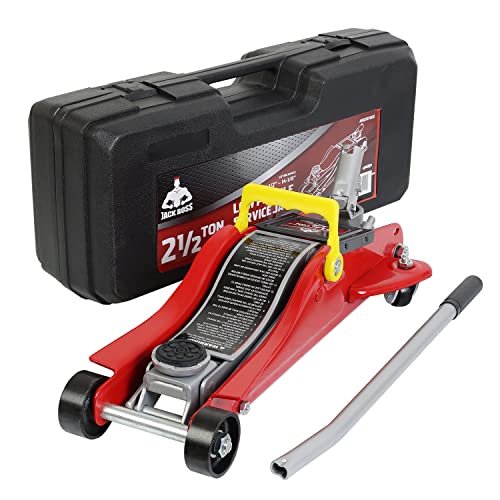
Jack Boss 2.5-Ton Low Profile Floor Jack
Designed for home garages, this compact hydraulic trolley jack slides easily under low-clearance sedans with its 3.5-inch minimum height. Its 5,500-pound capacity and bundled carrying case make routine tire changes and undercarriage maintenance straightforward to manage and store.
Pros
- Low 3.5-inch minimum height fits low-clearance vehicles
- Includes hard-shell case for organized storage
- Four 360-degree swivel casters allow easy positioning
- Integrated overload valve enhances operating safety
- Padded handle protects vehicle bodywork from damage
Cons
- 14-inch maximum lift height limits high-clearance vehicle use
- Weighs over 35 pounds, making transport somewhat heavy
Pro-LifT F-2315PE 3000 LBS Hydraulic Trolley Jack
The Pro-LifT F-2315PE is an 18-pound portable hydraulic trolley jack rated for 3,000 pounds with a 5.25-inch to 12-inch lift range and an included blow-molded case. It is ideal for residential DIYers, mobile mechanics, and car owners seeking a compact, reliable tool for quick tire changes and brake service on passenger vehicles.
Pros
- Compact 18-pound steel chassis and integrated carrying handle make transport and positioning effortless
- Included hard-shell blow-molded case protects against dust, moisture, and fluid mess during transport
- All-welded steel frame provides dependable structural rigidity over lightweight stamped alternatives
- Rear swivel casters ensure smooth maneuverability on level concrete garage floors and paved driveways
Cons
- Maximum lift height of 12 inches limits working clearance and is not suitable for high-clearance trucks or tall SUVs
- Minimum saddle height of 5.25 inches may not clear lowered sports cars without auxiliary drive-on helper ramps
- The 3,000-lb capacity restricts use strictly to corner lifting on lightweight passenger cars and small crossovers
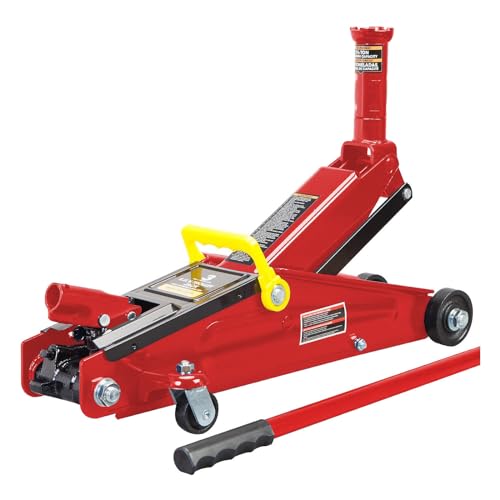
BIG RED T83006 3-Ton Floor Jack
Engineered for high-riding trucks and SUVs, the BIG RED T83006 delivers up to 20-7/8 inches of lift height with an extended saddle neck. Its 6,000-pound capacity and integrated overload bypass provide reliable lifting power for routine garage maintenance.
Pros
- Generous 20-7/8 inch maximum lift height
- Extended saddle neck reaches high truck frames quickly
- Built-in safety bypass valve prevents overloading
- Smooth 360-degree swivel casters ease garage positioning
Cons
- Minimum 5-7/8 inch height is tall for low-profile cars
- Single-piston pump requires more strokes than dual-piston models
BIG RED 1.5-Ton Hydraulic Trolley Floor Jack
Built for standard passenger cars, this compact steel trolley jack delivers a 13-inch maximum lift and includes a dedicated storage case for easy trunk transport. Its built-in safety bypass and smooth-rolling casters make it a practical option for roadside tire changes and routine garage maintenance.
Pros
- Lightweight and portable at roughly 16 pounds
- Includes a protective blow-mold carrying case
- Safety bypass system prevents hazardous overloading
- Full 360-degree rear swivel casters for easy alignment
Cons
- Not rated or recommended for SUVs and trucks
- Limited maximum lifting height of 13 inches
Jack Boss 3-Ton Low Profile Floor Jack
Built for home garages and shops, this heavy-duty steel service jack combines a low 3-1/8-inch minimum clearance with a high 20-inch maximum reach. Dual hydraulic pumps ensure fast lifting, while a slow-descent release valve safely lowers vehicles weighing up to 6,600 pounds.
Pros
- Low 3-1/8-inch profile fits low-clearance vehicles
- Dual pumps reach desired height with fewer strokes
- Wide lifting range extends up to 20 inches
- Slow-descent valve enhances vehicle lowering safety
- Sturdy all-steel frame built for heavy garage use
Cons
- Heavy 69-pound weight reduces overall portability
- Large 30-inch length demands substantial storage space
The Mechanics and Severe Risks of Overnight Hydraulic Vehicle Support
Leaving any motor vehicle resting solely on a hydraulic floor jack overnight introduces dangerous garage hazards and risks severe structural vehicle damage. Hydraulic jacks rely entirely on pressurized fluid confined by rubber seals to maintain lifting height, making them inherently dynamic tools rather than static supports. Over several hours, ambient temperature changes, seal seepage, and microscopic valve leakage inevitably cause hydraulic pressure to bleed down. Understanding the mechanical limitations of automotive lifting tools clarifies why mechanical locking stands are always required for any extended vehicle elevation.
How Hydraulic Pressure Bleed Causes Sudden Lift Failure
Hydraulic trolley jacks operate on Pascal’s principle, where mechanical leverage forces hydraulic oil into a high-pressure cylinder to push a lifting ram upward. The fluid pressure required to hold an axle weighing thousands of pounds reaches extreme internal levels within the cylinder casing. This immense hydraulic force relies entirely on flexible nitrile rubber O-rings, polyurethane cup seals, and precision-machined steel check balls. Even in brand-new service jacks, these soft sealing components are engineered to contain dynamic fluid motion during active lifting, not to hold static loads indefinitely.
Microscopic imperfections in the check valve seating surfaces or minor surface wear on internal cylinder walls permit tiny volumes of fluid to bypass the primary pressure chamber over time. While an active lift of five minutes exhibits no noticeable settling, six to eight hours of sustained pressure forces hydraulic fluid past the internal seals back into the reservoir. This continuous seepage results in ram creep, where the lift arm slowly settles downward millimeter by millimeter. In worst-case scenarios, an aged seal can suffer complete blowout under sustained static stress, dropping the vehicle abruptly to the garage floor.
Thermal Contraction of Hydraulic Fluid in Cool Garages
Ambient temperature fluctuations inside residential garages significantly accelerate hydraulic cylinder pressure drop overnight. When a vehicle is lifted in the late afternoon, the hydraulic jack oil, commonly an anti-foaming ISO VG 22 or ISO VG 32 fluid, is warm from ambient air and friction. As outside temperatures plummet after sunset, the unheated garage air cools the steel jack chassis and the enclosed hydraulic reservoir. Fluids naturally contract as they cool, directly reducing the physical volume of oil supporting the main cylinder piston.
This volumetric reduction immediately decreases internal hydraulic pressure, causing the lift arm to sag even without mechanical seal leakage. A vehicle that appeared securely elevated at dusk can sit several inches lower by sunrise simply due to basic thermal dynamics. If tools, jack handles, or body panels are positioned near the vehicle, this unexpected settling can crush surrounding equipment or distort vehicle bodywork. When vehicle maintenance requires leaving an axle elevated for multi-day repairs, relying on thermal stability inside a standard hydraulic cylinder is an unacceptable gamble.
Chassis Instability and Lateral Shift on Rolling Casters
Beyond internal hydraulic loss, the physical architecture of a trolley floor jack presents severe lateral tipping hazards during extended vehicle support. Hydraulic service jacks, such as the TONDA 1.5 Ton or the Jack Boss 3 Ton Low Profile models, are mounted on wide steel front rollers and rear 360-degree swivel casters. These wheels are specifically engineered to roll across concrete as the lifting arm swings through an arc, compensating for changing chassis geometry during elevation. However, those same free-rolling wheels make the jack inherently mobile and susceptible to unintended directional shifting.
Overnight settlement or subtle ground vibrations can induce lateral forces that cause the jack casters to pivot or shift unexpectedly. If a tire on the grounded axle slowly loses air pressure or the garage floor features even a slight slope, the vehicle mass shifts toward the jack saddle. Unlike stationary jack stands with wide, pyramid-style bases, a trolley jack offers a relatively narrow footprint that can tilt or kick out sideways under uneven weight distribution. Once a rolling jack begins to tilt off its vertical axis, the lifting arm rapidly slips off the chassis contact point.
Undercarriage and Suspension Damage from Creeping Lift Saddles
When a hydraulic floor jack slowly loses height beneath an unattended vehicle, the descending weight concentrates immense stresses on localized chassis points. Most modern passenger cars feature unibody construction where lift points consist of reinforced vertical pinch weld seams along the rocker panels. Standard steel jack saddles with grooved metal edges are designed to seat against these seams temporarily while the vehicle is raised. As the jack cylinder slowly deflates overnight, the changing angle of the lift arm can fold, crush, or tear the delicate sheet metal flanges.
Vehicles equipped with factory ground effects, plastic side skirts, or aerodynamic undertrays face even greater risks from unmonitored hydraulic creep. If the jack arm drifts downward unevenly, the bodywork can catch on the steel side plates of the jack frame, cracking expensive fiberglass or composite trim. Furthermore, if a jack is positioned under an independent suspension control arm, prolonged static deflection places unnatural torque on rubber suspension bushings and ball joints. Proper workshop practice requires transferring vehicle weight directly to broad, secure points before component damage occurs.
The Purpose and Limitations of Internal Safety Bypass Valves
Many DIY mechanics mistakenly assume that built-in safety valves on modern floor jacks provide automatic protection against overnight settling. Commercial trolley jacks, including models from BIG RED and Jack Boss, incorporate internal safety bypass valves engineered into their hydraulic pump manifolds. These spring-loaded bypass valves serve a single specific purpose: preventing the operator from lifting loads that exceed the rated working load limit. When hydraulic pressure exceeds factory safety thresholds, the bypass valve opens momentarily to divert excess oil back to the reservoir.
These internal overload mechanisms provide zero protection against pressure loss, seal degradation, or gradual fluid seepage while the jack is held stationary. In fact, safety valves contain their own internal springs and sealing balls that represent another potential pathway for microscopic fluid bypass under continuous static pressure. Some heavy-duty units, like the Jack Boss 3 Ton racing jack, undergo factory overload testing to verify structural strength up to 1.5 times rated capacity. Even with certified ASME PASE compliance and heavy overload margins, manufacturers universally state that safety valves are not holding brakes and cannot replace mechanical stands.
Step-by-Step Protocol for Safely Staging a Vehicle Overnight
Safely elevating a vehicle for overnight maintenance requires a disciplined staging sequence that isolates hydraulic equipment from static holding duties. The entire procedure must begin on a solid, level concrete surface with the vehicle transmission shifted into park or reverse gear. Heavy-duty rubber or steel wheel chocks must be wedged tightly against both sides of the tires remaining on the garage floor to eliminate any roll-away movement. While using car ramps at home provides excellent elevation for rapid oil changes, jobs requiring wheel removal demand a coordinated floor jack and jack stand protocol.
Position the floor jack saddle directly beneath a factory-approved lifting location, such as a reinforced crossmember, frame rail, or boxed subframe mount. Pump the jack handle until the vehicle rises to the desired clearance height, ensuring the lifting arm travels smoothly through its upward arc. Position a pair of mechanical, ASME PASE compliant jack stands with locking pawls or solid steel pins directly beneath structural frame points. Slowly rotate the jack release valve counterclockwise, metering the fluid discharge carefully to lower the vehicle chassis gently onto the broad saddles of the stands.
Once the vehicle mass rests firmly on the mechanical stands, perform a deliberate physical stability check by firmly pushing the bumper or fender. The vehicle should exhibit zero rocking, shifting, or settling on the stands before you leave the work area. Many mechanics leave the floor jack saddle raised until it just makes light contact with an adjacent crossmember as an emergency backup. However, the release valve should remain slightly relieved so that zero static vehicle weight rests on the hydraulic cylinder overnight.
Hydraulic Jack Maintenance to Prevent Pressure Bleed and Leaks
Maintaining hydraulic floor jacks in optimal condition reduces the likelihood of premature pressure loss during normal service operations. Trapped air bubbles inside the hydraulic circuit are the leading cause of spongy handle resistance, incomplete lift strokes, and rapid settling under load. Purging air requires turning the release valve counterclockwise to the open position, pumping the handle rapidly through ten to fifteen full cycles, and tightening the valve closed. If the ram continues to exhibit slow lifting or spongy travel, removing the rubber oil fill plug allows trapped air pockets to escape from the fluid reservoir.
Fluid replenishment must be performed exclusively with dedicated, anti-foaming ISO VG 22 or ISO VG 32 hydraulic jack oil. Under no circumstances should motor oil, brake fluid, or automatic transmission fluid ever be introduced into a hydraulic floor jack. Brake fluid and standard automotive lubricants contain aggressive chemical additives that degrade internal nitrile rubber O-rings, leading to catastrophic seal failure. While operating metal service ramps avoids hydraulic fluid maintenance entirely, keeping service jacks clean and properly filled ensures reliable lifting power for years of garage projects.
Routine inspection of the polished chrome cylinder ram is equally vital for preserving internal pressure containment. Any accumulation of grit, metal shavings, or moisture on the ram surface can score the cylinder bore and cut the high-pressure cup seals during retraction. Always store hydraulic trolley jacks with the lift arm fully lowered and the release valve lightly closed to keep the polished ram protected inside the fluid bath. Checking around the base of the pump pistons for weeping oil provides an early warning sign that internal seals require replacement before the jack is loaded again.
Choosing Reliable Lifting Equipment for Home Garage Projects
Selecting the right floor jack depends on matching vehicle curb weight, chassis ground clearance, and suspension travel against specific tool specifications. Compact sedans and light sports cars benefit from low-profile frames like the Jack Boss 3 Ton Low Profile or the Jack Boss 2.5 Ton trolley jack. These units feature minimum collapsed heights ranging from 3.5 inches to less than 4 inches, easily slipping beneath low rocker panels and factory pinch welds. Equipped with dual-piston rapid-pump mechanisms, these jacks reach the vehicle chassis in fewer handle strokes, saving effort during repetitive garage setups.
Full-size pickup trucks, commercial vans, and lifted sport utility vehicles require significantly greater lifting stroke to overcome long suspension travel and axle droop. Service jacks such as the BIG RED 3 Ton Hydraulic Trolley Jack provide an extended maximum lift height of 20-7/8 inches with an extra-long saddle neck for taller frames. Portable options like the TONDA 1.5 Ton, Pro-LifT F-2315PE, or Big RED 1.5 Ton models offer compact steel frames and blow-molded carrying cases, making them convenient for trunk storage and roadside tire changes. Regardless of whether you select a heavy-duty steel garage jack or a lightweight aluminum hybrid racing jack, every manufacturer explicitly commands pairing the tool with rated jack stands.
Structural durability and maneuverability remain critical when managing heavy vehicle loads across concrete garage floors or paved driveways. Welded steel chassis provide maximum torsional rigidity under heavy loads, while hybrid aluminum-and-steel frames reduce total tool weight for easier transport. Ball-bearing rear swivel casters and wide front rollers ensure smooth positioning beneath designated factory crossmembers without excessive strain. Investing in quality lifting equipment with documented overload testing and integrated safety bypass valves establishes a strong foundation for home automotive maintenance, provided safe weight-holding protocols are always observed.
Treating a hydraulic floor jack strictly as an elevation tool and never as a static holding fixture protects both the mechanic and the vehicle. Overnight garage projects require mechanical locking jack stands, secure wheel chocks, and level concrete staging to eliminate the catastrophic risks of hydraulic pressure bleed. Understanding how fluid mechanics, thermal contraction, and caster mobility operate ensures that your vehicle remains safely suspended until the next morning’s work begins.
About the author
Mike Bumbeck is an automotive journalist and hands-on product evaluator with a long-standing interest in classic vehicles, motorcycles, and practical garage equipment. His work brings a grounded perspective to automotive tools, maintenance products, and the details that matter when choosing gear for real-world use.