
What Is Hydraulic Car Lift: Practical Guide and Garage Setup for 2026
Explore what is hydraulic car lift mechanics, bay clearances, and foundation rules in this detailed November 2026 home garage equipment guide.
 By Christian Hazel
Updated October 10, 2026

Crawling across cold garage concrete to service transmissions or replace worn suspension bushings quickly exposes the physical limits of traditional jack stands. Investing in reliable shop equipment changes how home mechanics and professional technicians interact with vehicles by moving heavy maintenance up to chest or standing height. Understanding what is hydraulic car lift technology entails allows vehicle owners to evaluate whether fluid-driven lifting frames or stationary post assemblies fit their workshop requirements. Modern equipment lines range from compact rolling jacks to heavy-duty two-post hoists designed for complete chassis access. For DIY enthusiasts exploring options, selecting capable hydraulic car lift setups provides a substantial leap in both daily productivity and workplace comfort.
Fluid power systems provide the immense mechanical force required to elevate multi-ton vehicles smoothly and safely. Before committing workshop square footage to any lifting structure, owners must assess structural slab thickness, available vertical ceiling height, and required electrical amperage. Reviewing proven residential car lift options helps identify how different frame architectures accommodate varying garage dimensions and vehicle weights. Choosing the right machinery turns challenging maintenance jobs into manageable routines while maintaining rigid physical safety through robust mechanical locking components.
| Award | Product | BJL Score About BJL ScoreThe BJL Score is our own rating from 0 to 10, based on performance, design and build, ease of use, and value. It reflects independent research and is never influenced by manufacturers, retailers, or affiliate commissions. Learn more › | |
|---|---|---|---|
| Best Overall |
DNA Motoring TOOLS-00234 2-Ton Hydraulic Trolley
|
8.8/10 | Buy |
| Best Budget |
 COZONY 5-Ton Hydraulic Car Ramps |
8.8/10 | Buy |
 Rueekfil 9,000 lbs Portable Car Lift |
8.8/10 | Buy | |
| Best Premium |
 Weize 12,000-lb 2-Post Automotive Lift with 4HP |
8.8/10 | Buy |
| Best Value |
 Albott 7000 LBS Portable Scissor Car Lift |
8.6/10 | Buy |
 KATRAX 7000 lb 2-Post Hydraulic Auto Lift |
8.3/10 | Buy | |
 VEVOR Portable Scissor Car Lift |
8.1/10 | Buy | |
 Albott 8000 LBS Portable Car Lift |
7.8/10 | Buy |
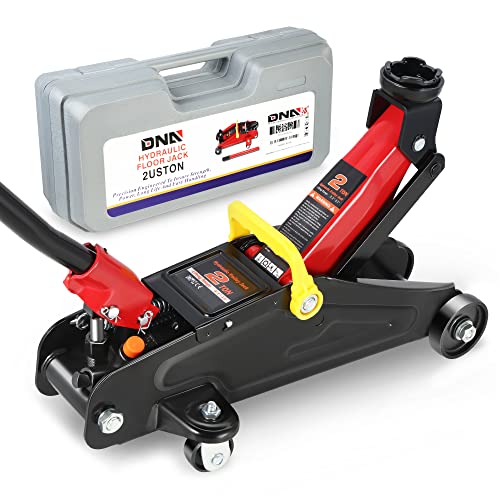
DNA Motoring TOOLS-00234 2-Ton Hydraulic Trolley
The DNA Motoring TOOLS-00234 is a compact 2-ton (4,000 lb) hydraulic trolley floor jack featuring a 5.1-inch to 13-inch lifting span and built-in overload protection. Engineered for DIY mechanics servicing passenger sedans and compact cars, it provides rapid vehicle lifting that must be supported with auxiliary mechanical jack stands.
Pros
- Manageable 4,000 lb capacity easily raises compact and mid-size passenger cars for wheel and brake service
- Built-in hydraulic overload valve prevents internal damage if overloaded beyond the rated capacity
- Rear swivel casters allow quick and precise positioning under factory lift points
- Compact frame footprint fits easily in residential garages with restricted floor space
Cons
- Maximum lift height is capped at 13 inches, limiting workspace depth for heavy underbody repairs
- Minimum 5.1-inch collapsed saddle height may not clear heavily lowered or track-tuned sports cars
- Not rated or recommended for full-size pickup trucks, commercial vans, or large three-row SUVs
COZONY 5-Ton Hydraulic Car Ramps
The COZONY Hydraulic Car Ramps offer a combined 11,050-pound (5-ton) capacity with an adjustable 9-inch to 14-inch lift range powered by integrated hydraulic jacks. Featuring a shallow approach angle for low-clearance vehicles, this heavy-duty steel pair suits home garage DIYers seeking dependable under-car service clearance without permanent floor anchoring.
Pros
- Substantial 11,050-lb combined rating comfortably accommodates compact cars up to mid-size trucks and SUVs
- Hydraulic elevation feature adds up to 5 inches of clearance over conventional fixed drive-on ramps
- Gradual approach angle accommodates lowered performance vehicles and low ground-clearance sedans
- Zero infrastructure requirements with no electrical wiring, air compressors, or foundation anchors needed
Cons
- Combined weight of 83.78 pounds requires physical effort to move and reposition around the shop floor
- Lifts only one axle at a time, preventing simultaneous four-wheel brake jobs or tire rotations without auxiliary stands
- Manual hydraulic pumps must be operated individually on each ramp to maintain level vehicle rise
Rueekfil 9,000 lbs Portable Car Lift
The Rueekfil 9,000-lb portable electric-hydraulic lift offers a low-profile, unanchored vehicle lifting solution for home mechanics facing standard 8-to-10-foot ceilings. Powered by a standard 120V motor and featuring mechanical locks with a 28-inch max rise, it provides a stable alternative to floor jacks for DIY tire, brake, and chassis service.
Pros
- Substantial 9,000-lb gross load capacity comfortably handles half-ton trucks and SUVs that exceed smaller 5,000-lb or 7,000-lb portable systems.
- Runs on standard 120V residential current, eliminating the cost and hassle of commercial electrical subpanel modifications.
- Completely unanchored layout requires zero concrete drilling, making it ideal for rented garages or post-tension slabs.
- Includes bottom wheels and wall-mount hanging brackets to maximize floor space when the lift is not in service.
Cons
- Hydraulic fluid is not pre-filled; requires sourcing 3.2 liters of ISO 46 hydraulic oil before initial priming and operation.
- A total shipping weight of 485 pounds requires multiple helpers or mechanical assistance during freight unloading and initial staging.
- The 28-inch maximum elevation provides creeper-level access but does not allow full standing headroom beneath the vehicle.
Weize 12,000-lb 2-Post Automotive Lift with 4HP
The Weize 12,000-lb two-post automotive lift delivers heavy-duty lifting capacity backed by a 4-HP, 220V single-phase motor and a convenient single-point mechanical safety lock release. With an overall height of roughly 112.6 inches and a generous 101-inch drive-through width, it is a practical choice for DIY mechanics and service bays working on half-ton to one-ton trucks.
Pros
- Substantial 12,000-lb load rating accommodates heavy diesel trucks, work vans, and family SUVs
- Single-point safety lock release mechanism streamlines vehicle lowering and improves shop efficiency
- High-power 4-HP 220V hydraulic power unit delivers reliable lifting torque for heavy chassis
- Generous 101-inch drive-through clearance prevents mirror and wheel scuffing on wide utility vehicles
- Relatively compact 112.6-inch overall height fits garages with moderate 10-to-11-foot ceilings
Cons
- Requires a dedicated 220V single-phase electrical circuit and hardwired connection by a qualified electrician
- Heavy freight shipping weight of 1,574 pounds requires mechanical equipment such as a forklift or tractor for offloading
- Lacks third-party Automotive Lift Institute (ALI) gold label certification, which may affect municipal or commercial insurance requirements
Albott 7000 LBS Portable Scissor Car Lift
The Albott 7000 LBS Portable Car Lift delivers reliable frame-engaging lifting power with a 28-inch maximum rise height, making it an excellent unanchored solution for low-ceiling residential garages. Built from high-strength Q235B steel, it suits DIY mechanics and car enthusiasts tackling brake jobs, tire rotations, and chassis maintenance on level concrete.
Pros
- Substantial 7,000-lb capacity easily handles most domestic sedans, sports cars, and midsize SUVs
- Mobile four-wheel design eliminates permanent concrete drilling and fits well under standard 8-to-10-foot residential ceilings
- Includes extension panels and multi-height adapter blocks to reach factory frame contact points across different wheelbases
- Multiple mechanical locking positions allow safe, stable under-vehicle working heights off hydraulic pressure
Cons
- Maximum 28-inch rise height does not provide full standing headroom underneath the vehicle
- Weighs 401 pounds, which requires moderate physical effort to reposition or wheel across uneven garage thresholds
- Requires a minimum load of approximately 220 pounds on the frames to compress the return springs and initiate descent
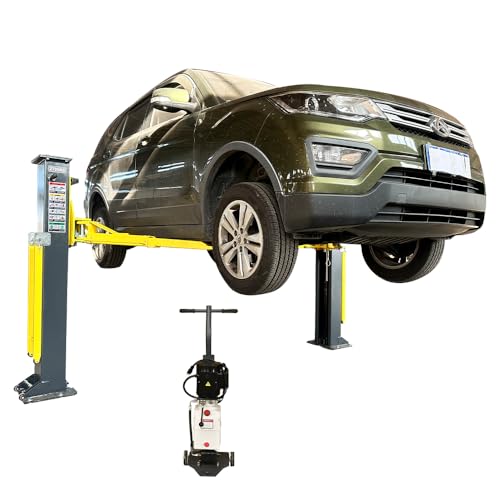
KATRAX 7000 lb 2-Post Hydraulic Auto Lift
The KATRAX 7,000-lb two-post clear-floor hydraulic auto lift provides a residential-friendly 110V power configuration designed for lifting sedans, SUVs, and light trucks in home garages and private workshops. It is a practical lifting solution for DIY mechanics seeking an accessible two-post layout without needing a commercial 220V electrical hookup.
Pros
- Convenient 110V hydraulic power unit eliminates the need for commercial 220V electrical wiring in residential bays
- Rated 7,000-lb capacity with 8,000-lb proof evaluation handles most standard passenger cars, SUVs, and light utility trucks
- Two-section adjustable arm design accommodates various vehicle wheelbases and factory frame contact points
- Industrial-gauge steel construction with protective rubber collision pads helps prevent structural deflection and door damage
Cons
- Clear-floor layout requires verified overhead ceiling height clearance before assembly to accommodate upper crossbeam structures
- Requires a sound, level concrete slab foundation capable of withstanding two-post surface-mount anchor bolt pullout stresses
- LTL freight delivery requires planning for heavy crate offloading, column staging, and multiple-person assembly
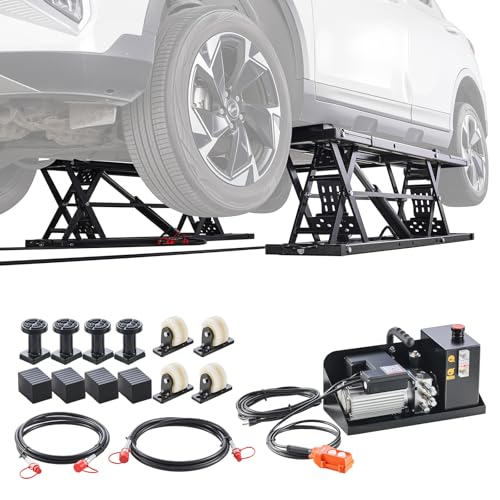
VEVOR Portable Scissor Car Lift
The VEVOR 9,000 lb portable electric-hydraulic vehicle lift delivers up to 28 inches of working height on a standard 120V residential circuit without requiring permanent floor anchoring. It is an ideal mid-rise lifting solution for home garage DIYers, truck and SUV owners, and shops with standard 8-to-10-foot ceilings.
Pros
- Substantial 9,000 lb rating safely handles heavier modern trucks, crossovers, and electric vehicles
- Plugs into standard 120V household outlets for straightforward residential garage installation
- Reaches up to 28 inches of working height, ideal for low 8-to-10-foot residential garage ceilings
- Includes four non-slip rubber pads and four taller frame-contact extension columns in the box
Cons
- Total crated package weight of over 450 lbs requires multiple sets of hands or equipment to unload
- Requires sourcing ISO 46 hydraulic oil separately and bleeding the system before initial operation
- The 6.1-inch collapsed profile may require drive-on helper boards for aggressively lowered sports cars
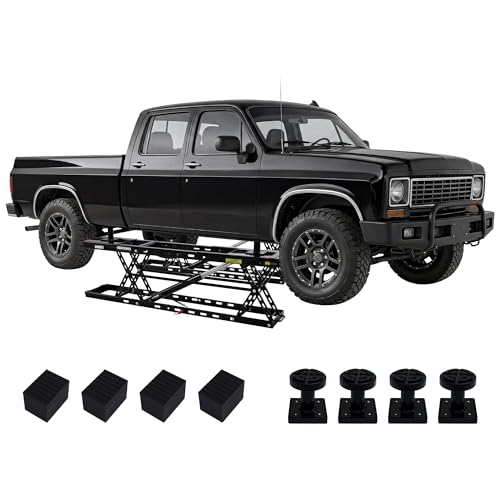
Albott 8000 LBS Portable Car Lift
The Albott 8000 LBS Portable Car Lift provides an 8,000-pound capacity frame-engaging scissor system constructed from high-tensile Q355B steel for low-ceiling residential garages. Featuring mechanical safety locks, dual locking pins, and extension plates reaching up to 75 inches, it suits DIYers and truck owners seeking serious lifting capability without permanent concrete anchoring.
Pros
- Substantial 8,000-lb gross capacity handles heavier consumer trucks and SUVs that exceed smaller portable units.
- Requires no permanent concrete slab anchor bolts, allowing free floor repositioning and low-ceiling garage clearance.
- Included extension plates lengthen frame support reach up to 75 inches to engage separated factory jacking points.
- Constructed from high-grade Q355B structural steel with dual locking pins for reliable mechanical safety.
Cons
- Individual frames weigh roughly 130 pounds each, requiring physical effort to slide and align beneath vehicles.
- Requires sourcing ISO No. 46 hydraulic fluid separately before initial setup and cylinder bleeding.
- Maximum lift height of 27.4 inches is restricted to creeper work and does not offer full standing undercarriage access.
Engineering Principles, Lift Architectures, and Garage Integration Guide
Elevating several tons of vehicle weight safely requires a precise balance between fluid mechanics and structural steel engineering. In short, what is hydraulic car lift machinery comes down to a specialized hydraulic circuit that converts pressurized fluid energy into smooth vertical mechanical force to raise passenger cars, SUVs, and commercial trucks. While the fundamental fluid principles remain consistent across different automotive hoists, structural frames, electrical power units, and locking systems vary significantly based on workshop intent. Navigating these distinctions ensures that garage owners choose equipment that matches their vehicle weight classes and physical garage dimensions.
Fundamental Mechanics of Fluid-Powered Vehicle Lifting
Hydraulic vehicle lifts operate according to Pascal’s law, which states that pressure applied to an enclosed fluid transmits equally in all directions throughout the container. An electric or manual hydraulic pump draws specialized oil from a reservoir and forces it through high-pressure lines into one or more heavy steel cylinders. Because hydraulic fluid resists compression under heavy loads, this pressurized volume pushes internal cylinder pistons outward with tremendous linear force. That linear motion either raises carriage assemblies directly on vertical columns or pushes mechanical scissor linkages upward to elevate vehicle frames.
Lowering a vehicle does not require the hydraulic pump to force fluid in reverse against the load. Instead, an operator opens a metered lowering valve, which allows vehicle gravity to push fluid back into the reservoir at a controlled speed. Portable scissor systems built by manufacturers like Albott and Rueekfil require a minimum downward weight, often between one hundred and two hundred pounds, to compress internal return springs and descend smoothly. Velocity fuses and integrated flow-restricting valves prevent rapid fluid escape if an external hydraulic line suffers unexpected damage during vehicle service.
Essential Mechanical Safety Systems and Positive Lock Engagement
A central tenet of workshop safety dictates that hydraulic fluid pressure lifts the vehicle, but mechanical steel locks must always support the load during service. Pressurized hoses, threaded fittings, and internal cylinder seals are serviceable components that can weep fluid or lose holding pressure over extended periods. To eliminate reliance on hydraulic pressure alone, vehicle lifts incorporate heavy steel ladder locks or notched stop bars inside structural columns or scissor arms. After raising a vehicle to working height, the operator releases hydraulic pressure slightly so the carriages settle directly onto physical locking teeth.
Mechanical lock release systems differ between lift models based on operational duty and garage workflow. High-capacity commercial hoists, such as the Weize two-post frame, feature a single-point mechanical release lever that disengages both column latches at the same time. Smaller portable scissor frames often utilize manual release pins, safety rods, or multi-position stop levers that operators disengage at each scissor bank before lowering. These positive mechanical stops ensure that sudden hydraulic fluid leaks or severed lines cannot cause a vehicle to drop while technicians work underneath.
Comparing Two-Post, Portable Scissor, and Drive-Up Hydraulic Systems
Two-post surface-mounted lifts represent the industry standard choice for complete suspension, brake, and powertrain repairs in dedicated workshops. Units like the Weize 12,000-pound lift and KATRAX 7,000-pound hoist mount heavy vertical steel columns directly to the floor, using telescoping swing arms that reach vehicle chassis lift points. The KATRAX hoist utilizes an asymmetric arm configuration that positions vehicle weight slightly rearward, allowing vehicle doors to swing open past the columns for cabin access. These fixed hoists leave wheels hanging free and undercarriages completely open for transmission drops, exhaust fabrication, and differential service.
Portable electric-hydraulic scissor lifts provide a flexible lifting alternative for low-ceiling residential bays and detailing shops where permanent vertical posts are impractical. Equipment from brands like VEVOR and Albott collapse into low-profile steel frames and roll across smooth concrete on integrated wheels when garage space is needed. These portable frames achieve lift heights up to twenty-eight inches, providing generous working room for brake overhauls, tire rotations, and rocker panel work. For owners outfitting larger commercial facilities, exploring heavy-duty commercial lifts provides valuable perspective on wider drive-through dimensions and higher structural steel ratings.
For routine oil changes and quick undercarriage inspections, hydraulic drive-up ramps and rolling trolley jacks deliver practical lifting capability without frame contact pads. The COZONY hydraulic ramp system combines steel drive-up inclines with integrated hydraulic bottle jacks, raising vehicles up to fourteen inches while keeping tires firmly supported. In contrast, low-profile trolley jacks like the DNA Motoring two-ton service jack provide rapid spot lifting for wheel removal and brake pad changes. While trolley jacks and drive-up ramps do not provide standing access, they offer compact fluid power for quick garage maintenance routines.
Concrete Foundation Verification and Wedge Anchor Integrity
Installing a fixed two-post hydraulic hoist requires a solid structural concrete foundation to resist substantial rotational pulling forces generated by vehicle weight. As vehicles rise on cantilevered swing arms, vertical columns act as leverage points, creating upward tension on floor anchors along the column baseplates. Industry installation guidelines generally require a concrete floor thickness of at least four inches with a compressive strength of 3,000 PSI, cured for at least twenty-eight days. Thin residential slabs or cracked concrete floors cannot provide adequate anchor pull-out resistance for heavy passenger trucks and full-size SUVs.
Installers should verify slab thickness by drilling test holes before securing heavy baseplates to the garage floor. Wedge anchor bolts require specific embedment depths and must remain at least six inches away from slab edges, relief cuts, and expansion joints to prevent concrete blowouts. In modern residential garages with post-tensioned foundations, high-strength steel tendons remain under extreme tension within the slab. Drilling into a live post-tension cable can cause severe structural damage or physical injury, making professional ground-penetrating radar scanning vital if cable layouts remain unverified.
Ceiling Height Calculations and Overhead Clearances
Ceiling height represents the primary physical boundary when planning a fixed hydraulic lift installation in a residential garage or barn workshop. To determine required clearance for two-post lifts, add total column height plus several inches of buffer space for column assembly and beam placement. Clear-floor designs incorporate an overhead crossbeam with a padded shutoff bar that halts motor operation if a tall vehicle roof contacts the limit switch. Floor-plate models route hydraulic lines and cables across the concrete beneath a flat steel plate, accommodating low-ceiling bays with exposed overhead rafters.
Planning a four-post parking lift to store one vehicle over another requires calculating total vertical stack dimensions with safety margins. Add the lower vehicle height, upper vehicle height, runway deck thickness, and four to six inches of overtravel clearance needed to clear safety lock ladders. Standard overhead garage door tracks often interfere with vehicle roofs, requiring high-lift track conversions and wall-mounted jackshaft door openers. For homeowners comparing four-column storage options against two-post service hoists, studying four-post parking lift configurations helps clarify runway lengths, column spacing, and overall bay footprints.
Electrical Service Sizing for Hydraulic Power Units
Hydraulic vehicle lifts depend on dedicated electric power units to drive the fluid pump and generate required system hydraulic pressure. Commercial-grade two-post equipment, such as the Weize four-horsepower unit, operates on 220-volt single-phase power and requires a dedicated thirty-amp circuit breaker to handle startup current. Running a large motor on undersized branch wiring can trigger severe voltage drop, motor humming, and tripped breakers during heavy vehicle ascent. Providing a dedicated 220-volt circuit ensures smooth pump cycle speeds, prevents electrical overloads, and protects the electric motor from premature heat damage.
Many residential portable lifts are engineered to operate on standard 110-volt or 120-volt household branch circuits for maximum convenience. The KATRAX two-post lift and portable scissor frames from VEVOR and Rueekfil use efficient electric motors that plug directly into standard grounded wall outlets. While 110-volt power packs elevate vehicles slightly slower than larger 220-volt commercial units, they avoid immediate electrical panel upgrades in detached garages. Ensure that 110-volt power units connect to dedicated twenty-amp outlets without light-duty extension cords, which introduce electrical resistance and strain motor windings.
Hydraulic Fluid Specifications and Routine Maintenance Protocols
Consistent hydraulic performance requires clean fluid with the correct viscosity rating recommended by equipment manufacturers for specific climate conditions. Brands like Albott, VEVOR, and Rueekfil recommend anti-wear ISO 32 or ISO 46 hydraulic fluid for their electric pumping systems. Using incorrect fluid viscosity or dirty oil can lead to sluggish cylinder extension, pump cavitation, and internal valve chatter during operation. After filling the hydraulic reservoir, operators must cycle the cylinders and bleed air from cylinder bleeder screws to eliminate spongy movement and ensure level carriage travel.
Routine maintenance routines extend beyond fluid checks to structural cables, sheaves, and mechanical latch assemblies. Two-post lifts utilize heavy steel equalization cables to synchronize carriage ascent across both columns and keep the vehicle level. Operators should inspect equalization wire ropes monthly for signs of fraying, loose tension, or pulley wear, adjusting lock nuts so mechanical latches click simultaneously. In addition, periodic checks should verify that baseplate anchor bolts retain proper torque and that swing arm gear locks mesh securely when arms contact lifting points.
Logistical Delivery Realities, Assembly Demands, and Selection Logic
Ordering a full-size hydraulic lift involves commercial freight shipping logistics that require advance planning before the delivery truck arrives. Stationary two-post hoists ship as massive steel crates weighing up to two thousand pounds or more via commercial freight carriers. Standard residential delivery trucks cannot unload these heavy steel bundles using common liftgates, requiring buyers to arrange flatbed wrecker offloading, mobile forklifts, or freight terminal pickup. In contrast, portable scissor lifts and trolley jacks arrive in modular boxes, making residential delivery and garage staging far simpler for DIY mechanics.
Choosing the right lifting system requires matching your primary maintenance goals against your physical garage space and vehicle types. If routine tasks focus on brake jobs, tire rotations, and detailing in a standard residential bay, portable scissor frames offer mobility and simple 110-volt operation without anchor drilling. For deep powertrain swaps, exhaust fabrication, and full undercarriage access on heavy trucks, a permanent two-post lift anchored to verified concrete provides unmatched utility. Evaluating vehicle weight ratings, ceiling clearances, and floor integrity ensures that your hydraulic equipment provides years of safe service.
Understanding the mechanical principles behind fluid power allows vehicle owners to select workshop equipment with total confidence. Prioritizing verified concrete foundations, proper electrical supply, and rigid mechanical safety locks transforms any garage workspace into an efficient service environment. Regular inspection of hydraulic hoses, fluid levels, and mechanical lock engagement guarantees dependable operation across every maintenance task. Taking time to measure clearances and prepare your workspace ensures your hydraulic lift delivers safe lifting performance for years to come.
About the author
Christian Hazel is an automotive journalist with extensive experience covering four-wheel-drive vehicles, mechanical upgrades, and off-road equipment. His background includes technical reviews, installation features, and project-vehicle coverage, bringing useful context to equipment choices for trucks, Jeeps, and off-road enthusiasts.