
What Is a Floor Jack Pad: Practical Guide for 2026
Learn what is a floor jack pad, how it safeguards pinch welds, and how to protect vehicle chassis rails during hydraulic lifting in November 2026.
 By Emily Markham
Updated October 28, 2026


Positioning a hydraulic trolley jack beneath a modern vehicle requires precise alignment to prevent severe metal bending or finish scraping. When bare steel jack saddles press directly against thin sheet metal seams or coated underbody rocker panels, concentrated contact pressure often crushes factory seams and strips protective coatings. Understanding what is a floor jack pad helps vehicle owners prevent this unnecessary structural and cosmetic damage during routine maintenance. A dedicated rubber or composite saddle cushion acts as a protective buffer between the hard metal saddle and the vehicle chassis, distributing lifting force evenly across reinforced contact points.
Modern unibody cars rely on specific vertical flanges known as pinch welds, which can buckle or fold over when subjected to direct metal-on-metal contact. Many home mechanics evaluate alternative elevation methods by comparing car ramps and jack stands before settling on a traditional hydraulic lift setup. Incorporating a heavy-duty slotted jack pad adapter ensures the weight of the vehicle rests on structural base metal rather than bending the delicate sheet metal lip. Adding this inexpensive component creates a stable, high-friction contact interface that keeps your lifting setup steady throughout the entire maintenance process.
| Award | Product | BJL Score About BJL ScoreThe BJL Score is our own rating from 0 to 10, based on performance, design and build, ease of use, and value. It reflects independent research and is never influenced by manufacturers, retailers, or affiliate commissions. Learn more › | |
|---|---|---|---|
| Best Overall |
Robbor 3-Ton Slotted Rubber Jack Pads (4-Pack)
|
9.2/10 | Buy |
| Best Premium |
 TONDA Pinch Weld Floor Jack Pads (2-Pack) |
8.6/10 | Buy |
 Yesland 3-Inch Jack Pad Adapters (6-Pack) |
8.6/10 | Buy | |
| Best Budget |
 JUKFITA Slotted Rubber Floor Jack Pad |
8.1/10 | Buy |
 Moibunka 5-Inch Floor Jack Rubber Pad |
8.1/10 | Buy | |
 TONDA 4.92-Inch Rubber Floor Jack Pad |
8.1/10 | Buy | |
| Best Value |
 AKSOVA 5-Ton Pinch Weld Jack Pad |
8.1/10 | Buy |
 Yesland 4.8-Inch Floor Jack Saddle (2-Pack) |
8.0/10 | Buy |
Robbor 3-Ton Slotted Rubber Jack Pads (4-Pack)
Built for standard flat-saddle floor jacks, this four-pack of heavy-duty rubber pads prevents frame and pinch-weld damage during vehicle maintenance. Each pad handles up to three tons, making them practical protective gear for DIY garage repairs.
Pros
- High 3-ton capacity suitable for most consumer vehicles
- Pack of four supports multi-point lifts
- Prevents metal-on-metal contact and paint scratching
- Durable heavy-duty rubber material
Cons
- 0.4-inch slot width may not fit wider pinch welds
- Only compatible with flat-saddle floor jacks
TONDA Pinch Weld Floor Jack Pads (2-Pack)
These slotted rubber adapters protect vehicle pinch welds and frame rails from bending during maintenance. Rated for loads up to 3 tons, the waffle-textured pads cushion lifting points and prevent metal-to-metal contact on compatible floor jacks.
Pros
- Protects pinch welds from bending and scratching
- Anti-slip waffle texture improves grip during lifting
- Solid rubber construction dampens heavy contact pressure
- Includes two pads for multiple lifting points
Cons
- Maximum load rating is capped at 3 tons
- 4.92-inch diameter may exceed compact jack saddles
Yesland 3-Inch Jack Pad Adapters (6-Pack)
Designed to protect vehicle pinch welds during maintenance, these dense rubber pads offer reliable cushioning and grip on floor jacks. The six-pack provides versatile coverage for DIY mechanics working with standard car lifts and stands.
Pros
- Dense rubber prevents pinch weld crushing and paint damage
- Deep 3/8-inch slot fits standard vehicle frame seams
- Anti-slip surface provides stable contact while lifting
- Six-pack offers plenty of spares for multiple stands
- Compatible with a wide range of floor jacks
Cons
- Fixed groove depth may not suit extra-deep seams
- Square shape may not seat flat in small round cups
- Rubber surface can degrade under sustained high tonnage
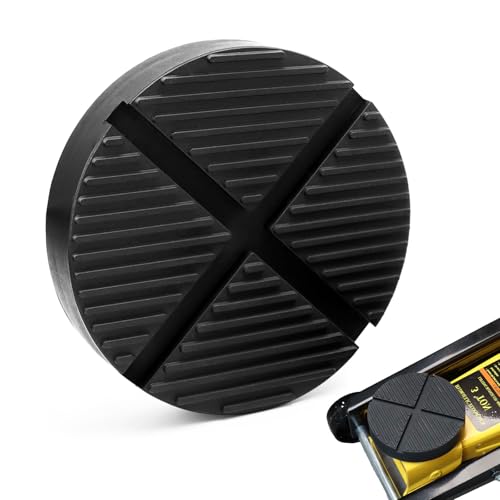
JUKFITA Slotted Rubber Floor Jack Pad
Designed to shield vehicle pinch welds and frame rails during lifting, this slotted rubber cushion provides a sturdy, non-slip interface for standard floor jacks. Its protective build helps prevent costly underbody deformation and paint damage during maintenance.
Pros
- Protects pinch welds and underbody paint from gouges
- Slotted center provides stable crossbeam alignment
- Durable rubber composition cushions vehicle contact points
- Broad diameter offers a solid contact surface
Cons
- Requires checking jack saddle dimensions for proper fit
- Fixed groove size may not accommodate extra-thick welds
Moibunka 5-Inch Floor Jack Rubber Pad
Designed to shield pinch welds and underbody rails during lifting, this heavy-duty rubber puck supports vehicle loads up to 3 tons. The molded cross-groove pattern helps stabilize contact points, making it a practical accessory for home mechanics using floor jacks.
Pros
- Prevents pinch welds and frame rails from bending
- Cross-grooved design securely grips vehicle seams
- Durable rubber resists crushing under 3-ton loads
- Wide 5-inch diameter provides a sturdy base
Cons
- Large 5-inch size may not fit smaller jack saddles
- Maximum capacity is limited to 3 tons
- Sold as an individual single pad
TONDA 4.92-Inch Rubber Floor Jack Pad
The TONDA 4.92-Inch Rubber Floor Jack Pad provides a slotted, waffle-textured cushion designed for 2-3 ton lifting applications on unibody pinch welds. It is an ideal garage accessory for DIY mechanics wanting to prevent bent rocker seams and metal-to-metal gouging during floor jack lifting.
Pros
- Deep cross-slotted grooves seat vehicle pinch welds securely to prevent metal crushing
- Textured waffle pattern enhances contact grip between lifting point and jack saddle
- Heavy-duty rubber composition cushions up to 2-3 ton vehicle lifting applications
- Substantial 4.92-inch diameter spreads contact load across compatible floor jack saddles
Cons
- Pack includes only one pad, requiring an extra purchase if lifting both sides simultaneously
- Wide 4.92-inch diameter may not fit smaller or deeply recessed floor jack saddle cups
- Dense rubber can show compression marks or cosmetic wear under heavy concentrated point loads over time
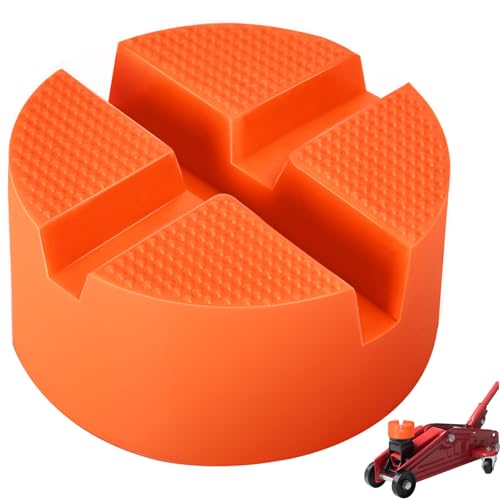
AKSOVA 5-Ton Pinch Weld Jack Pad
Molded from heavy-duty composite rubber, this adapter shields vehicle frame rails and painted pinch welds from bending or scratching during maintenance. Its 1.9-inch height and textured cross-groove surface add clearance and prevent slippage when using a floor jack.
Pros
- Robust 5-ton weight rating
- Cross-groove design cushions pinch welds effectively
- Resistant to high and low temperature deformation
- Granular surface texture provides reliable friction
- Adds nearly two inches of vertical lift clearance
Cons
- May exhibit cosmetic flaws like scratches or color spotting
- Single-pack design requires buying extra for multiple jacks
Yesland 4.8-Inch Floor Jack Saddle (2-Pack)
Built to replace worn lift pads, this two-pack from Yesland equips hydraulic jacks with a wide 4.8-inch rubber-cushioned surface and a sturdy 4-ton rating. The 1-1/8-inch stem provides a secure drop-in fit for compatible jacks while safeguarding vehicle undercarriages against marring.
Pros
- Robust 4-ton load rating for trucks and cars
- Protective rubber coating prevents slippage and scratches
- Wide diameter distributes lifting pressure effectively
- Two-pack provides an immediate spare replacement saddle
Cons
- Incompatible with jacks requiring stems other than 1-1/8 inches
- Rubber surface can experience wear under frequent heavy contact
Understanding Floor Jack Pads and Vehicle Undercarriage Protection
A floor jack pad is a resilient cushion or adapter made from dense rubber, composite elastomer, or polyurethane that fits onto the steel saddle of a hydraulic jack. Its primary function is to eliminate direct metal-on-metal contact between the hard teeth of a jack saddle and the underside of a vehicle. By creating a compliant barrier, the pad distributes concentrated lifting forces over a wider surface area while establishing high-friction traction. Home mechanics and automotive technicians rely on these protective accessories to prevent cosmetic scuffs, paint fractures, and structural bending on modern chassis designs.
Core Purpose and Mechanical Role of a Jack Pad
Automotive floor jacks typically feature a circular steel lifting saddle equipped with sharp perimeter teeth or raised metallic edges. These rugged steel teeth are originally designed to bite into rigid truck frame rails or heavy cast-iron axle housings to prevent lateral slippage under load. When applied to modern passenger vehicles or crossover utility platforms, however, those same hardened teeth act like chisels against painted sheet metal. A floor jack pad covers these aggressive steel edges, substituting a dense, energy-absorbing surface that conforms slightly to the chassis under compression.
Friction plays an equally vital role in vehicle stability while raising an axle or corner. Smooth painted metal pressing against polished steel creates a low-friction interface that can slip if the jack wheels fail to track smoothly across the garage floor. High-density rubber pads, particularly those featuring waffle-textured or multi-dimensional granular surface patterns, significantly enhance friction at the point of contact. This tactile grip stabilizes the lifting interface as the jack arm arcs upward through its operating stroke, reducing lateral shift risks.
Unibody Pinch Welds and Lifting Point Damage
Most modern passenger cars and small crossovers feature unibody chassis construction rather than a separate ladder frame. Along the lower rocker panels of these vehicles, structural steel stampings are joined together to form a downward-protruding vertical seam known as a pinch weld. Vehicle manufacturers reinforce specific segments along this seam to serve as designated emergency lifting points. Even though these reinforced zones carry vehicle weight, the vertical flange itself is quite narrow and remains highly vulnerable to lateral bending when subjected to flat, bare metal pressure.
Lifting directly against an unsupported pinch weld with a flat metal saddle causes the thin vertical flange to fold over sideways under localized pressure. Once a pinch weld crushes, surrounding primer and paint layers crack away from the stressed steel. This exposed bare metal quickly succumbs to road moisture and oxidation, leading to rocker panel rust that degrades chassis rigidity over time. A slotted jack pad prevents this damage by bridging the vertical flange, allowing vehicle weight to transfer into the reinforced rocker backing instead of bending the seam lip.
Slotted Adapters Versus Flat Cushion Configurations
Jack pads generally fall into two distinct structural categories: slotted pinch weld adapters and solid flat cushioning pucks. Slotted adapters feature a precision-cut groove running across the top face, designed specifically to cradle the vertical sheet metal flange of a unibody car. Some models utilize a single directional groove, whereas others feature a cross-groove pattern that allows perpendicular or diagonal alignment regardless of jack orientation. These slotted designs allow the tall weld lip to sit recessed inside the channel while the broader shoulders of the pad support the structural chassis.
Flat jack pucks provide a continuous, planar rubber contact surface without vertical channels. These solid round or square pads excel when lifting vehicles featuring heavy boxed frame rails, solid rear axle tubes, or tubular engine subframe cradles. Pickup trucks and body-on-frame sport utility vehicles benefit from flat pads because their lift points present wide contact faces without delicate sheet metal seams. Placing a flat rubber disk on the jack saddle protects chassis coatings while preventing the jack from gouging soft suspension components.
Selecting the appropriate channel geometry requires checking both the height and thickness of your vehicle’s factory pinch weld seam. Standard slotted pads often feature groove widths ranging between 0.4 inches and 0.7 inches, with groove depths between 0.23 inches and 0.6 inches. If a slot is too shallow, the bottom of the groove makes premature contact with the narrow edge of the weld flange before the pad shoulders engage. Matching the slot depth to the flange height allows the lifting load to distribute naturally across the reinforced rocker shelf.
Material Formulations and Structural Durability
The structural effectiveness of a jack pad depends heavily on its material formulation and durometer hardness rating. Quality pads are manufactured from vulcanized heavy-duty rubber or upgraded composite rubber compounds designed to balance cushioning with compression resistance. Ordinary soft rubber deforms excessively under vehicle weight, which can cause the pad to squeeze out from between the saddle and the car. High-density composite rubber maintains dimensional integrity under loads rated between 2 tons and 5 tons, resisting shear forces while conforming microscopically to the lifting surface.
Durability under garage conditions also requires resistance to temperature fluctuations and chemical exposure. Quality composite rubber formulations retain their tensile strength in freezing winter garages as well as sweltering summer driveways. They resist structural degradation when exposed to common automotive residues, helping the pad maintain its shape over repeated lifting cycles. Tough solid rubber blocks deliver long-wearing service life without cracking prematurely under repetitive compression forces.
Some manufacturers offer integrated cast-iron or alloy-steel replacement saddles coated with vulcanized rubber. These heavy-duty assemblies, such as units engineered with a 1-1/8 inch mounting stem, replace the factory metal saddle entirely rather than resting loosely in the existing cup. Rated for working load limits of 4 tons, these stem-mounted hybrid saddles provide maximum lateral rigidity combined with a permanent rubber protective face. This setup appeals to busy workshops where loose pads might otherwise become misplaced between tire changes.
Saddle Dimensions and Jack Fitment
Ensuring physical compatibility between the pad and your hydraulic floor jack saddle is essential for safe operation. Floor jack saddles vary considerably in diameter, ranging from compact 2.5-inch saddles on portable aluminum racing jacks to broad 5-inch saddles on heavy shop units. A jack pad should sit securely inside the recessed rim of the steel saddle without hanging excessively over the edges. Universal pads with diameters of roughly 2.9 inches to 3 inches fit standard compact service jacks, whereas larger 4.9-inch to 5-inch pads align with wide commercial saddles.
Overall pad thickness also impacts how your lifting equipment interacts with lower vehicle ride heights. A heavy-duty pad typically adds between 1 inch and 1.9 inches of vertical height to the collapsed profile of your floor jack. If you maintain a lowered sports car or a vehicle with deep front splitters, this added pad thickness could prevent your jack from rolling smoothly under factory lift points. In such situations, pairing a low-profile trolley jack with a slim 1-inch slotted adapter preserves the clearance necessary to access recessed pinch welds without rubbing against body trim.
Square jack adapters represent another versatile design option for both floor jacks and mechanical jack stands. A 3-inch square rubber pad provides an expansive contact patch that can sit cleanly within rectangular jack stand saddles or atop round jack plates. Many DIY enthusiasts appreciate multi-packs containing four to six pads, allowing them to equip their main lifting jack and multiple support stands simultaneously. Having uniform protective pads across every piece of lifting hardware ensures consistent undercarriage defense throughout an entire repair session.
Safe Staging and Alignment Protocols
Safe vehicle lifting always begins with disciplined workspace staging and surface preparation on solid, level concrete. Park the vehicle on flat ground, set the transmission firmly in park or reverse gear, and engage the emergency parking brake completely. Always place heavy-duty wheel chocks in front of and behind the wheels remaining on the ground to eliminate any potential roll-away movement. While some drivers prefer elevating a car at home using fixed ramps for basic underhood checks, hydraulic jacks equipped with slotted pads offer precise control when wheels must come off.
Locate the factory-designated lifting points by checking the small indicator notches stamped into the lower rocker panel sheet metal. Roll the floor jack into position, placing the rubber pad directly underneath the reinforced notch so the slot aligns with the vertical flange. Pump the jack handle slowly until the pad makes light initial contact with the vehicle undercarriage, then pause to inspect the alignment thoroughly. Verify that the pinch weld rests centered inside the groove and that the pad sits squarely within the saddle bowl before applying substantial hydraulic pressure.
As the hydraulic cylinder extends and raises the chassis, observe how the jack wheels move along the concrete floor. A trolley floor jack must roll forward slightly during elevation to maintain vertical alignment beneath the changing pivot arc of the lift arm. A high-friction rubber pad helps hold the contact point steady, but excessive floor resistance or debris under the jack casters can introduce lateral tension. Smooth, controlled handle strokes allow the jack to settle naturally beneath the chassis, keeping the lift pad squarely compressed against the factory lifting pocket.
The Mandatory Transition to Mechanical Jack Stands
A hydraulic floor jack is engineered solely as a dynamic lifting device, never as a static load-holding tool. Internal hydraulic pressure relies on flexible elastomeric seals, check valves, and fluid circuits that can experience gradual pressure loss or sudden seal failure. Never place any portion of your body underneath a vehicle supported only by a hydraulic jack, regardless of pad quality or jack tonnage rating. Always calculate vehicle axle loads, knowing that raising one end lifts roughly 50 to 60 percent of the total curb weight, and select support equipment with appropriate working load limits.
Once the vehicle reaches the desired clearance height, immediately slide ASME PASE compliant mechanical jack stands beneath adjacent structural support points. Many mechanics utilize secondary slotted rubber cushions on their jack stand saddles to maintain pinch weld protection during the resting phase. When raising vehicles for routine maintenance, having cushioned contact surfaces on both the jack and the stands guarantees zero damage from start to finish. Carefully meter the jack release valve to lower the vehicle slowly onto the mechanical stands, ensuring full load transfer before releasing hydraulic tension completely.
Before disconnecting or rolling the hydraulic jack away, perform a firm physical stability check by gently shaking the vehicle bumper. The elevated chassis must remain entirely motionless on the mechanical support stands without shifting, settling, or flexing at the padded contact points. Once stability is confirmed, leave the lowered floor jack directly under the lift point with light contact as an added secondary precaution. This rigorous staging discipline guarantees maximum workshop safety while preserving the structural integrity of your vehicle’s factory rocker panels.
Inspection Routine and Replacement Guidelines
Rubber and composite jack pads undergo immense compressive and shear forces during normal service life, requiring routine inspection prior to each use. Examine the central groove and shoulder areas closely for deep structural tears, horizontal splits, or permanent crushing deformation. Minor superficial scuffing or surface dirt is normal, but cracks that penetrate through half the material thickness compromise structural integrity. A compromised pad can split unexpectedly under load, allowing the bare steel saddle teeth to punch upward into the vehicle bodywork.
Chemical exposure serves as another common catalyst for premature rubber breakdown in active home garages. Spills of petroleum-based brake fluid, engine motor oil, or aggressive brake cleaner can soften natural rubber compounds and cause swelling or gummy degradation. If a pad becomes softened, sticky, or distorted from chemical contamination, retire the accessory immediately and replace it with fresh hardware. Storing your rubber pads in a clean, dry toolbox away from direct sunlight, extreme heat sources, and solvent vapors preserves material elasticity for years of dependable use.
Investing in a well-fitted, heavy-duty floor jack pad is one of the most practical upgrades any home mechanic can make. By preventing crushed pinch welds, preserving factory rust-inhibiting paint coats, and boosting lifting traction, this compact accessory protects both vehicle value and workshop safety. Always verify saddle dimensions, choose the correct slotted or flat geometry for your specific chassis, and maintain strict vehicle elevation protocols on every automotive project.
About the author
Emily Markham is an automotive aftermarket editor who has covered professional tools, workshop equipment, and the businesses that support vehicle repair since 2019. Her editorial background gives her a practical understanding of how technicians and shop owners evaluate equipment, product value, and long-term support.