
How Wide Is a Two Post Car Lift: Width Dimensions and Bay Guide for 2026
Learn how wide is a two post car lift in November 2026, including overall column width, drive-through clearance, and garage bay spacing requirements.
 By Christian Hazel
Updated October 10, 2026


Setting up an automotive service bay requires accurate layout planning to prevent costly structural interferences. Knowing how wide is a two post car lift determines whether your vehicle doors can swing open, whether you have walking clearance around the perimeter, and whether your concrete slab accommodates the required anchor bolt edge distances. Most standard commercial and residential two-post lifts feature an overall exterior width ranging between 130 inches and 145 inches from the outer edges of the baseplates. Measuring your garage bay width beforehand ensures that shop toolboxes, workbenches, and structural side walls do not impede routine mechanical work.
Drive-through clearance between the vertical columns typically measures between 95 inches and 105 inches, allowing standard passenger cars, light trucks, and full-size SUVs to enter smoothly. When evaluating modern hydraulic car lift setups, you must balance exterior footprint against vehicle cabin accessibility and drive-through convenience. Symmetric and asymmetric column designs further alter how vehicles line up between the posts, shifting the center of gravity and vehicle door openings. Verifying these dimensional tolerances before drilling anchors into your concrete floor protects your investment and ensures a safe workspace.
| Award | Product | BJL Score About BJL ScoreThe BJL Score is our own rating from 0 to 10, based on performance, design and build, ease of use, and value. It reflects independent research and is never influenced by manufacturers, retailers, or affiliate commissions. Learn more › | |
|---|---|---|---|
| Best Overall |
Jack Boss 10,000 LB Clear-Floor 2-Post Car Lift
|
9.1/10 | Buy |
| Best Value |
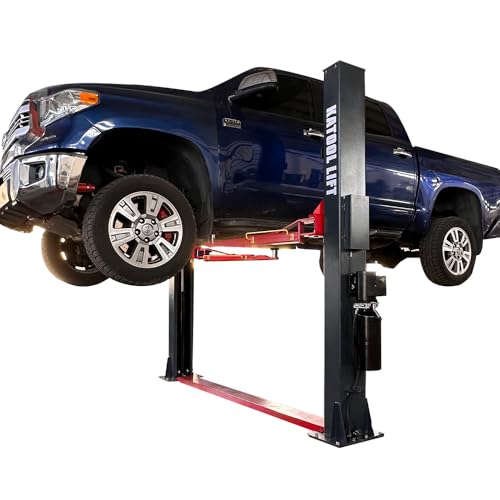 KATOOL 12,000-lb Heavy-Duty 2-Post Car Lift |
8.9/10 | Buy |
| Best Budget |
 KATOOL 11,000 lb 2-Post Car Lift |
8.8/10 | Buy |
 Weize 12,000-lb 2-Post Automotive Lift with 4HP |
8.8/10 | Buy | |
| Best Premium |
 KATOOL 12,000 lb 2-Post Clearfloor Automotive Lift |
8.4/10 | Buy |
 KATOOL AK-M120 12,000 lb Extra Height 167-Inch |
8.3/10 | Buy | |
 KATOOL ME 11000 lbs 2-Post Car Lift |
8.1/10 | Buy | |
 KATOOL M120 12,000 lb Extra Height Clear-Floor |
8.0/10 | Buy |
Jack Boss 10,000 LB Clear-Floor 2-Post Car Lift
The Jack Boss 10,000 LB Clear-Floor Two-Post Lift delivers a 76.77-inch maximum rise height and an open floor workspace powered by a 220V motor. Designed with a single-point mechanical lock release and chain-drive lifting mechanism, it suits DIY mechanics and repair shops equipped with appropriate ceiling clearance and concrete foundations.
Pros
- Rated 10,000-lb capacity handles light trucks, SUVs, and standard passenger cars
- Clear-floor overhead beam configuration eliminates floor-plate obstacles for transmission jacks and oil caddies
- Single-point manual lock release simplifies the lowering procedure from one column
- Full 76.77-inch rise height allows ample undercarriage headroom for working standing up
- Solid 2-year warranty coverage on metal framing, hydraulic motor, and electrical components
Cons
- Requires customer-supplied forklift or heavy machinery for freight delivery offloading
- Requires a dedicated 220V electrical circuit, precluding standard 110V residential wall outlet use
- Overhead clear-floor beam design demands tall ceiling clearance compared to floor-plate models
KATOOL 12,000-lb Heavy-Duty 2-Post Car Lift
The KATOOL 12,000-lb two-post automotive lift delivers heavy-duty lifting capacity powered by a robust 4.0 HP 220V motor, symmetric arms, and single-point lock release. It is an ideal solution for independent shops and home mechanics servicing full-size trucks, SUVs, and passenger vehicles with appropriate slab and electrical support.
Pros
- High 12,000-lb lifting capacity readily handles heavy diesel trucks, work vans, and fleet vehicles.
- Single-point safety lock release streamlines daily shop workflow for solo mechanics.
- Supplied with screw-on pads and 100mm height extension adapters right in the crate.
- Generous 70.86-inch maximum rise height provides ample undercarriage working room.
Cons
- Crated shipping weight of 1,379 lbs requires a forklift on-site for offloading or customer freight terminal pickup.
- Carries European CE certification rather than third-party Automotive Lift Institute (ALI) gold label certification.
- Requires a dedicated 220V single-phase electrical supply and user-sourced hydraulic oil prior to initial startup.
KATOOL 11,000 lb 2-Post Car Lift
The KATOOL 11,000-lb two-post clearfloor automotive lift combines a high-output 4.0 HP 220V motor with dual hydraulic chain-drive cylinders to deliver a 4.25-inch to 70.75-inch lifting range. It is ideal for home mechanics, vehicle restorers, and independent shop operators with appropriate concrete foundations and 220V single-phase power.
Pros
- Heavy-duty 11,000-lb rating provides exceptional load headroom for full-size pickups, light trucks, and heavy unibody SUVs
- Low 4.25-inch minimum pad clearance accommodates standard passenger cars and lower ground-clearance vehicles
- Clearfloor overhead configuration keeps the bay floor free of raised drive-over baseplates for seamless transmission jack rolling
- Integrated column rubber padding helps protect vehicle door edges when entering and exiting elevated vehicles
- Powerful 4.0 HP single-phase 220V motor delivers reliable hydraulic lifting muscle for heavy-duty chassis
Cons
- Dual-side manual safety releases require walking to both columns to disengage mechanical locks before lowering
- Requires heavy freight offloading coordination via on-site forklift or customer terminal pickup for the 1,200-lb package
- Demands a dedicated 220V single-phase electrical circuit and verification of a sufficiently cured, structural concrete foundation
Weize 12,000-lb 2-Post Automotive Lift with 4HP
The Weize 12,000-lb two-post automotive lift delivers heavy-duty lifting capacity backed by a 4-HP, 220V single-phase motor and a convenient single-point mechanical safety lock release. With an overall height of roughly 112.6 inches and a generous 101-inch drive-through width, it is a practical choice for DIY mechanics and service bays working on half-ton to one-ton trucks.
Pros
- Substantial 12,000-lb load rating accommodates heavy diesel trucks, work vans, and family SUVs
- Single-point safety lock release mechanism streamlines vehicle lowering and improves shop efficiency
- High-power 4-HP 220V hydraulic power unit delivers reliable lifting torque for heavy chassis
- Generous 101-inch drive-through clearance prevents mirror and wheel scuffing on wide utility vehicles
- Relatively compact 112.6-inch overall height fits garages with moderate 10-to-11-foot ceilings
Cons
- Requires a dedicated 220V single-phase electrical circuit and hardwired connection by a qualified electrician
- Heavy freight shipping weight of 1,574 pounds requires mechanical equipment such as a forklift or tractor for offloading
- Lacks third-party Automotive Lift Institute (ALI) gold label certification, which may affect municipal or commercial insurance requirements
KATOOL 12,000 lb 2-Post Clearfloor Automotive Lift
The KATOOL 12,000-lb clear-floor two-post automotive lift provides serious lifting power with a 4.0HP 220V motor and convenient single-side lock release. Designed with 70.87 inches of vertical rise, it is ideal for home mechanics and shop owners servicing full-size pickups, SUVs, and passenger cars.
Pros
- High 12,000-lb lifting capacity comfortably accommodates heavy full-size trucks and SUVs
- Single-side manual lock release saves time and simplifies carriage lowering
- Clear-floor layout provides completely open bay floor access for oil drains and jacks
- Strong 4.0HP 220V hydraulic power unit delivers reliable lifting force
- Standing vertical rise height of 70.87 inches provides ample undercarriage workspace
Cons
- Requires on-site forklift for offloading or customer pickup at an LTL freight terminal
- Demands substantial garage ceiling clearance to accommodate overhead crossbar installation
- Requires a dedicated 220V single-phase electrical circuit and separate hydraulic oil purchase
KATOOL AK-M120 12,000 lb Extra Height 167-Inch
The KATOOL AK-M120 is an extra-tall 12,000 lb clear-floor two-post automotive lift engineered with a massive 167-inch overhead height, a 73-inch rise, and a 220V 4HP motor. It provides heavy-duty lifting capability and unobstructed undercarriage access for commercial shops and high-ceiling home bays servicing large trucks and commercial vans.
Pros
- Massive 12,000 lb lifting capacity handles demanding 3/4-ton and 1-ton trucks, fleet vehicles, and full-size SUVs with ease.
- Extra-height 167-inch profile accommodates tall chassis configurations that standard clear-floor lifts cannot clear.
- Smooth dual hydraulic chain-drive system minimizes maintenance concerns common with traditional wire rope equalization designs.
- High-output 4HP 220V motor ensures rapid lift cycle speeds to keep commercial bays and active home garages productive.
- Clear-floor configuration keeps the center bay completely free of drive-over baseplates or raised floor obstructions.
Cons
- Requires substantial ceiling clearance of over 14 feet (167 inches), making it incompatible with standard 8-to-12-foot residential garage ceilings.
- Demands dedicated 220V electrical wiring and verified heavy-duty concrete slab thickness to safely anchor the 12,000 lb columns.
- Freight delivery requires an on-site forklift or flatbed wrecker offload due to the heavy 1,770 lb crated package weight.
KATOOL ME 11000 lbs 2-Post Car Lift
The KATOOL ME 11,000-lb two-post lift features a symmetric Double S arm design, a 70.75-inch maximum lift height, and a low 4.25-inch minimum pad profile. Suited for serious DIYers and service bays handling trucks, SUVs, and passenger cars, it requires a verified concrete slab and forklift-assisted delivery offloading.
Pros
- High 11,000-lb rated lifting capacity easily handles full-size pickup trucks, large SUVs, and commercial fleet vehicles
- Symmetric Double S arm configuration balances vehicle weight evenly between columns for stable lifting
- Generous 70.75-inch maximum rise height provides comfortable standing working clearance for underbody service
- Low 4.25-inch minimum pad profile slides easily under lower-clearance sedans and performance sports cars
Cons
- Shipping package weighs 1,369 lbs and requires an on-site forklift or flatbed trailer for regional terminal pickup
- Concrete slab foundation specifications, electrical voltage requirements, and hydraulic fluid must be verified via the manual prior to setup
- Symmetric arm geometry requires precise vehicle placement to allow sufficient door opening clearance between columns
KATOOL M120 12,000 lb Extra Height Clear-Floor
The KATOOL M120 is a heavy-duty, clear-floor two-post automotive lift featuring a 12,000-pound capacity, an extra-tall 167-inch overhead clearance, and a robust 4HP 220V motor. Designed for commercial repair bays and tall pole barns servicing heavy pickup trucks and high-roof vans, it requires substantial ceiling height and dedicated forklift offloading.
Pros
- Heavy 12,000 lb rating easily accommodates heavy-duty three-quarter-ton and one-ton pickup chassis
- Extended 167-inch overhead clearance solves vertical height restrictions for tall utility vehicles
- Powerful 4HP 220V power unit provides strong hydraulic drive without struggling under load
- Dual-chain drive layout offers durable lifting action with less stretch than standard cable setups
- Clear-floor design leaves the shop slab totally smooth for rolling service equipment
Cons
- Demands at least 14 feet of overhead bay clearance, excluding it from standard residential 8-to-12-foot garages
- Freight delivery requires buyer-supplied forklift equipment or a trip to a local freight terminal to offload the 1,698 lb crate
- Requires a dedicated 220V single-phase electrical circuit and a verified heavy-duty concrete foundation
Understanding Two-Post Car Lift Width, Clearances, and Bay Dimensions
A standard two-post automotive hoist typically requires an overall installation width between 130 and 145 inches, while providing a drive-through clearance between 95 and 105 inches. Determining exact spatial parameters involves examining exterior column boundaries, baseplate mounting footprints, swing arm travel arcs, and vehicle door opening space. Selecting the correct lift width ensures you have adequate structural margin on your concrete floor while maintaining comfortable walk-around space inside the service bay.
Key Width Dimensions: Overall Exterior Width vs Drive-Through Clearance
Evaluating two-post hoist dimensions requires distinguishing between the total exterior width and the practical drive-through clearance. The overall exterior width encompasses the outer edges of the heavy steel baseplates, which anchor the vertical columns to your concrete slab. Units like the Weize 12,000-pound capacity automotive lift feature an overall exterior width dimension of approximately 137 inches. This measurement dictates the physical space the steel framework occupies across your garage floor, establishing the baseline boundary for column placement.
Drive-through clearance represents the open space available between the inner column faces or the carriage slide mechanisms. For example, published specifications for models such as the Weize two-post lift list an inside drive-through clearance of 101 inches. Vehicles must pass through this corridor without their tires, mirrors, or running boards scraping against the protective column pads. If a vehicle has a wide track or oversized aftermarket towing mirrors, a drive-through clearance under 100 inches can create a narrow passage during daily shop operations.
Baseplate dimensions also expand the operational footprint beyond the main vertical uprights. Heavy-duty columns use thick steel floor plates that spread downward structural forces across the concrete slab. These baseplates generally add several inches of width on each side beyond the upright column channels. Factoring in baseplate perimeter flanges ensures you do not crowd adjacent workshop equipment, structural framing, or perimeter masonry walls.
Symmetric vs Asymmetric Post Geometry and Vehicle Door Clearance
Column orientation directly impacts how wide your functional working area must be when staging a vehicle between the posts. In a symmetric configuration, the columns face directly toward each other across the bay, positioning the vehicle center of gravity squarely between the vertical posts. Symmetric designs, such as the KATOOL Double S configuration or standard symmetric arm systems, divide the vehicle load evenly with identical arm lengths on the front and rear. This layout functions reliably for long-wheelbase cargo vans and heavy diesel trucks, but it places the vehicle front doors right next to the steel columns.
Asymmetric hoist designs rotate the columns at roughly a 30-degree angle and utilize unequal arm reach, with shorter arms in front and longer arms in back. This configuration positions the vehicle further toward the rear of the bay, placing approximately 30 percent of the vehicle weight forward of the columns and 70 percent behind them. Shifting the vehicle rearward allows technician doors to swing open past the columns, granting unobstructed access to the cabin and steering wheel. When reviewing residential car lift planning, evaluating door travel arcs helps determine whether an asymmetric or symmetric model best suits your vehicle fleet.
Door protection pads attached to column faces offer valuable defense against paint damage when opening doors inside narrower bays. Units like the KATOOL 11,000-pound and 12,000-pound lifts incorporate thick rubber door guards along the column faces. While these rubber buffers prevent metal-to-metal contact, an asymmetric layout or a wider overall column spread remains the most practical way to exit the vehicle comfortably after driving into position.
Minimum Garage Bay Width and Perimeter Working Clearance
Installing a two-post lift requires considerably more space than just the bare exterior width of the steel columns. A typical lift measuring 137 inches wide occupies roughly 11.5 feet of floor space from baseplate to baseplate. To work safely and comfortably, technicians require at least two to three feet of open aisle clearance on the outer side of each column. This additional perimeter space accommodates the hydraulic power unit, manual lock release levers, and tool cart movement around the bay.
Planning for a minimum garage bay width of 14 to 15 feet provides adequate buffer space for routine mechanical tasks. In a narrow 12-foot single-car bay, an exterior lift width of 135 inches leaves only a few inches of clearance between the lift baseplates and the garage walls. Such tight spacing prevents technicians from operating the single-point safety lock release or reaching the manual lowering valve on the hydraulic power unit. It also severely restricts access when performing suspension repairs, wheel balancing, or brake rotor service.
Workplace ergonomics and safety guidelines emphasize unhindered egress routes around vehicle service bays. Service technicians must be able to navigate quickly around the hoist without tripping over hoses, cables, or foundation shims. Maintaining ample lateral distance between the lift columns and side walls also allows convenient placement of tool chests, drain tubs, and fluid exchange equipment. Measuring your total shop width before finalizing column positions avoids severe spatial bottlenecks later on.
Concrete Slab Width, Thickness, and Anchor Edge Distance Requirements
The structural stability of any surface-mounted two-post hoist depends entirely on the concrete foundation beneath the baseplates. Unlike four-post lifts that distribute vehicle weight downward across four resting pads, two-post lifts generate substantial tensile pullout force on the outer anchor bolts. Manufacturers typically require a continuous concrete slab with a minimum thickness of 4 inches and a compressive strength rating of at least 3,000 PSI cured for 28 days. Test drilling the slab before marking column positions ensures the concrete depth satisfies manufacturer specifications.
Anchor bolt edge distance represents a critical safety constraint that dictates where you can place the columns across the slab width. Wedge anchor bolts must generally be positioned at least 6 inches away from any slab edge, expansion joint, or relief cut. Placing an anchor too close to an expansion seam can cause the concrete to crack or blow out under heavy vehicle loads. If your garage slab features central control joints or perimeter foundations, you must adjust the lift position to maintain mandatory setback margins.
Post-tension concrete slabs present another severe safety hazard during two-post lift anchoring. Cutting or drilling into a tensioned steel tendon inside a post-tension slab can cause structural failure or severe injury. Homeowners and shop operators must locate post-tension cables using ground-penetrating radar scanning before boring anchor holes into the floor. If a residential slab is too thin or contains unverified seams, pouring dedicated reinforced concrete footings provides the structural strength necessary for safe lifting.
Clear-Floor Overhead vs Baseplate Floor-Plate Width Considerations
Two-post lifts generally fall into two structural architectures that influence total height, width, and floor accessibility. Clear-floor designs, such as the Jack Boss 10,000-pound lift and KATOOL clear-floor hoists, route hydraulic hoses and equalization cables through an overhead crossbeam. This overhead configuration leaves the floor between the columns completely flat, facilitating unobstructed rolling of transmission jacks, oil drains, and mobile toolboxes. However, the overhead crossbeam fixes the total width and height of the assembly, requiring ceiling clearance that accommodates the overhead beam.
Floor-plate or baseplate lifts route the synchronization cables and hydraulic hoses beneath a low-profile steel cover plate running across the shop floor. This setup eliminates the overhead crossbeam, making baseplate models practical for workshops with restricted ceiling heights. The trade-off involves a slight floor ridge between the columns, which can impede small-wheeled service carts and fluid pans. Baseplate models typically have fixed column spacing determined by the length of the bottom cover plate and equalization cables.
Both overhead clear-floor and baseplate configurations require precise horizontal alignment during column erection. Even a small variance in floor levelness can tilt the columns inward or outward, binding the internal carriage slide blocks and causing uneven cable tension. Technicians use precision steel horseshoe shims beneath the baseplates to level the columns before torquing anchor bolts to specified foot-pound ratings. Proper leveling ensures the rated width between the columns remains consistent from floor level to maximum lifting height.
Matching Vehicle Track Width and Arm Reach to Lift Post Spacing
A hoist drive-through width must accommodate the wide variety of vehicle chassis that enter the service bay. Compact commuter cars possess narrow track widths and short wheelbases, requiring swing arms that retract sufficiently to contact inner frame lifting points. Conversely, commercial fleet vans, full-size pickup trucks, and dual-rear-wheel haulers demand broad drive-through clearance and extended arm reach. For example, Jack Boss specifications indicate suitability for vehicles up to 134.65 inches in width when accounting for total clearance and body reach.
Swing arm design dictates whether lift pads can safely engage structural frame points without binding against tires. Multi-stage telescoping arms provide variable reach, allowing technicians to slide the outer stages inward for narrow unibody pinch welds or extend them outward for wide truck frames. Models such as the KATOOL 12,000-pound lifts include screw-on rubber pads and extension support adaptors. These height adapters allow the pads to clear low-hanging side skirts, running boards, and frame rails on heavier work trucks.
Minimum lowered arm height also plays a vital role when setting up low-slung performance vehicles. Lift models from KATOOL specify a lowered pad height of 4.25 inches, enabling low-clearance vehicles to roll between the posts without bottoming out. When selecting heavy-duty car lift logistics for fleet service, balancing minimum arm clearance against high-capacity frame adapters ensures consistent vehicle versatility across varied vehicle classes.
Electrical Placement, Ceiling Clearance, and Freight Unloading Realities
Spatial planning for a two-post hoist extends beyond floor width into vertical clearance and electrical infrastructure. Powerful hydraulic power units, such as the 4.0-horsepower motors used on KATOOL and Weize hoists, require dedicated 220V single-phase electrical circuits. The power unit is typically mounted to the primary column, adding several inches of lateral width that must be factored into your bay layout. Installing a dedicated 30-amp circuit breaker with properly sized wiring ensures reliable motor starts under heavy vehicle loads.
Ceiling height clearance must also align with overall column dimensions and overhead crossbeam shutoff bars. Extra-height models, such as the KATOOL AK-M120 with 167 inches of vertical clearance, demand commercial-grade shop ceilings or high pole barn rafters. Clear-floor hoists integrate padded shutoff limit switches across the overhead beam that kill electrical power if a tall vehicle roof contacts the bar. Verifying that garage door tracks, lighting fixtures, and opener mechanisms do not interfere with the overhead beam avoids costly installation complications.
Receiving and offloading the crated lift package introduces immediate logistical demands for residential garage owners. Two-post lifts ship as heavy steel freight assemblies often weighing between 1,500 and 1,800 pounds. Manufacturer delivery terms for KATOOL, Weize, and Jack Boss models state that buyers must arrange appropriate unloading equipment, such as a forklift or rollback tow truck, or schedule terminal pickup. Preparing adequate driveway staging space ensures the crated lift can be safely unloaded and transferred into the garage bay without damaging the hydraulic components.
Verifying Alignment, Plumb, and Final Structural Spacing
Accurate physical layout on the concrete floor ensures smooth, bind-free operation across the lifespan of the lift. Technicians begin installation by snapping chalk lines on the cured concrete slab to establish column centerlines and verify bay squareness. Measuring diagonal dimensions between column baseplate corners confirms that the posts sit perfectly parallel before drilling anchor holes. Any angular misalignment will cause the carriages to bind against the internal column tracks, resulting in premature wear on slider blocks and synchronization cables.
Once the baseplates are anchored, checking vertical plumb with a precision machinist level on both the face and side of each column is essential. Adjusting steel horseshoe shims under the anchor bolts eliminates floor slope errors and ensures the equalization cables share equal load tension. Both equalization cables must be adjusted so that the mechanical safety locks click simultaneously into their respective lock ladders on both columns during ascent. Single-point manual lock release systems, featured on models from Weize and KATOOL, then allow smooth disengagement from a single operating position.
Taking the time to measure your garage bay width, concrete anchor margins, and drive-through paths guarantees a safe and productive lifting environment. Verifying that your concrete slab meets minimum 3,000 PSI requirements and allowing ample aisle space around the columns ensures your two-post hoist serves your workshop reliably for years to come. Following manufacturer installation procedures and checking lock synchronization guarantees a solid foundation for all undercarriage repairs.
About the author
Christian Hazel is an automotive journalist with extensive experience covering four-wheel-drive vehicles, mechanical upgrades, and off-road equipment. His background includes technical reviews, installation features, and project-vehicle coverage, bringing useful context to equipment choices for trucks, Jeeps, and off-road enthusiasts.