
How Wide Is a 2 Post Car Lift: Bay Dimensions and Clearance Guide for 2026
Check how wide is a 2 post car lift in November 2026. Explore overall width dimensions, drive-through clearance, and required bay spacing for shop bays.
 By Mike Bumbeck
Updated October 10, 2026
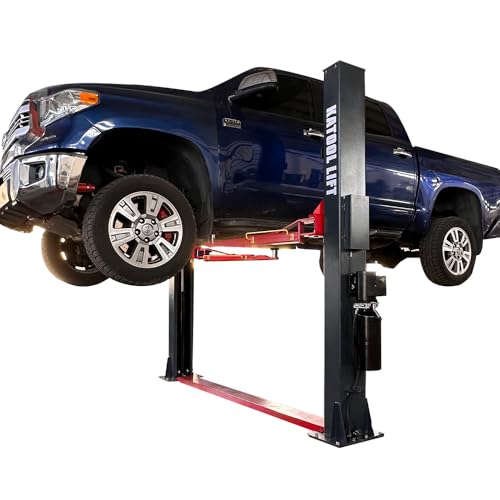

Setting up an automotive service bay requires precise spatial planning to prevent cramped working conditions and structural layout headaches. Measuring your shop footprint before pouring concrete or uncrating heavy equipment determines whether a lift will function smoothly or obstruct daily movement. Understanding how wide is a 2 post car lift is essential for determining both overall exterior width and drive-through clearance between upright steel columns. When installing a unit in a home garage, allocating adequate lateral space ensures technicians can swing vehicle doors freely and navigate rolling toolboxes around the perimeter. Exploring proper residential car lift options helps clarify how column dimensions interact with existing structural posts, perimeter walls, and workbench configurations.
Most standard two-post designs feature an overall exterior width spanning roughly 130 to 145 inches from baseplate to baseplate. Drive-through clearance between columns typically ranges from 95 to 110 inches, dictating which vehicle track widths can pass through comfortably. Balancing these dimensions alongside concrete foundation depth, overhead ceiling clearance, and arm geometry prevents costly installation errors. Evaluating manufacturer dimension schematics ensures your selected hoist accommodates everything from compact sedans to wide-track pickup trucks without bottlenecking shop workflow.
| Award | Product | BJL Score About BJL ScoreThe BJL Score is our own rating from 0 to 10, based on performance, design and build, ease of use, and value. It reflects independent research and is never influenced by manufacturers, retailers, or affiliate commissions. Learn more › | |
|---|---|---|---|
| Best Overall |
KATOOL 12,000-lb Heavy-Duty 2-Post Car Lift
|
8.9/10 | Buy |
| Best Budget |
 KATOOL 11,000 lb 2-Post Car Lift |
8.8/10 | Buy |
| Best Premium |
 Weize 12,000-lb 2-Post Automotive Lift with 4HP |
8.8/10 | Buy |
 XK L2900 2-Post Auto Car Lift: 9000 lb Capacity |
8.6/10 | Buy | |
| Best Value |
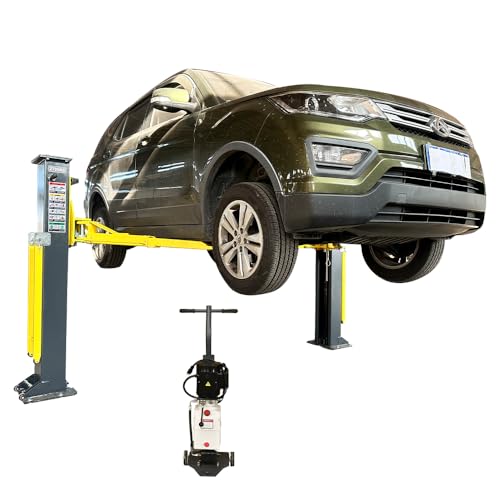 KATRAX 7000 lb 2-Post Hydraulic Auto Lift |
8.3/10 | Buy |
 KATOOL AK-M120 12,000 lb Extra Height 167-Inch |
8.3/10 | Buy | |
 KATOOL ME 11000 lbs 2-Post Car Lift |
8.1/10 | Buy | |
 KATOOL M120 12,000 lb Extra Height Clear-Floor |
8.0/10 | Buy |
KATOOL 12,000-lb Heavy-Duty 2-Post Car Lift
The KATOOL 12,000-lb two-post automotive lift delivers heavy-duty lifting capacity powered by a robust 4.0 HP 220V motor, symmetric arms, and single-point lock release. It is an ideal solution for independent shops and home mechanics servicing full-size trucks, SUVs, and passenger vehicles with appropriate slab and electrical support.
Pros
- High 12,000-lb lifting capacity readily handles heavy diesel trucks, work vans, and fleet vehicles.
- Single-point safety lock release streamlines daily shop workflow for solo mechanics.
- Supplied with screw-on pads and 100mm height extension adapters right in the crate.
- Generous 70.86-inch maximum rise height provides ample undercarriage working room.
Cons
- Crated shipping weight of 1,379 lbs requires a forklift on-site for offloading or customer freight terminal pickup.
- Carries European CE certification rather than third-party Automotive Lift Institute (ALI) gold label certification.
- Requires a dedicated 220V single-phase electrical supply and user-sourced hydraulic oil prior to initial startup.
KATOOL 11,000 lb 2-Post Car Lift
The KATOOL 11,000-lb two-post clearfloor automotive lift combines a high-output 4.0 HP 220V motor with dual hydraulic chain-drive cylinders to deliver a 4.25-inch to 70.75-inch lifting range. It is ideal for home mechanics, vehicle restorers, and independent shop operators with appropriate concrete foundations and 220V single-phase power.
Pros
- Heavy-duty 11,000-lb rating provides exceptional load headroom for full-size pickups, light trucks, and heavy unibody SUVs
- Low 4.25-inch minimum pad clearance accommodates standard passenger cars and lower ground-clearance vehicles
- Clearfloor overhead configuration keeps the bay floor free of raised drive-over baseplates for seamless transmission jack rolling
- Integrated column rubber padding helps protect vehicle door edges when entering and exiting elevated vehicles
- Powerful 4.0 HP single-phase 220V motor delivers reliable hydraulic lifting muscle for heavy-duty chassis
Cons
- Dual-side manual safety releases require walking to both columns to disengage mechanical locks before lowering
- Requires heavy freight offloading coordination via on-site forklift or customer terminal pickup for the 1,200-lb package
- Demands a dedicated 220V single-phase electrical circuit and verification of a sufficiently cured, structural concrete foundation
Weize 12,000-lb 2-Post Automotive Lift with 4HP
The Weize 12,000-lb two-post automotive lift delivers heavy-duty lifting capacity backed by a 4-HP, 220V single-phase motor and a convenient single-point mechanical safety lock release. With an overall height of roughly 112.6 inches and a generous 101-inch drive-through width, it is a practical choice for DIY mechanics and service bays working on half-ton to one-ton trucks.
Pros
- Substantial 12,000-lb load rating accommodates heavy diesel trucks, work vans, and family SUVs
- Single-point safety lock release mechanism streamlines vehicle lowering and improves shop efficiency
- High-power 4-HP 220V hydraulic power unit delivers reliable lifting torque for heavy chassis
- Generous 101-inch drive-through clearance prevents mirror and wheel scuffing on wide utility vehicles
- Relatively compact 112.6-inch overall height fits garages with moderate 10-to-11-foot ceilings
Cons
- Requires a dedicated 220V single-phase electrical circuit and hardwired connection by a qualified electrician
- Heavy freight shipping weight of 1,574 pounds requires mechanical equipment such as a forklift or tractor for offloading
- Lacks third-party Automotive Lift Institute (ALI) gold label certification, which may affect municipal or commercial insurance requirements
XK L2900 2-Post Auto Car Lift: 9000 lb Capacity
The XK L2900 is a 9,000-pound capacity two-post automotive hoist engineered with a compact 106.3-inch column height, making it an appealing option for residential garages and low-ceiling workshop bays. Powered by a 220V 3HP motor requiring a 30-amp circuit, it features asymmetric telescoping arms, double-point safety locks, and included truck adapters for DIY mechanics servicing passenger cars and light trucks.
Pros
- Compact 106.3-inch overall height fits easily under 9-foot to 10-foot residential garage ceilings
- Robust steel thickness across columns (11/64"), carriages (3/16"), and swing arms (15/64") with 5/8-inch stiffened base plates
- Includes a full set of truck adapters and anchor bolts right in the package
- Wide 100-inch drive-through clearance between columns accommodates wider light-duty trucks and SUVs
- Strong 220V 3HP motor provides reliable lifting speed between 20 and 60 seconds
Cons
- Double-point manual safety lock release requires releasing latches at both columns before lowering the lift
- Heavy 1,400-pound crated shipping package strictly requires an on-site forklift or tractor to offload, or freight terminal pickup
- Requires dedicated 220V 30-amp electrical wiring and separate sourcing of AW32 or AW46 hydraulic fluid
KATRAX 7000 lb 2-Post Hydraulic Auto Lift
The KATRAX 7,000-lb two-post clear-floor hydraulic auto lift provides a residential-friendly 110V power configuration designed for lifting sedans, SUVs, and light trucks in home garages and private workshops. It is a practical lifting solution for DIY mechanics seeking an accessible two-post layout without needing a commercial 220V electrical hookup.
Pros
- Convenient 110V hydraulic power unit eliminates the need for commercial 220V electrical wiring in residential bays
- Rated 7,000-lb capacity with 8,000-lb proof evaluation handles most standard passenger cars, SUVs, and light utility trucks
- Two-section adjustable arm design accommodates various vehicle wheelbases and factory frame contact points
- Industrial-gauge steel construction with protective rubber collision pads helps prevent structural deflection and door damage
Cons
- Clear-floor layout requires verified overhead ceiling height clearance before assembly to accommodate upper crossbeam structures
- Requires a sound, level concrete slab foundation capable of withstanding two-post surface-mount anchor bolt pullout stresses
- LTL freight delivery requires planning for heavy crate offloading, column staging, and multiple-person assembly
KATOOL AK-M120 12,000 lb Extra Height 167-Inch
The KATOOL AK-M120 is an extra-tall 12,000 lb clear-floor two-post automotive lift engineered with a massive 167-inch overhead height, a 73-inch rise, and a 220V 4HP motor. It provides heavy-duty lifting capability and unobstructed undercarriage access for commercial shops and high-ceiling home bays servicing large trucks and commercial vans.
Pros
- Massive 12,000 lb lifting capacity handles demanding 3/4-ton and 1-ton trucks, fleet vehicles, and full-size SUVs with ease.
- Extra-height 167-inch profile accommodates tall chassis configurations that standard clear-floor lifts cannot clear.
- Smooth dual hydraulic chain-drive system minimizes maintenance concerns common with traditional wire rope equalization designs.
- High-output 4HP 220V motor ensures rapid lift cycle speeds to keep commercial bays and active home garages productive.
- Clear-floor configuration keeps the center bay completely free of drive-over baseplates or raised floor obstructions.
Cons
- Requires substantial ceiling clearance of over 14 feet (167 inches), making it incompatible with standard 8-to-12-foot residential garage ceilings.
- Demands dedicated 220V electrical wiring and verified heavy-duty concrete slab thickness to safely anchor the 12,000 lb columns.
- Freight delivery requires an on-site forklift or flatbed wrecker offload due to the heavy 1,770 lb crated package weight.
KATOOL ME 11000 lbs 2-Post Car Lift
The KATOOL ME 11,000-lb two-post lift features a symmetric Double S arm design, a 70.75-inch maximum lift height, and a low 4.25-inch minimum pad profile. Suited for serious DIYers and service bays handling trucks, SUVs, and passenger cars, it requires a verified concrete slab and forklift-assisted delivery offloading.
Pros
- High 11,000-lb rated lifting capacity easily handles full-size pickup trucks, large SUVs, and commercial fleet vehicles
- Symmetric Double S arm configuration balances vehicle weight evenly between columns for stable lifting
- Generous 70.75-inch maximum rise height provides comfortable standing working clearance for underbody service
- Low 4.25-inch minimum pad profile slides easily under lower-clearance sedans and performance sports cars
Cons
- Shipping package weighs 1,369 lbs and requires an on-site forklift or flatbed trailer for regional terminal pickup
- Concrete slab foundation specifications, electrical voltage requirements, and hydraulic fluid must be verified via the manual prior to setup
- Symmetric arm geometry requires precise vehicle placement to allow sufficient door opening clearance between columns
KATOOL M120 12,000 lb Extra Height Clear-Floor
The KATOOL M120 is a heavy-duty, clear-floor two-post automotive lift featuring a 12,000-pound capacity, an extra-tall 167-inch overhead clearance, and a robust 4HP 220V motor. Designed for commercial repair bays and tall pole barns servicing heavy pickup trucks and high-roof vans, it requires substantial ceiling height and dedicated forklift offloading.
Pros
- Heavy 12,000 lb rating easily accommodates heavy-duty three-quarter-ton and one-ton pickup chassis
- Extended 167-inch overhead clearance solves vertical height restrictions for tall utility vehicles
- Powerful 4HP 220V power unit provides strong hydraulic drive without struggling under load
- Dual-chain drive layout offers durable lifting action with less stretch than standard cable setups
- Clear-floor design leaves the shop slab totally smooth for rolling service equipment
Cons
- Demands at least 14 feet of overhead bay clearance, excluding it from standard residential 8-to-12-foot garages
- Freight delivery requires buyer-supplied forklift equipment or a trip to a local freight terminal to offload the 1,698 lb crate
- Requires a dedicated 220V single-phase electrical circuit and a verified heavy-duty concrete foundation
Understanding Two-Post Car Lift Width Dimensions and Garage Bay Planning
Determining the physical space required for an automotive hoist involves far more than measuring the gap between two garage walls. A clear understanding of how wide is a 2 post car lift establishes whether your workspace can safely support vehicle staging, technician movement, and structural anchoring. While overall exterior dimensions define the outer footprint, drive-through clearance governs the actual size of vehicles that can navigate between the uprights. Evaluating these dimensional metrics in tandem with your garage layout ensures efficient workflow while preventing hazardous obstructions.
Overall Exterior Width vs. Drive-Through Clearance: The Essential Distinction
Automotive lift manufacturers publish two distinct width figures that every installer must recognize. The overall exterior width represents the total span from the outside edge of one column baseplate to the outside edge of the opposing baseplate. Across common light-duty and medium-duty two-post models, this measurement generally ranges from 130 inches to roughly 145 inches. Power unit placement also matters, as a side-mounted hydraulic pump can add another 6 to 10 inches of lateral projection to one column. Failing to account for this pump protrusion often causes surprising clearance conflicts with nearby shop walls or shelving.
The second critical metric is the drive-through clearance, which defines the usable passage between the inside faces of the carriages or swing-arm pivots. For standard automotive models, drive-through dimensions typically measure between 95 inches and 105 inches. This internal corridor determines whether wide pickup trucks, commercial vans, or performance cars can roll into the lifting bay smoothly. Mistaking the overall footprint for drive-through clearance can result in selecting a hoist that cannot accommodate your vehicle fleet. Verifying both measurements against your intended vehicles ensures that neither exterior shop walls nor interior column faces impede daily operations.
Dimensional Analysis of Typical Two-Post Lifts
Examining manufacturer specifications across varied weight capacities reveals consistent dimensional trends. An entry-level or mid-tier unit such as the XK 2 Post Auto Car Lift 9000 lb Capacity Truck hoist features an overall exterior width of 133-1/4 inches paired with a drive-thru width clearance of 100 inches. Its baseplates measure 18.89 inches across, demanding stable concrete support along the outer edges of the bay. These proportions represent a common baseline for residential installations where standard light trucks and sedans make up the bulk of the workload.
When stepping up to heavy-duty equipment, the physical footprint expands to support greater vehicle mass. The Weize 2 Post Automotive Car Lift provides an overall exterior width of 137 inches with a dedicated drive-through width of 101 inches to accommodate heavy-duty diesel chassis. Similarly, units like the KATOOL 12000 lbs Extra Height 167inch 2 Post Lift expand structural upright thickness to safely hoist work trucks up to 12,000 pounds. Even with increased lifting capacity, manufacturers work to keep drive-through widths between 100 and 105 inches to preserve compatibility with standard garage bays. Paying close attention to individual model schematics helps buyers identify which lift matches their specific architectural boundaries.
Symmetric vs. Asymmetric Arm Geometry and Door Opening Width
Lifting arm architecture directly influences how practical a given lift width feels during everyday use. In a symmetric configuration, the columns face each other squarely, and the swing arms extend equally toward the front and rear of the bay. This layout positions the center of gravity directly between the uprights, which provides superior balance for heavy, square-bodied vehicles such as extended-cab work trucks. Models like the ME 11000lbs Double S Design 2 Post Lift Car Lift utilize symmetric arm structures to maintain balanced weight distribution across a wide variety of chassis shapes. However, symmetric column alignment often positions the vehicle doors directly parallel to the lift posts, severely limiting door-opening width once parked.
Asymmetric designs resolve this door-clearance problem by angling the columns backward slightly or using shorter front arms paired with longer rear arms. This 30/70 weight balance approach positions roughly thirty percent of the vehicle forward of the posts and seventy percent behind them. As a result, the front doors swing open behind the uprights, allowing the technician to enter and exit the passenger compartment with ease. While asymmetric layouts dramatically improve cabin access in narrow bays, they require careful vehicle positioning to avoid overloading the shorter swing arms. Choosing between symmetric and asymmetric designs depends heavily on whether you prioritize heavy truck balance or unrestricted cabin entry.
Concrete Slab Footprint and Anchor Edge Setback Requirements
Total lift width does not merely dictate overhead and wall spacing; it also dictates concrete foundation layout. Surface-mounted two-post lifts transfer immense tensile and shear loads into the garage floor through steel baseplates that commonly measure between 18 and 20 inches in width. Most manufacturers mandate a reinforced concrete floor with a minimum thickness of 4 inches and a compressive rating of at least 3,000 PSI cured for 28 days. Installing heavy steel columns on unverified residential slabs risks catastrophic anchor pullout under maximum vehicle loads. Verifying slab depth via test drilling ensures that the floor can withstand the substantial lateral leverage exerted by raised vehicles.
Wedge anchor placement introduces another vital dimensional restriction called edge distance. Standard expansion anchors generally require a minimum setback of 6 inches from any concrete joint, saw cut, or perimeter foundation edge to prevent the surrounding concrete from cracking under outward expansion pressure. If a garage bay measures 12 feet wide and your lift requires 135 inches from plate edge to plate edge, the outer anchor bolts may land uncomfortably close to slab relief cuts. Furthermore, post-tension concrete slabs present severe drilling hazards that can destroy structural tendons and compromise building integrity. Always verify that your concrete footprint provides adequate uncracked real estate beneath both baseplates before drilling anchor holes.
Bay Spacing Formulas: Calculating Total Garage Width Needed
Determining whether a two-post hoist will fit your workspace requires a simple layout formula. Technicians should start with the overall exterior width of the hoist, which averages roughly 135 inches, or 11.25 feet. To maintain a safe and functional work environment, you must add at least 24 to 36 inches of unobstructed walkway clearance on each side of the columns. When including a side-mounted hydraulic power unit and rolling tool cart pathways, the ideal single-bay width quickly reaches 14 to 15 feet. Attempting to wedge a standard two-post lift into a 10-foot or 11-foot single garage bay leaves zero space for emergency egress or arm adjustment.
Evaluating surrounding shop equipment ensures that your lift installation does not disrupt adjacent workspace activities. If your garage includes permanent workbenches, stationary air compressors, or heavy storage cabinets along the perimeter walls, their depths must be subtracted from the total available room width. Technicians often consult detailed guides on hydraulic car lift setups to understand how hydraulic hoses, overhead shutoff bars, and lateral clearances interact within tight shop boundaries. Maintaining generous perimeter spacing ensures you can roll transmission jacks, oil drains, and engine cranes past the columns without colliding with structural posts or raised vehicles.
Vertical and Lateral Obstruction Management in Residential Workshops
Ceiling height and overhead mechanical hardware interact directly with column width during the layout phase. Two-post lifts fall into two distinct structural styles: clear-floor overhead models and baseplate floor-plate designs. Clear-floor lifts route hydraulic lines and steel equalization cables across a top crossbeam, creating an open floor between the columns that accommodates rolling oil drains easily. However, these overhead models often reach total heights between 112 and 167 inches, demanding substantial vertical clearance beneath rafters and lighting fixtures. If your ceiling height is restricted, baseplate models route cables under a floor-mounted cover plate, but that bottom ridge can slightly hinder the movement of small floor jacks.
Horizontal garage door hardware presents another frequent obstacle when positioning a two-post lift within a residential bay. Standard center-mounted garage door openers and overhead horizontal tracks often align directly with the path of the vehicle roof as the lift ascends. Converting garage doors to high-lift tracks and installing a side-mounted jackshaft opener moves the door assembly tight against the ceiling, clearing vital vertical and lateral operating space. Evaluating these overhead mechanisms early prevents the frustrating discovery that your open garage door strikes the top of your hoist or limits lifting travel. Coordinated spatial planning guarantees that all moving shop components function harmoniously without mechanical interference.
Vehicle Track Width and Mirror Clearance Considerations
Drive-through clearance becomes an urgent concern when servicing modern full-size trucks and commercial transport vehicles. While compact passenger cars easily clear a 100-inch drive-through corridor, full-size pickup trucks feature body widths around 80 inches, with extended towing mirrors expanding the total vehicle envelope past 96 inches. When maneuvering such vehicles between lift posts with a 100-inch drive-through rating, technicians are left with only two to three inches of margin on either side. Folding side mirrors inward before driving onto the hoist is often mandatory to avoid scratching painted mirror housings against steel carriages.
Wheelbase and track dimensions also dictate how swing arms engage vehicle lift points. Many commercial shops utilize versatile auto car lift systems capable of servicing both narrow unibody commuter cars and heavy four-wheel-drive platforms. Standard lift pads must adjust low enough to slip beneath sports car rocker panels, as seen in units offering 3.875-inch to 4.25-inch minimum pad heights. Conversely, wide-track trucks often require tall truck frame adapters to clear running boards and exhaust pipes before contact is made. Confirming that your lift swing arms offer sufficient telescoping reach ensures that you can center varied vehicle wheelbases safely within the drive-through envelope.
Freight Receiving and Physical Footprint Logistics
Preparing for the arrival of a two-post car lift requires practical material-handling arrangements before assembly can begin. Manufacturer shipping crates for hoists like the XK 2 Post Auto Car Lift weigh around 1,400 pounds, while heavy-duty commercial units can exceed 1,700 pounds. These packages contain long structural columns spanning anywhere from 9 to 14 feet in length, making manual residential offloading impossible. Freight carriers commonly require customers to have a forklift or tractor with forks ready at the delivery site, or arrange for freight terminal pickup using an open flatbed trailer. Preparing your offloading equipment ahead of delivery prevents costly carrier redelivery fees and damaged freight claims.
Once the crated lift arrives at your facility, staging the heavy steel columns requires dedicated floor space outside the immediate bay footprint. Technicians must unpack and inspect the hydraulic cylinders, equalization cables, power unit, and mounting hardware for transit damage before bolting anything to the floor. Snapping chalk lines across your verified concrete slab ensures that both baseplates align squarely before rotary hammer drilling begins. Taking the time to double-check column plumb, baseplate squareness, and drive-through width prior to torquing wedge anchors prevents uneven carriage travel and premature mechanical wear.
Practical Summary for Selecting the Correct Lift Width
Selecting the optimal width for a two-post car lift requires balancing your vehicle fleet against the structural boundaries of your building. A standard overall exterior width of 133 to 137 inches provides stable column anchoring while demanding a minimum bay width of roughly 14 feet for comfortable technician access. Drive-through clearance should never fall below 100 inches if your service routine includes full-size pickup trucks, commercial vans, or wide-track SUVs. Combining accurate dimensional measurements with certified concrete slab thickness and proper arm geometry ensures a safe, efficient lifting environment that serves your workshop reliably for years to come.
About the author
Mike Bumbeck is an automotive journalist and hands-on product evaluator with a long-standing interest in classic vehicles, motorcycles, and practical garage equipment. His work brings a grounded perspective to automotive tools, maintenance products, and the details that matter when choosing gear for real-world use.