
How to Move a Car Lift: Practical Relocation Guide for 2026
Learn how to move a car lift safely in November 2026, covering mobile wheel kits, unbolting two-post columns, slab prep, and transport logistics.
 By Christian Hazel
Updated October 10, 2026


Rearranging an automotive workshop or moving to a new home often forces mechanics to rethink their bay layout. Relocating heavy machinery involves far more than simply rolling a toolbox across smooth concrete. Understanding how to move a car lift requires evaluating whether you are shifting a mobile frame assembly or unbolting heavy surface-mounted columns. If you are comparing different shop setups, reviewing our guide on residential vehicle lifts can help clarify how various frame profiles fit inside residential bays. Taking time to inspect your shop layout prevents structural mistakes before you start unfastening hardware.
Portable low-rise and mid-rise units often include rolling casters, but fixed two-post or four-post structures require careful rigging, fluid handling, and anchor extraction. Rushing the disassembly process can warp synchronization cables, damage hydraulic fittings, or ruin fresh concrete floors. Planning each mechanical step protects both the lifting machinery and the vehicle platforms you depend on daily. Balancing equipment weight correctly ensures that every transition between workshop bays remains smooth and secure.
| Award | Product | BJL Score About BJL ScoreThe BJL Score is our own rating from 0 to 10, based on performance, design and build, ease of use, and value. It reflects independent research and is never influenced by manufacturers, retailers, or affiliate commissions. Learn more › | |
|---|---|---|---|
| Best Overall |
LGYORWAY Portable Single Post Mobile Car Lift
|
9.2/10 | Buy |
| Best Value |
 Rueekfil 7000 LBS Portable Car Lift |
9.2/10 | Buy |
| Best Premium |
 KATOOL 7000 lb Portable Mid-Rise Scissor Lift |
9.1/10 | Buy |
 Albott 7000 LBS Portable Scissor Car Lift |
8.6/10 | Buy | |
| Best Budget |
 AUTOXBERT Universal Rubber Jack Pad Adapter Block |
8.3/10 | Buy |
 VEVOR Portable Manual Car Lift 4400 lbs Capacity |
8.1/10 | Buy | |
 Albott 8000 LBS Portable Car Lift |
7.8/10 | Buy |
LGYORWAY Portable Single Post Mobile Car Lift
The LGYORWAY Portable Single Post Car Lift is a non-hydraulic, mobile tire-engaging lifting station rated for up to 8,800 lbs per wheel with a 33.5-inch maximum lift height. Requiring no electrical wiring, hydraulic fluid, or concrete floor anchors, it is an ideal choice for home garage DIYers and mobile mechanics seeking safe wheel-end access without pinching rocker panels.
Pros
- Mechanical drive requires no 110V or 220V electrical circuits and zero hydraulic fluid sourcing
- Tire-engaging forks eliminate contact with vulnerable vehicle pinch welds, floorboards, and rocker panels
- Compact 31.9 x 30.7 x 49.2-inch footprint rolls easily across standard residential garage slabs on 4 casters
- Substantial 33.5-inch rise height provides far superior working clearance compared to conventional 20-inch floor jacks
- Includes a heavy cargo plate to double as an industrial shop dolly and material handling station
Cons
- Lifts only one wheel or vehicle corner at a time rather than elevating the entire chassis simultaneously
- Carries European CE and TUV marks rather than American Automotive Lift Institute (ALI) gold label certification
- Requires a smooth, solid, and level hard surface to safely support and roll under substantial loads
Rueekfil 7000 LBS Portable Car Lift
The Rueekfil 7000 LBS Portable Car Lift is a heavy-duty, frame-engaging hydraulic vehicle lift designed for home garage DIYers and mobile mechanics seeking up to 28 inches of working clearance without drilling into concrete. Built from Q235B carbon steel with positive mechanical safety locks and wall-mount storage handles, it provides a stable platform for servicing unibody sedans, SUVs, and light trucks.
Pros
- Substantial 7,000-pound lifting capacity easily handles heavier passenger cars, midsize trucks, and modern electric vehicles
- Unanchored portable frame design operates without requiring permanent anchor bolts or structural slab modifications
- Mechanical safety locks provide rigid structural engagement at working height before undercarriage service begins
- Comes packaged with 11-inch extension plates, adjustable height columns, and rubber lift pads for versatile chassis contact
- Built-in nylon rolling wheels and wall-mount handles simplify workshop repositioning and vertical off-the-floor storage
Cons
- Total crated package weight of 418 pounds requires a helper or mechanical assistance during freight delivery and unboxing
- Safety locks require manual physical disengagement on both independent lift frames before lowering the vehicle
- Maximum 26.8 to 28-inch lift height requires creeper access rather than providing full upright standing headroom
KATOOL 7000 lb Portable Mid-Rise Scissor Lift
The KATOOL 7,000 lb mid-rise scissor lift delivers 39 inches of lifting clearance with an ultra-low 4.3-inch collapsed profile powered by standard 110V electricity. It is an ideal solution for DIY mechanics, sports car enthusiasts, and low-ceiling garage owners who require dependable vehicle lifting without drilling permanent floor anchors.
Pros
- Substantial 7,000 lb capacity handles a wide variety of passenger cars, lowered sports cars, and light utility vehicles
- Ultra-low 4.3-inch drive-over profile eliminates clearance issues on low-slung performance vehicles
- Runs on a standard 110V household electrical supply for effortless residential garage integration
- Compact 39-inch vertical rise is perfectly matched to standard 8-to-10-foot residential ceiling heights
- Freestanding design avoids the concrete anchor drilling and slab modifications required by two-post lifts
Cons
- LTL freight delivery requires an on-site forklift for offloading or customer pickup at a regional freight terminal
- A 39-inch maximum lift height requires creeper or rolling stool use rather than full upright standing clearance
- Hydraulic oil is not pre-filled and must be sourced separately prior to system priming and operation
Albott 7000 LBS Portable Scissor Car Lift
The Albott 7000 LBS Portable Car Lift delivers reliable frame-engaging lifting power with a 28-inch maximum rise height, making it an excellent unanchored solution for low-ceiling residential garages. Built from high-strength Q235B steel, it suits DIY mechanics and car enthusiasts tackling brake jobs, tire rotations, and chassis maintenance on level concrete.
Pros
- Substantial 7,000-lb capacity easily handles most domestic sedans, sports cars, and midsize SUVs
- Mobile four-wheel design eliminates permanent concrete drilling and fits well under standard 8-to-10-foot residential ceilings
- Includes extension panels and multi-height adapter blocks to reach factory frame contact points across different wheelbases
- Multiple mechanical locking positions allow safe, stable under-vehicle working heights off hydraulic pressure
Cons
- Maximum 28-inch rise height does not provide full standing headroom underneath the vehicle
- Weighs 401 pounds, which requires moderate physical effort to reposition or wheel across uneven garage thresholds
- Requires a minimum load of approximately 220 pounds on the frames to compress the return springs and initiate descent
AUTOXBERT Universal Rubber Jack Pad Adapter Block
The AUTOXBERT Universal Rubber Jack Pad Adapter is a slotted support block designed to protect delicate pinch-weld seams and rocker panels from bending during maintenance. It provides a non-slip interface for DIY mechanics lifting unibody vehicles with standard floor jacks or lift saddles.
Pros
- Helps prevent costly structural bending and paint damage to factory unibody pinch welds and rocker panels
- Durable, wear-resistant rubber compound provides traction to minimize metal-on-metal slippage during lifting
- Broad compatibility across popular Japanese and domestic unibody passenger cars and crossovers
- Includes a handy storage bag to keep road grime and tool drawer grease contained
Cons
- Single-piece package requires buying additional units if outfitting a multi-pad hoist or four-point lift
- Groove depth and width may not fit deep, non-standard, or heavily modified frame rail seams
- Rubber material will naturally experience surface wear and indentation under repeated heavy vehicle contact
VEVOR Portable Manual Car Lift 4400 lbs Capacity
The VEVOR Portable Manual Car Lift delivers a 4,400-lb (2-ton) capacity and a 5.9 to 23-inch lift range driven mechanically by a power drill or hand crank without requiring hydraulics or electrical wiring. Featuring an unanchored triangular steel frame, 31.5-inch non-slip contact pads, and nylon transport casters, it is an accessible solution for home garage DIYers working on compact cars in low-ceiling spaces.
Pros
- Completely mechanical lifting operation requires no hydraulic fluid, air compressors, or dedicated 220V electrical circuits
- Low 5.9-inch collapsed profile easily slides beneath low-clearance vehicles and tucks away against garage walls when not in use
- Integrated nylon caster wheels allow a single operator to roll and position the lift frame effortlessly across smooth concrete floors
- Generous 31.5-inch non-slip rubberized contact pads distribute weight evenly to protect factory pinch welds and rocker panels
Cons
- 4,400-lb gross weight limit is not suitable for full-size pickup trucks, heavy electric vehicles, or large SUVs
- Lifting mechanism strictly prohibits impact wrenches and requires manual drill or hand-crank operation
- Maximum 23-inch lift height is designed for creeper work rather than providing full standing headroom
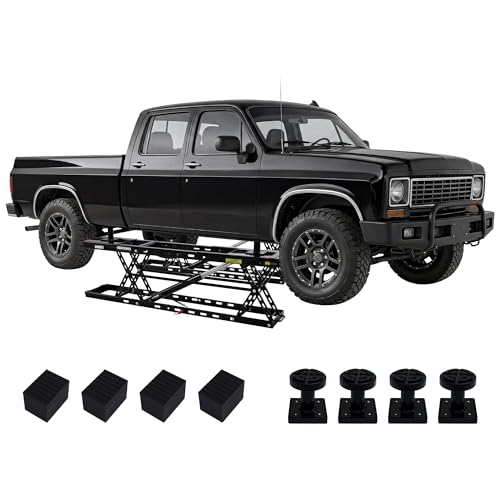
Albott 8000 LBS Portable Car Lift
The Albott 8000 LBS Portable Car Lift provides an 8,000-pound capacity frame-engaging scissor system constructed from high-tensile Q355B steel for low-ceiling residential garages. Featuring mechanical safety locks, dual locking pins, and extension plates reaching up to 75 inches, it suits DIYers and truck owners seeking serious lifting capability without permanent concrete anchoring.
Pros
- Substantial 8,000-lb gross capacity handles heavier consumer trucks and SUVs that exceed smaller portable units.
- Requires no permanent concrete slab anchor bolts, allowing free floor repositioning and low-ceiling garage clearance.
- Included extension plates lengthen frame support reach up to 75 inches to engage separated factory jacking points.
- Constructed from high-grade Q355B structural steel with dual locking pins for reliable mechanical safety.
Cons
- Individual frames weigh roughly 130 pounds each, requiring physical effort to slide and align beneath vehicles.
- Requires sourcing ISO No. 46 hydraulic fluid separately before initial setup and cylinder bleeding.
- Maximum lift height of 27.4 inches is restricted to creeper work and does not offer full standing undercarriage access.
Complete Guide to Relocating and Moving an Automotive Car Lift
Relocating an automotive lift is a major mechanical project that requires careful planning, proper equipment, and strict attention to structural safety. The specific process for how to move a car lift depends primarily on whether your equipment is a portable frame model, a mobile four-post storage rack, or a permanently bolted two-post service hoist. Portable units require mechanical reconfiguration and caster deployment, while stationary surface-mounted lifts demand complete mechanical disassembly, anchor extraction, and hydraulic fluid reclamation. Understanding the physical demands of your specific machinery ensures that you transport the equipment without personal injury or structural damage.
Determining Lift Architecture and Relocation Complexity
Automotive lifts fall into two distinct operational categories when considering shop relocation. Portable designs, including mid-rise scissor jacks, single-post tire lifts, and mobile frame-engaging models, feature built-in transport provisions like nylon wheels, pivot dollies, or tow bars. These units allow a single person or small crew to reposition the framework within minutes on flat concrete floors. Heavy equipment like surface-mounted two-post lifts or bolted four-post service platforms require extensive mechanical teardown before any structural component can safely move.
Evaluating equipment weight and physical dimensions is essential before picking up a single wrench. A compact portable frame unit like the Rueekfil Heavy-Duty Portable Car Lift 7000 LBS or the Albott 7000 LBS Portable Car Lift with Extension utilizes high-strength Q235B steel assemblies that fold down for straightforward garage maneuvering. In contrast, commercial two-post steel columns can stand over twelve feet tall and weigh upwards of seven hundred pounds per upright. Matching your moving strategy to the actual structural architecture of the lift prevents severe shop accidents and component distortion.
Moving Portable Scissor and Single-Post Vehicle Lifts
Portable automotive lifts offer the simplest moving procedure because they do not anchor permanently into concrete slabs. To relocate a portable scissor unit or split-frame system, lower the lifting carriages completely onto their lowest mechanical stops. Relieving hydraulic pressure allows internal safety locks to disengage and collapses the scissor arms to their lowest profile. Units like the VEVOR Portable Car Lift, 4400 lbs Capacity rely on high-strength nylon casters that roll smoothly once the lifting structure rests closed.
Garages with floor variations demand extra care during transit. Manufacturers specify that portable equipment should only operate on flat ground, and models like the Albott 8000 LBS Portable Car Lift for Home Garage require surfaces with slopes under four degrees. Debris and expansion cracks can easily snag smaller nylon wheels and tip an unbalanced frame. Clearing your path of hoses, cords, and grit ensures the rolling dollies glide smoothly to the new bay.
When transporting portable units to a new shop, prepare the hydraulic power pack and hoses for travel. Disconnect quick-connect hydraulic couplings and seal fittings with dust caps to prevent fluid contamination. Dual-frame assemblies often weigh around one hundred thirty pounds per lifting rail, making them manageable for two people to lift onto a utility trailer. Securing the frames with ratcheting straps keeps steel linkages from shifting or pinching hydraulic lines during transport.
Relocating Four-Post Parking Lifts Using Caster Kits
Four-post storage lifts present a unique relocation scenario because many residential models remain unanchored during routine vehicle stacking. Most four-post manufacturers offer optional polyurethane caster wheel kits designed for shop reorganization. These caster assemblies hook directly into the crossbeam corner posts near the safety ladders. Lowering the lift runways onto the caster pins raises the column baseplates approximately one to two inches off the shop floor.
Once elevated on caster wheels, a four-post hoist becomes a rolling frame that moves across a smooth bay. Moving an assembled four-post rack requires at least two or three workers to guide the perimeter columns simultaneously. Uneven pushing forces can rack the rectangular geometry of the crossbeams, causing internal safety locks or pulleys to bind. Maintaining slow movement prevents heavy columns from gaining momentum or drifting toward garage walls.
Transporting a four-post lift to an entirely new building requires complete disassembly rather than rolling on casters. Disassemble the structure by removing drive-on approach ramps, unbolting runways, disconnecting crossbeams, and unstringing internal steel cables. Labeling each cable route and pulley bracket during disassembly saves hours of alignment work during reassembly. Securing long steel runways onto an open equipment trailer requires balanced weight distribution to prevent trailer sway.
Decommissioning and Disassembling Stationary Two-Post Lifts
Disassembling a surface-mounted two-post lift requires strict adherence to mechanical safety protocols. Begin by disconnecting electrical power at the main breaker panel and applying a lockout tag to prevent accidental motor activation. Lower the lifting arms fully so internal carriages rest securely against column base stops. Relieve residual hydraulic pressure by depressing the manual lowering lever before loosening any fluid line fittings.
Draining the hydraulic reservoir is the next crucial step in preparing the lift for transport. Position a clean fluid catch basin beneath the power unit drain plug or remove the return line to pump fluid into sealed jugs. Most systems operate on standard No. 46 hydraulic oil or ISO AW-32 fluid, which should be inspected for contamination before reuse. To understand how fluid pressures and pump configurations operate, review our breakdown of hydraulic car lift systems for deeper operational context.
Once the fluid is drained, remove the hydraulic lines and steel equalization cables running between the columns. Loosen the cable adjusting nuts at the top of each carriage block to relieve tension completely. Carefully pull the cables through the lower pulleys and wrap them into loose coils to prevent permanent kinks or broken strands. Coil the equalization lines carefully to protect the internal wire strands from grit and mechanical distortion.
Removing the overhead crossbeam on clear-floor lifts requires dedicated overhead support equipment before unfastening column bolts. An engine hoist or transmission jack must support the center of the crossbeam while you remove the end attachment bolts. Lower the crossbeam slowly to floor level to protect the padded shutoff bar and internal microswitch wiring. Never attempt to remove crossbeam bolts from ladders without mechanical support holding the central span.
Extracting Concrete Wedge Anchors and Freeing Column Baseplates
Extracting the heavy steel wedge anchors that secure two-post columns into the floor requires specific mechanical techniques. Because wedge anchors expand permanently against internal concrete walls during initial torqueing, you cannot simply unscrew them from the floor. Removing the outer hex nuts and washers allows the column baseplate to slide free, but threaded studs remain protruding from the slab. You must decide whether to extract the studs entirely or cut them flush with the concrete surface.
The most common method involves using an angle grinder equipped with a metal cut-off wheel to slice anchor studs flush with the concrete. After cutting the steel flush, drive the remaining stub slightly beneath the surface using a heavy punch, then patch the indentation with industrial concrete repair epoxy. If complete anchor extraction is required, a core-drilling rig with a diamond-tipped bit can core around the anchor shank before filling the hole with non-shrink grout. Both approaches leave the floor smooth for future garage utility.
Never pry aggressively against the column baseplate with large wrecking bars to force an anchor free. Excessive leverage can bend the welded baseplate flange or deform precision alignment shims underneath the column. If an anchor stud resists upward movement, tap the top of the stud with a brass drift to dislodge the expander clip inside the concrete hole.
Safe Rigging, Handling, and Transport of Steel Uprights
Two-post columns present significant tipping hazards once unbolted from the concrete foundation. The center of gravity on each column sits high along the upright rail, especially on models with direct-drive cylinders or integrated carriages. Wrap heavy-duty nylon lifting slings around the upper column and secure them to an engine crane or forklift boom before removing the final baseplate nuts. Lower the upright slowly onto wooden blocking or machinery dollies to prevent direct concrete impact.
Transporting heavy columns and structural crossbeams across long distances requires adequate vehicle payload capacity and robust tie-down rigging. Moving full-size columns and long runways exceeds the cargo capacity of standard consumer trailers, making commercial transport solutions a common necessity. If you are coordinating long-distance vehicle transport or receiving crated equipment, our detailed guide on heavy-duty lift pickup and freight logistics covers useful transport options. Secure every structural component with transport chains or ratcheting straps to eliminate shifting during road travel.
Protecting internal hydraulic cylinders, mechanical safety locks, and slider blocks during transit prevents expensive repair work later. Wrap cylinder rod ends and hydraulic ports in protective wrap to guard against grit, moisture, and road debris. Secure movable lifting carriages to column rails using secondary transport straps so they cannot slide along the tracks during loading or braking. Careful handling during the transport stage guarantees that your lift mechanisms remain true and ready for precise reinstallation.
Foundation Verification and Garage Preparation at the New Location
Before standing columns at a new installation location, you must thoroughly evaluate the concrete slab to ensure structural suitability. Surface-mounted two-post lifts require a minimum concrete slab thickness of four inches with a compressive strength rating of at least 3,000 PSI cured for a minimum of twenty-eight days. Performing a test core drill in an inconspicuous area confirms actual concrete depth, as residential garage floors often taper near perimeter walls. Never install a two-post lift on cracked, spalled, or unreinforced concrete.
Post-tension concrete foundations introduce extreme hazards that demand professional verification before drilling any anchor holes. Post-tension slabs contain high-strength steel tendons under massive mechanical tension that can snap violently if struck by a rotary hammer bit. If your garage floor features post-tension warning stamps or exterior anchor pockets, hire a certified concrete scanning professional using ground-penetrating radar to map cable positions. Maintaining safe clearance from post-tension cables is an absolute requirement for every installer.
Calculating overhead clearance is equally critical when laying out your lift in a new workshop bay. Measure total vertical space from the concrete floor to the lowest ceiling obstacle, accounting for overhead garage door tracks, light fixtures, and roof trusses. If vehicle stacking height conflicts with standard door hardware, consider converting your overhead door to high-lift tracks paired with a wall-mounted jackshaft opener. This layout adjustment preserves valuable vertical airspace and prevents vehicle roofs from striking horizontal door tracks.
Reassembly, Column Plumbing, and Equalization Balancing
Reassembling your lift begins by snapping accurate chalk lines to establish column positioning, squaring, and drive-through clearance. Position the baseplates over your chalk lines, verifying that each anchor hole sits at least six inches away from slab edges, relief cuts, or expansion joints. Drill anchor holes using a heavy-duty rotary hammer drill and an industrial carbide bit matching the manufacturer anchor diameter. Thoroughly vacuum concrete dust and pulverized debris from each hole before tapping fresh wedge anchors into place.
Plumbing the vertical columns is necessary to prevent carriage binding and premature slider block wear. Use a precision magnetic spirit level along both the face and side profile of each column upright to detect any floor slope. If the column leans outward or inward, insert slotted steel horseshoe shims beneath the baseplate corners until the upright stands plumb. Once plumbed, tighten wedge anchor nuts using a calibrated torque wrench to the exact foot-pound specification provided in the manufacturer manual.
Restring the equalization cables through the lower pulleys and attach the threaded tension rods to each lifting carriage. Cable synchronization is essential because it forces both carriages to rise and descend at the exact same physical rate regardless of vehicle weight bias. Adjust the cable tension nuts until both wire ropes exhibit equal deflection when pulled by hand with moderate force. Proper cable balancing prevents hydraulic cylinder strain and ensures that mechanical safety locks engage their corresponding ladder slots together.
Operational Commissioning and Safety Lock Verification
Completing the relocation requires a thorough mechanical commissioning sequence before lifting any vehicle. Refill the hydraulic reservoir with fresh hydraulic oil of the specified grade and bleed trapped air from the cylinder bleed screws. Cycle the unloaded lift through its full vertical stroke several times while listening closely to the mechanical safety lock latches. Both column latches must produce distinct, simultaneous clicking sounds as they pass over each safety ladder stop during the ascent.
Inspect every hydraulic fitting, hose crimp, and cylinder seal for fluid seepage while the lift holds position at full extension. Lower the lift fully to verify that carriages descend smoothly without shuddering or binding along the column channels. After cycling the equipment under a light test load, re-torque all concrete wedge anchors to confirm that no studs slipped or loosened in the freshly drilled holes. Taking these methodical verification steps ensures that your relocated automotive lift operates reliably and safely for years of dependable shop service.
About the author
Christian Hazel is an automotive journalist with extensive experience covering four-wheel-drive vehicles, mechanical upgrades, and off-road equipment. His background includes technical reviews, installation features, and project-vehicle coverage, bringing useful context to equipment choices for trucks, Jeeps, and off-road enthusiasts.