
How Tall of a Garage for a Car Lift: Garage Clearance Guide for 2026
Learn how tall of a garage for a car lift is required for safe operation, vehicle stacking, and overhead door clearance in October 2026.
 By Hank O'Hop
Updated October 10, 2026
By Hank O'Hop
Updated October 10, 2026

Planning overhead clearance inside a residential workshop requires precise measurements before unbolting equipment or pouring fresh footings. Many homeowners ask how tall of a garage for a car lift is actually required before investing in dedicated shop hardware. Installing a full-rise or mid-rise hoist transforms routine underbody maintenance, eliminating the physical strain of creeper boards and jack stands. Exploring modern residential car lift options reveals that ceiling height, vehicle dimensions, and overhead obstructions all dictate what fits. Understanding these physical spatial relationships protects vehicle roofs, prevents structural contact with roof trusses, and ensures smooth mechanical safety lock engagement.
Clearance calculations involve far more than just measuring from bare concrete to the nearest drywall panel. Overhead garage door tracks, center-mounted automatic openers, hanging light fixtures, and safety shutoff bars all consume vital vertical space. When evaluating hydraulic car lift setups, buyers must account for the vehicle roof height, total carriage rise, and mandatory safety lock overtravel. A sports car parked on a low-rise scissor frame requires dramatically less vertical room than a full-size pickup truck raised on a commercial clear-floor hoist. Verifying these spatial requirements early keeps installation straightforward and prevents dangerous clearance surprises once equipment arrives on site.
| Award | Product | BJL Score About BJL ScoreThe BJL Score is our own rating from 0 to 10, based on performance, design and build, ease of use, and value. It reflects independent research and is never influenced by manufacturers, retailers, or affiliate commissions. Learn more › | |
|---|---|---|---|
| Best Overall |
KATOOL Portable Car Lift Mid Rise Scissor Lift
|
9.1/10 | Buy |
| Best Premium |
 WEIZE 11000lbs Two Post Car Lift
|
9.1/10 | Buy |
| Best Budget |
 Albott 7000 LBS Portable Car Lift with Extension
|
8.6/10 | Buy |
 Albott 7000 lb Portable Car Lift with Extension
|
8.1/10 | Buy | |
 Albott 8000 LBS Portable Car Lift with Extension
|
8.1/10 | Buy | |
| Best Value |
 Albott 8000 LBS Portable Car Lift Quick Jack
|
8.1/10 | Buy |
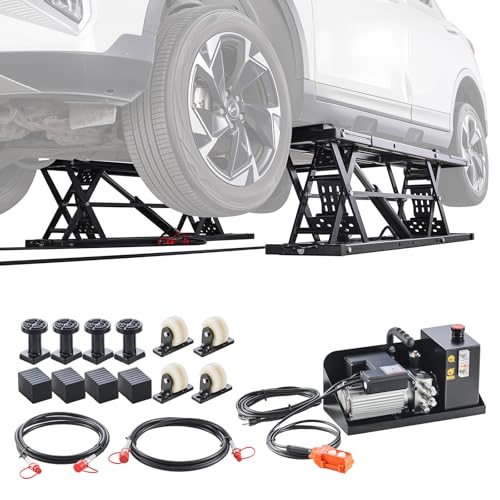 VEVOR Portable Car Lift, 9000 lbs Capacity
|
8.1/10 | Buy | |
 KATOOL 12000 lbs Extra Height 167inch 2 Post Lift
|
8.0/10 | Buy | |
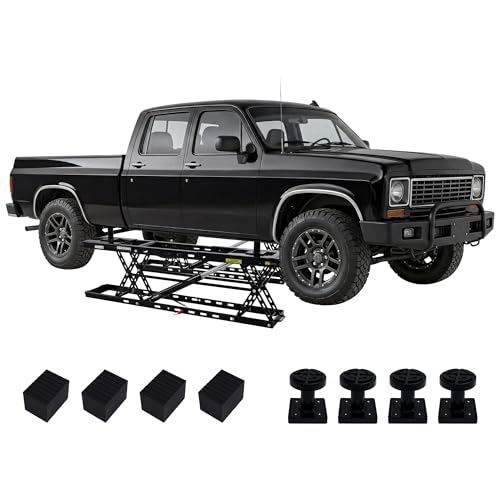 Albott 8000 LBS Portable Car Lift for Home Garage
|
7.8/10 | Buy |
Essential Garage Height and Overhead Clearance Guidelines for Car Lifts
The minimum ceiling height required for a car lift ranges from 8 feet for portable mid-rise scissor lifts up to 14 feet or more for commercial two-post hoists. Choosing the right lift style depends directly on the vertical clearance between the concrete floor and the lowest overhead obstruction. While standard residential garages typically measure between 8 and 9 feet tall, specialized vehicle lifts allow productive repair work within those compact envelopes. Accurately mapping out vertical clearances prevents costly installation mistakes, structural damage, and vehicle roof collisions.
The Fundamental Garage Height Formula for Vehicle Lifts
Calculating ceiling height requires an exact mathematical formula rather than rough estimation. For full-service two-post hoists, minimum ceiling height equals the vehicle height plus the maximum stroke of the lifting carriage, or the overall column height, whichever is greater. You must also include 4 to 6 inches of clearance to account for safety lock overtravel when lifting past the mechanical lock pawls. A vehicle measuring 65 inches tall lifted to a full stroke of 72 inches demands 137 inches of open space, plus the lock margin, requiring roughly 12 feet of clearance.
For vehicle storage applications where one vehicle parks above another, the calculation shifts to a two-car stacking formula. The required height equals the height of the lower vehicle plus the upper vehicle, plus the thickness of the drive-on runways, plus 6 inches of buffer space. Utilizing a specialized four-post car lift designs configuration provides stable drive-on parking, but the physical sum of both vehicles dictates your minimum ceiling threshold. Failing to calculate runway thickness and safety lock overtravel can trap the upper vehicle on its top safety stop.
Ceiling Height Requirements by Lift Architecture
Different car lift designs accommodate varying ceiling heights, giving homeowners flexibility based on their garage dimensions. Portable frame-engaging lifts and mid-rise scissor platforms represent the most adaptable solution for standard residential garages with 8-foot to 9-foot ceilings. Units like the Albott portable lifts raise vehicles between 20 and 28 inches, keeping the vehicle roof safely below residential rafters. Mid-rise scissor units like the KATOOL 7000 lb lift achieve 39 inches of maximum lifting height with an ultra-low 4.3-inch collapsed profile.
Two-post surface-mounted lifts require substantially more overhead room due to their rigid vertical steel columns. Floor-plate two-post lifts, such as the WEIZE 11000lbs model with its 109-inch total column height, route equalization cables across a low steel threshold on the floor. This design allows installation under ceilings as low as 9.5 to 10 feet, provided the raised vehicle clears the ceiling. Conversely, clear-floor two-post models feature an overhead crossbeam connecting the column tops, demanding ceiling heights of 12 to 14.5 feet for models like the KATOOL 12000 lbs lift.
Accounting for Overhead Obstacles Beyond Bare Drywall
Garage ceiling height is not simply the distance from the concrete floor to the ceiling joists. Mechanical elements such as garage door horizontal tracks, torsion spring assemblies, and center-mounted garage door openers frequently hang 12 to 24 inches below the drywall. When the garage door rolls open, the door panels travel horizontally into the exact vertical envelope where a lifted vehicle needs to sit. Hanging shop lights, radiant heaters, and natural gas lines also present immediate collision hazards during vehicle lifting.
To accurately map your available vertical clearance, mark out the proposed footprint of your lift baseplates on the concrete floor. Drop a plumb bob or use a self-leveling laser level from every overhead fixture directly down to the marked perimeter. Measure the vertical distance to the lowest physical obstruction located within the lift bay. Documenting the absolute lowest point in the vehicle travel envelope establishes the true ceiling height limit for your equipment purchase.
Garage Door Track Modifications and Jackshaft Openers
Standard garage doors present the single most common obstacle for residential car lift installations. Conventional residential garage doors utilize low-radius tracks that turn horizontally around 7 to 8 feet above the floor, directly cutting through the bay where a vehicle would rise. Upgrading to a high-lift garage door track conversion extends the vertical door tracks closer to the ceiling before curving backward. In garages with 10-foot to 12-foot ceilings, high-lift tracks keep the open garage door tucked tightly against the roof structure, completely clearing the lift bay.
Installing high-lift door hardware almost always requires eliminating traditional center-mounted trolley garage door openers. A center ceiling opener uses a hanging rail and motor head that sit directly above the vehicle roof, creating a severe obstruction. Replacing the trolley unit with a wall-mounted jackshaft opener mounts the motor directly beside the door torsion spring shaft on the front wall. This configuration frees up the entire central ceiling envelope for vehicle clearance, adding several feet of unobstructed vertical space.
Two-Post Clear-Floor Versus Baseplate Clearances
Evaluating two-post hoists requires understanding the clear distinction between clear-floor and baseplate structural architectures. Baseplate two-post lifts position their synchronization cables and hydraulic lines underneath a heavy-gauge steel cover plate bolted across the floor between the columns. Because there is no top crossbeam connecting the columns, the total height of the lift is strictly defined by the steel posts. For instance, the WEIZE 11000lbs lift features an overall column height of 109 inches, making it possible to erect the posts inside a 10-foot garage bay.
Clear-floor two-post lifts utilize an overhead steel arch connecting the top of each column, leaving the floor surface completely unobstructed. This overhead crossbeam houses the equalization cable sheaves and incorporates a padded overhead shutoff limit switch. If a tall vehicle contacts this shutoff bar during lifting, an electrical microswitch instantly cuts power to the hydraulic pump to prevent roof crushing. The KATOOL 12000 lbs extra-height lift stands at an overall height of 167 inches, meaning the workshop ceiling must exceed 14 feet just to stand the columns upright and bolt the crossbeam.
Concrete Slab Structural Requirements and Floor Anchoring
Sufficient garage ceiling height is meaningless if the concrete slab beneath the lift cannot safely support the dynamic structural loads. Surface-mounted two-post lifts exert tremendous tensile pullout forces on floor anchors, requiring solid structural concrete. Standard residential automotive hoists require a minimum concrete slab thickness of 4 inches with a compressive strength rating of at least 3,000 PSI cured for a minimum of 28 days. Anchoring a lift to an unverified slab can result in catastrophic column pullout, concrete cracking, or complete vehicle collapse.
Verifying slab thickness requires drilling test pilot holes in the proposed column locations using a rotary hammer drill. If your concrete fails to meet the 4-inch, 3,000 PSI standard, you must saw-cut the slab and pour dedicated concrete footings measuring at least 4 feet square by 12 inches deep. Wedge anchor bolts must maintain specified embedment depths, typically 3.25 to 4 inches, and must sit at least 6 inches away from any slab edge or expansion joint. Furthermore, post-tension concrete slabs containing high-tensile steel cables must never be drilled without professional ground-penetrating radar scanning to prevent structural slab failure.
Portable and Low-Rise Lift Options for Low-Ceiling Garages
Automotive enthusiasts working in garages with 8-foot or 9-foot ceilings do not need to abandon vehicle lifting altogether. Portable frame-engaging scissor lifts provide substantial undercarriage access while operating safely within tight vertical boundaries. Units such as the Albott 7000 LBS and 8000 LBS portable lifts use dual frame-contact assemblies that collapse to a low profile and raise vehicles between 20 and 28 inches. With a standard sedan measuring around 55 inches in height, raising the car 28 inches results in a total height of 83 inches, easily clearing an 8-foot ceiling.
Mid-rise scissor lifts, such as the KATOOL 7000 lb portable scissor lift, expand capability by offering up to 39 inches of vertical lift. This height provides ample room for wheel removal, brake jobs, body panel detailing, and full exhaust system replacement while sitting comfortably on a rolling shop stool. When selecting heavy-duty equipment like heavy-duty car lift systems, verifying weight ratings alongside lifting heights ensures vehicle safety. Portable scissor lifts like the VEVOR 9000 lbs model also include mobile nylon casters and tow handles, allowing mechanics to wheel the equipment out of the bay when not in use.
Drive-Through Width, Vehicle Balance, and Bay Dimensions
Vertical height is only one spatial dimension required for safe vehicle lifting; horizontal floor space and bay width are equally critical. Installing a two-post lift requires adequate room between columns for vehicle doors to swing open without contacting the steel posts. Symmetric two-post lifts position the vehicle evenly across the columns with a 50/50 balance point, which can restrict door opening clearance on wider trucks and passenger cars. Asymmetric lift designs angle the columns and utilize shorter front arms, shifting the vehicle center of gravity rearward into a 30/70 distribution to permit vehicle doors to swing open easily.
Bay width must accommodate the total outside column width, the hydraulic power unit mount, and technician walkways. A lift with an overall width of 137 inches, like the WEIZE 11000lbs model, needs at least 2 to 3 feet of clear walking space on either side for safe operation and maintenance. That means the garage bay should ideally measure at least 14 to 15 feet wide to allow unhindered movement around the vehicle perimeter. Additionally, ensure the garage bay depth allows long-wheelbase vehicles to sit fully centered on the lift arms while keeping both garage doors closed.
Electrical Demands and Hydraulic Safety Protocols
Operating an automotive lift safely requires matching the mechanical assembly with adequate electrical and hydraulic infrastructure. Light-duty portable scissor hoists typically utilize 110V or 120V hydraulic power units operating on dedicated 15-amp or 20-amp household circuits. In contrast, heavy-duty two-post lifts feature 220V single-phase motors rated at 3 to 4 horsepower, requiring a dedicated 20-amp or 30-amp double-pole breaker. Undersized wiring or running high-draw hydraulic motors on extension cords leads to voltage drop, motor overheating, and premature switch failure.
Safety protocols must never rely solely on hydraulic fluid pressure to support a suspended vehicle over time. High-quality vehicle lifts feature mechanical safety locks, such as dual-point mechanical latch releases or automatic multi-position ladder stops, that physically lock the carriage into the column steel. Once a vehicle reaches the desired service height, the operator must lower the carriage onto the nearest mechanical lock teeth before crawling underneath. Operators must also regularly check hydraulic fluid levels, using clean ISO 32 or ISO 46 hydraulic oil, and bleed air from the dual-cylinder hydraulic circuits to prevent spongy lifting.
Practical Verification and Pre-Purchase Garage Planning
Before ordering an automotive lift, execute a thorough site audit to confirm your garage meets all physical and dimensional requirements. Verify that your concrete floor is level within manufacturer tolerances, as floor slopes exceeding 4 degrees create severe carriage binding and balance risks. If your floor slopes toward an entry drain, use precision steel horseshoe shims beneath the baseplates to achieve perfect column plumb, never exceeding manufacturer shim limits. Verify LTL freight shipping logistics in advance, as crated two-post lifts weigh upwards of 1,500 to 2,000 pounds and arrive on flatbed freight trucks requiring terminal pickup or dedicated forklift offloading. Taking time to measure clearances, verify concrete integrity, and plan electrical access ensures your garage lift operates safely and reliably for years to come.
About the author
Hank O'Hop writes about automotive tools, hands-on repairs, and the challenges of maintaining and improving project cars. His published work covers workshop equipment, engine hoists, power tools, and garage upgrades, offering practical insights for readers who prefer to understand their equipment before putting it to work.