
How Tall Ceiling for Car Lift: Garage Clearance Guide for 2026
Calculate how tall ceiling for car lift setups require in October 2026 using vehicle height formulas, lock clearances, and overhead door track layout.
 By Mike Bumbeck
Updated October 10, 2026
By Mike Bumbeck
Updated October 10, 2026

Garage bay dimensions dictate equipment choices, and overhead clearance remains the most overlooked constraint during workshop planning. Overhead light fixtures, garage door tracks, and structural roof trusses quickly limit vertical travel when raising a vehicle for chassis service or multi-car stacking. Calculating how tall ceiling for car lift installations require involves far more than simply checking column dimensions on a spec sheet. Planning for full lift rise, lock safety release travel, and roofline clearance prevents costly vehicle damage and ensures dependable operation across diverse residential car lift options.
Vehicle profiles vary drastically, meaning an installation tailored for a lowered coupe cannot accommodate a full-size pickup truck on the same lift carriage. Factoring in mechanical safety lock drop ranges, overhead crossbeam shutoff bars, and ceiling joist spacing protects your vehicles and workshop investment. Selecting proper hydraulic car lift systems demands a careful assessment of vertical space before drilling concrete or erecting heavy steel columns. Understanding how building boundaries interact with vehicle heights allows home mechanics and collectors to choose equipment that delivers reliable utility without structural surprises.
| Award | Product | BJL Score About BJL ScoreThe BJL Score is our own rating from 0 to 10, based on performance, design and build, ease of use, and value. It reflects independent research and is never influenced by manufacturers, retailers, or affiliate commissions. Learn more › | |
|---|---|---|---|
| Best Overall |
HLOMAUD Low Ceiling Best 4 Post Car Parking
|
9.2/10 | Buy |
| Best Value |
 WEIZE 11000lbs Two Post Car Lift
|
9.1/10 | Buy |
| Best Premium |
 TRIUMPH NTO-10A 10000Lbs Two Post Clear Floor
|
8.9/10 | Buy |
| Best Budget |
 Albott 7000 LBS Portable Car Lift with Extension
|
8.6/10 | Buy |
 Albott 7000 lb Portable Car Lift with Extension
|
8.1/10 | Buy | |
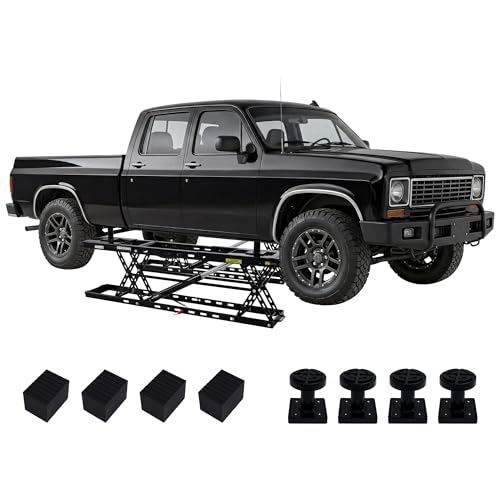 Albott 8000 LBS Portable Car Lift for Home Garage
|
7.8/10 | Buy |
Comprehensive Ceiling Height Requirements and Calculations for Car Lifts
Determining the necessary vertical clearance for an automotive lift requires evaluating the structural profile of the building alongside vehicle dimensions and equipment engineering. Many garage owners assume a lift fits if the column height matches the ceiling, but real-world operation introduces critical overhead variables. Lifting a vehicle safely requires accounting for maximum stroke extension, mechanical safety lock engagement travel, and roof obstructions such as door tracks or rafters. A methodical assessment prevents costly installation mistakes, structural collisions, and unworkable vehicle positioning.
The Essential Ceiling Height Calculation Formula
Accurate vertical clearance planning begins with a standardized mathematical formula tailored to your intended shop usage. When planning a drive-on four-post lift for vehicle stacking, the required clearance equals the lower vehicle height plus the upper vehicle height plus the runway thickness plus a safety margin of four to six inches. The runway assembly generally measures between four and five inches in thickness depending on structural steel gusseting and reinforcement. The additional four to six inches provides essential travel to lift the carriage off its mechanical safety lock pawls before lowering.
Service lifts dedicated to wheels-free chassis maintenance follow an alternative clearance formula based on lifting stroke. For a two-post surface-mounted lift, required vertical space equals the total vehicle height plus the maximum lift rise height plus four to six inches for overhead clearance. If you plan to service a pickup truck measuring seventy-four inches tall on a lift offering a seventy-inch rise, the bay requires approximately one hundred fifty inches or twelve and a half feet of overhead room. Running a service hoist to full extension under a low ceiling forces the vehicle roof directly into rafters or drywall.
Ignoring mechanical lock overtravel remains a frequent error among first-time lift buyers. Hydraulic vehicle lifts do not rest directly on fluid pressure; instead, they lock securely onto mechanical ladder notches along the columns. To disengage these safety locks and descend, the hydraulic power unit must first raise the vehicle roughly two to three inches above the active locking dog. If the vehicle roof sits flush against drywall when rested on the top lock notch, the power unit cannot clear the lock mechanism, trapping the vehicle at full elevation.
Two-Post Clear-Floor Versus Floor-Plate Clearance Dynamics
Two-post automotive hoists generally fall into two distinct structural architectures: clear-floor overhead models and baseplate floor-plate designs. Overhead clear-floor lifts, such as the TRIUMPH NTO-10A 10000Lbs Two Post Clear Floor hoist, feature a rigid steel crossbeam connecting the columns at a total height of one hundred forty-five inches. This overhead arch houses hydraulic equalization cables and hoses, leaving the garage floor completely open for transmission jacks and fluid drainers. Installing a clear-floor hoist requires the ceiling to measure at least one to two inches taller than the top crossbeam to allow clearance during assembly.
Overhead clear-floor hoists also incorporate a padded overhead shutoff bar or microswitch limit cable positioned directly beneath the top crossbeam. If a tall commercial van or lifted SUV contacts this padded shutoff bar, the electrical circuit instantly cuts power to the hydraulic motor, stopping the ascent before the vehicle roof crushes into steel framing. In garages with ceilings between nine and eleven feet, overhead models cannot physically stand upright. For these restricted environments, baseplate models route equalization lines across the concrete floor beneath a heavy-duty beveled steel cover plate.
Baseplate lifts provide significantly reduced column heights while preserving substantial lifting capacity for vehicle maintenance. For example, the WEIZE 11000lbs Two Post Car Lift utilizes an overall column height of one hundred nine inches, which equals nine feet and one inch. With a maximum lifting height of 70.87 inches, this hoist allows technicians to walk beneath standard passenger sedans while clearing ceilings that would never accommodate an overhead crossbeam. However, home mechanics working under baseplate systems must remain mindful of the vehicle roofline, as baseplate designs lack overhead cutoff bars to stop upward travel automatically.
Four-Post Parking Lifts and Vehicle Stacking in Residential Garages
Four-post lifts serve as the primary solution for automotive enthusiasts seeking to double residential garage parking capacity without constructing additional bays. Unlike two-post models that concentrate structural stresses onto concrete floor anchors, four-post hoists distribute vehicle weight across four corner posts, creating a stable platform for long-term vehicle storage. Equipment such as the HLOMAUD Low Ceiling Best 4 Post Car Parking lift is engineered specifically to maximize vehicle stacking clearance in residential structures. Stacking two vehicles safely demands rigorous verification of rooflines and undercarriage dimensions.
Consider a standard residential application stacking a vintage sports coupe measuring fifty inches tall beneath a modern sedan measuring fifty-six inches tall. Adding the five-inch thickness of the steel runway platforms and five inches of safety lock clearance yields a required ceiling height of one hundred sixteen inches, or nine feet eight inches. If your garage features a standard ten-foot ceiling, this stacking combination functions smoothly with comfortable margin. You can explore additional storage solutions in our detailed guide to four-post storage lifts for various bay layouts.
Attempting to store larger passenger vehicles such as crossover SUVs or full-size pickup trucks drastically alters vertical requirements. A standard four-wheel-drive pickup truck commonly stands seventy-two to seventy-six inches tall from tire tread to cab roofline. Stacking a fifty-four-inch sports car underneath a seventy-four-inch truck, along with platform thickness and lock clearance, pushes the minimum ceiling requirement to one hundred thirty-eight inches. Placing taller vehicles on the lower parking space rather than upper runways often simplifies drive-on approach angles and optimizes clearance beneath sloping rooflines.
Portable and Mid-Rise Scissor Lifts for Low-Ceiling Garages
Garages built with standard eight-foot or nine-foot ceiling heights often cannot accommodate full-rise vertical posts or multi-vehicle stacking hoists. In these space-constrained bays, portable frame-engaging scissor lifts provide a practical compromise for brake jobs, suspension rebuilds, detailing, and tire rotations. Portable units eliminate fixed vertical columns altogether, preserving clear sightlines and maximum floor utility when equipment is disconnected and rolled away. Because these lifts raise vehicles only twenty to thirty inches off the concrete, they operate comfortably under conventional eight-foot ceilings.
Compact frame lifts deliver substantial utility while remaining safely beneath residential rafters. The Albott 7000 LBS Portable Car Lift with Extension provides a maximum lift height of twenty-eight inches using flexible height increments and extension panels. Under an eight-foot ceiling of ninety-six inches, raising a fifty-four-inch car by twenty-eight inches places the roofline at eighty-two inches, leaving fourteen inches of buffer under drywall. Built from Q235B high-strength steel, this mobile scissor platform supports vehicles up to seven thousand pounds and rolls aside on integrated wheels after servicing.
For heavier vehicles or extended frames, high-strength scissor platforms accommodate longer wheelbases without increasing required shop height. The Albott 8000 LBS Portable Car Lift for Home Garage utilizes Q355B structural steel and includes an 8.3-inch extension plate that expands overall length up to seventy-five inches. Featuring an adjustable post range of 19.7 to 27.4 inches and up to twenty-two inches of standalone lift height, it supports heavier trucks and SUVs. Mobile scissor lifts provide an outstanding solution when vertical constraints rule out full-size posts, provided you operate on level concrete.
Garage Door Tracks, Opener Hardware, and Overhead Obstructions
Measuring the clear drywall height of an empty garage bay represents only the initial step of assessing vertical clearance. The single most common physical interference during residential vehicle lift installation comes from overhead garage door assemblies. Standard sectional garage doors ride on horizontal tracks that hang twelve to eighteen inches below finished ceiling joists. When an overhead door rolls open into the bay, it occupies prime vertical space directly above where the lifted vehicle hood or cabin sits.
Solving this spatial conflict typically requires retrofitting your garage door hardware with a high-lift track conversion. A high-lift track system extends the vertical door track upward closer to the ceiling drywall before curving into a horizontal orientation. In bays with twelve-foot ceilings, a high-lift conversion hugs the roofline tightly, leaving the vehicle bay unobstructed. In buildings with sufficient roof pitch, a full vertical-lift track moves the door panels straight up against the wall, eliminating horizontal ceiling rails entirely from the vehicle workspace.
The garage door opener motor presents another frequent spatial hurdle that requires hardware modification. Conventional ceiling-mounted garage door openers hang a motorized trolley track directly down the center of the bay, right in the line of vehicle ascent. Upgrading to a side-mounted jackshaft opener solves this clearance issue by mounting directly beside the garage door torsion spring on the front wall. Removing the center trolley frees up the center of the bay, protecting vehicle rooflines and lift columns from accidental mechanical impacts.
Concrete Slab Integrity and Foundation Prerequisites
While vertical ceiling height establishes physical fit, concrete slab structural integrity dictates whether a surface-mounted lift can safely operate. Two-post lifts exert tremendous mechanical leverage and tension forces upon concrete anchor bolts, especially when hoisting heavy trucks with an uneven weight distribution. Installing a two-post hoist requires a minimum concrete slab thickness of four inches with a compressive strength of at least 3,000 PSI, fully cured for twenty-eight days. You can review structural mounting demands in our analysis of heavy-duty shop lifts to understand industrial anchoring requirements.
Verifying concrete slab thickness before purchasing equipment protects your garage floor and personal safety. Residential builders frequently pour garage floors unevenly, resulting in sections that measure only three inches thick despite nominal four-inch plans. Core drilling test holes at the exact planned column baseplate locations confirms true concrete depth before anchoring. Anchor bolts must maintain at least six inches of edge distance from slab expansion joints, control cuts, or perimeter edges to prevent catastrophic concrete cracking under load.
Post-tension concrete foundations introduce critical safety hazards that demand specialized evaluation before installing any surface-anchored equipment. Post-tension slabs incorporate high-strength steel cables stretched under extreme mechanical tension inside the cured concrete. Drilling into or severing a post-tension tendon can cause catastrophic structural slab failure, serious property damage, or severe physical injury. Garages featuring post-tension slabs must undergo professional ground-penetrating radar scanning to map cable locations precisely, or rely strictly on unanchored portable equipment that does not penetrate the floor.
Electrical Service and Hydraulic Power Considerations
Operating a hydraulic automotive lift requires evaluating garage electrical panel capacity and circuit configurations. Full-size shop lifts typically demand dedicated 208-volt to 240-volt single-phase power connections to drive industrial hydraulic pumps. For instance, the WEIZE 11000lbs Two Post Car Lift utilizes a powerful 220-volt, 60-hertz single-phase, 3-horsepower hydraulic power unit to raise heavy commercial loads smoothly. Powering a commercial-grade hydraulic unit requires a dedicated thirty-ampere circuit breaker and appropriately sized copper wiring to prevent voltage drop and motor hum during heavy lifting cycles.
Smaller portable scissor lifts offer distinct electrical advantages for residential garages lacking high-voltage subpanels. Many compact scissor hoists operate on standard 110-volt or 120-volt dedicated twenty-ampere residential branch circuits, allowing easy plug-in operation without panel modifications. Regardless of electrical voltage, maintaining proper hydraulic fluid viscosity ensures reliable operation and seal longevity. Hydraulic lifts commonly specify premium anti-wear hydraulic oil, such as ISO 46 or Grade No. 46 fluid, which maintains stable pressure characteristics across changing garage temperatures.
Practical Planning Checklist for Overhead Bay Verification
Finalizing your vehicle lift purchase requires performing comprehensive physical site measurements across the entire garage bay. Never rely on architectural drawings or single-point measurements, as residential concrete floors slope toward drainage thresholds, and ceiling joists can bow downward over time. Use an accurate laser distance measure to record the vertical distance from concrete to drywall across multiple grid points where columns and vehicle roofs will align. Identify all secondary obstructions, including overhead fluorescent fixtures, fire sprinkler pipes, garage door opener rails, and drop-down attic stairs.
Evaluate your complete vehicle fleet along with any future vehicle purchases before choosing your lift model. Factor in auxiliary accessories such as roof cargo racks, ski carriers, exterior antennas, and suspension lift kits that increase overall vehicle height. Matching your actual vertical clearances against equipment specifications, like those found on compact baseplate hoists or portable scissor platforms, guarantees an efficient and secure workshop setup. Taking the time to calculate overhead margins meticulously ensures every lifting cycle remains safe, smooth, and dependable for years to come.
About the author
Mike Bumbeck is an automotive journalist and hands-on product evaluator with a long-standing interest in classic vehicles, motorcycles, and practical garage equipment. His work brings a grounded perspective to automotive tools, maintenance products, and the details that matter when choosing gear for real-world use.