
How Much Is a Car Lift for a Garage: Cost Breakdown and Practical Guide for 2026
Determining how much is a car lift for a garage involves evaluating equipment tiers, slab requirements, and setup expenses in October 2026.
 By Larry Carley
Updated October 9, 2026

Crawling across a cold garage floor on creeper boards quickly reveals the physical limitations of servicing vehicles with conventional floor jacks and jack stands. When automotive hobbyists and DIY mechanics explore shop upgrades, understanding how much is a car lift for a garage involves looking well beyond the equipment tag. The overall financial commitment includes evaluating concrete slab depth, running dedicated electrical service, and managing heavy freight delivery logistics. Reviewing residential vehicle lift options helps clarify which lift format aligns with your bay footprint and workshop maintenance needs.
Lift design choices directly shape your total project outlay, ranging from compact portable frames to permanent surface-mounted two-post hoists. Low-profile scissor units require minimal structural modification, whereas tall clear-floor columns demand verified slab compressive strength and high-lift garage door tracks. Structural steel thickness, hydraulic cylinder configurations, and automatic safety release mechanisms also influence long-term equipment value. Examining these practical factors beforehand prevents project delays and ensures a safe, efficient lifting setup for routine repairs or seasonal vehicle storage.
| Award | Product | BJL Score About BJL ScoreThe BJL Score is our own rating from 0 to 10, based on performance, design and build, ease of use, and value. It reflects independent research and is never influenced by manufacturers, retailers, or affiliate commissions. Learn more › | |
|---|---|---|---|
| Best Overall |
KATOOL 7000 lb Portable Mid-Rise Scissor Lift
|
9.1/10 | Buy |
| Best Premium |
 DigMaster 8000 LBS Portable Two Post Car Lift |
9.1/10 | Buy |
 WEIZE 11,000 lb Two-Post Car Lift with 220V 3HP |
9.1/10 | Buy | |
| Best Value |
 KATOOL 11,000 lb 2-Post Car Lift |
8.8/10 | Buy |
 Weize 12,000-lb 2-Post Automotive Lift with 4HP |
8.8/10 | Buy | |
| Best Budget |
 Albott 7000 LBS Portable Scissor Car Lift |
8.6/10 | Buy |
 VEVOR Portable Manual Car Lift 4400 lbs Capacity |
8.1/10 | Buy | |
 Albott 7000 lb Portable Car Lift with Extension |
8.1/10 | Buy | |
 VEVOR Portable Scissor Car Lift |
8.1/10 | Buy |
KATOOL 7000 lb Portable Mid-Rise Scissor Lift
The KATOOL 7,000 lb mid-rise scissor lift delivers 39 inches of lifting clearance with an ultra-low 4.3-inch collapsed profile powered by standard 110V electricity. It is an ideal solution for DIY mechanics, sports car enthusiasts, and low-ceiling garage owners who require dependable vehicle lifting without drilling permanent floor anchors.
Pros
- Substantial 7,000 lb capacity handles a wide variety of passenger cars, lowered sports cars, and light utility vehicles
- Ultra-low 4.3-inch drive-over profile eliminates clearance issues on low-slung performance vehicles
- Runs on a standard 110V household electrical supply for effortless residential garage integration
- Compact 39-inch vertical rise is perfectly matched to standard 8-to-10-foot residential ceiling heights
- Freestanding design avoids the concrete anchor drilling and slab modifications required by two-post lifts
Cons
- LTL freight delivery requires an on-site forklift for offloading or customer pickup at a regional freight terminal
- A 39-inch maximum lift height requires creeper or rolling stool use rather than full upright standing clearance
- Hydraulic oil is not pre-filled and must be sourced separately prior to system priming and operation
DigMaster 8000 LBS Portable Two Post Car Lift
Engineered for home workshops with limited overhead space, the DigMaster portable two-post lift delivers an 8,000-pound capacity, 51.3-inch maximum lifting height, and 220V electric-lock operation. It offers DIY mechanics wheel-free service capability without the permanent footprint of a full-height commercial two-post hoist.
Pros
- 8,000-lb capacity handles passenger vehicles, light trucks, and SUVs without taking up permanent bay space
- Low column height of roughly 72 inches fits comfortably beneath standard 8-foot or 9-foot residential ceilings
- Mid-rise 51.3-inch elevation provides comfortable creeper or rolling seat clearance for underside vehicle maintenance
- Electric lock release system simplifies carriage engagement compared to complex manual dual-point release cables
Cons
- Maximum 51.3-inch lift height does not provide full stand-up undercarriage headroom for taller mechanics
- Requires a 220V electrical power connection, which may necessitate running dedicated garage wiring
- Substantial 1,223-lb shipping weight requires planned freight handling, equipment assistance, or extra hands for unloading
WEIZE 11,000 lb Two-Post Car Lift with 220V 3HP
The WEIZE 11,000-lb two-post automotive lift combines a high-output 220V 3HP hydraulic power unit with an open-floor layout for home garage mechanics and light commercial service bays. Requiring a dedicated 220V circuit, structural concrete slab, and dual-point lock disengagement, it offers substantial lifting capacity for sedans, SUVs, and work trucks.
Pros
- High 11,000-lb capacity easily handles heavier half-ton and three-quarter-ton trucks
- Wide 110.23-inch drive-through clearance makes vehicle positioning simple and stress-free
- Rugged 220V 3 HP hydraulic motor delivers dependable lifting muscle
- Clear-floor layout leaves garage floor completely open for transmission jacks and fluid drains
Cons
- Dual-point safety release requires walking to both columns to disengage locks before lowering
- Requires a dedicated 220V single-phase electrical hookup and an appropriate concrete foundation
- Heavy 1,426-lb shipping package requires a forklift, trailer ramp, or helpers for freight delivery offloading
KATOOL 11,000 lb 2-Post Car Lift
The KATOOL 11,000-lb two-post clearfloor automotive lift combines a high-output 4.0 HP 220V motor with dual hydraulic chain-drive cylinders to deliver a 4.25-inch to 70.75-inch lifting range. It is ideal for home mechanics, vehicle restorers, and independent shop operators with appropriate concrete foundations and 220V single-phase power.
Pros
- Heavy-duty 11,000-lb rating provides exceptional load headroom for full-size pickups, light trucks, and heavy unibody SUVs
- Low 4.25-inch minimum pad clearance accommodates standard passenger cars and lower ground-clearance vehicles
- Clearfloor overhead configuration keeps the bay floor free of raised drive-over baseplates for seamless transmission jack rolling
- Integrated column rubber padding helps protect vehicle door edges when entering and exiting elevated vehicles
- Powerful 4.0 HP single-phase 220V motor delivers reliable hydraulic lifting muscle for heavy-duty chassis
Cons
- Dual-side manual safety releases require walking to both columns to disengage mechanical locks before lowering
- Requires heavy freight offloading coordination via on-site forklift or customer terminal pickup for the 1,200-lb package
- Demands a dedicated 220V single-phase electrical circuit and verification of a sufficiently cured, structural concrete foundation
Weize 12,000-lb 2-Post Automotive Lift with 4HP
The Weize 12,000-lb two-post automotive lift delivers heavy-duty lifting capacity backed by a 4-HP, 220V single-phase motor and a convenient single-point mechanical safety lock release. With an overall height of roughly 112.6 inches and a generous 101-inch drive-through width, it is a practical choice for DIY mechanics and service bays working on half-ton to one-ton trucks.
Pros
- Substantial 12,000-lb load rating accommodates heavy diesel trucks, work vans, and family SUVs
- Single-point safety lock release mechanism streamlines vehicle lowering and improves shop efficiency
- High-power 4-HP 220V hydraulic power unit delivers reliable lifting torque for heavy chassis
- Generous 101-inch drive-through clearance prevents mirror and wheel scuffing on wide utility vehicles
- Relatively compact 112.6-inch overall height fits garages with moderate 10-to-11-foot ceilings
Cons
- Requires a dedicated 220V single-phase electrical circuit and hardwired connection by a qualified electrician
- Heavy freight shipping weight of 1,574 pounds requires mechanical equipment such as a forklift or tractor for offloading
- Lacks third-party Automotive Lift Institute (ALI) gold label certification, which may affect municipal or commercial insurance requirements
Albott 7000 LBS Portable Scissor Car Lift
The Albott 7000 LBS Portable Car Lift delivers reliable frame-engaging lifting power with a 28-inch maximum rise height, making it an excellent unanchored solution for low-ceiling residential garages. Built from high-strength Q235B steel, it suits DIY mechanics and car enthusiasts tackling brake jobs, tire rotations, and chassis maintenance on level concrete.
Pros
- Substantial 7,000-lb capacity easily handles most domestic sedans, sports cars, and midsize SUVs
- Mobile four-wheel design eliminates permanent concrete drilling and fits well under standard 8-to-10-foot residential ceilings
- Includes extension panels and multi-height adapter blocks to reach factory frame contact points across different wheelbases
- Multiple mechanical locking positions allow safe, stable under-vehicle working heights off hydraulic pressure
Cons
- Maximum 28-inch rise height does not provide full standing headroom underneath the vehicle
- Weighs 401 pounds, which requires moderate physical effort to reposition or wheel across uneven garage thresholds
- Requires a minimum load of approximately 220 pounds on the frames to compress the return springs and initiate descent
VEVOR Portable Manual Car Lift 4400 lbs Capacity
The VEVOR Portable Manual Car Lift delivers a 4,400-lb (2-ton) capacity and a 5.9 to 23-inch lift range driven mechanically by a power drill or hand crank without requiring hydraulics or electrical wiring. Featuring an unanchored triangular steel frame, 31.5-inch non-slip contact pads, and nylon transport casters, it is an accessible solution for home garage DIYers working on compact cars in low-ceiling spaces.
Pros
- Completely mechanical lifting operation requires no hydraulic fluid, air compressors, or dedicated 220V electrical circuits
- Low 5.9-inch collapsed profile easily slides beneath low-clearance vehicles and tucks away against garage walls when not in use
- Integrated nylon caster wheels allow a single operator to roll and position the lift frame effortlessly across smooth concrete floors
- Generous 31.5-inch non-slip rubberized contact pads distribute weight evenly to protect factory pinch welds and rocker panels
Cons
- 4,400-lb gross weight limit is not suitable for full-size pickup trucks, heavy electric vehicles, or large SUVs
- Lifting mechanism strictly prohibits impact wrenches and requires manual drill or hand-crank operation
- Maximum 23-inch lift height is designed for creeper work rather than providing full standing headroom
Albott 7000 lb Portable Car Lift with Extension
The Albott 7000 lb Portable Car Lift provides residential mechanics with reliable mid-rise lifting capacity without requiring permanent concrete anchors. Built from high-strength Q355B steel with dual mechanical locking pins, it delivers up to 20 inches of working height for brake jobs, tire rotations, and underbody maintenance.
Pros
- 7,000-pound lifting capacity accommodates a wide variety of passenger vehicles and half-ton trucks.
- Modular extension plates increase maximum jacking spread up to 70.7 inches for longer chassis.
- Dual mechanical safety locks ensure the raised vehicle is mechanically supported during undercar service.
- Compact folding frame design with integrated wall-mount handles preserves valuable garage floor space.
Cons
- Individual lifting frames weigh roughly 120 pounds each, requiring physical effort to position beneath vehicles.
- Maximum rise height of 20 inches provides practical clearance for wheel and suspension service, but does not allow full standing headroom.
- Hydraulic fluid is not included and requires sourcing ISO grade No. 46 hydraulic oil prior to first operation.
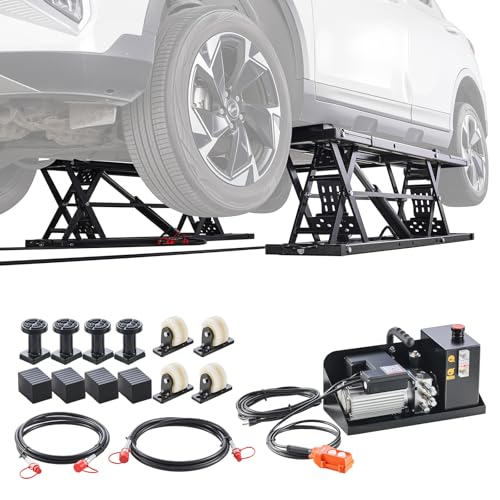
VEVOR Portable Scissor Car Lift
The VEVOR 9,000 lb portable electric-hydraulic vehicle lift delivers up to 28 inches of working height on a standard 120V residential circuit without requiring permanent floor anchoring. It is an ideal mid-rise lifting solution for home garage DIYers, truck and SUV owners, and shops with standard 8-to-10-foot ceilings.
Pros
- Substantial 9,000 lb rating safely handles heavier modern trucks, crossovers, and electric vehicles
- Plugs into standard 120V household outlets for straightforward residential garage installation
- Reaches up to 28 inches of working height, ideal for low 8-to-10-foot residential garage ceilings
- Includes four non-slip rubber pads and four taller frame-contact extension columns in the box
Cons
- Total crated package weight of over 450 lbs requires multiple sets of hands or equipment to unload
- Requires sourcing ISO 46 hydraulic oil separately and bleeding the system before initial operation
- The 6.1-inch collapsed profile may require drive-on helper boards for aggressively lowered sports cars
Evaluating the Full Investment Behind a Home Garage Car Lift
Determining how much is a car lift for a garage requires calculating equipment manufacturing classes alongside structural site modifications. The initial purchase price of the lift unit itself represents only one portion of establishing a functional residential vehicle bay. Garage owners must account for foundation verification, dedicated high-amperage electrical wiring, residential freight handling, and vertical overhead adjustments. Reviewing these interconnected factors beforehand prevents costly mid-installation surprises and ensures a reliable workspace.
Equipment Architecture and Mechanical Categories
Automotive lifts fall into distinct mechanical categories that cater to different garage footprints and budget allocations. Portable mechanical tilt lifters and manual frame platforms offer the most accessible entry tier for home mechanics working in tight residential bays. Units like the VEVOR 4400 lbs Capacity portable lift operate via hand cranks or drill adapters rather than hydraulic pumps, eliminating electrical infrastructure expenses entirely. These manual frames raise passenger cars and light crossovers to comfortable working heights for brake jobs, tire rotations, and rocker panel detailing. Because they avoid hydraulic fluid and motorized components, manual lifts minimize ongoing operating expenses while fitting inside standard single-car garage layouts.
Mid-rise scissor lifts and full-height two-post hoists provide greater elevation and lifting speed for demanding mechanical projects. Equipment such as the Albott 7000 LBS Portable Car Lift with Extension and the KATOOL Portable Car Lift Mid Rise Scissor Lift collapse down to low drive-over profiles, utilizing movable casters that roll out of the bay when parking daily drivers. For complete underbody access, models like the WEIZE 11000lbs Two Post Car Lift and the KATOOL 11000lbs 4.0HP 2 Post Lift elevate heavy trucks over five feet into the air. Fixed two-post hoists utilize structural steel columns and telescoping swing arms, though their installation requires permanent anchoring into reinforced concrete.
Concrete Foundation Requirements and Slab Assessment Expenses
Evaluating existing concrete flooring is the single most critical structural step when budgeting for a permanent surface-mounted lift. Two-post hoists exert substantial tensile pullout forces on floor anchors alongside high compressive loads on the slab surface. Manufacturers specify a minimum concrete thickness of four inches, with many commercial-rated models recommending four and a half to six inches of reinforced material. The concrete must carry a minimum compressive rating of 3,000 PSI and have cured for at least twenty-eight days before anchor bolt installation. Standard wedge anchor bolts require at least three and a quarter inches of embedment depth while maintaining at least six inches of edge distance from relief cuts, expansion joints, or slab perimeters.
Residential garage slabs poured during home construction often vary in thickness, tapering near perimeter footings or floor drain contours. Verifying slab adequacy requires drilling test holes with a masonry bit or hiring a contractor to take core drill measurements. If the floor measures under four inches thick or displays structural cracking, owners must budget for saw-cutting the slab and pouring reinforced concrete footings. Homes built with post-tension slabs require hiring a concrete scanning professional equipped with ground-penetrating radar to locate tensioned steel cables before drilling. Striking a live post-tension tendon with a rotary hammer drill can cause explosive concrete spalling, severe structural damage, and personal injury.
Electrical Infrastructure and Dedicated Power Supply
Power unit electrical specifications directly influence the overall installation outlay for a home workshop hoist. Low-rise scissor platforms and portable lifts frequently feature standard 110V or 120V electric-hydraulic power units that plug into standard residential receptacles. Equipment such as the VEVOR Portable Car Lift, 9000 lbs Capacity operates on standard 120V power, avoiding the need for service panel modifications. These 120V motors draw between fifteen and twenty amperes during operation, making them practical for garages with modest electrical service capacity. However, 110V motors feature longer cycle times and lower duty cycles compared to industrial motors, requiring patience during repeated lifting intervals.
Heavier two-post hoists, including the WEIZE 2 Post Automotive Car Lift, demand dedicated 220V single-phase motors producing three to four horsepower. Running a high-output 220V hydraulic power unit necessitates installing a dedicated branch circuit from the main electrical breaker panel to the lift station. This electrical installation calls for heavy-gauge copper wiring, a dedicated thirty-ampere double-pole circuit breaker, and an industrial wall-mounted shutoff switch. Comparing electrical demands across different hydraulic car lift systems helps owners select a hoist compatible with their existing garage electrical service while accounting for electrician labor.
Freight Delivery Logistics, Liftgate Limitations, and Offloading
Shipping logistics represent a substantial and frequently overlooked component of garage equipment budgeting. Automotive lifts ship as Less-Than-Truckload (LTL) freight on commercial flatbed trailers or enclosed semi-trailers due to their length and structural steel weight. Full-size two-post lift packages often measure ten to twelve feet long and weigh over fifteen hundred pounds, exceeding typical residential delivery handling. Buyers must examine shipping terms closely to determine whether curbside residential delivery, liftgate service, or terminal pickup is included in their purchase.
Residential freight delivery often encounters practical barriers when fifty-three-foot semi-trucks attempt to navigate narrow suburban streets, steep driveways, or cul-de-sacs. Even when carriers offer hydraulic liftgate service, standard truck liftgates cannot balance extra-long crated lift columns safely. Manufacturers clearly indicate that buyers remain responsible for offloading crated steel from the delivery truck bed. Arranging for a forklift, farm tractor equipped with pallet forks, or local rollback tow truck to slide the heavy freight down ensures safe receiving without incurring carrier storage fees. Pallet jacks also cannot roll across cracked driveways or gravel surfaces, making mechanical offloading equipment essential for residential freight deliveries.
Vertical Overhead Clearance and Garage Door Adaptations
Garage ceiling height determines which lift design can realistically operate inside a residential workspace. While mid-rise portable frames like the Albott 7000 lb Portable Car Lift with Extension raise vehicles roughly twenty to twenty-eight inches, two-post hoists lift vehicles past six feet. Operating a full-rise two-post lift safely requires a minimum ceiling clearance between eleven and twelve feet, factoring in vehicle roof height and column caps. Calculating vertical clearance requires adding lower vehicle height, upper vehicle height, runway or pad thickness, and an extra six inches of lock overtravel margin. Garages with standard eight-foot or nine-foot ceilings cannot clear tall columns, prompting owners to choose baseplate designs or scissor lifts.
Ceiling obstacles such as lighting fixtures, structural joists, and overhead garage door tracks require careful spatial planning before hoist selection. Standard garage door tracks run horizontally right through the center of the bay, directly intersecting the elevation path of a raised vehicle. Resolving this spatial conflict requires modifying the garage door track assembly to follow the garage ceiling contour. High-lift garage door track conversions paired with wall-mounted jackshaft openers keep the open door tight against the ceiling, safely recovering two to three feet of vital vertical working clearance.
Structural Steel Fabrication, Arm Geometry, and Safety Locks
Internal mechanical architecture and component engineering heavily dictate hoist reliability and long-term operating safety. Robust two-post hoists utilize heavy-gauge structural steel columns, synchronized equalization cables, and continuous mechanical ladder locks. Models such as the KATOOL 11000lbs 4.0HP 2 Post Lift incorporate dual-side manual safety releases, while the Weize 2 Post Automotive Car Lift provides single-point release convenience. Single-point releases disengage column safety latches using a single operational handle, streamlining descent while reducing repetitive walking between columns.
Lifting arm geometry determines how conveniently vehicles can be balanced and positioned across the garage work area. Asymmetric arm designs feature shorter front arms and longer rear arms, shifting the vehicle center of gravity rearward between the columns. This asymmetric configuration allows driver and passenger cabin doors to swing open wider without striking column paint or rubber door guards. Reviewing mechanical lock construction and arm configurations across different heavy-duty lift models allows buyers to match hoist durability with their specific vehicle weight requirements. Heavy steel arm restraint gears mesh together automatically upon carriage ascent, locking swing arm angles securely under full vehicle load.
Installation Approaches: DIY Assembly Versus Certified Labor
Choosing between self-installation and hiring professional automotive equipment technicians impacts both project budget and structural peace of mind. Setting up a portable scissor lift or mechanical tilt frame remains manageable for experienced DIY home mechanics. Portable units arrive largely preassembled, requiring only hydraulic fluid filling, line bleeding, and caster wheel installation. Manufacturers design portable frames for immediate operation without floor anchoring, eliminating specialized concrete drilling tools from the initial assembly process.
Erecting a heavy surface-mounted two-post hoist presents complex rigging, column squaring, and precision alignment challenges. Raising twelve-foot steel uprights weighing hundreds of pounds requires capable helpers, rigging straps, or a shop engine crane. The columns must be leveled across sloped garage slabs using steel horseshoe shims, ensuring perfectly plumb vertical alignment. Setting wedge anchors requires a rotary hammer drill, vacuuming concrete dust from the holes, and torquing each bolt to precise foot-pound specifications. Hiring certified installation crews adds labor expense but eliminates physical strain, ensuring anchor bolts are torqued properly and equalization cables are synchronized to industry standards.
Operational Supplies, Fluid Maintenance, and Essential Accessories
Operating an automotive lift involves modest recurring maintenance costs that ensure smooth hydraulic cycling and prolonged component life. Hydraulic power units do not ship with fluid inside their reservoirs due to commercial shipping safety regulations. Buyers must purchase clean ISO 32 or ISO 46 anti-wear hydraulic oil, or manufacturer-specified automatic transmission fluid, before initial startup. High-capacity power units require three to four gallons of fluid, making oil purchase an essential initial startup expense.
Periodic maintenance routines require cable tension adjustments, slider block greasing, and hydraulic seal inspections. Braided equalization cables stretch slightly during initial lifting cycles, necessitating periodic tension adjustments across top pulleys or floor channels. Column slider blocks benefit from regular coats of lithium grease to minimize friction and prevent carriage binding during ascent. Technicians should also inspect hydraulic line fittings for weepage, clean mechanical lock pawls, and verify smooth locking ladder engagement. Furthermore, owners servicing trucks or full-size SUVs should budget for drop-in truck height adapters and frame cradle pads, which ensure secure contact with structural frame rails.
Calculating the true expenditure of a home garage car lift requires balancing base equipment capabilities against necessary structural site improvements. By accounting for concrete verification, electrical wiring, freight handling, and vertical overhead adjustments alongside the hoist purchase, homeowners can establish a safe, highly functional workshop. Evaluating these mechanical and facility requirements in advance ensures your vehicle hoist operates reliably across years of automotive repair, restoration, and storage projects.
About the author
Larry Carley is an experienced automotive technical writer and editor with more than four decades of work covering vehicle diagnostics, repair procedures, and automotive technology. His extensive technical writing helps readers understand mechanical systems, maintenance decisions, and the importance of accurate information when working on vehicles.