
How Much Concrete for Car Lift: Concrete Slab and PSI Guide for 2026
Learn how much concrete for car lift setups in October 2026. Explore slab thickness, 3,000 PSI requirements, curing time, and wedge anchor depth.
 By Mike Bumbeck
Updated October 10, 2026
By Mike Bumbeck
Updated October 10, 2026

Installing an automotive hoist turns a standard residential bay into a capable workshop, yet the structural integrity of your garage floor dictates whether that equipment operates safely. Many mechanics focus exclusively on ceiling clearance and motor wiring, overlooking the vital question of how much concrete for car lift installations is needed to support thousands of pounds overhead. A standard vehicle hoist places immense point loads and dynamic tensile forces across anchor bolts, meaning a weak or thin slab presents serious structural risks. Reviewing various residential car lift options reveals that foundation specifications depend heavily on whether you choose a two-post hoist or a portable frame-contact system.
Commercial two-post lifts transfer severe pulling leverage to the garage floor, demanding substantial slab depth, proper compressive strength, and verified anchor embedment. Conversely, low-profile scissor platforms and frame-engaging jacks distribute vehicle mass over wider baseplates, creating very different foundation requirements for home garages. Before bolting down heavy equipment or wheeling in high-capacity service gear, verifying your concrete slab thickness and compressive strength rating protects your investment and ensures daily workshop safety.
| Award | Product | BJL Score About BJL ScoreThe BJL Score is our own rating from 0 to 10, based on performance, design and build, ease of use, and value. It reflects independent research and is never influenced by manufacturers, retailers, or affiliate commissions. Learn more › | |
|---|---|---|---|
| Best Overall |
Rueekfil Heavy-Duty Portable Car Lift 7000 LBS
|
9.2/10 | Buy |
| Best Value |
 KATOOL Portable Car Lift Mid Rise Scissor Lift
|
9.1/10 | Buy |
| Best Premium |
 WEIZE 11000lbs Two Post Car Lift
|
9.1/10 | Buy |
| Best Budget |
 7000 LBS Portable Car Lift with Extension Plates
|
8.9/10 | Buy |
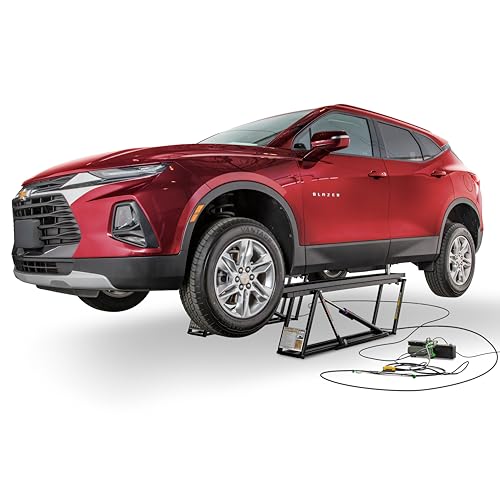 QuickJack 8000TL Portable Car Lift with 8,000lb
|
8.9/10 | Buy | |
 VCYOPN 4 PCS Car Lifting Pads
|
8.6/10 | Buy | |
 Albott 7000 LBS Portable Car Lift with Extension
|
8.6/10 | Buy | |
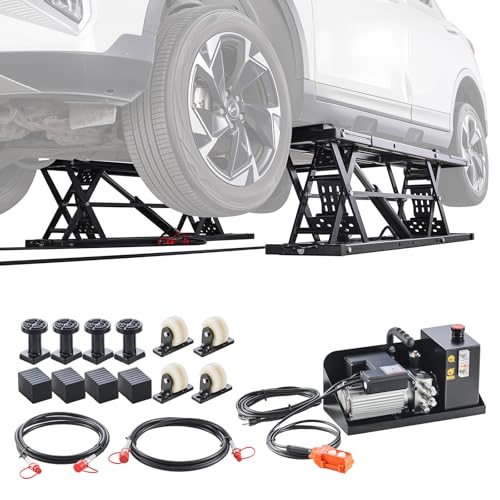 VEVOR Portable Car Lift, 9000 lbs Capacity
|
8.1/10 | Buy | |
 Motool Technology 15000lbs Heavy Duty 2 Post Lift
|
8.0/10 | Buy |
Concrete Slab Specifications for Automotive Lifts
Determining how much concrete for car lift stability is required starts with a clear standard: most two-post surface-mounted lifts require a minimum slab thickness of 4 inches with a compressive strength of at least 3,000 PSI, fully cured for a minimum of 28 days. Heavy-duty commercial units capable of hoisting full-size trucks often demand 6 inches of 4,000 PSI concrete to handle massive leverage forces. In contrast, portable frame-engaging lifts and low-rise scissor models distribute downward force without anchor bolts, permitting operation on standard solid slabs provided the floor remains level. Understanding these engineering differences prevents costly garage floor failures and ensures your setup stays anchored securely under heavy working conditions.
Minimum Slab Thickness and Compressive Strength Thresholds
Automotive lift manufacturers establish rigid concrete guidelines because vehicle hoists exert severe mechanical stress on foundation slabs. For a typical two-post hoist handling up to 10,000 pounds, engineering standards require a continuous poured slab measuring no less than 4 inches in actual physical depth. The concrete must provide a minimum compressive strength of 3,000 pounds per square inch (PSI) after completing a full 28-day curing cycle. When lifting larger vehicles on heavy equipment, such as the WEIZE 11000lbs Two Post Car Lift, verified foundation density prevents baseplate cracking and anchor failure.
Residential garage floors frequently fail to meet commercial installation requirements due to inconsistent residential construction methods. Home builders often pour slabs around 3 inches thick over compacted dirt or gravel, creating variable depths that cannot withstand high tensile stress. Furthermore, residential concrete mixes may only reach 2,500 PSI, which is adequate for parking a commuter car but insufficient for supporting upright steel columns. If a slab lacks the necessary compressive density, anchor bolts can crumble the surrounding matrix when subjected to rated working loads.
Comprehending the physical forces at play explains why concrete specifications are so strict for two-post designs. While a parked car exerts purely downward compressive force across four tires, a raised vehicle on two swing arms acts as a massive cantilever. This dynamic lever arm produces tremendous upward pullout tension on the floor anchors located on the vehicle side of the column baseplate. High-compressive 3,000 to 4,000 PSI concrete provides the internal aggregate cohesion required to resist these continuous pulling forces during shop service.
Anchor Bolt Embedment Depth and Baseplate Edge Setback
Wedge anchor bolts function by expanding outward against the inner walls of drilled concrete holes to create mechanical friction. Surface-mounted two-post lifts standardly utilize 3/4-inch diameter wedge anchors that require an effective embedment depth between 3.25 inches and 4.5 inches. In a standard 4-inch slab, drilling completely through the floor is common practice to allow anchor flush seating and potential future removal. If the slab lacks sufficient depth, the expanding collar of the wedge anchor cannot achieve adequate mechanical purchase against the concrete wall.
Edge setback distances represent another crucial engineering factor that garage owners regularly overlook during equipment positioning. Lifting equipment manuals mandate that column anchor bolts must sit at least 6 to 8 inches away from any slab edge, expansion joint, or saw-cut control joint. Placing wedge anchors too close to an expansion joint directs lateral expansion pressure toward the weakest point of the slab. When lateral stress finds an open seam, the concrete can spall or fracture outward, completely releasing anchor clamping tension.
Proper torque settings ensure anchor retention without fracturing the surrounding concrete aggregate during final assembly. Manufacturers typically specify tightening wedge anchors to approximately 85 to 110 foot-pounds using a calibrated torque wrench. Over-tightening an anchor can crush the internal concrete core, stripping the friction grip and destroying holding capacity. Conversely, under-torquing leaves the column baseplate vulnerable to micro-movement, which steadily wallows out the drilled hole during repeated lifting cycles.
Testing Existing Garage Floors Before Equipment Setup
Visual floor inspection cannot confirm whether an existing residential concrete slab meets minimum installation parameters. The most reliable method to verify slab thickness involves test drilling using a rotary hammer drill and a 1/2-inch masonry bit. By drilling through the concrete at the intended column footprint locations, you can insert a narrow wire probe or depth gauge to measure the exact thickness from the surface to the gravel base. Drilling test holes also reveals hidden voids, air pockets, or moisture layers beneath the concrete pour.
Evaluating existing concrete condition requires a thorough survey of hairline cracks, surface scaling, and chemical deterioration. Concrete that displays structural cracking or widespread spalling cannot provide the structural integrity demanded by surface-mounted equipment. Road salts, engine fluids, and standing groundwater can gradually weaken concrete binders over decades of garage use. If test holes produce crumbling powdery residue instead of solid masonry chips, the slab may have degraded below safe operating thresholds.
Post-tension concrete slabs present an extreme safety hazard that requires specialized identification before any rotary drilling begins. Many modern residential garages built on slab-on-grade foundations contain high-tension steel cables embedded within the concrete matrix. Striking a post-tension cable with a hammer drill bit can trigger explosive structural failure and cause severe injury. Garage owners should inspect foundation walls for post-tension warning stamps and arrange professional ground-penetrating radar scanning to map cable paths before drilling anchor holes.
Foundation Differences Between Two-Post and Portable Scissor Lifts
Structural demands change dramatically depending on the architecture of the automotive lift selected for the garage. Frame-mounted commercial systems like the Motool Technology 15000lbs Heavy Duty 2 Post Lift concentrate immense dynamic leverage into small baseplate footprints. These massive machines rely entirely on the tensile holding strength of anchor bolts driven deep into thick reinforced concrete. Installing such high-capacity systems on unverified thin slabs risks catastrophic column tilting and foundation blowout under load.
In contrast, portable lifting systems interact with garage floors through broad surface-contact bases rather than vertical pullout anchors. Units like the QuickJack 8000TL Portable Car Lift with 8,000lb capacity or the KATOOL Portable Car Lift Mid Rise Scissor Lift rest flat along the ground, translating vehicle weight into pure downward compression. Because these portable frames do not utilize wedge anchors, they can safely operate on sound 3-inch or 4-inch residential slabs that cannot support a bolted two-post unit. Comparing these systems with broader hydraulic car lift systems illustrates how weight distribution alters foundation demands.
Even though portable lifts eliminate anchor pullout concerns, they still require smooth, structurally sound, and level concrete surfaces. Manufacturers of mobile lifts, including the Albott 7000 LBS Portable Car Lift with Extension and the Rueekfil Heavy-Duty Portable Car Lift 7000 LBS, explicitly prohibit operation on slopes exceeding 4 degrees. Operating a portable scissor lift on uneven or cracked surfaces causes side-loading on lifting cylinders and mechanical safety locks. Additionally, durable rubber accessories such as VCYOPN 4 PCS Car Lifting Pads help distribute contact force evenly at the vehicle chassis lifting points.
Pouring Dedicated Concrete Footers for Substandard Slabs
When test drilling reveals that an existing garage slab measures under 4 inches, pouring dedicated concrete footers provides a dependable solution. Garage owners planning to install heavy equipment often cut out sections of the existing floor directly under the planned column locations. Constructing independent structural pads allows you to achieve the depth, rebar reinforcement, and compressive strength required by manufacturer engineering sheets. This modification transforms a lightweight residential bay into a professional-grade repair environment without repouring the entire garage floor.
Standard footer retrofits typically involve cutting two rectangular pits measuring approximately 4 feet wide by 4 feet long, or pouring a continuous trench across the bay. Excavating to a depth of 12 inches creates a massive concrete ballast capable of handling heavy vehicles. Steel reinforcing rebar mats tied in a grid pattern provide tensile strength throughout the new pour. Contractors also drill horizontally into the surrounding existing slab to install steel tie-in dowels, locking the new pads securely into the broader floor structure.
Curing time remains a critical operational milestone that cannot be rushed after pouring dedicated lift footers. Fresh concrete achieves compressive strength gradually through chemical hydration, reaching roughly 70 percent of design strength within seven days. Torquing wedge anchors into green concrete before the full 28-day cure window will crush the curing aggregate and ruin anchor retention. Following strict curing schedules guarantees the structural foundation reaches its specified 3,000 or 4,000 PSI capacity before supporting loaded vehicles.
Floor Levelness, Slope Tolerances, and Column Shimming Protocols
Residential garage floors are intentionally poured with a slight pitch toward the overhead garage door to encourage water and snow drainage. This standard drainage slope, often measuring between 1/8 inch and 1/4 inch per foot, creates installation challenges for vertical car lift columns. Lift columns must stand completely plumb to ensure equalized carriage travel, synchronized lock engagement, and smooth slider block movement. If a column tilts outward or inward along a floor slope, internal binding can damage carriage tracks and stress hydraulic cylinders.
Correcting minor floor slope requires the careful placement of high-strength steel horseshoe shims beneath the column baseplate. Lift manufacturers typically permit a maximum shim stack thickness of 1/2 inch under any individual baseplate corner. When leveling columns, placing shims directly adjacent to anchor bolt locations ensures solid clamping force without bending the steel plate. Stacking loose washers or using soft metal shims is unsafe, as compressed gaps can cause columns to wobble under dynamic vehicle loads.
Extreme floor pitch exceeding allowable shim limits demands non-shrink structural grout pads or localized concrete grinding before anchoring. Creating a level raised grout pad using high-strength cementitious mortar establishes a flat bearing plane across the entire baseplate perimeter. Anchors must remain long enough to achieve required embedment into the underlying concrete slab beneath the grout pad. Maintaining a truly plumb vertical stance protects synchronization cables and structural components over years of heavy shop operation.
Heavy-Duty Applications and Commercial Foundation Requirements
When selecting equipment designed for heavier payloads, such as high-capacity hoists or large vehicle lifts, foundation criteria become substantially more demanding. Exploring dedicated commercial units within our heavy-duty car lifts reference shows that machines rated above 12,000 pounds require specialized engineering attention. Units like the Motool Technology 15000lbs Heavy Duty 2 Post Lift exert extreme dynamic loads that standard 4-inch residential slabs cannot handle safely. For these high-tonnage machines, manufacturers frequently specify a minimum concrete depth of 6 to 8 inches with 4,000 PSI compressive strength.
Higher-capacity vehicles, including commercial work vans and long-wheelbase diesel trucks, create severe off-center load distributions. When an extended pickup sits on asymmetric swing arms, the vehicle center of gravity shifts rearward, dramatically increasing tensile leverage against the front floor anchors. A 4-inch slab subjected to such concentrated forces can suffer catastrophic shear failure along anchor lines. Equipping your workshop for commercial-grade fleet service demands verifying that the concrete sub-base contains adequate aggregate compaction to prevent slab settlement.
Even heavy portable systems like the VEVOR Portable Car Lift, 9000 lbs Capacity require an exceptionally solid foundation despite being mobile. While portable units do not anchor into the floor, a 9,000-pound load supported on narrow steel rollers or contact bars can crack weak or thin residential slabs. Distributing weight safely requires concrete that is free from hollow under-slab washouts, tree root intrusions, or frost heave cracks. Ensuring the subfloor provides solid uniform backing keeps high-capacity equipment functioning smoothly during heavy lifting tasks.
Long-Term Foundation Maintenance and Anchor Torque Audits
Maintaining a vehicle lift safely involves ongoing inspection of the concrete foundation and anchor hardware throughout the equipment lifespan. Newly installed wedge anchors tend to seat slightly deeper into the concrete during the initial dozen lifting cycles under vehicle weight. Performing an anchor torque audit after the first week of service ensures bolts maintain their specified foot-pound tightness. Technicians should use a calibrated torque wrench rather than an impact gun to avoid shearing concrete threads or overstressing anchor studs.
Regular visual inspections around column baseplates reveal early signs of concrete fatigue before hazardous failures develop. Mechanics should check for radial spiderweb cracks propagating away from anchor holes, which indicate excessive stress concentration or weak concrete mix. Any noticeable lifting or gap between the baseplate and the floor surface signals loose anchors or foundation degradation. Keeping the garage floor clean and dry prevents hydraulic fluids and road brine from seeping down anchor holes and corroding steel wedges.
Understanding exactly how much concrete for car lift installations is needed ensures your home garage or professional shop operates with complete confidence. Standard surface-mounted two-post lifts require a verified 4-inch slab with 3,000 PSI strength, while heavy commercial hoists demand 6 inches or dedicated poured footers. If your residential concrete cannot meet strict anchoring parameters, choosing a sturdy frame-engaging portable lift or pouring independent reinforced pads offers a secure, practical path forward. Taking the time to test, measure, and verify your foundation guarantees safe vehicle lifting for every maintenance project.
About the author
Mike Bumbeck is an automotive journalist and hands-on product evaluator with a long-standing interest in classic vehicles, motorcycles, and practical garage equipment. His work brings a grounded perspective to automotive tools, maintenance products, and the details that matter when choosing gear for real-world use.