
How Deep of Concrete for a Car Lift: Concrete Slab and Foundation Guide for 2026
Learn how deep of concrete for a car lift requirements for garage safety in November 2026. Check slab depth, compressive strength, and anchor specs before installing your hoist.
 By Larry Carley
Updated October 10, 2026


Evaluating a residential garage floor before bolting down heavy automotive service equipment requires careful structural verification. Many homeowners assume an existing workshop floor can handle towering columns, yet determining how deep of concrete for a car lift is essential to prevent foundation failure under heavy vehicles. Most standard surface-mounted two-post hoists generate substantial tension and pull-out force at the baseplate anchor bolts during operation. Reviewing our residential car lift guide provides a clear picture of how equipment designs interact with everyday garage layouts. Checking your slab depth and concrete compressive strength ensures that your lifting setup remains stable, level, and safe under real-world loads.
While four-post storage units spread their overall weight across four broad corner posts, two-post frame-engaging models exert immense dynamic stress on a relatively small concrete footprint. Drilling test holes, inspecting expansion joints, and confirming a minimum 3,000 PSI rating help eliminate foundation issues before tightening a single wedge anchor. Portable frame-engaging lifts and mid-rise scissor platforms can offer flexible alternatives when existing slabs fail to meet structural depth criteria. Taking the time to verify foundation depth protects your vehicle investment, your workshop floor, and your personal safety every time you lift a vehicle.
| Award | Product | BJL Score About BJL ScoreThe BJL Score is our own rating from 0 to 10, based on performance, design and build, ease of use, and value. It reflects independent research and is never influenced by manufacturers, retailers, or affiliate commissions. Learn more › | |
|---|---|---|---|
| Best Overall |
Rueekfil 7000 LBS Portable Car Lift
|
9.2/10 | Buy |
| Best Budget |
 VEVOR Portable Air Car Lift |
9.1/10 | Buy |
| Best Premium |
 WEIZE 11,000 lb Two-Post Car Lift with 220V 3HP |
9.1/10 | Buy |
| Best Value |
 Albott 7000 LBS Portable Scissor Car Lift |
8.6/10 | Buy |
 GANSNAY 3.2-Inch Rubber Lift Block |
8.1/10 | Buy | |
 VEVOR Portable Scissor Car Lift |
8.1/10 | Buy | |
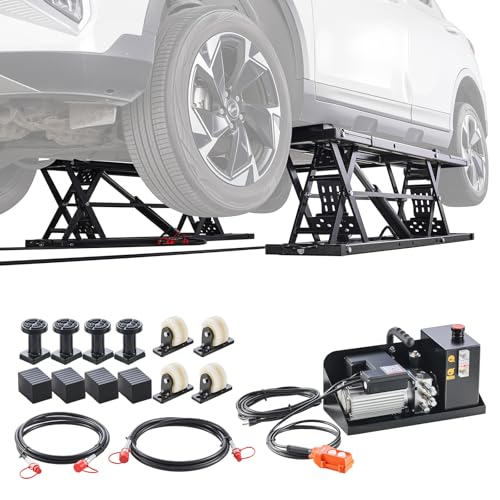
 MachPro 8,000 lb Portable 2-Post Mid-Rise Car Lift |
7.8/10 | Buy |
Rueekfil 7000 LBS Portable Car Lift
The Rueekfil 7000 LBS Portable Car Lift is a heavy-duty, frame-engaging hydraulic vehicle lift designed for home garage DIYers and mobile mechanics seeking up to 28 inches of working clearance without drilling into concrete. Built from Q235B carbon steel with positive mechanical safety locks and wall-mount storage handles, it provides a stable platform for servicing unibody sedans, SUVs, and light trucks.
Pros
- Substantial 7,000-pound lifting capacity easily handles heavier passenger cars, midsize trucks, and modern electric vehicles
- Unanchored portable frame design operates without requiring permanent anchor bolts or structural slab modifications
- Mechanical safety locks provide rigid structural engagement at working height before undercarriage service begins
- Comes packaged with 11-inch extension plates, adjustable height columns, and rubber lift pads for versatile chassis contact
- Built-in nylon rolling wheels and wall-mount handles simplify workshop repositioning and vertical off-the-floor storage
Cons
- Total crated package weight of 418 pounds requires a helper or mechanical assistance during freight delivery and unboxing
- Safety locks require manual physical disengagement on both independent lift frames before lowering the vehicle
- Maximum 26.8 to 28-inch lift height requires creeper access rather than providing full upright standing headroom
VEVOR Portable Air Car Lift
The VEVOR Portable Air Car Lift delivers a 6,613-lb (3-ton) capacity and a 21.7-inch maximum lift height, utilizing heavy-duty dual airbags and an integrated scissor frame to elevate vehicle axles in seconds. It is ideal for residential DIY mechanics, mobile technicians, and low-ceiling garage owners who want rapid tire, brake, and suspension access without permanent floor anchoring.
Pros
- Rapid 1 to 6-second elevation cycle powered by pneumatic airbags eliminates manual hydraulic pumping
- Generous 6,613-lb capacity easily handles most passenger cars, crossovers, and half-ton pickup trucks
- Requires no permanent floor anchoring, making it suitable for standard residential concrete slabs
- Comes equipped with dedicated support stands, wheel chocks, and rubber lifting pads
- Low overall height fits effortlessly under standard 8-to-10-foot residential garage ceilings
Cons
- Requires an external shop air compressor with adequate flow and pressure to inflate the heavy-duty airbags
- Weighing 286.6 pounds, manual repositioning around the shop floor requires deliberate physical effort
- Designed primarily for axle or wheel-end lifting rather than raising an entire vehicle simultaneously
WEIZE 11,000 lb Two-Post Car Lift with 220V 3HP
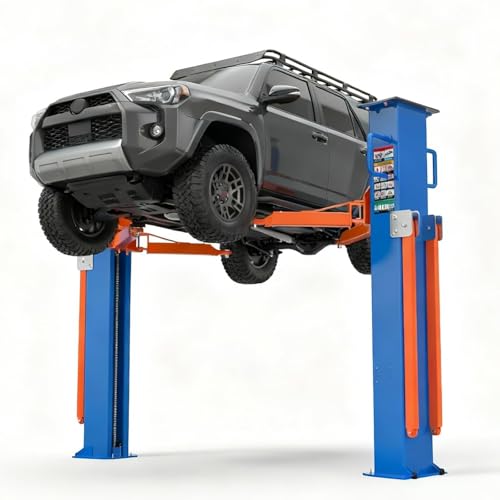
The WEIZE 11,000-lb two-post automotive lift combines a high-output 220V 3HP hydraulic power unit with an open-floor layout for home garage mechanics and light commercial service bays. Requiring a dedicated 220V circuit, structural concrete slab, and dual-point lock disengagement, it offers substantial lifting capacity for sedans, SUVs, and work trucks.
Pros
- High 11,000-lb capacity easily handles heavier half-ton and three-quarter-ton trucks
- Wide 110.23-inch drive-through clearance makes vehicle positioning simple and stress-free
- Rugged 220V 3 HP hydraulic motor delivers dependable lifting muscle
- Clear-floor layout leaves garage floor completely open for transmission jacks and fluid drains
Cons
- Dual-point safety release requires walking to both columns to disengage locks before lowering
- Requires a dedicated 220V single-phase electrical hookup and an appropriate concrete foundation
- Heavy 1,426-lb shipping package requires a forklift, trailer ramp, or helpers for freight delivery offloading
Albott 7000 LBS Portable Scissor Car Lift
The Albott 7000 LBS Portable Car Lift delivers reliable frame-engaging lifting power with a 28-inch maximum rise height, making it an excellent unanchored solution for low-ceiling residential garages. Built from high-strength Q235B steel, it suits DIY mechanics and car enthusiasts tackling brake jobs, tire rotations, and chassis maintenance on level concrete.
Pros
- Substantial 7,000-lb capacity easily handles most domestic sedans, sports cars, and midsize SUVs
- Mobile four-wheel design eliminates permanent concrete drilling and fits well under standard 8-to-10-foot residential ceilings
- Includes extension panels and multi-height adapter blocks to reach factory frame contact points across different wheelbases
- Multiple mechanical locking positions allow safe, stable under-vehicle working heights off hydraulic pressure
Cons
- Maximum 28-inch rise height does not provide full standing headroom underneath the vehicle
- Weighs 401 pounds, which requires moderate physical effort to reposition or wheel across uneven garage thresholds
- Requires a minimum load of approximately 220 pounds on the frames to compress the return springs and initiate descent
GANSNAY 3.2-Inch Rubber Lift Block
Built for shops handling trucks and SUVs, this 3.2-inch block provides extra chassis clearance with an 8,000-pound capacity. Its nylon-reinforced top layer resists tearing from frame contact while the textured rubber base secures placement on lift platforms.
Pros
- High 8,000-pound load rating
- Nylon reinforcement resists splitting and gouging
- Anti-slip base grips lift platforms securely
- Provides 3.2 inches of extra reach
Cons
- Noticeable rubber odor when first unpacked
- Relatively heavy at nearly five pounds per block
VEVOR Portable Scissor Car Lift
The VEVOR 9,000 lb portable electric-hydraulic vehicle lift delivers up to 28 inches of working height on a standard 120V residential circuit without requiring permanent floor anchoring. It is an ideal mid-rise lifting solution for home garage DIYers, truck and SUV owners, and shops with standard 8-to-10-foot ceilings.
Pros
- Substantial 9,000 lb rating safely handles heavier modern trucks, crossovers, and electric vehicles
- Plugs into standard 120V household outlets for straightforward residential garage installation
- Reaches up to 28 inches of working height, ideal for low 8-to-10-foot residential garage ceilings
- Includes four non-slip rubber pads and four taller frame-contact extension columns in the box
Cons
- Total crated package weight of over 450 lbs requires multiple sets of hands or equipment to unload
- Requires sourcing ISO 46 hydraulic oil separately and bleeding the system before initial operation
- The 6.1-inch collapsed profile may require drive-on helper boards for aggressively lowered sports cars
MachPro 8,000 lb Portable 2-Post Mid-Rise Car Lift
The MachPro 8,000 lb mid-rise two-post lift provides a 51.3-inch maximum rise height designed specifically for residential garages with standard 8-to-10-foot ceilings. Operating on 220V power and built from Q235 steel, it features wheeled columns for mobility, though it strictly requires concrete anchor bolt installation during vehicle lifting.
Pros
- Compact 71.88-inch column height fits easily inside standard 8-foot or 9-foot residential garage ceilings
- Substantial 8,000-pound load capacity handles most half-ton trucks, SUVs, and passenger cars within rating limits
- Wheeled columns and mobile power unit cart allow the lift to be moved out of the way for floor storage when unbolted
- Integrated tool tray on the hydraulic power unit cart adds immediate workspace organization during brake and wheel service
Cons
- Dual-point manual safety release requires manually pulling safety rings on both columns prior to lowering the vehicle
- Minimum pad height of 5.25 inches may require auxiliary drive-on helper boards for extremely low sports cars
- Despite portable transport wheels, the lift must be anchored to a cured concrete floor with expansion bolts during operation
Concrete Slab Thickness and Foundation Guidelines for Automotive Lifts
Determining the exact concrete thickness in your workshop bay is the single most critical structural task before purchasing or erecting an automotive lift. Installing heavy shop machinery on a sub-par foundation risks catastrophic anchor pullout, column tipping, and expensive vehicle damage. Manufacturer engineering specifications dictate precise depth, compressive strength, and edge distance thresholds that must be satisfied before bolting any equipment to the floor.
The Standard Concrete Depth Rules for Two-Post and Four-Post Lifts
Most equipment manufacturers specify a minimum concrete slab thickness of 4 inches for light to medium-duty two-post surface-mounted hoists rated up to 9,000 or 10,000 pounds. This standard 4-inch requirement assumes a continuous, solid slab resting on properly compacted subbase gravel without hollow voids underneath. Because a two-post hoist holds a vehicle on cantilevered swing arms, the columns experience extreme dynamic prying forces that try to pull the baseplate anchors straight out of the floor. For heavier two-post models rated at 11,000 pounds or higher, manufacturers often mandate a minimum slab depth of 4.5 to 6 inches. Skipping this depth verification leaves the anchors with insufficient mechanical bite to withstand full working loads.
Four-post vehicle hoists interact with concrete slabs in a completely different mechanical fashion than two-post systems. A four-post lift distributes vehicle weight across four distinct upright columns, placing the concrete almost entirely in pure downward compression rather than severe tensile pullout. Consequently, a sound 4-inch concrete slab with standard residential compressive strength is generally more than adequate to support a four-post parking or service hoist. Many homeowners choose four-post designs precisely because their foundation requirements are less demanding than cantilevered two-post systems. While some four-post parking lifts can operate free-standing using mobile caster kits, bolting the baseplates into solid concrete provides superior lateral stability and prevents equipment drift over time.
Why Concrete Compressive Strength and Cure Time Matter Just as Much as Depth
Slab depth tells only half the structural story when assessing garage suitability for vehicle lifting equipment. The compressive strength of the concrete, measured in pounds per square inch (PSI), determines whether the material will crumble under the concentrated tension generated by wedge anchors. Most automotive lift manufacturers require a minimum compressive strength of 3,000 PSI before any column baseplate can be bolted down. Lower-grade residential concrete, often poured at 2,000 to 2,500 PSI to save building costs, lacks the internal aggregate bonding required to hold mechanical expansion anchors under severe leverage. If anchor bolts are torqued into weak concrete, the expansion collars will crush the surrounding paste rather than wedging securely against the aggregate.
Cure time is equally vital when preparing a new garage slab or pouring fresh concrete pads for workshop hoists. Fresh concrete requires a minimum curing period of 28 days to reach its design compressive strength before you drill anchor holes or apply structural loads. Drilling into green concrete that has only cured for one or two weeks risks cracking the entire slab and preventing expansion anchors from achieving their specified holding power. Chemical hydration continues to strengthen concrete well past four weeks, but loading the floor prematurely interrupts this crystalline bonding process. Always verify that your concrete has passed the 28-day cure window before attempting installation of any surface-mounted columns.
Mechanical Anchor Bolt Embedment and Slab Edge Clearances
Anchor bolt embedment depth directly determines whether a lift column stays anchored or tears free under asymmetric vehicle loads. Standard wedge anchors supplied with two-post lifts, typically measuring 3/4-inch in diameter, generally require a minimum effective embedment depth of 3.25 inches into a 4-inch slab. This tight tolerance means the anchor must sit deep enough to engage sound concrete without punching completely through the bottom of the slab into the subbase gravel. When an installer drills through the bottom of the concrete, moisture can enter the hole, causing anchor corrosion, and the expansion clip may lose radial pressure. Using a rotary hammer with a reliable depth stop ensures that every hole stops safely within the solid mass of the concrete.
Edge distance is another non-negotiable metric when planning column locations relative to expansion joints, control cuts, and foundation perimeters. Lift manufacturers strictly mandate maintaining at least 6 to 8 inches of clearance between any anchor bolt and an expansion joint, saw cut, or slab edge. Concrete relies on lateral mass to resist the expanding outward pressure generated when wedge anchors are torqued to specified foot-pound ratings. Drilling too close to a control joint or perimeter cold joint creates a shear plane that causes the concrete edge to fracture or blowout under load. Proper bay layout requires marking all existing slab cuts and adjusting column centerlines to maintain safe setbacks across all baseplate mounting holes.
How to Accurately Test and Measure Your Existing Garage Floor
Visual inspection cannot tell you how deep a concrete slab actually is, making physical test drilling an essential pre-installation step. Builders frequently pour residential garage floors with uneven thickness, leaving areas near the center or edges thinner than the intended 4-inch design. To verify your actual slab depth, select the proposed mounting location for your columns and drill a small test hole using a masonry bit. You can insert a thin wire with a hooked tip or a depth gauge through the hole to measure the distance from the top surface to the bottom edge of the slab. Drilling two or three test holes across the planned baseplate footprint confirms whether the thickness remains consistent where your anchors will bite.
Beyond slab thickness, checking floor levelness and slope is vital to ensure lift columns remain perfectly plumb. Standard residential garages are deliberately poured with a slight pitch toward the overhead door to facilitate water drainage. Installing columns on a sloped surface causes the lifting carriages to bind in the tracks and places uneven strain on internal equalization cables. While steel horseshoe shims can correct minor slopes up to 1/2 inch under baseplates, steeper garage pitches require leveling grout pads or custom shimming solutions approved by equipment engineers. Exploring various hydraulic car lift systems will help you understand how drive-over and clear-floor carriage geometries respond to uneven floor grades.
Post-Tension Slab Hazards and Ground-Penetrating Radar Scanning
Modern residential home foundations, particularly in areas with expansive soils, frequently utilize post-tension concrete slabs rather than standard reinforced slabs. Post-tension slabs contain high-strength steel tendons that are stretched under immense mechanical tension after the concrete cures. Drilling into a post-tension slab without knowing tendon locations poses an extreme safety hazard to the installer and structural integrity of the home. If a rotary hammer bit strikes an active tendon, the cable can snap violently, rupturing through the concrete surface with explosive force. This sudden release of energy can destroy shop equipment, cause severe personal injury, and compromise the foundation structural integrity.
Homeowners can often identify post-tension foundations by checking for a stamp embedded in the garage floor or locating plastic pocket-former plugs along the exterior foundation beam. If your garage slab is post-tensioned, you must never drill anchor holes based on visual estimation or guesswork. The only safe protocol is hiring a professional concrete scanning contractor equipped with ground-penetrating radar (GPR) to map tendon paths accurately. The scanning technician can mark safe drilling zones directly on the concrete, allowing you to position column baseplates without intersecting high-tension steel. When safe drilling zones cannot accommodate your chosen lift footprint, alternative surface-mounted or portable equipment must be considered.
Foundation Requirements for Portable, Scissor, and Frame-Engaging Lifts
Workshops with questionable concrete depth or post-tension restrictions often benefit from portable and low-profile lifting alternatives. Frame-engaging portable units like the Rueekfil Heavy-Duty Portable Car Lift 7000 LBS or Albott 7000 LBS Portable Car Lift distribute vehicle weight along wide horizontal steel base frames. Because these units do not require permanent anchor bolts in the floor, they eliminate the risk of anchor pullout caused by thin residential concrete. Similarly, higher-capacity mobile designs like the VEVOR Portable Car Lift, 9000 lbs Capacity use reinforced alloy steel frames that sit directly on flat concrete floors. These systems provide dependable lifting height for brake and suspension repairs while sidestepping the rigorous anchor embedment demands of permanent columns.
Even though portable scissor hoists and air-bag jacks do not require drilled wedge anchors, concrete surface integrity remains critical. Compact rapid lifts like the VEVOR Air Portable Car Lift and portable scissor assemblies require a smooth, flat, crack-free surface to prevent binding as the rollers travel along the ground. Using these lifts on crumbling concrete, uneven gravel, or steep slopes exceeding manufacturer limits can cause frame distortion or tipping hazards. Furthermore, pairing portable lifts with accessories like the GANSNAY 3.2″ Car Lift Rubber Block helps bridge chassis contact points safely without damaging vehicle undercarriages. A flat 3.5 to 4-inch concrete pad provides an ideal foundation for mobile hoists without requiring structural foundation modifications.
Pouring Dedicated Concrete Footings When Existing Slabs Fall Short
When test drilling reveals that an existing residential slab is under 4 inches thick or compromised by extensive cracking, pouring dedicated concrete footings is the safest solution. Rather than repouring an entire garage floor, installers can saw-cut isolated sections of the slab beneath each proposed column location. Typical retrofit footings for a two-post hoist require excavating a pad measuring at least 4 feet by 4 feet with a depth of 12 inches or more, depending on local building codes and soil conditions. This excavated pocket is then reinforced with a tied grid of rebar to prevent cracking and tie the new mass together. Pouring high-strength 3,000 or 4,000 PSI concrete into these prepared pits creates robust anchor foundations capable of handling commercial-grade machinery.
Properly integrating new concrete footings with the existing floor requires pinning the perimeter with dowels drilled into the surrounding slab. Steel dowels help transfer loads across the cold joint and prevent differential settling between the old garage floor and the new footing pads. Once the new concrete is poured and finished flush with the surrounding floor, the full 28-day curing schedule must be observed before drilling wedge anchor holes. Pouring isolated pads also allows you to position baseplates exactly where needed without worrying about old expansion joints or weak aggregate. Taking the retrofit footing route ensures your vehicle hoist has structural support that satisfies manufacturer foundation guidelines.
Verifying Power, Clearances, and Lift Geometry Alongside Foundation Depth
A solid concrete foundation provides the necessary structural base, but garage bay ceiling height and electrical capacity must be addressed concurrently. Two-post clear-floor hoists feature rigid overhead beams with safety shutoff bars designed to prevent tall vehicles from crashing into ceiling rafters. Reviewing the overall height of heavy-duty models like the WEIZE 11000lbs Two Post Car Lift ensures that your garage roof trusses and garage door tracks provide adequate vertical clearance. If ceiling height is limited, mid-rise two-post options like the MachPro 8000 lbs 2 Post Car Lift provide substantial lifting range while fitting under lower rafters. Reviewing our guide on heavy duty car lift requirements helps clarify how overall height, drive-through clearance, and column width fit inside residential dimensions.
Electrical service supply must also match your chosen hoist motor specifications to avoid tripping breakers during heavy vehicle ascent. Many full-size hoists incorporate 220V single-phase motors that require dedicated 20-amp or 30-amp circuit breakers to supply adequate starting torque. Portable options frequently operate on standard 120V circuits or pneumatic power units, simplifying installation in detached workshops with modest electrical panels. In addition to electrical planning, evaluating arm configurations ensures that asymmetric or symmetric arms reach vehicle frame pick-up points without damaging pinch welds. Balancing foundation depth, ceiling clearances, and electrical supply creates a safe, reliable lifting environment tailored to your maintenance needs.
Verifying that your garage concrete possesses the required 4-inch depth, 3,000 PSI compressive strength, and safe edge clearances transforms your workshop into a secure maintenance space. Taking the time to drill test holes, inspect for post-tension tendons, and evaluate floor levelness guarantees that your mechanical anchors will hold firm under peak vehicle weight. Whether you bolt down a permanent two-post lift, secure a four-post parking hoist, or deploy a versatile portable frame-engaging unit, grounding your equipment on a verified concrete foundation ensures dependable performance for every automotive project.
About the author
Larry Carley is an experienced automotive technical writer and editor with more than four decades of work covering vehicle diagnostics, repair procedures, and automotive technology. His extensive technical writing helps readers understand mechanical systems, maintenance decisions, and the importance of accurate information when working on vehicles.