
Are Floor Jack Extensions Safe to Use? Safety Risks and Guidelines for 2026
Understand if are floor jack extensions safe to use in November 2026, examining capacity derating, thread types, lateral shear risks, and garage protocols.
 By Emily Markham
Updated October 13, 2026


Working on modified off-road trucks, lifted sport utility vehicles, or solid-axle four-wheel-drive rigs often reveals a frustrating obstacle during routine garage maintenance. Standard hydraulic trolley jacks frequently run out of vertical piston stroke long before oversized tires leave the concrete, primarily due to deep suspension droop and high chassis ride height. Home mechanics facing this gap often wonder whether aftermarket lift risers and adapters are mechanically sound or if elevating the jack saddle introduces unacceptable tipping hazards. In practical garage setups, are floor jack extensions safe to use only when they incorporate positive mechanical locking systems and when operators strictly observe the physics of lateral load deflection.
A poorly planned lifting configuration can easily lead to bent rocker panels, crushed undercarriage components, or sudden vehicle instability. Experienced mechanics understand the necessity of supporting elevated vehicles on mechanical stands, yet understanding how vertical risers change the behavior of a hydraulic service jack requires specific mechanical knowledge. By evaluating load derating schedules, thread engagement types, caster roll dynamics, and saddle designs, vehicle owners can safely clear suspension travel without compromising shop safety.
| Award | Product | BJL Score About BJL ScoreThe BJL Score is our own rating from 0 to 10, based on performance, design and build, ease of use, and value. It reflects independent research and is never influenced by manufacturers, retailers, or affiliate commissions. Learn more › | |
|---|---|---|---|
| Best Overall |
TONDA Rubber Floor Jack Pads 2-Pack
|
9.1/10 | Buy |
| Best Budget |
 Generic 2-Ton Floor Jack Cross Beam Adapter |
8.6/10 | Buy |
| Best Value |
 911 Motorsports Fine Thread Jack Extension |
8.6/10 | Buy |
| Best Premium |
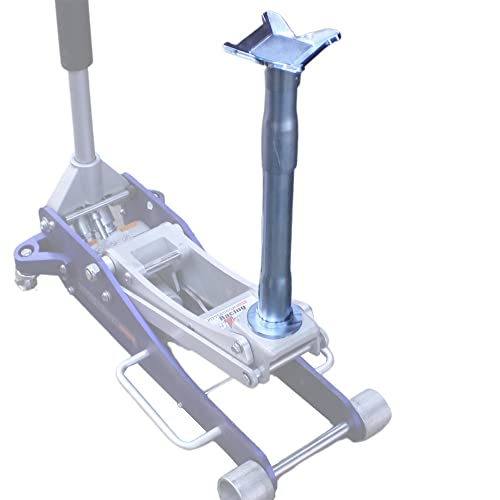 911 Motorsports 4x4 Bolt-On Jack Extension |
8.3/10 | Buy |
TONDA Rubber Floor Jack Pads 2-Pack
The TONDA 2-Pack Rubber Floor Jack Pads provide a 0.51-inch slotted groove and 1.29-inch height profile to help protect unibody pinch welds from bending and surface damage during floor jack lifting. Sized with a 2.83-inch diameter for compatible 2-3 ton hydraulic jacks, this set is ideal for DIY mechanics servicing unibody passenger cars and crossovers.
Pros
- Cushions unibody pinch welds to help prevent folded sheet metal, scratched paint, and rust-prone seam damage
- Adds 1.29 inches of effective lifting height to bridge gaps on recessed factory lift points
- Pre-cut 0.51-inch wide by 0.5-inch deep slot aligns smoothly with standard automotive pinch welds
- Solid rubber composition minimizes metal-to-metal contact slippage against hydraulic jack saddles
Cons
- Sized specifically for 2.83-inch saddles and may not fit larger commercial floor jack cups or deep-dished saddles
- Slot dimensions (0.51-inch wide by 0.5-inch deep) may not accommodate oversized, modified, or reinforced truck frame seams
- Rubber pucks are designed for hydraulic jack lifting points and are not a substitute for rated static jack stands
Generic 2-Ton Floor Jack Cross Beam Adapter
The Generic 2-Ton Floor Jack Cross Beam Adapter converts standard floor jacks into a balanced two-point lifting beam with an adjustable 29.5- to 41.7-inch span and a 4,400-lb working load limit. Featuring dual rubber-padded saddles and a sturdy 22-pound steel build, it is a practical upgrade for DIY mechanics seeking safer, more stable axle and subframe lifts.
Pros
- 4,400 lb (2-ton) capacity comfortably handles single-axle lifting duties for common passenger vehicles and SUVs
- Adjustable 29.5- to 41.7-inch crossarm width spans a broad selection of factory chassis lift points
- Protective rubber contact pads prevent gouging and help reduce slips against metal frame surfaces
- 22-pound overall weight balances structural rigidity with easy garage handling and storage
Cons
- Adds several inches of vertical stack height to the jack saddle, which may limit clearance under low-profile or lowered sports cars
- Requires verifying the center mounting pin or saddle cup fitment with your specific hydraulic floor jack model prior to purchase
- Lacks dedicated side positioning handles, requiring manual two-handed adjustment along the telescoping track
911 Motorsports Fine Thread Jack Extension
This heavy-duty adapter converts compatible floor jacks into a versatile raised platform with added lifting clearance. Constructed from A572 steel and DOM tubing, it provides a stable contact point for servicing lifted vehicles.
Pros
- Sturdy steel and DOM tube construction
- Textured polyurethane pad prevents slipping and damage
- Protective zinc plating resists rust
- Adds significant reach for taller vehicles
Cons
- Only fits jacks with fine-thread bolt-on mounts
- Maximum load rating capped at 3 tons
911 Motorsports 4x4 Bolt-On Jack Extension
Built from heavy-duty DOM tubing and A572 steel, this modular system adds up to 16 inches of lift height for taller trucks and off-road rigs. Its dual-sided saddle supports both round tubes and standard vehicle frames.
Pros
- Modular design stacks up to 16 inches high
- Dual-sided saddle fits frames and round tubes
- Durable DOM steel construction with zinc plating
- Manufactured in the USA
Cons
- Weight rating drops by half at full extension
- Requires matching specific fine-thread jack specifications
Safety Engineering, Load Dynamics, and Practical Guidelines for Floor Jack Extensions
Floor jack extensions are fundamentally safe only when built from heavy-duty structural steel, bolted or pinned securely into the lifting arm, and operated within strict derated capacity limits. Introducing extra height between the jack saddle and the vehicle lifting point creates dynamic physical forces that standard floor jacks were never designed to manage without careful planning. When vehicle owners respect mechanical ratings and follow strict elevation procedures, purpose-built risers provide a reliable way to overcome severe suspension travel.
The Physics of Jack Extensions: Moment Arms, Lateral Shear, and Tipping Risks
Every floor jack is engineered around a specific mechanical center of gravity calculated from the factory saddle height. Adding a vertical riser creates an extended moment arm that dramatically multiplies any off-center lateral force. If a lifted truck shifts even slightly sideways during elevation, that tall extension acts as a lever against the floor jack saddle bowl and lift arm pin. What would normally be a minor side load on a standard saddle becomes severe rotational torque capable of twisting the lift arm.
The arc of movement inherent in hydraulic trolley jacks further complicates this physical dynamic. As the hydraulic cylinder pushes the main arm upward, the saddle does not travel in a purely vertical line; it sweeps through a continuous radial arc. Under standard conditions, the steel casters on the jack roll slightly forward across the concrete floor to remain centered directly beneath the vehicle lift point. When an extension adds significant height, any delay in caster roll generates intense horizontal shear forces across the riser base.
This reality highlights why makeshift spacers like stacked wooden blocks, scrap steel tubing, or loose hockey pucks represent an extreme danger. Unsecured materials rely purely on surface friction to resist lateral shifting. As the lifting arm sweeps through its natural arc, unbolted spacers can easily kick out sideways, dropping thousands of pounds of vehicle weight instantly. Dedicated risers eliminate this failure point by utilizing solid mechanical fasteners, retaining pins, or tight socket collars that prevent angular separation.
Rated Capacity Derating: Why Height Halves Your Working Load Limit
One of the most dangerous misconceptions in DIY automotive service is assuming that a floor jack retains its full working load limit when equipped with an extension. The stated tonnage rating on any hydraulic trolley jack assumes that the vehicle load rests directly in the factory saddle cup adjacent to the pivot pin. As you increase the vertical distance between the pivot point and the contact pad, the structural bending forces acting on the lift arm increase proportionally. To maintain safety margins, operators must systematically derate the jack capacity based on extension length.
Commercial manufacturers of engineered extension hardware establish clear derating schedules to account for these multiplied stresses. For instance, high-end modular designs like the 911 motorsports 4×4 extension system provide exact capacity limits based on assembled height. While a 6-inch riser allows the jack to operate at its full factory rating up to 3 tons, adding an 11-inch extension reduces safe capacity to 75 percent of the jack rating. When combining modular tubes to achieve a 16-inch total rise, the working load limit drops down to just 50 percent of the original rating.
Understanding this derating schedule is essential when calculating actual lifting weights on full-size trucks and sport utility vehicles. Elevating one end of a 6,000-pound truck places roughly 3,000 to 3,600 pounds onto the lifting saddle, representing between 50 and 60 percent of the gross vehicle curb weight. If you attach a tall 16-inch riser to a standard 2-ton floor jack, its derated capacity falls to just 2,000 pounds, creating an immediate overload condition. Always calculate your axle load and match it against the derated threshold rather than the original manufacturer rating plate.
Mechanical Attachment Styles: Bolt-On Threads, Drop-In Pins, and Structural Tubing
The safety of any floor jack extension depends heavily on the interface connecting the riser to the lifting arm. Professional extension systems completely replace the standard factory saddle rather than merely sitting inside it. Common attachment styles include bolt-on fine thread stems, bolt-on coarse thread bolts, drop-in smooth pins, and horizontal cross-pin retainers found on lightweight service jacks. Choosing the incorrect mounting interface guarantees loose fitment and dangerous wobble under heavy automotive loads.
Thread pitch precision is vital when installing bolt-on systems like the Flat Saddle Short Floor Jack Extension from 911 motorsports. Most modern automotive floor jacks utilize a fine thread bolt measuring approximately 1 inch in diameter with a 1.5-millimeter thread pitch. However, specific brands like Torin and Duralast frequently employ coarse thread bolts featuring a 3.0-millimeter pitch. Attempting to force an incompatible thread pitch into the lift arm strips threads, destroying the mechanical connection and inviting sudden failure under load.
Structural metallurgy also separates legitimate lifting hardware from substandard aftermarket accessories. High-quality systems employ heavy-gauge drawn-over-mandrel (DOM) steel tubing swaged to tight tolerances, often paired with 1/4-inch A572 high-strength plate steel saddles. DOM tubing provides uniform wall thickness, exceptional tensile strength, and zero longitudinal weld seams that could split under lateral deflection. Heavy zinc plating or industrial powder coating protects the steel against corrosion, preserving dimensional tolerances over years of garage storage.
Cross-Beam Adapters Versus Vertical Risers: Distributing Axle Weight Safely
When elevating wide structural components like solid truck axles, front subframes, or engine cradles, cross-beam adapters provide an excellent alternative to tall single-point risers. A cross-beam adapter, such as a 2-ton rated steel beam spanning between 29.5 and 41.7 inches, mounts directly into the floor jack saddle receiver. Instead of concentrating all vehicle weight onto a single elevated post, the cross-member distributes the load across two padded contact points spaced widely apart.
This dual-pad layout dramatically improves roll stability, neutralizing the tipping hazards often associated with tall, single-post extensions. The generic Floor Jack Cross Beam Adapter features adjustable telescopic arms that lock in place across varying chassis widths, providing customized support under reinforced frame rails. Equipped with heavy-duty rubber contact pads, the adapter cushions underbody metal while providing a broad base that prevents the vehicle from rocking during tire removal or brake service.
However, cross-beam adapters introduce their own geometry constraints that mechanics must accommodate. Because the beam sits across the jack arm and features elevated end pads, it significantly increases the minimum collapsed height of your lifting tool. While perfectly suited for lifted trucks, four-wheel-drive sport utility vehicles, and shop cranes, a cross-beam will not slide beneath passenger cars or vehicles with low rocker panels. For center-point lifting on tall frames where clearance is abundant, cross-beams deliver unmatched lateral stability.
Pinch Weld Risers and Rubber Pads: Protecting Flanges Without Sacrificing Stability
Not every lifting scenario requires multiple inches of steel tube extension to achieve adequate garage clearance. On unibody passenger cars and modern crossovers, mechanics often need just an extra inch of elevation while protecting delicate sheet metal seams. Compact rubber lifting adapters, such as the TONDA Floor Jack Pads, provide modest height extension while offering a dedicated channel for factory pinch welds. These dual-purpose pads prevent the floor jack saddle from crushing body seams or scraping protective undercoating.
The slotted profile on these rubber adapters measures approximately 0.51 inches wide and 0.5 inches deep, allowing the vertical pinch weld flange to seat cleanly inside the groove. This alignment ensures that lifting forces transfer directly to the reinforced floor structure adjacent to the seam rather than crushing the thin vertical metal flange. Measuring 2.83 inches in diameter and 1.29 inches in thickness, these compact adapters add just enough clearance to prevent side skirts and rocker trim from binding against the jack lift arm.
When evaluating total vehicle lift height, mechanics must ensure that rubber composition matches the demands of vehicle weight. Soft, low-density rubber pads can deform, squish, or split under multiple tons of pressure, creating sudden balance shifts during elevation. High-density vulcanized rubber or polyurethane saddle pads maintain their structural rigidity under full tonnage ratings, providing reliable cushioning without introducing squirm or unpredictable compression.
Safe Vehicle Elevation Protocol: Staging, Pumping, and Mechanical Stand Transition
Operating a floor jack with an extension demands precise staging and absolute adherence to garage safety protocols. The workspace must consist of a clean, level, solid concrete floor completely free of cracks, expansion joints, gravel, or oil spills. Asphalt driveways are unsuitable for extended lifting because the narrow steel wheels of the jack can sink into the softened bitumen under heavy loads. Sinking wheels prevent the jack from rolling forward during the lift stroke, forcing the extension into an aggressive tilt that can drop the load.
Wheel chocking is mandatory on whichever axle remains in ground contact, placing heavy-duty chocks securely in front of and behind both tires. After seating the extension saddle under a certified factory lift point, engage the hydraulic pump handle slowly to bring the saddle into light contact with the chassis. Double-check that the extension stands perfectly vertical and that specialized saddles, like the tube-cradle side on the 911 motorsports 4×4 adapter, seat fully around axle tubes or boxed frame sections.
While elevating, maintain visual focus on the floor jack casters and the vertical alignment of the riser tube. The trolley must creep forward smoothly across the floor as the lift arm ascends through its natural lifting arc. Operators should actively focus on preventing equipment slippage on smooth floors by monitoring the contact pad interface. Never use a hydraulic jack with an extension as a temporary work support; as soon as the chassis reaches required height, position mechanical jack stands beneath solid frame rails and gently lower the load onto the stands.
Critical Warning Signs and When to Condemn an Extension System
Routine inspection of extension hardware is crucial for identifying structural fatigue before catastrophic failure occurs. Before every lifting session, examine the extension tubes for any sign of bending, ovalization at pin holes, or micro-cracks around welded seams. Pay close attention to mounting threads on bolt-on adapters; if the threads show galling, flattening, or cross-threading damage, retire the hardware immediately. A compromised thread can shear under dynamic shock loads, dropping the entire assembly.
Monitor your hydraulic floor jack for unusual mechanical feedback when operating with extended hardware. If the pump handle develops spongy resistance, kicks back unexpectedly, or requires excessive force, stop lifting immediately and inspect the hydraulic system. Spongy pumping often signals trapped air in the hydraulic cylinder, requiring a thorough purge through the oil fill plug using dedicated ISO VG 22 or 32 hydraulic fluid. Continued operation with aerated fluid can cause sudden pressure drops that destabilize an extended load.
Ultimately, floor jack extensions serve as effective, practical tools when treated with the mechanical caution they demand. Matching the correct thread pitch, investing in seamless DOM steel construction, factoring in strict load derating schedules, and always transitioning the elevated vehicle onto heavy-duty jack stands ensures that high-lift garage maintenance remains completely safe.
About the author
Emily Markham is an automotive aftermarket editor who has covered professional tools, workshop equipment, and the businesses that support vehicle repair since 2019. Her editorial background gives her a practical understanding of how technicians and shop owners evaluate equipment, product value, and long-term support.