
A in 3 Ton Low Profile Floor Jack Review of 2026 Top Garage Picks
Explore top trolley jacks in this November 2026 a in 3 ton low profile floor jack review guide built around low saddle clearances, dual-piston pumps, and garage lifting safety.
 By Christian Hazel
Updated October 13, 2026


Low ground clearance turns simple garage maintenance into an absolute headache when a bulky service jack fails to roll under vehicle pinch welds. Sports cars, lowered sedans, and performance coupes require specialized chassis access without scratching delicate rocker panels or bending factory lift points. Analyzing specifications across modern lifting gear highlights why evaluating A In 3 Ton Low Profile Floor Jack Review matters for any serious home garage setup. A quality hydraulic trolley jack provides the dual advantage of ultra-low collapsed clearance alongside stout lifting capacity to raise three-ton family haulers and light trucks with equal stability. For vehicles sitting too low for standard floor saddles, pairing your jack with low-profile vehicle ramp options can provide the preliminary tire clearance needed to slide a service saddle beneath stubborn crossmembers safely.
Hydraulic efficiency keeps garage workflow smooth during weekend brake jobs, suspension rebuilds, and routine tire rotations. Dual-piston pump assemblies elevate the lifting arm rapidly, cutting handle stroke effort while universal joint release valves give you predictable descent control. Every garage mechanic must remember that hydraulic pressure is designed solely for lifting loads, never supporting them during maintenance. Positioning dedicated safety stands beneath reinforced frame points remains non-negotiable before you ever crawl under an axle, sparking the frequent debate over whether car ramps are better than jack stands for fast underbody jobs. Relying on verified manufacturer specs, structural steel chassis ratings, and real owner feedback ensures your equipment keeps garage projects both safe and productive.
| Award | Product | BJL Score About BJL ScoreThe BJL Score is our own rating from 0 to 10, based on performance, design and build, ease of use, and value. It reflects independent research and is never influenced by manufacturers, retailers, or affiliate commissions. Learn more › | |
|---|---|---|---|
| Best Overall |
Arcan A20003 3-Ton Low Profile Floor Jack
|
9.1/10 | Buy |
| Best Value |
 SATA 3-Ton Heavy-Duty Steel Floor Jack |
8.9/10 | Buy |
 VEVOR 3 Ton Low Profile Floor Jack |
8.8/10 | Buy | |
| Best Premium |
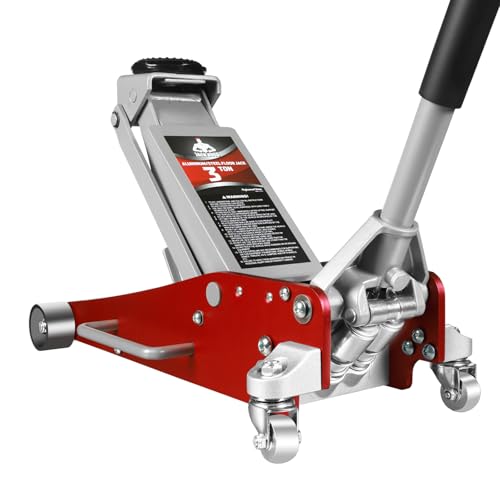 Jack Boss 3-Ton Low Profile Floor Jack |
8.8/10 | Buy |
| Best Budget |
 Winturbor 3-Ton Low-Profile Floor Jack |
8.1/10 | Buy |
 AV Steel 3-Ton Low Profile Floor Jack |
8.1/10 | Buy | |
 SATA 3-Ton Aluminum Floor Jack |
8.1/10 | Buy | |
 Maxority 3-Ton Low Profile Floor Jack |
8.0/10 | Buy |
Arcan A20003 3-Ton Low Profile Floor Jack
Built with a reinforced high-carbon steel chassis, this 3-ton floor jack easily reaches beneath low-clearance vehicles. It serves as a dependable, heavy-duty lifting option for home mechanics and workshop maintenance.
Pros
- Strong 6,000-pound load capacity
- Low-profile clearance fits low-riding vehicles
- Built-in hydraulic overload protection valves
- Durable high-carbon steel frame construction
- Smooth maneuverability with wide front wheels
Cons
- Heavy 76.8-pound weight makes transport cumbersome
- Bulkier storage footprint than aluminum alternatives
- Limited to a standard one-year warranty
SATA 3-Ton Heavy-Duty Steel Floor Jack
This SATA 3-ton heavy-duty steel floor jack combines a low-clearance chassis with a dual-piston rapid lift pump and an extended 19-1/8-inch maximum lift height. Factory reviewed to 1.5 times its rated 6,600-pound capacity, it provides dependable lifting muscle for home garage mechanics servicing passenger sedans, crossovers, and light pickups.
Pros
- Generous 3-ton (6,600 lb) rated capacity with factory proof evaluation to 1.5 times maximum load for enhanced structural confidence.
- Dual-piston rapid lift mechanism cuts unladen pump strokes to bring the saddle to vehicle contact points rapidly.
- Wide 3-3/4-inch to 19-1/8-inch elevation range accommodates low passenger cars as well as standard crossovers and light trucks.
- Rugged industrial-grade steel chassis offers dependable torsional rigidity and resistance to frame deformation.
- Precision slow-release descent valving helps prevent abrupt drops when settling the vehicle onto mechanical stands.
Cons
- Substantial 70-pound dry chassis weight makes manual lifting into high truck beds or mobile transport physically demanding.
- Bare steel saddle does not include a pre-installed slotted rubber pinch weld pad, requiring aftermarket protection for delicate unibody seams.
- Extended 28.3-inch steel chassis requires adequate clearance behind the vehicle to pump the handle comfortably in compact single-car bays.
VEVOR 3 Ton Low Profile Floor Jack
The VEVOR 3-ton low-profile floor jack provides 6,600 lbs of hydraulic lifting capacity with an ultra-low 3.35-inch minimum saddle height and rapid dual-piston pump action. Ideal for home garage DIYers and sports car enthusiasts needing dependable lifting power for oil changes, brake service, and tire rotations before setting jack stands.
Pros
- 3.35-inch low-profile entry height clears lowered vehicles and tight factory lift points
- Rapid dual-piston hydraulic pump reduces physical pumping effort and setup time
- Rugged all-steel construction with smooth-rolling rear swivel casters for easy positioning
- Complies with ASME PALD-2014 and CE standards with built-in overload protection
- Detachable rubber saddle pad and foam handle sleeve safeguard vehicle paint and chassis
Cons
- Heavy 73-pound curb weight makes lifting into truck beds or mobile service rigs demanding
- As a hydraulic floor jack, it provides zero mechanical locking and requires dedicated jack stands before working underneath
- 52-inch two-piece handle requires moderate clearance behind the vehicle during horizontal pumping
Jack Boss 3-Ton Low Profile Floor Jack
Built with a hybrid aluminum and steel frame, this 3-ton floor jack pairs a low 3-15/16-inch minimum clearance with a dual-piston rapid pump. It serves as a versatile lifting solution for low-slung sedans as well as standard SUVs and minivans.
Pros
- Low-profile 3-15/16-inch minimum lifting clearance
- Fast elevation with dual-piston hydraulic pump
- Hybrid aluminum and steel frame construction
- Protective rubber saddle shields vehicle chassis
- Meets rigorous ANSI/ASME PASE safety standards
Cons
- At 58.5 pounds, it remains relatively heavy to transport
- 18-5/16-inch max height may be limiting for lifted trucks
Winturbor 3-Ton Low-Profile Floor Jack
Built for both low-slung sports cars and larger SUVs, this hydraulic jack slides under clearances as low as 3.35 inches while supporting up to 6,000 pounds. A dual-piston pump speeds up every lift, making it a dependable option for garage maintenance and roadside tire changes.
Pros
- Low 3.35-inch profile fits under lowered vehicles
- Rapid dual-piston hydraulic lifting mechanism
- Includes tubeless tire repair kit and rubber pads
- Built-in safety overload protection valve
Cons
- Heavier steel frame weighs nearly 52 pounds
- Large 25.6-inch footprint requires ample storage space
AV Steel 3-Ton Low Profile Floor Jack
Built to clear lowered suspensions and standard passenger cars, this hydraulic steel jack reaches under chassis as low as 3-1/8 inches and extends to nearly 20 inches. A dual-piston pump speeds up lifts, backed by compliance with recognized ANSI/ASME PASE safety standards.
Pros
- Low 3-1/8-inch minimum height fits under low-clearance cars
- Dual-piston pump enables rapid lifting with less effort
- Meets rigorous ANSI/ASME PASE safety standards
- Heavy-duty steel construction ensures solid garage stability
Cons
- All-steel construction makes it considerably heavy to transport
- Long frame requires significant floor space for storage
SATA 3-Ton Aluminum Floor Jack
Designed for versatile garage work, this aluminum floor jack combines a low 3-3/4-inch clearance with a dual-piston pump for rapid vehicle elevation. Its aluminum construction significantly cuts down on overall weight, making positioning around the shop far less strenuous.
Pros
- Low 3-3/4-inch minimum height accommodates low-clearance vehicles
- Dual-piston system reduces physical pumping effort
- Aluminum body provides good portability around the shop
- Controlled release mechanism eliminates sudden drops
Cons
- Long 28.3-inch frame requires substantial storage room
- 19-1/8-inch maximum lift may not suit high-clearance trucks
Maxority 3-Ton Low Profile Floor Jack
The Maxority 3-Ton Low Profile Floor Jack delivers a 6,600-lb rated capacity with an extended-reach chassis and rapid dual-piston hydraulics for residential garage maintenance. Designed for sports cars and passenger vehicles on level concrete without requiring dedicated electrical wiring or permanent anchoring, it is an ideal mobile lifting tool for DIYers who support their vehicles on jack stands for routine service.
Pros
- 6,600-lb (3-ton) rated capacity handles a wide variety of passenger vehicles and sports cars
- Low-profile extended frame provides access beneath lowered vehicles with minimal ground clearance
- Dual-piston rapid pump mechanism minimizes the strokes required to meet the chassis
- High-strength steel construction delivers a sturdy, rigid platform during lifting operations
- Built-in overload protection valve promotes safer hydraulic operation
Cons
- Heavy-gauge steel construction adds physical lifting weight compared to lightweight aluminum racing jacks
- Ships in a random color finish, which may not match specific garage or workshop color schemes
- Requires pairing with appropriately rated mechanical jack stands before performing any under-vehicle maintenance
Frequently Asked Questions
Can a 3-ton low-profile floor jack lift full-size trucks and SUVs?
Yes, a 3-ton floor jack holds a 6,000-pound rating, which easily manages the axle or corner weight of most full-size pickups and SUVs. Floor jacks lift roughly half of a vehicle’s curb weight at a time during axle lifting, rather than the entire gross vehicle weight rating. You must verify that the jack’s maximum lift height, often between 18 and 20 inches, provides sufficient stroke to unload the suspension and lift tall truck tires off the ground.
What collapsed saddle height is required for lowered sports cars?
A minimum collapsed height under 3.5 inches is ideal for lowered sports cars and vehicles with aftermarket suspension. Models with a low-profile chassis slide beneath low rocker moldings and reach deep front crossmembers without binding against the front bumper. If your vehicle features extreme track lowering, reviewing how high car ramps should be can help you choose auxiliary clearance solutions.
What is the advantage of a dual-piston rapid lift pump?
Dual-piston hydraulic pumps raise the lift arm to the chassis contact point in fewer handle strokes compared to single-piston designs. One piston provides high fluid volume under low pressure for rapid arm extension, while the second piston delivers high pressure under heavy loads. This mechanism cuts pumping effort by nearly half during routine brake jobs and oil changes.
Is an aluminum racing jack better than a heavy-duty steel floor jack?
Aluminum jacks excel in portability and trackside use, weighing significantly less than equivalent all-steel units. A heavy-duty steel floor jack offers greater rigidity, higher long-term resistance to frame twisting under demanding shop conditions, and a lower purchase price. Hybrid designs combining steel lift arms with aluminum side plates offer a practical balance between carry weight and structural strength.
How do you purge trapped air from a hydraulic floor jack?
Bleeding air requires opening the release valve completely, pumping the handle rapidly through 10 to 15 full strokes, and closing the valve again. Trapped air causes spongy handle resistance and prevents the lift saddle from reaching full extension under vehicle weight. If the ram still feels soft, slightly loosening the rubber oil fill plug while the arm is fully lowered allows trapped air to vent from the reservoir.
Can you lift just one side of a vehicle safely with a trolley jack?
Yes, lifting a single side or corner is standard practice for tire rotations and brake inspections, provided you place mechanical jack stands immediately. Raising one side changes load distribution across tires remaining on concrete, which is why drivers often research whether car ramps can be used on one side before deciding on garage lifting techniques. Always chock the opposite wheels on flat, level pavement before raising any vehicle corner.
About the author
Christian Hazel is an automotive journalist with extensive experience covering four-wheel-drive vehicles, mechanical upgrades, and off-road equipment. His background includes technical reviews, installation features, and project-vehicle coverage, bringing useful context to equipment choices for trucks, Jeeps, and off-road enthusiasts.