
Would I Be Comfortable Using My Floor Jack Without Jack Stands? Practical Safety Guide for 2026
Asking would i be comfortable using my floor jack without jack stands highlights critical hydraulic risks for DIY repairs in November 2026.
 By Emily Markham
Updated October 25, 2026


Elevating a motor vehicle off the pavement changes the entire safety dynamic of any garage workspace. Many home mechanics wonder: would i be comfortable using my floor jack without jack stands? The clear answer across professional automotive workshops and mechanical engineering principles is an emphatic no. A hydraulic floor jack operates as a dynamic lifting tool engineered to elevate weight, but it lacks the positive mechanical lock required to serve as a static holding device.
Hydraulic fluid pressure depends entirely on internal rubber seals, check valves, and manual release screws that can fail without warning. When weighing garage support options, evaluating whether car ramps are better than jack stands reveals how vital positive mechanical support is for vehicle maintenance. Placing your body beneath thousands of pounds of steel supported only by pressurized hydraulic fluid invites severe danger. Safe workshop protocol requires transferring vehicle weight directly onto rated mechanical stands before conducting any underbody inspection, brake service, or suspension repair.
| Award | Product | BJL Score About BJL ScoreThe BJL Score is our own rating from 0 to 10, based on performance, design and build, ease of use, and value. It reflects independent research and is never influenced by manufacturers, retailers, or affiliate commissions. Learn more › | |
|---|---|---|---|
| Best Overall |
VEVOR 2-Ton Low Profile Floor Jack with Stands
|
9.1/10 | Buy |
| Best Value |
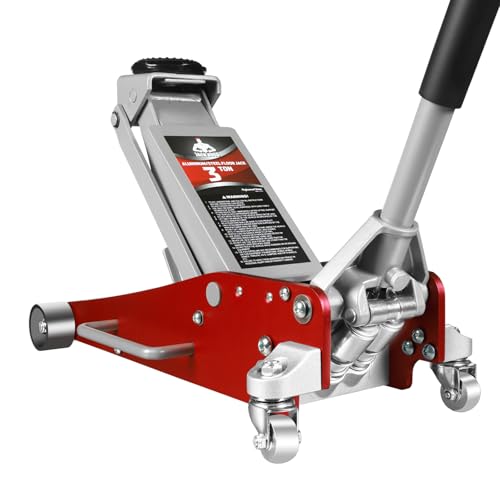 Jack Boss 3-Ton Low Profile Floor Jack |
8.8/10 | Buy |
VEVOR 2-Ton Low Profile Floor Jack with Stands
Built for low-clearance sedans and compact SUVs, this all-steel VEVOR combo pairs a 2-ton hydraulic trolley jack with matching ratchet stands. Its 5.1-inch minimum height slips easily under lower chassis, making routine tire and brake maintenance straightforward.
Pros
- Complete set with both jack and supporting stands
- 5.1-inch low profile fits lower sports cars and sedans
- Durable heavy-duty steel and cast-iron build
- Swivel casters provide effortless 360-degree positioning
Cons
- Maximum 12.2-inch jack lift height is short for tall trucks
- Single-piston pump requires more strokes than dual-piston alternatives
- 2-ton capacity restricts use with larger, heavier vehicles
Jack Boss 3-Ton Low Profile Floor Jack
Built with a hybrid aluminum and steel frame, this 3-ton floor jack pairs a low 3-15/16-inch minimum clearance with a dual-piston rapid pump. It serves as a versatile lifting solution for low-slung sedans as well as standard SUVs and minivans.
Pros
- Low-profile 3-15/16-inch minimum lifting clearance
- Fast elevation with dual-piston hydraulic pump
- Hybrid aluminum and steel frame construction
- Protective rubber saddle shields vehicle chassis
- Meets rigorous ANSI/ASME PASE safety standards
Cons
- At 58.5 pounds, it remains relatively heavy to transport
- 18-5/16-inch max height may be limiting for lifted trucks
The Mechanical Reality of Hydraulic Jacks and Under-Car Safety
Operating around motor vehicles requires an uncompromising understanding of workshop physics. Anyone asking whether they can safely rely on a hydraulic floor jack alone is fundamentally misunderstanding how hydraulic power functions. A hydraulic jack provides tremendous lifting leverage, but it offers zero guaranteed mechanical hold once the pumping action stops. Believing that a hydraulic ram can safely suspend an automobile while a technician works underneath creates an immediate risk to life and limb.
Hydraulic Mechanics and the Principle of Fluid Pressure
Hydraulic jacks generate lifting force through Pascal’s principle, where pressure applied to an incompressible liquid distributes equally in all directions. When you pump the jack handle, a small plunger forces hydraulic fluid through a one-way check valve into the primary cylinder. This fluid volume displaces the larger lifting ram upward, converting minimal user effort into thousands of pounds of mechanical lift. The entire system depends on constant fluid entrapment within a high-pressure chamber.
Single-piston jacks move a fixed volume of fluid with each downstroke, requiring steady effort to reach vehicle contact height. In contrast, dual-piston configurations accelerate this process by utilizing twin plungers to displace double the fluid volume until the saddle meets resistance. While this mechanism delivers impressive speed and efficiency during elevation, it does not change how the load is held. The weight of the vehicle remains balanced on a column of pressurized liquid rather than a solid mechanical structure.
Internal Failure Points: O-Rings, Check Balls, and Release Valves
The barrier separating several thousand pounds of vehicle weight from total collapse is a series of small, pliable nitrile rubber seals. High-pressure O-rings and U-cup packings maintain the fluid seal against the mirror-polished walls of the cylinder ram. Over time, heat cycles, physical friction, and microscopic contamination cause these elastomeric seals to degrade, harden, or tear. A sudden rupture in an internal high-pressure seal allows hydraulic fluid to bypass the piston immediately, dropping the lift arm in a split second.
Internal check valves present another vulnerability that cannot be visually inspected from outside the jack casing. These valves rely on precision steel ball bearings seating tightly against machined metal orifices to prevent fluid backflow. A single speck of metal shaving or hardened fluid sludge can lodge between the ball and seat, permitting slow fluid leakage. This condition leads to hydraulic creep, where the vehicle imperceptibly lowers toward the ground over minutes or hours.
Manual release valves introduce both mechanical and human failure points into the hydraulic circuit. These valves use a tapered needle or ball screw that seals against a fluid return passage when tightened clockwise. If the valve seat develops surface pitting or fails to close completely, hydraulic pressure bleeds back into the reservoir under static vehicle load. Furthermore, an accidental knock against the handle or an unintentional turn of the control knob can release line pressure instantly.
Chassis Movement, Jack Geometry, and Rollover Hazards
Floor jacks do not lift a vehicle along a purely vertical axis. Because the lifting arm is anchored to a central pivot point on the chassis, the saddle travels upward through a distinct radial arc. To keep the saddle centered beneath the vehicle lift point, the entire floor jack must roll forward slightly on its steel front wheels as it elevates. If the wheels bind on cracked concrete, debris, or rough asphalt, the jack cannot roll to accommodate the shifting geometry.
When a jack binds during elevation, significant lateral side-loading forces transfer directly into the lift arm and saddle. Floor jacks are engineered to withstand pure compressive vertical loads rather than lateral torsional stresses. A severe side load can cause the jack saddle to slide off the vehicle pinch weld or induce structural frame deflection. Without secondary mechanical supports in place, any sudden slip results in the vehicle falling directly onto the workshop floor.
Vehicle movement also introduces extreme hazards when only a floor jack supports the chassis. Elevating one corner or one axle shifts a portion of the vehicle mass toward the remaining contact patches. If the transmission is not locked, the parking brake is disengaged, or opposing tires are unchocked, the vehicle can pivot or roll. That minute roll can tilt the floor jack on its rear swivel casters, kicking the tool out from under the car completely.
The Myth of the Quick Job Without Secondary Supports
Many home hobbyists fall into the trap of bypassing safety stands for what they consider quick tasks. Routine maintenance jobs like swapping a flat tire, inspecting brake pads, or checking a suspension link often tempt users into skipping proper staging. Mechanics frequently assume that if they never place their entire torso under the vehicle, they remain safe from harm. This assumption overlooks the fact that reaching into a wheel well puts your hands, arms, and head in the direct crush path of the vehicle body.
A vehicle slipping off an unsupported jack creates severe secondary damage even if no human injury occurs. Brake rotors can smash against the pavement, bending splash shields and cracking expensive friction surfaces. Suspension control arms, tie rods, and steering knuckles can warp under the dynamic impact of a falling chassis. Repairing damaged rocker panels, crushed floor pans, and shattered brake components costs substantially more than taking two minutes to set mechanical stands.
Strict workshop safety rules dictate that no body part should ever enter the perimeter beneath an elevated vehicle held only by hydraulics. The only permissible operation with a standalone floor jack is the momentary act of raising the car to insert mechanical stands or lower it after removing them. Even when changing a tire on the roadside where stands might not be immediately available, experienced drivers keep their limbs entirely clear of the wheel well. Whenever garage repairs allow for planned staging, pairing the jack with dedicated stands is an absolute necessity.
Mechanical Jack Stands: The Physics of Positive Locking
Mechanical jack stands operate on a completely different physical principle than hydraulic lifting tools. Instead of depending on pressurized fluids and dynamic elastomeric seals, stands utilize solid cast iron, welded steel columns, or heat-treated mechanical pins. When you raise a ratchet-style stand, a weighted pawl drops into precision-cast teeth along the central support bar. This positive mechanical engagement creates a rigid, static column capable of holding stationary weight indefinitely without settling.
The wide, flared footprint of a dedicated jack stand provides lateral stability that a wheeled floor jack cannot match. Four-legged stamped steel bases distribute vertical loads over a broad surface area, preventing tipping and minimizing floor pressure points. When considering options for elevating vehicles, some drivers compare stands against drive-on ramps. Understanding practical setup steps, such as knowing how to stop car ramps from sliding on slick garage surfaces, highlights the general importance of stable foundation anchoring during automotive service.
Pin-style and ratchet-bar stands undergo rigorous structural testing to ensure they can sustain sustained static loads. Standards defined under ASME PASE require stands to withstand forces beyond their nominal working load limits without structural collapse. Once vehicle weight rests securely on mechanical teeth or hardened locking pins, the threat of sudden hydraulic fluid failure is eliminated entirely. This static security allows technicians to work beneath the vehicle with genuine peace of mind.
Equipment Sizing and Factory Safety Standards
Selecting the right lifting equipment requires understanding the relationship between vehicle curb weight and lifting capacity. A floor jack does not lift an entire automobile at once; it typically raises an axle or a single corner. Elevating the front or rear of a passenger vehicle requires supporting roughly 50 to 60 percent of the total curb weight due to dynamic weight transfer. Sizing lifting equipment with an ample margin of safety prevents overloading the hydraulic circuit during the elevation phase.
Equipment manufacturers often address this safety equation by packaging jacks and stands together in complete service kits. For instance, the VEVOR Low Profile Floor Jack, 2 Ton (4400 lbs) model explicitly pairs a steel racing floor jack with two dedicated ratchet jack stands. This combination acknowledges that while the jack provides a lifting range of 5.1 to 12.2 inches, long-term support requires the matching stands, which adjust from 10.6 to 16.5 inches. The inclusion of cast-iron ratchet bars ensures that users have immediate access to positive mechanical locking right out of the box.
Other heavy-duty options emphasize internal valving and rigorous safety margins to protect the tool during elevation. The Jack Boss 3 Ton Low Profile jack features a hybrid aluminum and welded steel frame with a lifting range from 3-15/16 inches to 18-5/16 inches. This unit incorporates dual-piston hydraulics and factory overload testing to 4.5 tons, representing 1.5 times its rated capacity under ANSI and ASME PASE standards. Yet, despite built-in overload bypass valves and robust hybrid construction, the manufacturer documentation remains clear that the tool is intended for lifting, not static load-bearing.
Step-by-Step Procedure for Safe Lifting and Load Transfer
Safe lifting begins long before the jack saddle touches the underside of the vehicle chassis. Always park the vehicle on a level, solid concrete slab rather than uneven asphalt, gravel, or dirt. Engage the parking brake firmly, shift manual transmissions into reverse or automatics into park, and place heavy-duty chocks on both sides of the tires remaining on the ground. These preliminary actions prevent unintended vehicle roll when the opposite axle leaves the pavement.
Next, identify the designated factory lift points outlined in your vehicle service manual. Positioning the saddle beneath reinforced pinch welds, solid subframe crossmembers, or solid axle tubes prevents structural damage to sheet metal rocker panels and floor pans. Align the floor jack so the saddle sits centered on the lift point, utilizing a rubber pad to protect underbody coatings. Pump the handle smoothly to elevate the chassis until it reaches the height required to clear your mechanical stands.
Slide the rated jack stands beneath secondary reinforced structural support locations specified by the vehicle manufacturer. Raise the ratchet bars or insert the locking pins to the nearest notch directly below the vehicle frame. Slowly rotate the floor jack release valve counterclockwise, using micro-metered control to allow the car to settle gently onto the stand saddles. Leave the floor jack in place with the saddle raised just a fraction of an inch below the lift point as an extra secondary backup, but ensure the full vehicle weight rests on the mechanical stands.
Before crawling under the car or removing wheel lug nuts, perform a firm physical stability check. Grasp the vehicle bumper or fender with both hands and shake the chassis firmly in multiple directions. If the vehicle shifts, wobbles, or feels unstable on the stands, immediately raise the jack, reposition the supports, and retest. Verifying mechanical stability while standing safely outside the crush zone ensures the vehicle will remain solid throughout the repair.
Hydraulic Maintenance to Prevent Pressure Creep and Seal Wear
Maintaining your hydraulic floor jack preserves its lifting efficiency and minimizes the risk of sudden valve failures. Hydraulic systems require dedicated anti-foaming hydraulic jack oil, typically ISO VG 22 or ISO VG 32 viscosity. Never introduce automotive fluids such as motor oil, brake fluid, or automatic transmission fluid into a hydraulic jack reservoir. These foreign lubricants contain aggressive chemical additives and detergents that rapidly degrade, swell, and destroy internal nitrile rubber seals.
Entrained air inside the hydraulic circuit causes spongy handle strokes and prevents the lifting ram from reaching its full stroke extension. To bleed trapped air, open the release valve two full turns counterclockwise and pump the handle rapidly through a dozen complete strokes. While holding the handle down, close the release valve and pump the saddle to maximum height to verify smooth operation. Keeping the polished chrome cylinder ram clean, free of grit, and stored fully retracted protects the precision metal surfaces from moisture pitting and corrosion.
Workshop safety ultimately rests on maintaining clear boundaries between dynamic lifting tools and static vehicle supports. You should never feel comfortable working around or beneath an automobile held exclusively by a hydraulic floor jack. Pairing a quality service jack with properly rated mechanical stands preserves your vehicle, prevents costly garage accidents, and guarantees that you return safely from every repair session. Approaching every lifting task with disciplined procedures turns routine home maintenance into a secure and professional experience.
About the author
Emily Markham is an automotive aftermarket editor who has covered professional tools, workshop equipment, and the businesses that support vehicle repair since 2019. Her editorial background gives her a practical understanding of how technicians and shop owners evaluate equipment, product value, and long-term support.