
Why Does My Short Floor Jack Handle Not Allow Controlled Lowering: Practical Guide for 2026
Understand why does my short floor jack handle not allow controlled lowering with hydraulic valve insights and safety tips for November 2026.
 By Christian Hazel
Updated October 28, 2026


Lowering an elevated vehicle onto garage stands should be a gentle, predictable procedure, yet many DIY mechanics find the vehicle suddenly crashing down the instant they crack the valve open. When you struggle to drop a vehicle smoothly, asking why does my short floor jack handle not allow controlled lowering exposes the fundamental physics of hydraulic leverage and valve sensitivity. A compact handle drastically reduces your rotational control, turning a minute twist of the wrist into an abrupt release of pressurized hydraulic fluid.
Understanding the relationship between handle leverage and fluid metering helps you avoid bent pinch welds, damaged underbody panels, and hazardous workshop drops. While determining whether car ramps compared to jack stands offer a steadier alternative for specific underbody maintenance tasks, mastering hydraulic floor jack modulation remains an indispensable garage skill. Analyzing how short handles interact with needle valves, internal check ports, and vehicle load weights clarifies why controlled descent requires deliberate mechanics.
| Award | Product | BJL Score About BJL ScoreThe BJL Score is our own rating from 0 to 10, based on performance, design and build, ease of use, and value. It reflects independent research and is never influenced by manufacturers, retailers, or affiliate commissions. Learn more › | |
|---|---|---|---|
| Best Overall |
Jack Boss 3-Ton Low-Profile Steel Floor Jack
|
8.8/10 | Buy |
| Best Premium |
 Jack Boss 3-Ton Low Profile Floor Jack |
8.8/10 | Buy |
| Best Budget |
 Jack Boss 1.5-Ton Hydraulic Floor Jack |
8.6/10 | Buy |
 Jack Boss 2.5-Ton Low Profile Floor Jack |
8.6/10 | Buy |
Jack Boss 3-Ton Low-Profile Steel Floor Jack
The Jack Boss 3-Ton Low-Profile Floor Jack pairs a stout 6,600-pound lifting capacity with an accessible 3-1/8-inch minimum saddle height and 20-inch maximum reach. Equipped with a dual-piston rapid pump and heavy-duty steel chassis, it is a versatile garage lifting solution for owners of passenger cars, crossovers, and light trucks.
Pros
- Versatile 3-1/8-inch to 20-inch elevation range accommodates both low-slung passenger cars and taller family utility vehicles
- Dual-pump hydraulic assembly expedites saddle rise to the vehicle frame before load engagement
- Robust all-steel frame delivers reassuring torsional stability under heavy single-axle loads
- 360-degree swivel rear casters allow straightforward alignment in tight residential garage bays
Cons
- Solid all-steel chassis carries substantial deadweight, making frequent vehicle trunk transport less convenient than lightweight aluminum units
- Long chassis profile requires adequate swing clearance for the pump handle when working in cramped single-car garages
- May require standard hydraulic air bleeding upon initial unboxing to ensure full stroke extension
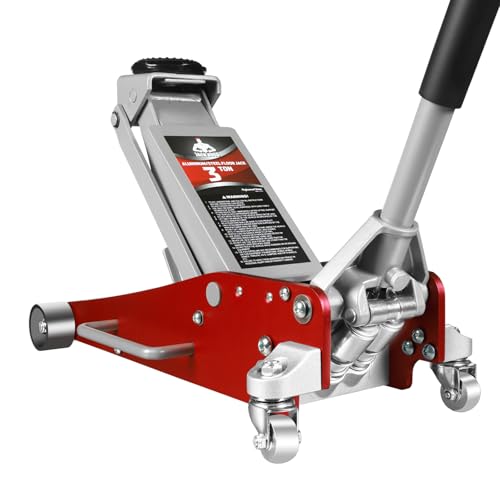
Jack Boss 3-Ton Low Profile Floor Jack
Built with a hybrid aluminum and steel frame, this 3-ton floor jack pairs a low 3-15/16-inch minimum clearance with a dual-piston rapid pump. It serves as a versatile lifting solution for low-slung sedans as well as standard SUVs and minivans.
Pros
- Low-profile 3-15/16-inch minimum lifting clearance
- Fast elevation with dual-piston hydraulic pump
- Hybrid aluminum and steel frame construction
- Protective rubber saddle shields vehicle chassis
- Meets rigorous ANSI/ASME PASE safety standards
Cons
- At 58.5 pounds, it remains relatively heavy to transport
- 18-5/16-inch max height may be limiting for lifted trucks
Jack Boss 1.5-Ton Hydraulic Floor Jack
Designed for sedan owners, this Jack Boss hydraulic jack offers a lifting range of 5.1 to 12.6 inches in a portable 16.6-pound frame. Its welded steel build and included hard storage case make it well-suited for trunk storage and quick tire changes.
Pros
- Lightweight design at under 17 pounds
- Hard blow-mold case included for storage
- Built-in overload safety valve
- Smooth positioning via 360-degree swivel casters
Cons
- Maximum 12.6-inch lift height is relatively low
- Capacity limited to sedans and lighter cars
- Minimum 5.1-inch height cannot accommodate ultra-low vehicles
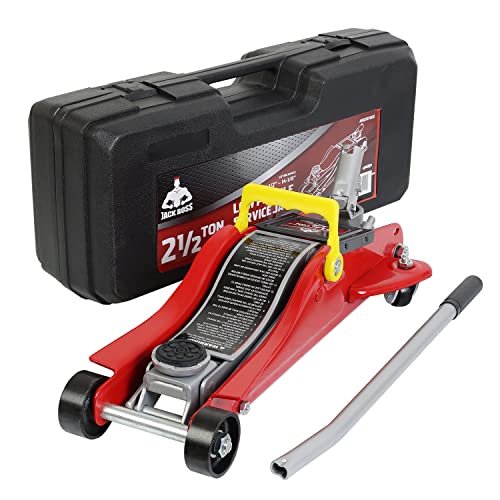
Jack Boss 2.5-Ton Low Profile Floor Jack
Designed for home garages, this compact hydraulic trolley jack slides easily under low-clearance sedans with its 3.5-inch minimum height. Its 5,500-pound capacity and bundled carrying case make routine tire changes and undercarriage maintenance straightforward to manage and store.
Pros
- Low 3.5-inch minimum height fits low-clearance vehicles
- Includes hard-shell case for organized storage
- Four 360-degree swivel casters allow easy positioning
- Integrated overload valve enhances operating safety
- Padded handle protects vehicle bodywork from damage
Cons
- 14-inch maximum lift height limits high-clearance vehicle use
- Weighs over 35 pounds, making transport somewhat heavy
The Mechanics Behind Short Handle Lowering Control and Hydraulic Valve Sensitivity
A hydraulic floor jack relies on precise fluid containment to keep heavy vehicles elevated safely during maintenance. When you open the release valve using a short handle, the rapid drop of the lift arm often catches users off guard. This sudden loss of control stems from mechanical leverage limitations, hydraulic valve geometry, and extreme pressure differentials inside the fluid chamber. Diagnosing this operational hurdle requires looking closely at how small rotational inputs translate into rapid fluid displacement.
Rotational Leverage and Arc Length Discrepancies
The primary reason a short handle fails to deliver controlled lowering comes down to fundamental physics and rotational arc length. A full-length service jack handle measuring over forty inches creates a broad sweeping circumference during rotation. This substantial distance allows your hand to move several inches along the arc while turning the internal release valve only a fraction of a single degree. In contrast, a stubby or compact handle offers a tight turning radius that amplifies every slight movement of your wrist.
Human hands naturally struggle to execute micro-metered rotations of one or two degrees without physical resistance or mechanical damping. When gripping a short tubular handle, typical muscular tremor or uneven grip pressure easily turns the shaft five to ten degrees in a split second. Because hydraulic release valves do not open linearly, that slight involuntary twist moves the valve needle from fully seated to wide open. The absence of long-lever damping strips away the fine motor control necessary for a gentle vehicle descent.
Torque calculations illustrate why handle length fundamentally changes the physical feedback you feel while operating the valve. Shorter levers reduce the distance between the applied hand force and the central axis of rotation. This geometry demands higher tactile sensitivity from the operator, meaning small mistakes produce instant mechanical consequences. Without the forgiving leverage of an extended bar, the user cannot smoothly counteract the sudden release of spring-loaded needle resistance.
Needle Valve Design and High-Pressure Fluid Dynamics
Inside the base of a hydraulic trolley jack, lowering speed is regulated by a tapered metal needle resting against a machined bypass seat. When the lift arm supports vehicle weight, internal hydraulic pressure builds to thousands of pounds per square inch behind that valve seat. Turning the handle unthreads the needle, pulling its tapered tip backward away from the fluid return orifice. Even a minute retraction creates an immediate gap that allows pressurized oil to escape back into the surrounding fluid reservoir.
The rate of hydraulic fluid discharge accelerates rapidly once the needle breaks contact with its tapered seat. High fluid pressure drives oil through tiny openings with surprising velocity, causing the main lifting ram to retract instantaneously. Because fluid flow increases exponentially rather than smoothly with each thousandth of an inch of needle travel, the valve exhibits an on-or-off behavior. A short handle gives you virtually zero mechanical buffer to find the sweet spot between full seal and unconstrained hydraulic bypass.
Universal Joint Gear Drives Versus Direct Pin Couplings
The internal mechanical linkage connecting your handle to the release valve dictates how smoothly torque transfers to the needle. Professional-grade shop jacks often incorporate a geared universal joint assembly that decouples the handle angle from the valve stem. These gear drives introduce subtle mechanical resistance and stable indexing that prevent the handle from spinning freely under pressure. The geared interface helps smooth out jerky wrist motions, translating coarse physical movement into controlled needle rotation.
Many lightweight, compact, and budget-friendly trolley jacks rely instead on a direct notched pin or slotted drive system. In these setups, the end of the short handle slides directly over the valve stem or mates via a cross-pin with noticeable mechanical slop. When you begin to turn the handle counterclockwise, the linkage takes up slack before suddenly catching the valve stem threads. This sudden engagement causes the needle to break loose with a sharp jerk, instantly opening the bypass passage and dropping the chassis.
Vehicle Weight Distribution and Pressure on Valve Seats
The physical weight of the elevated automobile substantially intensifies lowering sensitivity. When raising the front or rear axle of a passenger vehicle, a service jack carries roughly fifty to sixty percent of total curb weight. This immense mechanical load transfers directly into the hydraulic ram cylinder, transforming the hydraulic fluid into an extremely dense energy reservoir. Heavier vehicle corners place greater load against the tapered face of the release needle, increasing breakout friction.
High breakout friction means the user must apply noticeable rotational force just to break the valve needle free from its closed position. Once static friction breaks into kinetic sliding friction, the short handle spins much further than intended because there is little counter-resistance. With a full-length handle, your hands can easily absorb that initial snap through broad leverage. With a short handle, your grip lacks the leverage needed to halt rotational inertia immediately, resulting in an abrupt descent.
Aerated Hydraulic Fluid and Spongy Piston Cycling
Trapped air inside the hydraulic circuit represents another frequent contributor to uncontrollable lowering behavior. Air is naturally compressible, whereas dedicated hydraulic oil maintains rigid volumetric stability under heavy loads. If micro-bubbles become entrained in the fluid chamber during transport or after low oil levels, the hydraulic column behaves like an erratic sponge. As you begin to elevate or lower the vehicle, this compressed air creates unpredictable pressure spikes and drops across internal passages.
When cracking open the release valve on an aerated system, trapped air expands violently the moment backpressure drops. This sudden expansion blows hydraulic oil past the return check balls, causing the lifting arm to drop in rapid, jerky stages rather than a predictable slide. Purging trapped air through the rubber oil fill plug regularly restores solid fluid columns and improves metering predictability. Keeping hydraulic fluid clean and topped with anti-foaming ISO VG 22 or 32 jack oil ensures valve needles operate within stable fluid dynamics.
Comparing Jack Boss Floor Jack Designs and Handle Mechanisms
Lifting equipment designs vary widely across working load ratings and intended mobility requirements. Units like the Jack Boss Floor Jack 1.5 Ton (3,000 LBs) and Jack Boss Floor Jack 2.5 Ton (5500 LBs) feature compact frames and shorter operating handles tailored for portability in included storage cases. These portable trolley jacks provide practical utility for quick tire changes and compact automotive garages, but their shorter handles require deliberate two-handed finesse during release. Their compact geometries naturally trade away the feather-touch lowering modulation found on massive garage equipment.
Conversely, larger units such as the Jack Boss 3 Ton Floor Jack and the hybrid Jack Boss 3 Ton Low Profile feature extended multi-piece handles paired with rapid-lift dual pump mechanisms. The dual-piston architecture accelerates initial chassis contact, while the extended handle length gives technicians generous leverage during both pumping and release operations. The broader rotational radius on these three-ton service jacks minimizes twitchy valve movements. This structural difference highlights why service jacks with long handles offer superior lowering control compared to portable utility jacks.
Weight and structural materials also influence how stable a floor jack remains while you manipulate the release handle. Welded steel chassis provide heavy ground-hugging mass that prevents the frame from shifting while twisting a tight valve. Aluminum hybrid jacks blend strong steel lifting arms with lighter side plates for easier shop transport without sacrificing base rigidity. Selecting the proper frame size and handle configuration ensures your equipment matches your personal comfort with release modulation.
Safe Physical Techniques for Lowering with Short Handles
If you must operate a floor jack equipped with a short handle, adopting disciplined hand positioning can restore controlled operation. Never attempt to turn a short release valve handle using a single hand at the very tip. Grasping the base of the handle close to the pivot pin with one hand while using your other hand to apply counter-torque creates a stabilizing friction clamp. This opposing two-handed grip prevents the handle from snapping open the moment valve threads break free from static resistance.
Make minute rotational adjustments by nudging the handle in fractions of a millimeter rather than a continuous twisting motion. Listen for the initial hiss of fluid passing through the bypass orifice before allowing further rotation. If the vehicle begins descending rapidly, instantly reverse direction by twisting the handle clockwise to arrest downward travel. Practicing this controlled release technique with no vehicle load or on lightweight test objects helps you master the valve’s exact friction threshold.
Critical Support Procedures and Garage Safety Realities
Regardless of handle length or valve sensitivity, hydraulic jacks are engineered exclusively as lifting devices and never as static load-bearing supports. Internal hydraulic pressure depends on flexible rubber O-rings, check balls, and machined seats that can fail without warning. You must never place any part of your body underneath an elevated car supported only by a hydraulic cylinder. Always position mechanical jack stands underneath reinforced factory lift points before conducting inspections, brake jobs, or oil changes.
While some mechanics evaluate stopping lifting ramps from sliding as an alternative drive-on elevation method, standard floor jacks require rigid stability on smooth, level concrete surfaces. Before turning any release valve, ensure opposing wheels on the ground are securely chocked in both directions to prevent rolling accidents. Carefully lower the chassis onto your mechanical stands until the stands bear the entire vehicle weight. Leave the jack saddle raised lightly against the lift point as a redundant safety measure without carrying dynamic load.
Inspecting the structural integrity of your support stands before each lift is just as vital as checking your jack. Check for positive locking pawl engagement and verify that the stand capacity exceeds your vehicle axle requirements. Equipment designed under ASME PASE standards includes factory overload margins and wide-base footprints to resist tipping. Relying on mechanical steel stands completely eliminates the danger of abrupt hydraulic lowering during underbody maintenance.
Lift Height Clearance and Vehicle Suspension Travel
Lowering problems frequently become noticeable when lifting vehicles with significant suspension travel or limited rocker clearance. Understanding how your equipment interacts with vehicle geometry is just as essential as measuring proper garage lift heights for safe underbody clearance. When raising a tall crossover or sport utility vehicle, the jack arm must extend high enough to overcome suspension droop before the tires leave the floor. Lowering that extended stroke creates substantial initial downward velocity if the release valve opens too far.
Conversely, sports cars with low-profile ground effects require ultra-low collapsed saddle heights around three inches to clear pinch welds cleanly. If a short handle drops a low-clearance vehicle abruptly, the rocker panels or aerodynamic splitters can strike the jack frame or concrete floor. Maintaining micro-metered valve control protects fragile body trim, oil pans, and pinch weld flanges from severe impact damage. Matching jack stroke capabilities and handle length to your specific chassis clearance prevents costly underbody collisions.
Recognizing Worn Valve Seals and When to Upgrade
Not every erratic lowering issue originates strictly from handle length or user technique. Over years of service, metal particles, road grit, or degraded fluid can score the tapered tip of the release valve needle. A scored needle or damaged brass valve seat loses its gradual metering taper, causing fluid to rush past jagged crevices unevenly. If your floor jack drops abruptly even when turning the valve with extreme caution, internal seat erosion or broken detent springs may be responsible.
Inspect the valve stem assembly for fluid weeping, damaged threads, or excessive side-to-side wobble inside the hydraulic block. Replenishing old fluid with fresh anti-wear hydraulic jack oil and reseating check balls can restore smooth operation in salvageable units. However, if you regularly work on heavier trucks, SUVs, or lowered sedans, upgrading to a full-size floor jack with a long two-piece handle and universal joint gearing provides permanent relief. Investing in proper leverage ensures every lowering cycle remains calm, predictable, and fundamentally secure.
About the author
Christian Hazel is an automotive journalist with extensive experience covering four-wheel-drive vehicles, mechanical upgrades, and off-road equipment. His background includes technical reviews, installation features, and project-vehicle coverage, bringing useful context to equipment choices for trucks, Jeeps, and off-road enthusiasts.