
Floor Jack vs Bottle Jack Which One Do You Actually Need: Garage Lifting Guide for 2026
Floor jack vs bottle jack which one do you actually need for your vehicle? Compare lifting heights, tonnage, and safety in this November 2026 guide.
 By Mike Bumbeck
Updated October 28, 2026


Crawling around on a cold concrete floor trying to wedge a tall hydraulic cylinder beneath a cramped rocker panel will test anyone’s patience. Low-clearance sports cars demand a low minimum saddle height, while lifted 4×4 trucks need massive stroke reach to get tires off the ground. Deciding between a floor jack vs bottle jack which one do you actually need comes down to your vehicle stance, garage floor surface, and required lifting tonnage. Hydraulic trolley units roll effortlessly on smooth casters and slip right under tight pinch welds, but it is not easy to stash their long steel chassis inside a compact car trunk. In contrast, compact bottle jacks pack immense vertical muscle into an upright footprint that stashes easily behind a pickup bench seat.
Safety remains the golden rule in any driveway workshop, no matter which hydraulic lifter you keep on hand. Hydraulic seals hold dynamic pressure to raise a corner, but they should never bear static weight while you wrench underneath. Pairing your jack with heavy-duty mechanical stands keeps you safe, which is why debating whether are car ramps better than jack stands is a staple garage conversation before tackling suspension work. Evaluating published load ratings, collapsed profile clearances, and user feedback helps clarify whether a fast dual-piston service trolley or a rugged multi-ton vertical ram belongs in your maintenance arsenal.
| Award | Product | BJL Score About BJL ScoreThe BJL Score is our own rating from 0 to 10, based on performance, design and build, ease of use, and value. It reflects independent research and is never influenced by manufacturers, retailers, or affiliate commissions. Learn more › | |
|---|---|---|---|
| Best Overall |
Jack Boss 10-Ton Hydraulic Bottle Jack
|
9.1/10 | Buy |
| Best Budget |
 Jack Boss 3 Ton Fast Lift Steel Hydraulic Floor |
9.1/10 | Buy |
| Best Premium |
 Safe Jack 6-Ton Bottle Jack Recovery Kit |
8.9/10 | Buy |
| Best Value |
 Jack Boss 3-Ton Low Profile Floor Jack |
8.8/10 | Buy |
 Jack Boss 4-Ton Low Profile Hydraulic Jack |
8.4/10 | Buy | |
 Jack Boss 10 Ton Low Profile Welded Bottle Jack |
8.0/10 | Buy | |
 US Jack 20-Ton Standard Bottle Jack |
7.8/10 | Buy |
Jack Boss 10-Ton Hydraulic Bottle Jack
Delivering a 10-ton (20,000-lb) lifting capacity with an 8-13/16-inch collapsed height and a 17-5/8-inch maximum reach, this Jack Boss hydraulic bottle jack utilizes a welded drop-forged alloy steel cylinder to minimize fluid leakage. It serves as a dependable manual lifting ram for truck axle maintenance, trailer support, and structural sill leveling when paired with rated jack stands.
Pros
- Welded drop-forged alloy steel body resists oil weeping during vehicle transport
- 10-ton (20,000 lb) capacity easily handles corner weights on light trucks, SUVs, and farm trailers
- Adjustable top extension screw allows rapid mechanical height adjustment prior to pumping
- Built-in oil bypass and overload protection protect the hydraulic cylinder from over-extension
- Lightweight 10.36-lb frame is easy to reposition and store in truck boxes
Cons
- Minimum collapsed height of 8-13/16 inches may not slide under dropped solid axles with completely flat tires
- Manual hydraulic pumping requires physical effort and may feel slow when lifting near the 10-ton capacity threshold
- No integrated carrying handle, though the 10.36-lb dry weight keeps it reasonably portable
Jack Boss 3 Ton Fast Lift Steel Hydraulic Floor
The Jack Boss 3-ton fast lift hydraulic service jack delivers a 6,600-pound capacity with a working range of 5.15 to 18.3 inches. Built with heavy-duty steel and a precise universal joint release valve, it provides dependable lifting for garage maintenance, trucks, and SUVs.
Pros
- Robust 3-ton (6,600 lb) working load limit suitable for cars, SUVs, and light trucks
- Versatile 5.15-inch to 18.3-inch lifting range provides ample reach for brake and suspension service
- Universal joint release mechanism allows smooth, gradual descent control
- 360-degree rear swivel casters and rigid steel front wheels allow easy positioning under vehicle lift points
- Certified to meet ANSI/ASME PASE safety standards
Cons
- 5.15-inch collapsed height may not clear ultra-low ground clearance or lowered sports cars
- Heavier steel chassis footprint is best suited for garage floors rather than compact roadside storage
- Requires a smooth, firm concrete surface to roll and position safely without sinking
Safe Jack 6-Ton Bottle Jack Recovery Kit
Engineered for high-clearance vehicle recovery, this kit expands lift height from 8 to 36 inches using modular extensions. It suits off-road and utility vehicle owners who require adaptable, stable contact points along axles or frames.
Pros
- Broad 8 to 36 inch lift range
- Interchangeable extensions and pad attachments
- Allows direct lifting on axles or frames
- Extensions and pads made in the USA
Cons
- Total weight of 24 pounds adds recovery bulk
- Working load capped at 6 tons
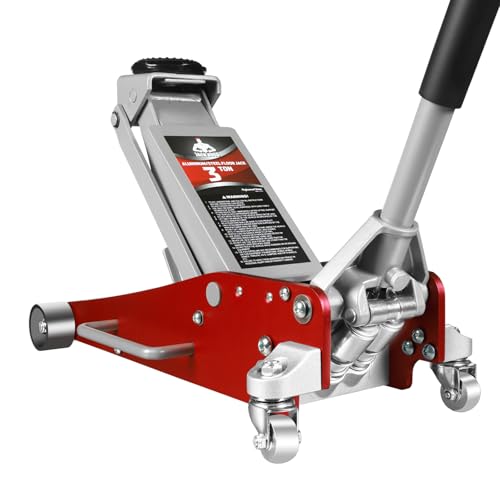
Jack Boss 3-Ton Low Profile Floor Jack
Built with a hybrid aluminum and steel frame, this 3-ton floor jack pairs a low 3-15/16-inch minimum clearance with a dual-piston rapid pump. It serves as a versatile lifting solution for low-slung sedans as well as standard SUVs and minivans.
Pros
- Low-profile 3-15/16-inch minimum lifting clearance
- Fast elevation with dual-piston hydraulic pump
- Hybrid aluminum and steel frame construction
- Protective rubber saddle shields vehicle chassis
- Meets rigorous ANSI/ASME PASE safety standards
Cons
- At 58.5 pounds, it remains relatively heavy to transport
- 18-5/16-inch max height may be limiting for lifted trucks
Jack Boss 4-Ton Low Profile Hydraulic Jack
Delivering an 8,800-pound rated lifting capacity with a 3.9-inch to 20-inch working range, the Jack Boss 4-Ton Low-Profile Hydraulic Jack utilizes a dual-piston pump to raise vehicles quickly. Its low starting clearance and wide stance make it well-suited for servicing passenger cars, SUVs, and light-duty pickup trucks in garage environments.
Pros
- Low 3.9-inch starting height easily slips beneath low vehicle lift points and dropped suspension perches
- Substantial 4-ton (8,800 lbs) rated capacity provides ample lifting strength for light trucks, SUVs, and passenger cars
- Dual-piston hydraulic pump speeds up unloaded lift reach compared to standard single-piston setups
- Wide stance and substantial frame deliver solid stability on smooth, level concrete garage floors
- Broad lifting range up to 20 inches helps clear extended suspension droop when changing tires
Cons
- Substantial dry weight of roughly 100 pounds makes mobile transport and roadside emergency carrying impractical
- Large 28-inch chassis footprint requires significant dedicated storage space in home garages or service bays
- Heavy frame is best suited for smooth concrete surfaces and may be difficult to maneuver on dirt or loose gravel
Jack Boss 10 Ton Low Profile Welded Bottle Jack
Delivering a 10-ton (20,000 lb) lifting capacity with an ultra-low 4.92-inch starting height, this Jack Boss double-ram bottle jack extends to 8.46 inches to clear tight axle spaces. Built with an all-welded leak-resistant body and all-weather hydraulic oil rated from -13 °F to 140 °F, it provides dependable vertical lifting power for low-clearance trucks, trailers, and machinery.
Pros
- Ultra-low 4.92-inch collapsed height fits into tight clearance gaps where standard-height bottle jacks cannot enter
- Double-ram telescoping cylinder provides 3.54 inches of vertical travel despite the stubby body height
- Fully welded body construction helps resist fluid weeping when carried in work trucks and toolboxes
- Pre-filled with hydraulic fluid engineered to operate reliably in sub-freezing weather down to -13 °F
Cons
- Maximum extended reach of 8.46 inches may require auxiliary cribbing blocks when lifting vehicles with tall suspension droop
- Manual pumping requires sufficient lever swing clearance alongside low-slung trailers or dropped vehicle chassis
- Compact base footprint requires placement on flat, rigid ground or a solid support plate to prevent settling into soft surfaces
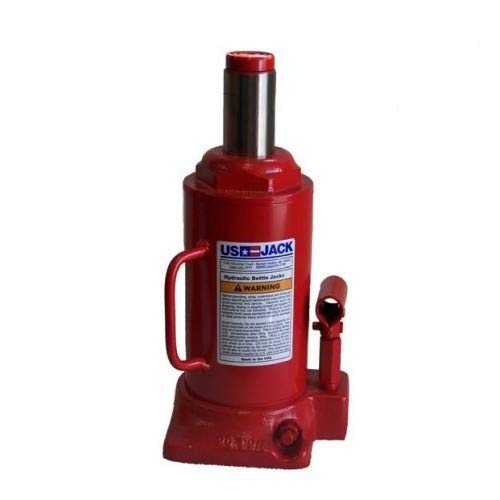
US Jack 20-Ton Standard Bottle Jack
Designed for heavy lifting, this US Jack bottle jack delivers a 20-ton capacity with an American-made build. Its substantial 37-pound frame provides dependable stability for demanding mechanical and shop tasks.
Pros
- High 20-ton capacity handles heavy machinery
- Manufactured in the USA
- Substantial weight ensures a stable base
- Compact footprint fits tight workspaces
Cons
- Heavier weight at 37 pounds to carry
- Tall 17.5-inch profile requires ample clearance
Frequently Asked Questions
Can a bottle jack fit under a lowered car?
No, standard bottle jacks generally cannot slide beneath low-profile passenger cars or sports cars. Most upright hydraulic cylinders feature a collapsed minimum saddle height of roughly 8 to 9 inches, which far exceeds the clearance of a lowered rocker panel or pinch weld. A low-profile trolley jack, such as models clearing under 4 inches, or learning how to make low profile car ramps provides the required clearance to access factory lifting points without scraping bodywork. Double-ram specialty bottle jacks can sit lower around 5 inches, but dedicated service jacks remain far superior for low-clearance vehicles.
Why do floor jacks offer better stability on residential garage floors?
Floor jacks provide superior stability because their wide horizontal steel chassis and four-point wheel base distribute weight across a broader surface area. As a vehicle ascends, the lifting arm travels in an arc, requiring the jack to roll slightly on its steel casters to stay centered beneath the lifting pad. Upright bottle jacks rest on a small, rigid baseplate that cannot roll, creating a tipping risk if the load shifts even slightly off-axis. Using a trolley jack on flat concrete prevents severe side-loading forces that could cause an unstable vertical cylinder to slip.
How does lifting capacity compare when evaluating Floor Jack Vs Bottle Jack Which One Do You Actually Need?
Bottle jacks deliver significantly higher weight ratings per dollar and per pound of tool weight than comparable floor jacks. A compact 10-ton or 20-ton hydraulic cylinder easily hoists commercial equipment, heavy solid axles, and house beams while weighing under 25 pounds. In contrast, a 3-ton or 4-ton trolley jack provides ample capacity for passenger trucks and SUVs, but the unit itself often weighs between 70 and 85 pounds. When weighing Floor Jack Vs Bottle Jack Which One Do You Actually Need in 2026, assess whether you need pure brute vertical tonnage or rolling convenience for lighter axle loads.
How much lift height do you actually need for trucks and SUVs?
You generally need at least 18 to 21 inches of maximum lift stroke to lift full-size truck and SUV tires completely off the pavement. Long-travel truck suspensions droop significantly before the tire breaks contact with the ground, consuming several inches of travel. Understanding how high should car ramps be and measuring your vehicle frame-to-ground distance ensures your lifting tool provides sufficient working stroke. High-reach service jacks or bottle jacks paired with secure axle collar extensions help bridge tall truck clearances safely.
Can you leave a vehicle supported on a hydraulic jack while working?
No, you must never work beneath a vehicle supported only by hydraulic pressure from any jack. Internal rubber O-rings, check balls, and bypass valves can fail suddenly, causing the hydraulic arm or ram to drop without warning. Service jacks and bottle jacks are strictly lifting mechanisms designed to elevate the chassis onto rated mechanical jack stands. Always lower the frame onto solid stands and chock the opposite wheels before unbolting components.
How does pump speed differ between single-piston bottle jacks and dual-piston floor jacks?
Dual-piston floor jacks raise the saddle to the chassis contact point significantly faster than standard bottle jacks. A dual-pump trolley mechanism displaces a higher volume of hydraulic fluid with each stroke of the long handle, often touching the frame in just three to five pumps. Bottle jacks use a shorter operating lever and a smaller internal plunger that requires numerous short, high-effort strokes to achieve similar elevation. While the bottle jack provides tremendous mechanical leverage for heavy loads, the dual-piston trolley jack saves considerable time during routine tire changes.
About the author
Mike Bumbeck is an automotive journalist and hands-on product evaluator with a long-standing interest in classic vehicles, motorcycles, and practical garage equipment. His work brings a grounded perspective to automotive tools, maintenance products, and the details that matter when choosing gear for real-world use.