
How Does a Floor Jack Work Simple Hydraulic Breakdown: Practical Guide for 2026
Understand how does a floor jack work simple hydraulic breakdown to service vehicles safely in November 2026, examining fluid pressure, bypass valves, and jack stand setup.
 By Hank O'Hop
Updated October 28, 2026


Raising a heavy passenger car or light truck requires transforming modest manual effort into thousands of pounds of upward mechanical force. Hydraulic service jacks accomplish this heavy lifting through an incompressible fluid loop governed by fundamental physical laws rather than complex motorized gears. Grasping how does a floor jack work simple hydraulic breakdown reveals why a few steady pumps on an elongated handle can raise a multi-ton frame rail off the ground with minimal physical fatigue. Understanding these internal mechanics also highlights why components like the pump piston, check valves, and internal reservoirs must work in harmony to prevent sudden pressure loss during garage maintenance.
Proper mechanical knowledge directly impacts shop safety, especially when positioning equipment beneath vehicle structural points. When comparing ramps to mechanical jack stands for vehicle support, technicians quickly learn that a hydraulic jack serves exclusively as a lifting tool rather than a sustained resting perch. Modern trolley jacks from brands like TONDA, BIG RED, and VEVOR rely on closed fluid circuits that make routine tire rotations and brake inspections straightforward. Inspecting how these fluid systems generate leverage, regulate descent, and manage dangerous over-pressurization ensures safer garage practices and longer tool longevity.
| Award | Product | BJL Score About BJL ScoreThe BJL Score is our own rating from 0 to 10, based on performance, design and build, ease of use, and value. It reflects independent research and is never influenced by manufacturers, retailers, or affiliate commissions. Learn more › | |
|---|---|---|---|
| Best Overall |
TONDA 1.5-Ton Hydraulic Floor Jack
|
9.1/10 | Buy |
| Best Budget |
 VEVOR 2-Ton Low Profile Floor Jack |
8.8/10 | Buy |
 DNA Motoring TOOLS-00234 2-Ton Hydraulic Trolley |
8.8/10 | Buy | |
| Best Premium |
 AUTOWN 3-Ton Hydraulic Floor Jack |
8.6/10 | Buy |
| Best Value |
 BIG RED T83006 3-Ton Floor Jack |
8.3/10 | Buy |
 AV Steel 4 Ton Heavy-Duty Hydraulic Floor Jack |
8.3/10 | Buy | |
 LARBANKE 2.5-Ton Low Profile Floor Jack |
8.1/10 | Buy | |
 AV Steel 3-Ton Hydraulic Floor Jack |
7.8/10 | Buy |
TONDA 1.5-Ton Hydraulic Floor Jack
Weighing under 15 pounds, this compact steel floor jack offers a 3,000-pound capacity for basic garage maintenance and tire rotations. Its 4.9-inch to 11.8-inch lift range and integrated carry handle make it a practical option for owners of compact cars and sedans.
Pros
- Lightweight construction at roughly 15 pounds
- Integrated carry handle for convenient transport
- Built-in bypass valve prevents accidental over-extension
- Swivel casters provide smooth positioning under vehicles
Cons
- Limited 11.8-inch maximum lift height
- 1.5-ton capacity unsuitable for trucks or SUVs
- 4.9-inch minimum clearance cannot fit ultra-low vehicles
VEVOR 2-Ton Low Profile Floor Jack
Built with a durable welded iron frame, this compact 2-ton hydraulic jack offers a 4.9-inch minimum clearance that easily slides under low-profile sedans and sports cars. Weighing under 19 pounds with an integrated top handle, it provides solid portability for routine garage maintenance.
Pros
- Low 4.9-inch entry height fits sports cars and sedans
- Rigid welded iron frame minimizes flexing under load
- Portable 18.85-pound weight with a built-in carry handle
- Rotating saddle protects vehicle chassis support points
- Overload safety release valve prevents hydraulic failure
Cons
- Maximum 13.2-inch lift height is restrictive for taller vehicles
- Single-piston pump requires more strokes than dual-piston designs
- 2-ton capacity is unsuitable for heavy full-size trucks
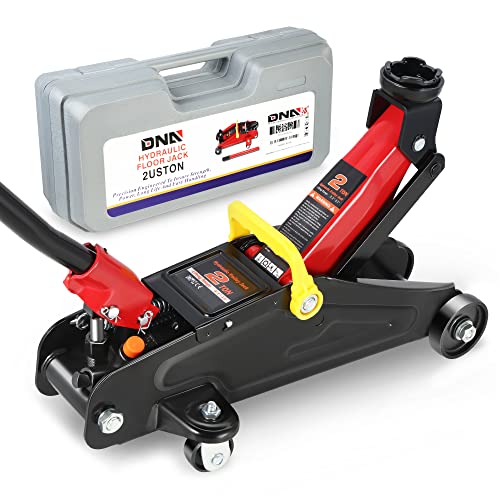
DNA Motoring TOOLS-00234 2-Ton Hydraulic Trolley
The DNA Motoring TOOLS-00234 is a compact 2-ton (4,000 lb) hydraulic trolley floor jack featuring a 5.1-inch to 13-inch lifting span and built-in overload protection. Engineered for DIY mechanics servicing passenger sedans and compact cars, it provides rapid vehicle lifting that must be supported with auxiliary mechanical jack stands.
Pros
- Manageable 4,000 lb capacity easily raises compact and mid-size passenger cars for wheel and brake service
- Built-in hydraulic overload valve prevents internal damage if overloaded beyond the rated capacity
- Rear swivel casters allow quick and precise positioning under factory lift points
- Compact frame footprint fits easily in residential garages with restricted floor space
Cons
- Maximum lift height is capped at 13 inches, limiting workspace depth for heavy underbody repairs
- Minimum 5.1-inch collapsed saddle height may not clear heavily lowered or track-tuned sports cars
- Not rated or recommended for full-size pickup trucks, commercial vans, or large three-row SUVs
AUTOWN 3-Ton Hydraulic Floor Jack
Built with heavy-gauge alloy steel, this 3-ton jack delivers a high 7.1 to 20.9-inch reach tailored for trucks and SUVs. Its rapid-lift hydraulic system and cross-grooved rubber pad provide stable, efficient lifting during maintenance.
Pros
- Substantial 6,600-pound capacity supports full-size vehicles
- Generous 20.9-inch maximum elevation height
- Fast elevation with minimal handle pumping
- Textured rubber saddle pad prevents frame slipping
- Removable handle allows compact garage storage
Cons
- High 7.1-inch minimum height does not fit low-clearance sedans
- Heavy alloy steel construction makes transport cumbersome
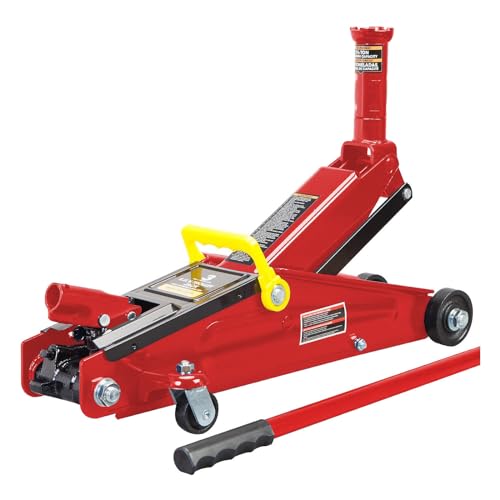
BIG RED T83006 3-Ton Floor Jack
Engineered for high-riding trucks and SUVs, the BIG RED T83006 delivers up to 20-7/8 inches of lift height with an extended saddle neck. Its 6,000-pound capacity and integrated overload bypass provide reliable lifting power for routine garage maintenance.
Pros
- Generous 20-7/8 inch maximum lift height
- Extended saddle neck reaches high truck frames quickly
- Built-in safety bypass valve prevents overloading
- Smooth 360-degree swivel casters ease garage positioning
Cons
- Minimum 5-7/8 inch height is tall for low-profile cars
- Single-piston pump requires more strokes than dual-piston models
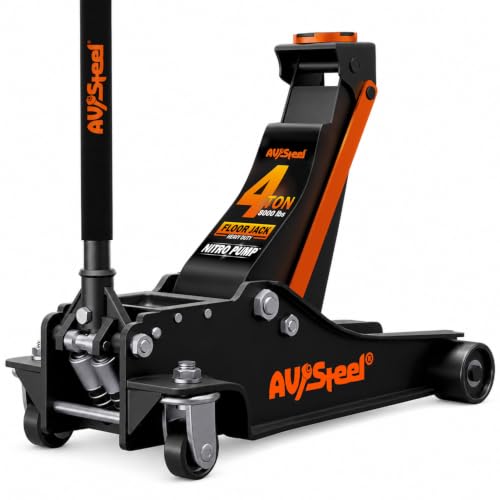
AV Steel 4 Ton Heavy-Duty Hydraulic Floor Jack
The AV Steel 4-ton hydraulic floor jack provides 8,000 lbs of lifting capacity and a 4-1/4-inch to 19-3/4-inch vertical range powered by a rapid dual-piston pump. Built with a rigid 87.3-pound all-steel chassis, it offers home garage mechanics and truck owners dependable lifting strength for standard passenger cars, crossovers, and half-ton pickups.
Pros
- Substantial 4-ton (8,000-lb) capacity easily handles heavy front and rear axle loads on half-ton pickups, large SUVs, and vans.
- Dual-piston rapid pump quickly raises the saddle to chassis contact points with minimal handle pumping strokes.
- Rigid 87.3-pound all-steel frame delivers superior stationary stability on home garage floors.
- Built-in overload protection valve guards the hydraulic cylinder against accidental over-capacity operation.
Cons
- Substantial 87.3-pound gross chassis weight makes vehicle trunk transport or mobile hauling physically demanding.
- Collapsed saddle height of 4-1/4 inches will not clear low-slung sports cars or lowered vehicles without drive-on ramps.
- Maximum lift height of 19-3/4 inches is not designed for lifted 4x4 trucks or long-travel off-road suspensions.
LARBANKE 2.5-Ton Low Profile Floor Jack
Built with a low 3.35-inch minimum clearance and a 2.5-ton capacity, this carbon steel jack suits DIY mechanics servicing low-clearance sedans and standard cars. Integrated side reflective strips and a built-in carry handle make it practical for dim garages and mobile repairs.
Pros
- Low clearance fits under lowered passenger cars easily
- Reflective strips improve safety in dim work areas
- Integrated carry handle facilitates transport around the shop
- Automatic overload valve guards against structural damage
Cons
- Single-piston pump lifts slower than dual-piston models
- 15.16-inch maximum lift height is inadequate for tall trucks
AV Steel 3-Ton Hydraulic Floor Jack
Built for standard passenger vehicles and light trucks, this heavy steel floor jack delivers a 6,000-pound capacity with a lift range of 5.5 to 18.5 inches. Its built-in overload protection and 360-degree rotating saddle make it a dependable option for routine garage maintenance.
Pros
- Generous 6,000-pound capacity for cars and SUVs
- Solid 5.5-inch to 18.5-inch lift clearance
- Durable all-steel frame ensures maximum stability
- Integrated overload valve prevents accidental over-lifting
- 360-degree rotating saddle aids quick, secure positioning
Cons
- Heavy 63.9-pound weight reduces overall portability
- Single-piston pump requires more strokes to reach height
- Unsuitable for lifted vehicles and heavy-duty trucks
Understanding Floor Jack Hydraulics and Mechanical Operation
A hydraulic service jack converts simple manual leverage into massive lifting force through a self-contained, closed-loop fluid circuit. Rather than depending on mechanical screw threads or geared teeth, these tools harness fluid displacement to elevate automotive chassis with exceptional precision. Understanding how each valve, piston, and passage operates inside the chassis enables home mechanics to lift vehicles safely and troubleshoot pressure issues before lifting a car. Every stroke of the handle represents a carefully timed sequence of fluid movement that multiplies human power into multi-ton lifting capacity.
The Core Physics: Pascal’s Principle and Mechanical Advantage
Hydraulic lifting equipment operates according to Pascal’s principle, which states that pressure applied to a confined fluid transmits equally in all directions throughout that fluid. In a standard trolley jack, mechanical force begins at the handle, which acts as a class-one or class-two lever providing initial mechanical advantage. When the operator pumps downward, this mechanical leverage drives a small-diameter pump piston into a specialized hydraulic chamber. Because hydraulic oil resists compression under normal operating pressures, that applied force generates immediate fluid pressure within the sealed circuit.
The real power multiplication occurs because of the dramatic surface area difference between the small pump piston and the much larger main lifting ram. Pressure is defined as force divided by surface area, meaning the fluid pressure created by the small piston acts uniformly against the broader face of the lifting cylinder. If the lifting ram possesses twenty times the surface area of the pump plunger, the output force produced on the vehicle lift arm multiplies twentyfold. This fluid-based mechanical multiplication allows a user applying fifty pounds of downward effort on the handle to effortlessly elevate thousands of pounds of vehicle curb weight.
Internal Anatomy: Reservoirs, Pump Pistons, and Main Lift Cylinders
The interior of a service jack features three primary fluid chambers arranged within a heavy-gauge steel or cast-iron frame. Surrounding the primary lifting cylinder is an outer reservoir jacket that stores the bulk of the unpressurized hydraulic oil when the jack rests fully collapsed. Positioned at the base of the handle assembly sits the small-diameter pump piston, fitted with durable nitrile O-rings or polyurethane U-cups that prevent fluid blow-by. Heavy-duty units, such as those manufactured with thick steel side plates like the AV Steel 4 Ton or AUTOWN 3 Ton models, rely on precision-honed cylinder walls to ensure leak-free operation under severe loads.
The central lifting cylinder houses the polished steel ram, which connects directly to the pivoting lift arm and saddle pad. When pressurized oil enters the base of this main cylinder, it forces the ram outward, driving the lift arm upward along an engineered arc. Sturdy return springs anchored between the frame and the lift arm provide the mechanical tension necessary to pull the ram back once fluid pressure releases. Keeping these internal chambers tightly sealed against contamination is essential, as even microscopic metal shavings or grit can score cylinder walls and compromise hydraulic integrity.
The Hydraulic Flow Cycle: One-Way Ball Check Valves in Action
Directing the directional flow of hydraulic fluid between the reservoir, pump chamber, and main ram requires a dual check-valve network. When the operator raises the pump handle, the small piston retracts upward inside its bore, creating a low-pressure vacuum inside the pump chamber. This suction lifts a steel inlet check ball off its machined seat, drawing clean hydraulic oil from the surrounding reservoir into the pump cylinder. At the exact same moment, the high pressure within the main lift cylinder presses a second delivery check ball firmly against its seat, preventing the elevated vehicle from dropping.
Pushing the handle downward reverses the fluid dynamics within the valve block. The descending pump plunger pressurizes the oil, forcing the inlet ball check tightly back onto its seat to block fluid from returning to the low-pressure reservoir. With nowhere else to go, the pressurized oil forces open the high-pressure delivery check ball and streams directly into the base of the main lifting ram cylinder. Repeating this alternating suction and delivery cycle continually pumps oil beneath the main ram, steadily driving the lifting saddle higher with every stroke.
Pump Mechanism Variations: Single-Piston Versus Dual-Piston Rapid Pumps
Hydraulic service jacks utilize either single-piston or dual-piston pump configurations to transfer fluid into the primary ram cylinder. Single-piston systems, commonly found on compact service tools like the TONDA 1.5 Ton, DNA Motoring 2 Ton, or VEVOR 2 Ton jacks, rely on a single plunger to handle both chassis contact and vehicle elevation. These systems provide steady, predictable lifting cycles but typically require more handle strokes to extend the saddle from its collapsed resting position up to the vehicle’s frame. For routine light-duty tasks, a single-piston pump provides dependable mechanical simplicity with fewer internal moving parts to maintain.
Dual-piston rapid-pump designs, such as the system integrated into the AV Steel 4 Ton floor jack, feature two distinct pump plungers operating side by side. During unloaded strokes, both pistons displace a generous volume of hydraulic fluid simultaneously, rapidly elevating the saddle to meet the frame rail in just a few handle pumps. Once the saddle contacts the vehicle and fluid pressure spikes, the hydraulic system automatically balances the load distribution, allowing smooth elevation without requiring excessive physical exertion. Professional mechanics and busy home hobbyists often prefer dual-piston designs because they significantly reduce setup time and handle pumping fatigue.
Controlled Descent Dynamics: Universal Joint Release Valves and Return Circuits
Lowering an elevated vehicle safely requires controlled modulation of internal hydraulic fluid back into the low-pressure storage reservoir. The release valve mechanism consists of a precision-tapered steel needle seated against a fluid return passage at the base of the hydraulic manifold. When the operator twists the handle counterclockwise, the mechanical linkage unscrews the needle valve slightly, opening a calibrated bypass route between the main cylinder and the reservoir. The tremendous static weight of the vehicle then drives the primary ram backward into its bore, expelling pressurized fluid back into the reservoir jacket.
Premium floor jacks utilize a universal joint or pinned gear drive at the base of the handle to provide micro-metered release control. This mechanical joint allows operators to open the release valve smoothly even when the handle sits angled at forty-five or ninety degrees relative to the shop floor. Cracking the valve open only a fraction of a turn ensures a slow, progressive descent that protects body panels, suspension bushings, and workshop equipment from sudden impact shock. Heavy external tension springs pull the lift arm completely flat once vehicle contact ceases, returning the saddle to its lowest collapsed clearance height.
Built-In Safety Systems: Overload Bypass Valves and Ram Travel Limiters
Factory-calibrated overload bypass valves protect hydraulic jacks and operators from the catastrophic dangers of lifting beyond rated working load limits. This critical safety valve features a stiff, factory-preset spring pressing a hardened ball against an internal bypass port inside the high-pressure hydraulic block. If an operator attempts to elevate a commercial truck or heavy equipment that exceeds the jack’s rated tonnage, the excessive fluid pressure overcomes the calibrated spring tension. The bypass valve unseats immediately, routing the pressurized oil directly back to the reservoir without allowing the lifting arm to rise any further.
In addition to overload protection, service jacks incorporate internal mechanical stops to prevent the primary hydraulic ram from overextending beyond its structural cylinder walls. Quality floor jacks from brands like BIG RED, LARBANKE, and VEVOR feature internal bypass ports or heavy retaining rings at the top of the cylinder bore. When the ram reaches its maximum engineered extension height, hydraulic fluid bypasses safely back to the reservoir rather than blowing past seals or bowing the cylinder walls. Operators must never tamper with or tighten the factory-sealed overload relief screw, as doing so disables the tool’s primary protection against structural hydraulic failure.
Fluid Specifications and Degradation: Why Dedicated Hydraulic Jack Oil Matters
Maintaining proper fluid quality is vital for preserving hydraulic pressure and protecting sensitive internal rubber O-rings from premature deterioration. Hydraulic jacks require clean, anti-foaming hydraulic jack oil, typically formulated to ISO VG 22 or ISO VG 32 viscosity standards. This specialized fluid contains anti-wear additives and anti-oxidation inhibitors that protect polished steel cylinder surfaces from rust while resisting foaming during rapid pumping cycles. Foam introduces compressible air bubbles into the fluid mixture, which creates spongy handle resistance and severely limits maximum lifting height.
Technicians must never introduce automotive fluids such as motor oil, automatic transmission fluid, or brake fluid into a hydraulic floor jack. Brake fluid is particularly destructive because its glycol-based chemical formulation rapidly softens, swells, and destroys internal nitrile and polyurethane rubber seals. Motor oil and transmission fluid feature incorrect viscosity profiles and detergent packages that cause sluggish valve response and promote gum formation inside microscopic check-valve ports. When understanding lift height requirements for underbody maintenance, maintaining fresh, uncontaminated hydraulic oil ensures your lifting arm achieves its full rated stroke every single time.
Hydraulic Troubleshooting: Purging Trapped Air and Resolving Cavitation
Air pockets trapped inside the hydraulic fluid circuit represent the most common cause of poor lifting performance, spongy handle pumping, and ram settling. Trapped air often enters the closed circuit during rough shipping, horizontal transit in a service truck, or after extended periods of vertical garage storage. Because air compresses easily while hydraulic oil does not, a cylinder contaminated with air pockets cannot generate sufficient hydraulic pressure to lift heavy vehicles. Operators typically notice this condition when the handle moves freely with zero resistance through the first half of its downward pumping stroke.
Purging trapped air is a straightforward maintenance procedure that restores firm handle resistance without requiring specialized shop tools. First, open the release valve by turning the handle counterclockwise two full turns, keeping the main ram completely retracted. Next, pump the handle rapidly through fifteen to twenty full strokes to force entrained air out of the high-pressure chambers and back into the reservoir. Finally, carefully unseat the rubber oil fill plug on the reservoir body to vent the accumulated air pressure before reseating the plug and closing the release valve tightly.
Structural Clearance and Frame Reach: Matching Jack Profiles to Vehicle Geometry
Matching a floor jack’s collapsed saddle height and maximum reach to vehicle chassis geometry is critical for safe garage operations. Low-profile floor jacks, such as models offering minimum entry heights below four inches like the LARBANKE 2.5T, slide easily under lowered sports cars, aerodynamic splitters, and flat tires. Conversely, high-clearance four-wheel-drive trucks and full-size SUVs require jacks capable of extending past twenty inches, such as the AUTOWN 3 Ton or BIG RED 3 Ton models. Without adequate maximum extension, excessive suspension droop will keep vehicle tires pinned firmly to the garage floor even when the jack ram reaches its maximum stroke limit.
Chassis stability also relies on rolling gear engineering and contact point protection during heavy lifting procedures. Quality trolley jacks combine wide steel front rollers with 360-degree ball-bearing rear swivel casters that allow the chassis to track smoothly beneath the vehicle as the lift arm swings upward in its natural arc. Incorporating rubber saddle pads prevents gouging thin unibody pinch welds or slipping against smoothed suspension subframes. While preventing equipment slippage on smooth floors is vital when positioning garage tools, ensuring the jack rolls freely during elevation prevents dangerous side-loading forces against the lifting ram.
Garage Protocol and Weight Transfer: Why Hydraulic Pressure Is Strictly for Lifting
A hydraulic floor jack is fundamentally designed as a dynamic lifting device, never as a static vehicle support mechanism. Hydraulic pressure relies on rubber O-rings, check ball seats, and machined tolerances that can weep or fail unexpectedly under continuous static loads. Working beneath an automobile supported solely by hydraulic pressure presents severe safety hazards that no experienced technician will ever risk. Before beginning any tire rotation, brake replacement, or underbody inspection, the elevated vehicle load must immediately transfer onto properly rated, mechanically locking jack stands.
Executing safe garage elevation requires following disciplined vehicle staging protocols before pumping the jack handle. Always position the vehicle on a flat, level concrete surface, engage the emergency parking brake, and place heavy-duty wheel chocks around the tires remaining in contact with the ground. Center the jack saddle beneath reinforced factory lift points, such as boxed frame rails, suspension cradles, or notched pinch weld seams, to avoid puncturing floor pans. Once raised to the target service height, position ASME PASE compliant jack stands beneath reinforced structural points, gently lower the jack onto the stands, and verify absolute vehicle stability before beginning maintenance.
About the author
Hank O'Hop writes about automotive tools, hands-on repairs, and the challenges of maintaining and improving project cars. His published work covers workshop equipment, engine hoists, power tools, and garage upgrades, offering practical insights for readers who prefer to understand their equipment before putting it to work.