
How Long Does a Floor Jack Last: Lifespan and Service Guide for 2026
Learn how long does a floor jack last and explore vital maintenance steps to maximize hydraulic lifespan in November 2026.
 By Larry Carley
Updated October 13, 2026


Proper vehicle lifting requires equipment that maintains hydraulic integrity across hundreds of service cycles. In residential garages and commercial workshops, determining how long does a floor jack last depends on build quality, duty cycles, and regular hydraulic maintenance. A well-constructed service jack fabricated from heavy-gauge carbon steel can function reliably for five to fifteen years or more, whereas neglected units suffering from contaminated oil or hardened rubber O-rings can fail within a couple of seasons. Recognizing how operating conditions and seal preservation impact working life helps mechanics avoid unexpected pressure drops during routine vehicle maintenance.
While hydraulic floor jacks provide substantial lifting force, they are engineered strictly as lifting tools that must always transfer vehicle weight onto mechanical jack stands before any work begins. When comparing underbody lifting equipment and evaluating car ramps versus jack stands, long-term reliability correlates directly with structural metallurgy and internal bypass protection. Selecting a durable jack equipped with wiper seals, overload valves, and dual-piston hydraulics ensures dependable performance through years of brake service, tire rotations, and suspension repairs.
| Award | Product | BJL Score About BJL ScoreThe BJL Score is our own rating from 0 to 10, based on performance, design and build, ease of use, and value. It reflects independent research and is never influenced by manufacturers, retailers, or affiliate commissions. Learn more › | |
|---|---|---|---|
| Best Overall |
Arcan A20003 3-Ton Low Profile Floor Jack
|
9.1/10 | Buy |
| Best Budget |
 AUTOWN 3-Ton Hydraulic Floor Jack |
8.6/10 | Buy |
| Best Premium |
 AV Steel 2-Ton Low Profile Floor Jack |
8.4/10 | Buy |
 WINMAX TOOLS Carbon Steel Hardwood Flooring Jack |
8.3/10 | Buy | |
 BIG RED T83006 3-Ton Floor Jack |
8.3/10 | Buy | |
 AV Steel 4 Ton Heavy-Duty Hydraulic Floor Jack |
8.3/10 | Buy | |
| Best Value |
 AV Steel 3-Ton Low Profile Floor Jack |
8.1/10 | Buy |
 Maxority 3-Ton Low Profile Floor Jack |
8.0/10 | Buy |
Arcan A20003 3-Ton Low Profile Floor Jack
Built with a reinforced high-carbon steel chassis, this 3-ton floor jack easily reaches beneath low-clearance vehicles. It serves as a dependable, heavy-duty lifting option for home mechanics and workshop maintenance.
Pros
- Strong 6,000-pound load capacity
- Low-profile clearance fits low-riding vehicles
- Built-in hydraulic overload protection valves
- Durable high-carbon steel frame construction
- Smooth maneuverability with wide front wheels
Cons
- Heavy 76.8-pound weight makes transport cumbersome
- Bulkier storage footprint than aluminum alternatives
- Limited to a standard one-year warranty
AUTOWN 3-Ton Hydraulic Floor Jack
Built with heavy-gauge alloy steel, this 3-ton jack delivers a high 7.1 to 20.9-inch reach tailored for trucks and SUVs. Its rapid-lift hydraulic system and cross-grooved rubber pad provide stable, efficient lifting during maintenance.
Pros
- Substantial 6,600-pound capacity supports full-size vehicles
- Generous 20.9-inch maximum elevation height
- Fast elevation with minimal handle pumping
- Textured rubber saddle pad prevents frame slipping
- Removable handle allows compact garage storage
Cons
- High 7.1-inch minimum height does not fit low-clearance sedans
- Heavy alloy steel construction makes transport cumbersome
AV Steel 2-Ton Low Profile Floor Jack
Built with an extended 36-inch reach and a low 3-inch starting height, this hydraulic jack easily targets recessed lift points on low-clearance vehicles. Its dual-piston pump delivers smooth, efficient raising up to 24-3/8 inches for routine home maintenance.
Pros
- Low 3-inch profile fits under sports cars
- Generous 24-3/8-inch maximum lifting height
- 36-inch extended frame reaches deep lift points
- Dual-piston system enables rapid vehicle lifting
- Built-in overload valve protects against excess weight
Cons
- Not suitable for trucks, minivans, or heavy SUVs
- 2-ton capacity limits use to lighter passenger vehicles
- Long 37.8-inch frame demands substantial storage space
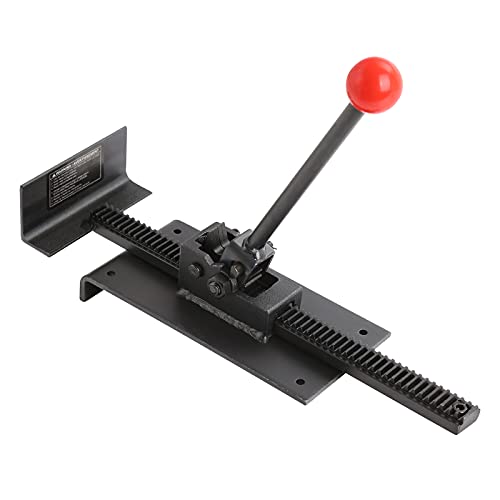
WINMAX TOOLS Carbon Steel Hardwood Flooring Jack
The WINMAX TOOLS Hardwood Flooring Jack is a heavy-duty carbon steel ratcheting positioning tool engineered to push or pull warped wood and laminate planks into place. Featuring non-slip handles and a compact ratchet design, it is an essential alignment tool for DIYers and shop owners outfitting trailer beds, garage lofts, or home floors.
Pros
- Solid carbon steel construction provides dependable rigidity against warped or crooked boards
- Smooth ratcheting mechanism allows controlled incremental tension in both push and pull directions
- Compact design maneuvers easily into tight corners, closets, and enclosed trailer edges where pry bars cannot fit
- Non-slip plastic grip handle ensures comfortable, fatigue-free manual operation across large installation areas
Cons
- Strictly a manual flooring alignment tool and completely unsuitable for automotive vehicle lifting
- Requires manual ratcheting effort and sequential repositioning for each bowed plank across larger jobs
- Lacks hydraulic assistance, limiting its functional utility strictly to horizontal carpentry alignment
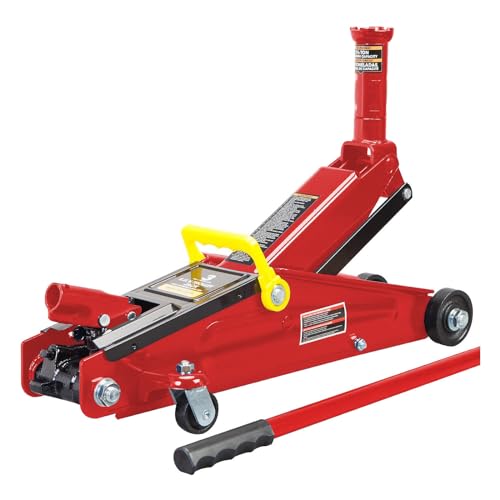
BIG RED T83006 3-Ton Floor Jack
Engineered for high-riding trucks and SUVs, the BIG RED T83006 delivers up to 20-7/8 inches of lift height with an extended saddle neck. Its 6,000-pound capacity and integrated overload bypass provide reliable lifting power for routine garage maintenance.
Pros
- Generous 20-7/8 inch maximum lift height
- Extended saddle neck reaches high truck frames quickly
- Built-in safety bypass valve prevents overloading
- Smooth 360-degree swivel casters ease garage positioning
Cons
- Minimum 5-7/8 inch height is tall for low-profile cars
- Single-piston pump requires more strokes than dual-piston models
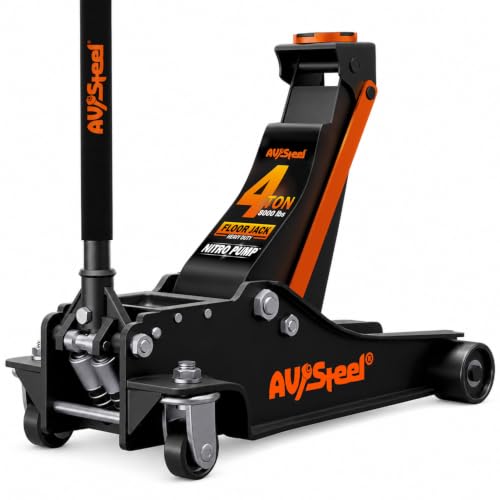
AV Steel 4 Ton Heavy-Duty Hydraulic Floor Jack
The AV Steel 4-ton hydraulic floor jack provides 8,000 lbs of lifting capacity and a 4-1/4-inch to 19-3/4-inch vertical range powered by a rapid dual-piston pump. Built with a rigid 87.3-pound all-steel chassis, it offers home garage mechanics and truck owners dependable lifting strength for standard passenger cars, crossovers, and half-ton pickups.
Pros
- Substantial 4-ton (8,000-lb) capacity easily handles heavy front and rear axle loads on half-ton pickups, large SUVs, and vans.
- Dual-piston rapid pump quickly raises the saddle to chassis contact points with minimal handle pumping strokes.
- Rigid 87.3-pound all-steel frame delivers superior stationary stability on home garage floors.
- Built-in overload protection valve guards the hydraulic cylinder against accidental over-capacity operation.
Cons
- Substantial 87.3-pound gross chassis weight makes vehicle trunk transport or mobile hauling physically demanding.
- Collapsed saddle height of 4-1/4 inches will not clear low-slung sports cars or lowered vehicles without drive-on ramps.
- Maximum lift height of 19-3/4 inches is not designed for lifted 4x4 trucks or long-travel off-road suspensions.
AV Steel 3-Ton Low Profile Floor Jack
Built to clear lowered suspensions and standard passenger cars, this hydraulic steel jack reaches under chassis as low as 3-1/8 inches and extends to nearly 20 inches. A dual-piston pump speeds up lifts, backed by compliance with recognized ANSI/ASME PASE safety standards.
Pros
- Low 3-1/8-inch minimum height fits under low-clearance cars
- Dual-piston pump enables rapid lifting with less effort
- Meets rigorous ANSI/ASME PASE safety standards
- Heavy-duty steel construction ensures solid garage stability
Cons
- All-steel construction makes it considerably heavy to transport
- Long frame requires significant floor space for storage
Maxority 3-Ton Low Profile Floor Jack
The Maxority 3-Ton Low Profile Floor Jack delivers a 6,600-lb rated capacity with an extended-reach chassis and rapid dual-piston hydraulics for residential garage maintenance. Designed for sports cars and passenger vehicles on level concrete without requiring dedicated electrical wiring or permanent anchoring, it is an ideal mobile lifting tool for DIYers who support their vehicles on jack stands for routine service.
Pros
- 6,600-lb (3-ton) rated capacity handles a wide variety of passenger vehicles and sports cars
- Low-profile extended frame provides access beneath lowered vehicles with minimal ground clearance
- Dual-piston rapid pump mechanism minimizes the strokes required to meet the chassis
- High-strength steel construction delivers a sturdy, rigid platform during lifting operations
- Built-in overload protection valve promotes safer hydraulic operation
Cons
- Heavy-gauge steel construction adds physical lifting weight compared to lightweight aluminum racing jacks
- Ships in a random color finish, which may not match specific garage or workshop color schemes
- Requires pairing with appropriately rated mechanical jack stands before performing any under-vehicle maintenance
Understanding Hydraulic Floor Jack Lifespan and Long-Term Durability
A quality hydraulic floor jack typically lasts between five and twenty years, depending on structural manufacturing, duty cycle, and fluid care. Heavy-duty commercial steel floor jacks used in professional repair facilities often operate for well over a decade when technicians perform regular fluid changes and replace worn seals. In contrast, entry-level consumer models stored in damp garages or subjected to dirty hydraulic fluid can exhibit pressure loss within three to five years. The practical lifespan of lifting equipment is fundamentally a function of hydraulic cylinder integrity, mechanical pivot wear, and seal preservation rather than simple calendar age.
Mechanical longevity also relies on how closely owners adhere to safe operating boundaries over time. Lifting vehicles on uneven driveways or exceeding working load limits introduces lateral chassis deflection that wears cylinder walls unevenly. Regular visual inspections of the main lift ram, caster bearings, and release valve mechanism can reveal minor wear before catastrophic pressure failure occurs. By understanding how hydraulic systems degrade, you can easily determine whether an aging floor jack requires basic maintenance, an internal seal rebuild, or immediate retirement.
Key Factors That Determine Floor Jack Longevity
Structural metallurgy forms the physical backbone of long-term jack durability and frame stability. Heavy-gauge carbon steel chassis plates resist frame twisting and lateral deflection under heavy vehicle corner loads. Aluminum service jacks provide excellent portability for track days or mobile work, but their lighter side plates can fatigue faster if repeatedly loaded near maximum working load limits. Solid steel side plates combined with welded tie rods ensure that the lifting arm remains perfectly aligned with the hydraulic power unit throughout thousands of service cycles.
The internal hydraulic seals represent the most critical wear items governing total service life. High-quality jacks utilize polyurethane U-cup piston seals and nitrile O-rings protected by external wiper seals to keep abrasive road grit out of the hydraulic cylinder. When debris bypasses an external dust seal, microscopic particles score the polished chrome ram, creating microscopic channels that allow pressurized fluid to escape. Models built with integrated wiper seals and chrome-plated piston rods offer significantly greater resistance to internal fluid weeping over years of garage service.
Operating capacity margins play an equally massive role in determining total equipment life. Using a 3-ton jack to lift a light compact sedan places minimal mechanical stress on the hydraulic pump block and safety valves. Conversely, constantly pushing a 2-ton jack to its absolute mechanical ceiling stresses the internal check valves, release seat, and return springs. Selecting a floor jack with adequate tonnage headroom keeps hydraulic operating pressures well below internal safety bypass thresholds, dramatically extending seal longevity.
Common Hydraulic and Mechanical Failure Modes
The most common symptom of an aging floor jack is cylinder creep, where the lift arm slowly settles downward under vehicle load. This condition occurs when high-pressure hydraulic fluid escapes past worn internal piston seals or an unseated release valve check ball. As nitrile seals age, they lose elasticity, harden, or develop microscopic tears that compromise their fluid-holding ability. While internal fluid bypass does not always produce visible external puddles, it indicates that the hydraulic cylinder can no longer maintain static pressure.
Fluid contamination and air intrusion frequently mimic permanent mechanical failure in older lifting units. Air bubbles trapped inside the high-pressure hydraulic chamber cause spongy pump handle resistance and prevent the lift arm from reaching maximum extension. When aerated fluid circulates through the pump block, cavitation can erode internal valve seats and degrade hydraulic efficiency. Fortunately, entrained air can usually be purged through routine bleeding, whereas contaminated, particulate-heavy oil requires a complete reservoir flush.
Beyond hydraulic seals, mechanical wear on external chassis hardware can render a floor jack unusable. Front steel rollers and rear 360-degree ball-bearing swivel casters endure immense load friction when rolling forward during vehicle elevation. Over time, ungreased caster pivot pins can deform, making it difficult to steer or align the jack under vehicle lift points. Stripping or excessive play in universal-joint gear drives can hinder precise lowering control, creating safety hazards during vehicle descent.
Usage Frequency and Operating Environment Effects
Usage frequency dictates how rapidly mechanical components reach their fatigue limits over time. A home mechanic who lifts a personal vehicle four to six times a year for tire rotations and oil changes places minimal cumulative wear on pump pistons. Under these low-cycle conditions, a floor jack often lasts fifteen to twenty years, limited primarily by the chemical aging of rubber seals. In contrast, commercial automotive shops cycling a floor jack dozens of times daily can exhaust seal packs within two to four years, necessitating periodic rebuilds.
Storage environments profoundly influence how long hydraulic assemblies survive without internal corrosion. Unheated residential garages experience drastic seasonal temperature shifts that generate condensation inside the oil reservoir and along the exposed lifting ram. Moisture emulsifies with hydraulic fluid, reducing its lubricity and accelerating rust formation inside the steel cylinder bore. Storing equipment in dry, climate-controlled conditions prevents moisture intrusion and protects bare steel surfaces from oxidation.
Outdoor driveway use presents unique challenges that degrade rolling gear and hydraulic pistons. Fine sand, road salt, and asphalt gravel adhere to oily chassis surfaces and migrate into the main pivot pins and lift arm bushings. When abrasive particles lodge between moving steel joints, they accelerate bore enlargement and cause noticeable frame slop. Wiping down the chassis, lifting arm, and saddle after working on dusty outdoor surfaces preserves mechanical tolerances and prolongs service life.
Essential Maintenance Procedures to Extend Working Life
Regular hydraulic fluid replenishment is the single most effective maintenance task for prolonging service life. Jack owners should inspect the reservoir level annually by removing the rubber oil fill plug located on the cylinder body. The fluid level should rest approximately 3/16 inch below the fill plug hole when the lift arm is completely lowered. Using clean, anti-foaming ISO VG 22 or ISO VG 32 hydraulic jack oil ensures proper lubrication of internal check balls and prevents seal shrinkage.
Chemical incompatibility represents a catastrophic mistake that destroys floor jacks almost immediately. Never introduce brake fluid, motor oil, automatic transmission fluid, or power steering fluid into a hydraulic jack reservoir. Automotive brake fluids chemically strip and liquefy internal nitrile O-rings and polyurethane cup seals within days. Motor oils contain detergent additives that foam under pressure, while transmission fluids can swell and soften hydraulic seals, leading to total pressure loss.
Trapped air must be purged periodically to restore crisp, responsive lifting action. To bleed the hydraulic circuit, first turn the handle clockwise or counterclockwise to open the release valve fully. With the valve open, rapidly pump the handle ten to fifteen full strokes to circulate fluid and push trapped air out of the pressure chamber. Next, slightly loosen the rubber oil fill plug to allow trapped air to vent, close the release valve, and test the lift stroke under zero load.
External moving parts require periodic lubrication to prevent metal-on-metal galling and premature binding. Applying heavy chassis grease or synthetic spray lubricant to the lift arm pivot pin, front roller axles, and rear caster ball bearings ensures smooth movement. Smooth rolling action is critical because a floor jack must roll forward slightly as the lift arm arches upward. If seized casters prevent the jack from rolling under load, lateral side-loading forces transfer to the vehicle lift point and bend the lifting arm.
Storage Strategies That Protect Seals and Cylinder Rods
Proper storage posture directly protects the most vulnerable hydraulic components from environmental damage. Always store your floor jack with the lifting arm and hydraulic ram completely lowered. When the ram remains extended, the polished chrome steel surface sits exposed to airborne humidity, road salt vapors, and dust. Pitting or rust spots on an extended ram will slice through internal wiper seals and O-rings the next time the jack retracts, causing permanent hydraulic leaks.
Managing internal pressure during storage helps preserve hydraulic valve seats and internal springs. After lowering the lift arm completely, close the release valve gently until it seats without over-tightening. Over-tightening the release valve can crush the internal steel check ball and score the brass seat inside the hydraulic block. Keeping the valve seated lightly prevents atmospheric moisture from entering the valve chamber while avoiding unnecessary mechanical stress on internal components.
Storing lifting equipment off cold, damp concrete floors prevents lower chassis corrosion and wheel seizure. Concrete slabs absorb ground moisture that can oxidize unpainted steel caster brackets, retaining rings, and lower chassis tie bars. Keeping the jack parked on a rubber stall mat, wood board, or clean garage shelf keeps moisture away from rolling components. Maintaining a clean, elevated storage spot ensures that the jack remains ready for safe operation whenever vehicle service is required.
Identifying Repairable Issues Versus Mandated Equipment Retirement
Minor hydraulic leaks around external valve screws and fill plugs are frequently repairable. Many reputable manufacturers offer replacement seal kits containing fresh nitrile O-rings, U-cup seals, wiper rings, and copper crush washers. If the cylinder bore and piston rod remain smooth and unpitted, installing a fresh seal kit can restore an older jack to like-new hydraulic performance. DIY mechanics comfortable with clean bench disassembly can often rebuild a hydraulic power unit in an afternoon.
Certain mechanical defects make floor jack repair impossible and require immediate equipment retirement. Any visible cracking in the cast iron saddle, fractured structural welds along the lift arm, or twisted side plates permanently compromises structural safety. Similarly, deeply scored or pitted cylinder walls cannot be fixed with new seals because fluid will continuously bypass the piston. When structural integrity is compromised, attempting to weld or patch a lifting chassis creates severe risk and must be avoided.
Internal safety bypass valves are factory-calibrated to prevent lifting beyond rated working load limits. Tampering with internal relief screws or trying to shim bypass springs to gain extra lifting capacity creates catastrophic failure risks. When an older jack repeatedly triggers its bypass valve under moderate loads or exhibits erratic handle kickback, the internal valve seats have deteriorated beyond reliable calibration. At that stage, retiring the unit and replacing it with modern ASME PASE certified equipment is the only safe course of action.
Selecting Compatible Lifting Equipment for Maximum Longevity
Sizing your floor jack appropriately prevents chronic overloading and extends operational life. Although a floor jack lifts only one corner or axle at a time (roughly 50% to 60% of vehicle curb weight), buying a higher tonnage rating provides essential structural headroom. A 3-ton or 4-ton jack lifting a 4,500 lb SUV operates well within its hydraulic design envelope, placing less stress on pump pistons and seals. Investing in higher tonnage capacity delivers thicker chassis plates and larger cylinder diameters that hold up better over decades.
Matching collapsed saddle height and maximum lift stroke to vehicle geometry prevents mechanical over-extension. Low-profile floor jacks with collapsed heights around 3 inches slide easily under sports coupes without scraping aerodynamic side skirts. Meanwhile, full-size trucks and SUVs require maximum lift reach of 20 to 24 inches to overcome suspension droop before the tires leave the ground. When evaluating garage clearance and working lift height considerations, choosing a jack with sufficient stroke eliminates the need for dangerous wooden blocks or makeshift saddle extensions.
Modern dual-piston rapid-pump mechanisms improve efficiency while reducing operator handle strokes. Dual-stage pumps feature pistons with different displacement volumes, allowing the saddle to contact the vehicle chassis in just a few strokes before engaging lifting resistance. With fewer handle cycles needed per lift, internal pump bores experience less cumulative friction wear over their operational lifespan. Quality rapid-pump systems engineered from alloy steel deliver long-term reliability while significantly cutting down on maintenance fatigue.
Non-Negotiable Garage Safety Protocols for Vehicle Elevation
Regardless of how well maintained or durable a floor jack is, it remains strictly a lifting tool rather than a static load-holding device. Hydraulic systems depend entirely on fluid pressure contained by flexible rubber seals, which can fail without warning due to internal contamination or sudden seal rupture. Never place any part of your body beneath an elevated vehicle supported solely by a hydraulic jack. Immediately after reaching the desired service height, mechanical jack stands must be positioned under reinforced factory lift points to carry the static vehicle load.
Safe vehicle lifting requires rigorous surface preparation and wheel security before operating the jack handle. Always park the vehicle on a smooth, solid, level concrete surface, engage the parking brake, and place transmission in park or reverse gear. Heavy-duty wheel chocks must be wedged firmly around the tires remaining on the ground to prevent unexpected vehicle rolling. Aligning the jack saddle squarely with reinforced pinch welds or frame rails prevents side-slipping and ensures that your lifting equipment performs safely throughout its entire service life.
About the author
Larry Carley is an experienced automotive technical writer and editor with more than four decades of work covering vehicle diagnostics, repair procedures, and automotive technology. His extensive technical writing helps readers understand mechanical systems, maintenance decisions, and the importance of accurate information when working on vehicles.